


TL;DR
Flutter is a strong stack for a mobile MVP because it builds iOS, Android, and web from a single codebase, with a reputation for polished, consistent UI and smooth performance. Like React Native, it removes the cost of building each platform separately, the key advantage when you are shipping a minimum viable product on a budget.
The short case: one codebase across platforms, a UI toolkit that renders the same everywhere (so your app looks intentional, not "good enough"), and strong performance from its compiled Dart core. This guide covers why Flutter fits MVPs, the stack around it, and Flutter vs React Native, as a spoke of our MVP tech stack guide.
Key Takeaways
- Flutter builds iOS, Android, and web from a single codebase, with a reputation for polished, consistent UI.
- Like React Native, it removes the cost of building each platform separately, the key advantage on a budget.
- Its UI toolkit renders the same everywhere, so your app looks intentional rather than "good enough."
- Its compiled Dart core gives strong performance.
- It is a spoke of the MVP tech stack, best weighed against React Native.
At a Glance
| Aspect | Flutter for a mobile MVP |
|---|---|
| Type | Cross-platform UI framework |
| Builds | iOS, Android, and web from one codebase |
| Language | Dart (compiled) |
| Strength | Polished, consistent UI and performance |
| Main alternative | React Native |
Why Flutter fits a mobile MVP
- One codebase, every platform. iOS, Android, and even web from the same Dart code, so a small team ships everywhere without separate native builds. The core MVP cost lever.
- Polished, consistent UI. Flutter draws its own widgets, so the app looks the same on every device and you can build a distinctive, delightful interface fast, useful when your market is crowded and feel matters.
- Strong performance. Compiled to native code, Flutter handles animation- and UI-heavy apps smoothly, an edge for products where the experience is the differentiator.
- Fast iteration. Hot reload makes the build-measure-learn loop quick.
- Production-proven and scalable. Backed by Google and used in major apps (per the Stack Overflow survey), so the MVP scales rather than being a throwaway.
The Flutter MVP stack
A lean Flutter MVP usually pairs:
- Backend + auth: Firebase (a natural Flutter pairing, both from Google) or Supabase, managed, with no server to run.
- Payments: Stripe or native in-app purchases.
- Push notifications: for the mobile retention loop.
- Analytics: wired in from day one (see MVP metrics).
A small senior team can ship a complete Flutter MVP, scoped to one core flow, in about 3 to 4 weeks.
How a Flutter MVP gets built
A Flutter MVP comes together in a recognisable shape, and understanding it helps you scope realistically:
- The app, in Dart. Flutter apps are written in Dart and built from widgets, composable UI building blocks for everything from a button to a whole screen. You compose widgets into the screens of your core flow, and Flutter renders them identically on iOS and Android.
- State management. As the app grows you add a state-management approach (Provider, Riverpod, or Bloc are common) to keep data and UI in sync. For an MVP you keep this as simple as the product allows, complexity here is a common over-engineering trap.
- The backend. Most Flutter MVPs use a managed backend, Firebase is the natural pairing (both Google: auth, database, storage, push, all wired up fast), with Supabase a strong alternative. This removes the need to build and run a server.
- Build and ship to the stores. Flutter compiles to native iOS and Android binaries, which you submit to the App Store and Google Play. One codebase produces both, the core reason it is so efficient for a cross-platform MVP.
The work is building UI and logic once, in Dart, rather than twice in Swift and Kotlin, which is what keeps the timeline short and the build-measure-learn loop fast.
What a Flutter MVP costs and how long it takes
Because one codebase serves both platforms, a Flutter MVP is markedly cheaper than two native apps and ships faster. A tightly scoped Flutter MVP, one core flow, built by a senior team, typically ships in about 3 to 4 weeks, on a managed backend that keeps infrastructure cost near zero until you have users. The cost driver is engineering time, which the single codebase roughly halves versus native iOS-plus-Android; for the full breakdown across approaches see how much it costs to build an MVP. As with any stack, scope discipline, not the framework, is what actually determines the timeline.
Real apps built on Flutter
Flutter is production-proven at the highest level, not just an MVP tool, which is what makes it safe to validate on without facing a forced rewrite later. Major apps from Google itself (including parts of Google Pay and Google Ads) and from large companies across fintech, e-commerce, and automotive ship on Flutter to millions of users.
For a founder that matters for one reason: the framework you validate your MVP on is the same one that scales to production, so a successful Flutter MVP grows into a real product by extension rather than by starting over.
Flutter vs React Native for an MVP
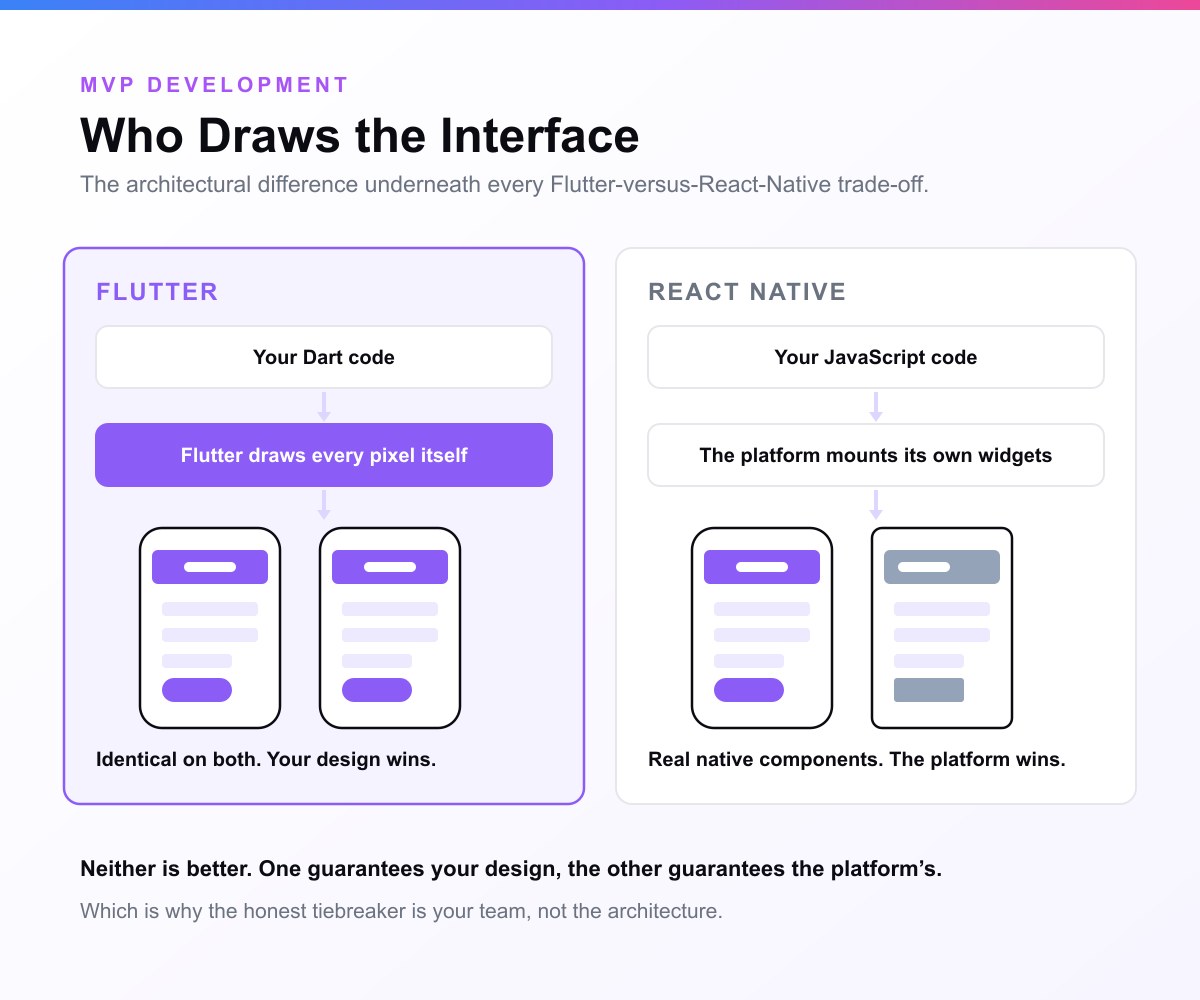
Both build cross-platform from one codebase and both are excellent MVP choices, the decision is usually about team and priorities:
- Flutter uses Dart, renders its own UI for pixel-perfect consistency and strong performance, and pairs naturally with Firebase. Great when UI polish and performance matter and your team is happy to use Dart.
- React Native uses JavaScript/TypeScript and the React ecosystem, ideal if you or your team already know React or web development, with the largest library ecosystem.
For a team coming from web/React, React Native is the natural pick; for a team that prioritizes UI consistency and is open to Dart, Flutter is excellent. Both ship a mobile MVP fast and scale into a real product.
When Flutter is the right choice (and when not)
Choose Flutter when: you are building a mobile (or mobile-plus-web) MVP, you value UI consistency and performance, and you want cross-platform savings. For a polished, design-forward app on a budget, it is hard to beat.
Look elsewhere when:
- Your product is purely a web app, where Next.js fits better.
- Your team already lives in the React/JavaScript world, where React Native is the more natural pick.
- You are non-technical and want to validate a standard idea with no code first.
Build your Flutter MVP with us
Flutter gives mobile MVPs cross-platform savings plus a UI that looks intentional and performs smoothly, a strong combination when the experience is part of what you are testing. Paired with Firebase or Supabase, a small senior team ships to every platform in weeks, on a foundation that scales.
We build MVPs on Flutter at MVP Development, one codebase for iOS, Android, and web, with the polished, consistent UI Flutter is known for. We ship funding-ready mobile MVPs in 3 to 4 weeks by senior engineers, on a fixed quote you approve before we start, with full code ownership. If React Native is the better fit for your team, we build on that too, the goal is the right stack for your product, not one we are selling.
Explore mobile app MVP development, or see the wider MVP tech stack guide.
Want your MVP built on Flutter? Tell us which platforms you must launch on and we will say whether Flutter earns its place in your build.
Related guides
- Mobile app MVP: the full mobile MVP guide (native vs cross-platform)
- React Native MVP: the main cross-platform alternative
- Next.js MVP: the web counterpart
- MVP tech stack: choosing the right technologies overall
- How to build an MVP: the full build process
Frequently asked questions
Is Flutter good for building an MVP?
Yes. Flutter builds iOS, Android, and web from a single codebase, so you avoid the cost of building each platform separately, the key advantage at the MVP stage. It is known for polished, consistent UI (it draws its own widgets) and strong performance from its compiled Dart core, which helps when the experience is part of what you are validating. It is production-proven and backed by Google, so the MVP scales rather than being a throwaway. A senior team can ship a cross-platform Flutter MVP in about 3 to 4 weeks.
Flutter or React Native for an MVP?
Both are excellent cross-platform choices; the decision is usually team and priorities. Flutter uses Dart, offers pixel-perfect UI consistency and strong performance, and pairs naturally with Firebase. React Native uses JavaScript/TypeScript and the React ecosystem, making it the natural pick for teams that already know React or web development, with the largest library ecosystem. Choose Flutter if UI polish and performance are priorities and Dart is fine; choose React Native if your team lives in the JS/React world. Either ships a mobile MVP fast and scales.
Can a Flutter MVP scale?
Yes. Flutter is used in major production apps and is backed by Google, so the codebase you validate on is one you can harden and scale rather than rebuild. Its compiled performance and single-codebase model support growth across platforms, and you extend the same app as you add features post-validation. As with any stack, building the MVP on Flutter rather than a throwaway tool keeps the eventual scale-up incremental rather than a from-scratch rewrite.
Does Flutter support web as well as mobile?
Yes. Flutter targets iOS, Android, web, and even desktop from one codebase, which makes it appealing when you want a mobile app and a web presence from the same project. In practice most MVPs lead with mobile (where Flutter's polish shines), but the ability to also output web from the same code can save effort. That said, for a product that is primarily a web app, a dedicated web stack like Next.js is usually the stronger choice; Flutter's sweet spot is mobile-first, design-forward apps.
Sources & references
- Flutter: the cross-platform UI toolkit
- Stack Overflow Developer Survey: framework adoption
- Eric Ries, The Lean Startup: validating fast and cheap
- Atlassian, Minimum Viable Product: scoping the MVP
The 3 to 4 week figure reflects MVP Development delivery data for tightly scoped builds.


