


TL;DR
Firebase gives your MVP a complete, Google-backed backend, a real-time NoSQL database, authentication, push notifications, serverless functions, and hosting, out of the box, so you ship features instead of building infrastructure. It is one of the most established backends for an MVP, especially a mobile-first or real-time one, with a mature ecosystem and a free tier you can launch on.
The short case: Firebase removes almost all backend setup, its real-time database and deep mobile tooling make it a natural fit for live, app-style products, and it pairs especially well with Flutter (both from Google) and React Native. The trade-offs to know going in are its NoSQL data model, usage-based pricing, and Google lock-in. This guide covers what Firebase gives you, how to build an MVP on it, what it costs, Firebase vs Supabase, and its limitations, as a spoke of our MVP tech stack guide.
Key Takeaways
- Firebase gives your MVP a complete, Google-backed backend: a real-time NoSQL database, auth, push, serverless functions, and hosting.
- You ship features instead of building infrastructure.
- Its real-time database and deep mobile tooling make it a natural fit for live, app-style products.
- It pairs especially well with Flutter and React Native.
- The trade-offs to know: a NoSQL data model, usage-based pricing, and Google lock-in.
At a Glance
| Aspect | Firebase for an MVP |
|---|---|
| Type | Backend-as-a-service (Google) |
| Database | Real-time NoSQL |
| Gives you | Auth, push, serverless functions, hosting |
| Best for | Mobile-first, real-time apps (pairs with Flutter, React Native) |
| Trade-offs | NoSQL model, usage pricing, Google lock-in |
Why Firebase fits an MVP
- A whole backend, instantly. Database, auth, push, serverless functions, storage, and hosting are all there from minute one, so you skip backend setup and build the product.
- Real-time by default. Firestore and the Realtime Database push data changes to clients live, the foundation for chat, presence, live dashboards, and collaborative features, without you building a websocket layer.
- Mobile-first and battle-tested. Firebase has deep, mature SDKs for iOS, Android, Flutter, and React Native, plus push notifications (FCM), crash reporting, and analytics, the things mobile MVPs live on, built in.
- Backed by Google. It is a mature, heavily-used platform with a huge ecosystem and excellent documentation, so it scales and is unlikely to disappear.
- A free tier to launch on. The Spark plan lets you build and validate at no cost, ideal at the validation stage, keeping the build-measure-learn loop fast.
What Firebase gives you out of the box
Firebase saves time because it bundles the backend pieces you would otherwise build or stitch together:
- Firestore / Realtime Database: NoSQL document databases that sync to clients in real time.
- Authentication: email/password, phone, and social logins (Google, Apple, and more) built in, the single most time-consuming thing to build yourself.
- Cloud Functions: serverless functions for custom server-side logic, webhooks, and integrations.
- Cloud Messaging (FCM): push notifications, essential for the mobile retention loop.
- Hosting & Storage: fast static hosting for web and file/media storage for uploads.
- Analytics & Crashlytics: usage analytics and crash reporting wired in, so you measure activation and catch issues from day one (see MVP metrics).
For an MVP, that combination means a senior developer can stand up the entire backend in hours and spend the real time on the product.
How to build an MVP with Firebase
Firebase is the backend; you pair it with a frontend. The common, fast shape:
- Pick the frontend. Most Firebase MVPs pair it with Flutter or React Native for mobile (Firebase's sweet spot), or a web frontend like Next.js. Firebase has first-class SDKs for all of them.
- Model your data in Firestore. Design your collections and documents for your core flow. Because Firestore is NoSQL, you model around how the app reads data (often duplicating/denormalising) rather than around relational tables, a different mindset to plan for.
- Turn on auth and security rules. Enable the auth providers you need and write security rules so each user can only access their own data, real security from day one.
- Wire the frontend to live data. Use the SDK to read, write, and subscribe to real-time updates, no API server to build or run.
- Add custom logic with Cloud Functions. Use serverless functions for anything that must run server-side: payments with Stripe, webhooks, scheduled jobs.
- Add push and ship. Wire up FCM for notifications, deploy, and you are live on both stores (or the web).
The work is building the product, not the infrastructure, which is exactly why this stack ships a mobile MVP so fast.
What a Firebase MVP costs
Firebase pricing has two tiers, and the model matters:
- Spark (free). Generous enough to build and validate a real MVP, database, auth, hosting, and a quota of usage at no cost.
- Blaze (pay-as-you-go). Once you exceed the free quotas you pay for what you use, metered per database read, write, delete, function invocation, and bandwidth.
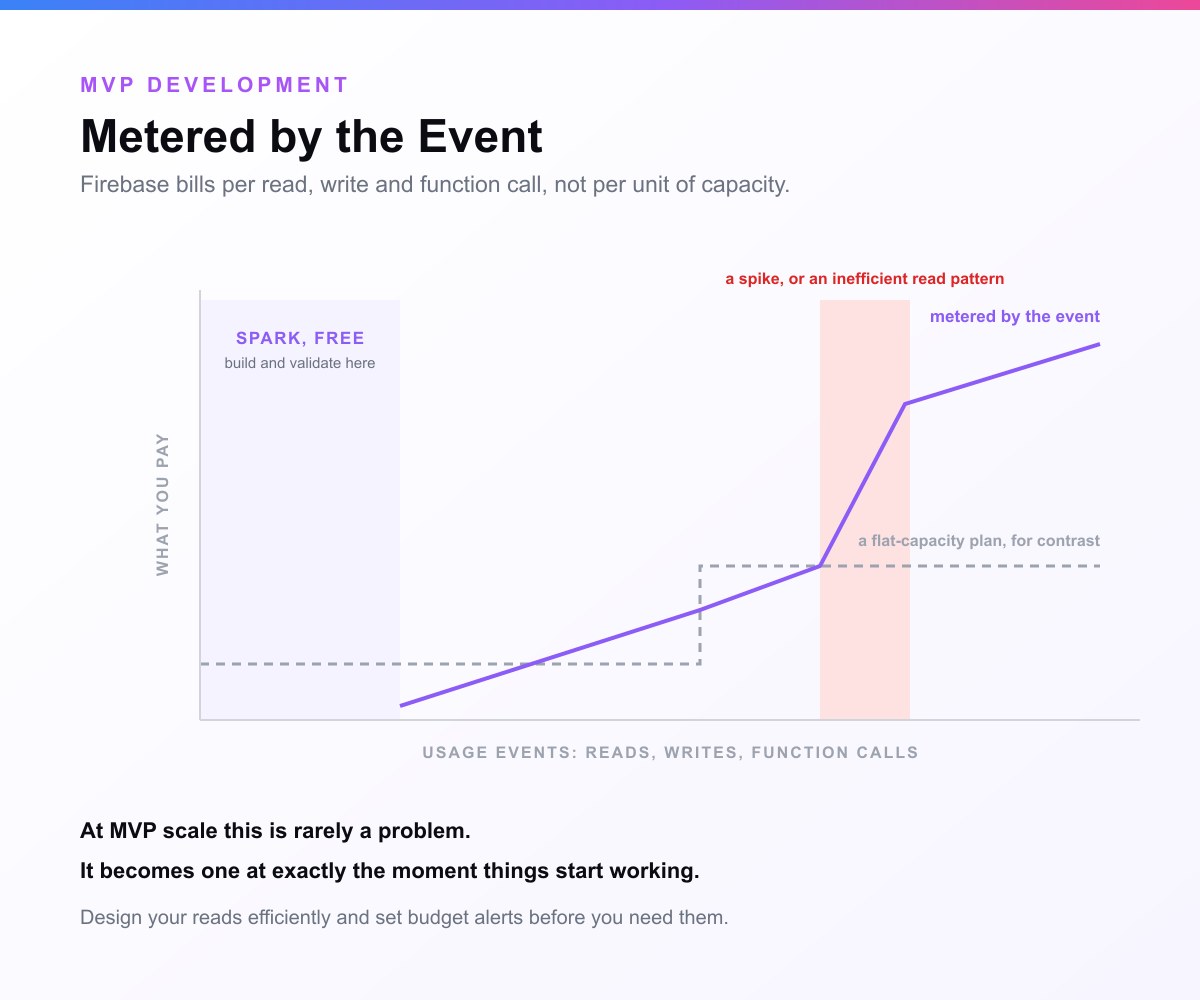
The thing to understand: Firebase's cost scales with usage events, not a flat capacity, so an inefficient data model (or a sudden spike in traffic) can run up costs faster than you expect. At MVP scale this is rarely a problem, but it is worth designing your reads efficiently and setting budget alerts. For the full picture across stacks, see how much it costs to build an MVP.
Firebase vs Supabase for an MVP
This is the decision most founders are really weighing, and it comes down to one core difference: Firebase is a NoSQL document store; Supabase is a relational SQL (Postgres) backend.
- Firebase is mature, Google-backed, and exceptional for mobile-first, real-time products, with the deepest mobile SDKs, push, crash reporting, and analytics in one place. The trade-offs are the NoSQL model (awkward for relational data and complex queries), usage-based pricing, and being a closed, proprietary ecosystem.
- Supabase gives you a relational SQL database with joins and complex queries, plus open-source portability and no lock-in. It is the modern default when your data is relational (most apps are) and you value the freedom to migrate.
The honest summary: choose Firebase if your MVP is mobile-first and real-time-heavy, you want the most mature mobile tooling, and a NoSQL model fits your data. Choose Supabase if your data is relational, you prefer SQL, and portability matters. Both have free tiers and ship fast, so it often comes down to NoSQL + mobile real-time (Firebase) vs relational SQL + portability (Supabase).
Limitations and downsides to know
Being honest about Firebase's trade-offs keeps your build smooth:
- NoSQL data modelling. Firestore is not relational, so complex queries and joins are limited, and you often denormalise (duplicate) data to keep reads fast. If your product is highly relational, this fights you, consider Supabase instead.
- Usage-based pricing can surprise you. Because you pay per read/write/operation, an inefficient query pattern or a traffic spike can spike costs. Design reads carefully and set budget alerts.
- Vendor lock-in. Firebase is proprietary and Google-owned, so migrating off it later means a real rewrite of your data layer, the opposite of Supabase's portable Postgres.
- It is a backend, not a full app builder. Firebase handles the server side; you still build the frontend. For no-code end-to-end, that is a Bubble or no-code job instead.
None of these are dealbreakers for a typical mobile or real-time MVP, they are simply the things to weigh before you commit.
Build your MVP on Firebase with us
Firebase is the fastest way to give a mobile-first or real-time MVP a complete, mature backend without spending weeks on infrastructure, real-time database, auth, push, and analytics, all from one Google-backed platform.
We build MVPs on Firebase at MVP Development, paired with Flutter or React Native for mobile (or Next.js for web), with a clean data model and proper security rules from day one. And if your product is relational and portability matters, we build on Supabase instead, the point is the right backend for your product, not one we are selling. Either way you get a funding-ready MVP in 3 to 4 weeks, by senior engineers, on a fixed quote you approve before we start, with full code ownership.
Explore mobile app MVP development and web app MVP development, or see the wider MVP tech stack guide.
Building a mobile or real-time MVP? Ask us where Firebase shines and where it bites and we will fit the honest answer to your roadmap.
Related guides
- Supabase MVP: the relational, open-source backend (Firebase's counterpart)
- Flutter MVP: the mobile frontend Firebase pairs with most
- React Native MVP: the other mobile frontend for a Firebase backend
- MVP tech stack: choosing the right technologies overall
Frequently asked questions
Is Firebase good for an MVP?
Yes, especially for a mobile-first or real-time MVP. Firebase gives you a real-time NoSQL database, authentication, push notifications, serverless functions, hosting, and analytics out of the box, so a small team can stand up a complete backend in hours and focus on the product. It has deep, mature SDKs for Flutter, React Native, iOS, and Android, a free tier to launch on, and the backing of Google. The trade-offs to weigh are its NoSQL data model (awkward for highly relational data), usage-based pricing, and vendor lock-in, but for a typical mobile or real-time MVP, Firebase is an excellent, fast choice.
Firebase or Supabase for an MVP?
The core difference is the database: Firebase is a NoSQL document store, Supabase is a relational SQL (Postgres) backend. Choose Firebase if your MVP is mobile-first and real-time-heavy, you want the most mature mobile tooling (push, crash reporting, analytics in one place), and a NoSQL model fits your data. Choose Supabase if your data is relational (most apps are), you prefer SQL and complex queries, and you want open-source portability with no lock-in. Both have generous free tiers and ship fast, so it usually comes down to NoSQL plus mobile real-time (Firebase) versus relational SQL plus portability (Supabase).
Can a Firebase MVP scale into a real product?
Yes. Firebase is built and operated by Google and powers large production apps, so the backend you validate on can scale with you. As you grow, the main things to manage are your data model (Firestore rewards designing reads efficiently) and cost (because pricing is usage-based, you optimise queries and set budget alerts). The one caveat is portability: Firebase is proprietary, so if you ever need to move off it, that is a real migration, unlike Supabase's standard Postgres. For most products that stay within Firebase, though, the path from MVP to scaled product is incremental rather than a rewrite.
Does Firebase work with Flutter and React Native?
Yes, and it is one of Firebase's biggest strengths. Firebase has first-class, mature SDKs for both Flutter (the two are both Google products and pair especially naturally) and React Native, as well as native iOS and Android. That means auth, the real-time database, push notifications, and analytics all wire into your mobile app with official, well-documented libraries. This deep mobile tooling is a large part of why Firebase is such a popular backend for mobile-first MVPs. It also supports web frontends like Next.js, though its sweet spot is mobile and real-time apps.
Sources & references
- Firebase: Google's app development backend platform
- Firebase Docs: official documentation
- Eric Ries, The Lean Startup: validating fast and cheap
- Atlassian, Minimum Viable Product: scoping the MVP
The 3 to 4 week figure reflects MVP Development delivery data for tightly scoped builds.


