


TL;DR
Next.js is one of the best stacks for building an MVP because it is full-stack, fast to ship, and built to scale, so the same codebase that gets you live in weeks also carries you well past validation. It is a React framework that handles the frontend, the backend (via API routes and server components), and deployment in one cohesive system, which is exactly what a small team building a minimum viable product wants.
The short case: one language (TypeScript) across the whole app, instant deploys on Vercel, a huge ecosystem of ready pieces, and an architecture that does not hit a wall when you grow. This guide covers why Next.js fits MVPs, the stack to pair it with, what you can build, and when to choose it (and when not), as a spoke of our wider MVP tech stack guide.
Key Takeaways
- Next.js is one of the best stacks for an MVP: full-stack, fast to ship, and built to scale.
- It is a React framework that handles frontend, backend (API routes and server components), and deployment in one system.
- One language (TypeScript) runs across the whole app, with instant deploys on Vercel.
- Its architecture does not hit a wall when you grow, so the codebase that gets you live also carries you past validation.
- It is best when you want one cohesive full-stack system, a spoke of the wider MVP tech stack.
At a Glance
| Aspect | Next.js for an MVP |
|---|---|
| Type | Full-stack React framework |
| Language | TypeScript / JavaScript |
| Best for | Web SaaS and full-stack apps you intend to scale |
| Deploy | One-click on Vercel |
| Scales past MVP? | Yes, no rewrite needed |
Why Next.js is a great fit for an MVP
An MVP stack needs two things that usually conflict: speed now and room to scale later. Most fast options (no-code, throwaway scripts) hit a ceiling; most scalable options are slow to start. Next.js is one of the few that gives you both.
- Full-stack in one codebase. Frontend, backend API routes, and server-side logic live together, so a small team ships an entire product without stitching separate systems. One language, TypeScript, top to bottom.
- Fast to ship. File-based routing, server components, and a mature component ecosystem mean you build the one core flow quickly, not from zero.
- Instant deployment. Paired with Vercel (from the same team), you get push-to-deploy, preview URLs, and free-tier hosting that scales automatically, no infrastructure to babysit at the MVP stage.
- No ceiling. Unlike no-code, Next.js is production-grade from day one. The MVP you validate on is the same foundation you scale on, so you avoid the rebuild that catches teams who start on throwaway tools.
- Huge ecosystem and talent pool. It is one of the most-used web frameworks (per the Stack Overflow survey), so libraries, auth, payments, and developers are all easy to find.
That combination, ship in weeks and scale without a rewrite, is why Next.js is a default choice for web and SaaS MVPs.
The Next.js MVP stack
Next.js is the framework; a typical lean MVP pairs it with a few proven pieces so the team builds product, not plumbing:
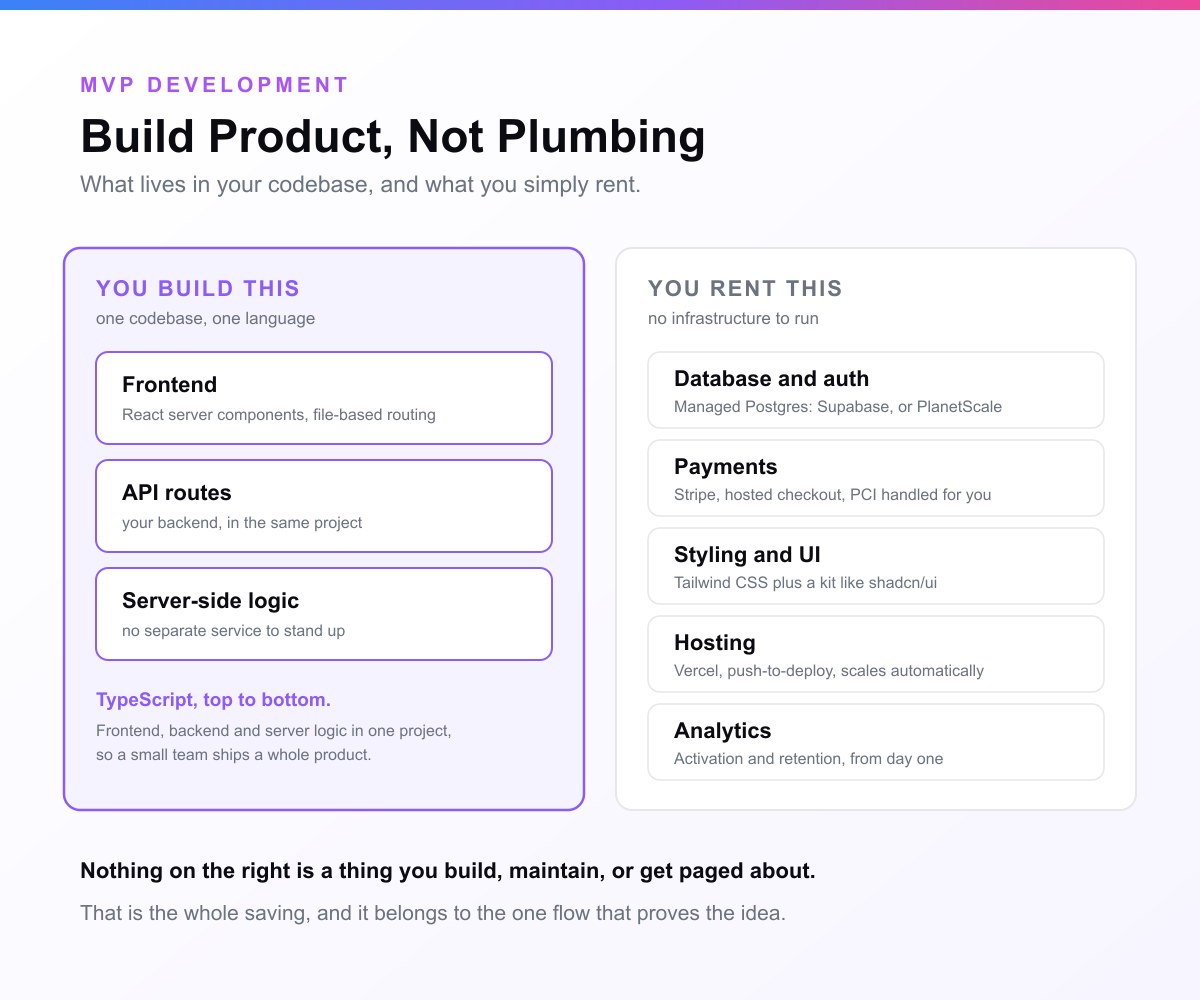
- Database + auth: a managed Postgres like Supabase, or PlanetScale, so there is no infrastructure to run.
- Payments: Stripe, with hosted checkout, PCI handled for you.
- Styling/UI: Tailwind CSS plus a component library like shadcn/ui, so you skip custom design until you have users.
- Hosting: Vercel, push-to-deploy with automatic scaling.
- Analytics: wired in from day one to measure activation and retention (see MVP metrics).
This stack lets a small senior team ship a complete, funding-ready MVP on one core flow in about 3 to 4 weeks, and it scales straight into a real product rather than forcing a migration.
What you can build with a Next.js MVP
Next.js suits most web-based products:
- SaaS products: auth, a core workflow, billing, and dashboards. The classic fit; see SaaS MVP.
- Marketplaces: listings, search, the transaction loop, and two-sided flows; see marketplace MVP.
- AI products: a model wrapped in a real product, with server-side API calls and streaming; see AI MVP.
- Dashboards and internal tools: data-heavy customer-facing or internal apps.
For native mobile apps you would reach for a mobile stack instead; Next.js is the web answer (and it powers excellent mobile-web experiences too).
When Next.js is the right choice (and when not)
Choose Next.js when: you are building a web or SaaS product, you or your team can write code (or you are hiring engineers), and you want a foundation that scales without a rewrite. For most web MVPs built by a real engineering team, it is the default.
Look elsewhere when:
- You are a non-technical founder who needs to validate a standard idea with zero code, a no-code MVP is faster there.
- You need a native mobile app, where a cross-platform mobile framework fits better.
- Your product is so simple a landing page answers the question, validate with a landing-page MVP first.
Next.js rewards having engineering capability; it is a stack for building real software, not a no-code shortcut. If you have that capability (or a build partner), it is hard to beat for a web MVP.
Common Next.js MVP mistakes
A few traps catch founders using Next.js for a first build:
- Over-architecting the rendering. Agonizing over SSR vs SSG vs ISR per page is full-product thinking. For an MVP, take the defaults, server components and ISR where it is obvious, and move on; you can tune rendering after you have users.
- Building a custom backend you did not need. Next.js API routes plus a managed backend like Supabase cover most MVPs. Standing up a separate service adds weeks for scale you do not have yet.
- Chasing the newest release features. New Next.js versions ship experimental APIs constantly. An MVP should sit on the stable, boring path, the ecosystem's size is the advantage, not the bleeding edge.
- Ignoring the app-shell weight. Shipping heavy client components everywhere throws away the framework's server-first performance win. Keep interactive islands small; your Core Web Vitals (and SEO) will thank you.
The theme, as with every stack choice: the framework is not the product. Spend the saved effort on the one flow that proves your idea.
Build your MVP on a stack that scales
Next.js gives founders the rare combination an MVP needs: ship fast now, scale later, on production-grade, fully-owned code, with no platform ceiling and no rebuild after validation. Paired with a managed database, Stripe, and Vercel, a small senior team can take a web or SaaS idea to a real, live product in weeks.
That is the stack we build on most at MVP Development. We ship funding-ready MVPs in 3 to 4 weeks on Next.js and a proven, scalable stack, by senior engineers, on a fixed quote you approve before we start, with full code ownership, so the MVP you validate on is the product you grow on.
Explore our MVP development services, or for a web app specifically, see MVP web development.
Building a web or SaaS MVP? Ask us why we reach for Next.js so often and whether your product is one of the exceptions.
Related guides
- MVP tech stack: choosing the right technologies overall
- React MVP: the React overview (Vite SPA, Next.js, React Native)
- SaaS MVP: the product type Next.js fits best
- No-code MVP: the faster route for non-technical validation
- How to build an MVP: the full build process
- Angular MVP: the enterprise-leaning frontend alternative
Frequently asked questions
Is Next.js good for building an MVP?
Yes, it is one of the best choices for a web or SaaS MVP. Next.js is a full-stack React framework that handles the frontend, backend, and deployment in one codebase, so a small team ships fast, and it is production-grade, so the MVP scales into a real product without a rewrite. Paired with a managed database, Stripe, and Vercel hosting, it lets a senior team build a complete first version on one core flow in about 3 to 4 weeks. The main caveat is that it rewards engineering capability; a non-technical founder validating a standard idea may move faster with no-code.
What stack pairs with Next.js for an MVP?
A common lean Next.js MVP stack is: Next.js for the app (frontend plus API routes), a managed database and auth like Supabase or Postgres, Stripe for payments, Tailwind CSS with a component library like shadcn/ui for UI, Vercel for push-to-deploy hosting, and analytics wired in from day one. This combination minimizes infrastructure work, one language across the stack and managed services instead of servers to run, so the team focuses on building the core flow rather than plumbing, and it scales smoothly past validation.
Can a Next.js MVP scale into a full product?
Yes, that is one of its biggest advantages. Unlike no-code platforms that hit a ceiling, Next.js is production-grade from day one, so the foundation you validate on is the same one you scale on, you avoid the expensive rebuild that catches teams who start on throwaway tools. As you grow, you harden and extend the same codebase, the architecture supports real traffic, server-side rendering, and complex features, rather than forcing a migration. Building the MVP on a scalable stack is what makes the eventual scale-up incremental instead of a from-scratch rewrite.
Is Next.js better than no-code for an MVP?
It depends on who is building. Next.js is better when you have engineering capability and want owned, scalable code, the MVP you validate on becomes the product you grow on, with no platform ceiling. No-code is better when you are non-technical and simply want to validate a standard idea fast and cheaply without writing code, accepting a likely rebuild if it succeeds. Many founders validate with no-code, then build the real product on Next.js once the idea is proven. Neither is universally "better"; the right one depends on your technical capability and whether the idea is already validated.
Sources & references
- Next.js: the full-stack React framework
- Vercel: push-to-deploy hosting built for Next.js
- Stack Overflow Developer Survey: framework adoption and the talent pool
- Eric Ries, The Lean Startup: building to validate fast
The 3 to 4 week figure reflects MVP Development delivery data for tightly scoped builds.


