


TL;DR
React Native is the go-to stack for a mobile MVP because it builds both iOS and Android apps from a single codebase, roughly halving the time and cost versus building each platform natively. For a founder who needs a minimum viable product on phones, fast and cheap, that one-codebase advantage is decisive.
The short case: one team and one codebase instead of two, a huge ecosystem (it shares the React world), and tooling like Expo that gets you from idea to a real app on real devices in days. This guide covers why React Native fits mobile MVPs, the stack around it, React Native vs Flutter, and when to choose it, as a spoke of our MVP tech stack guide.
Key Takeaways
- React Native builds both iOS and Android apps from a single codebase, roughly halving time and cost versus native.
- For a founder who needs a mobile MVP fast and cheap, that one-codebase advantage is decisive.
- One team and one codebase instead of two, sharing the huge React ecosystem.
- Tooling like Expo gets you from idea to a real app on real devices in days.
- It is a spoke of the MVP tech stack, best weighed against Flutter for mobile builds.
At a Glance
| Aspect | React Native for a mobile MVP |
|---|---|
| Type | Cross-platform mobile framework |
| Builds | iOS and Android from one codebase |
| Best for | Mobile MVPs on a budget |
| Tooling | Expo for fast idea-to-device |
| Main alternative | Flutter |
Why React Native fits a mobile MVP
Building a mobile MVP natively means two apps, two languages (Swift and Kotlin), and often two teams, double the time and cost before you have validated anything. React Native collapses that into one:
- One codebase, both platforms. Write once, ship to iOS and Android. For an MVP, that is the single biggest cost and speed lever in mobile.
- One team, one language. JavaScript/TypeScript and the React model, so a small team (or a web team that already knows React) can build mobile without hiring separate iOS and Android specialists.
- Fast iteration. Hot reload and tools like Expo make the build-measure-learn loop quick, you push changes to test devices in minutes.
- Production-proven and scalable. Used by major apps, so it is not a throwaway, the MVP scales into a real product. It is one of the most-used mobile frameworks per the Stack Overflow survey.
- Huge ecosystem. Libraries for navigation, auth, payments, and push notifications are all readily available.
For most mobile MVPs, this means you reach real users on both app stores in weeks, on a budget that leaves runway for iteration.
The React Native MVP stack
A lean React Native MVP typically pairs:
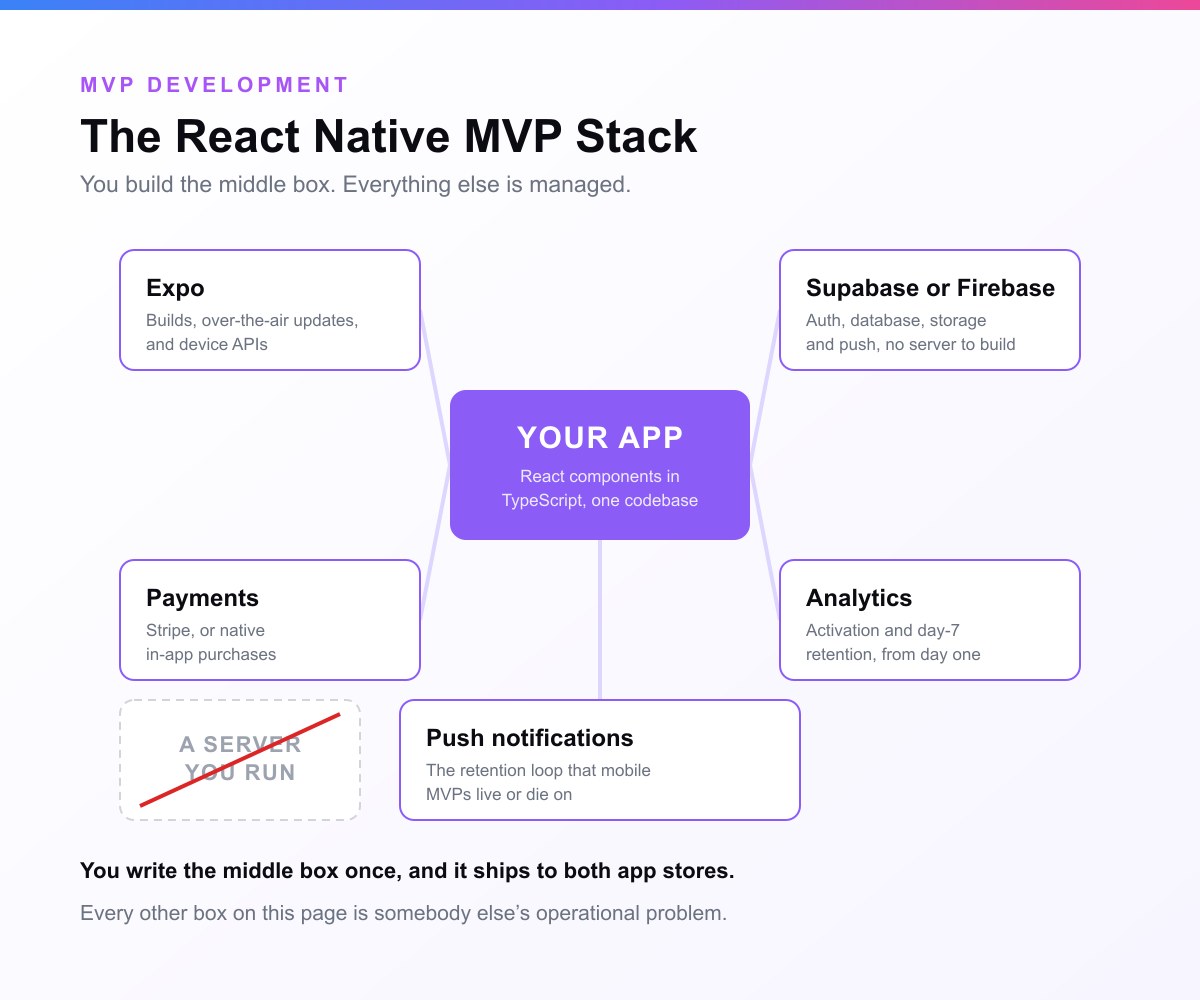
- Expo: the toolchain that handles builds, over-the-air updates, and device APIs, removing most native-config pain.
- Backend + auth: a managed backend like Supabase or Firebase, so there is no server to run.
- Payments: Stripe or native in-app purchases, depending on your model.
- Push notifications: essential for the retention loop that mobile MVPs live or die on.
- Analytics: wired in from day one to track activation and day-7 retention (see MVP metrics).
This stack lets a small senior team ship a complete mobile MVP, scoped to one core flow, to both stores in about 3 to 4 weeks.
How a React Native MVP gets built
A React Native MVP follows a recognisable shape, which helps you scope it realistically:
- The app, in React. You build the UI as React components in JavaScript or TypeScript, the same mental model as a React web app, which is why web teams pick it up so quickly. These components render as real native iOS and Android UI.
- Expo as the foundation. Most modern React Native MVPs start with Expo, which handles builds, over-the-air updates, and device APIs (camera, location, notifications) so you skip most native configuration and ship faster.
- The backend. A managed backend, Supabase or Firebase, provides auth, database, storage, and push out of the box, so there is no server to build or run, ideal at the validation stage.
- Build and ship to both stores. From one codebase you produce iOS and Android builds and submit them to the App Store and Google Play. That single codebase is the whole efficiency story.
The work is writing the app once in React rather than twice in Swift and Kotlin, which is what keeps the timeline short and the build-measure-learn loop fast.
What a React Native MVP costs and how long it takes
Because one codebase serves both platforms, a React Native MVP costs far less than two native apps and ships faster. A tightly scoped React Native MVP, one core flow, senior team, both platforms, typically ships in about 3 to 4 weeks, on a managed backend that keeps infrastructure cost near zero until you have users.
The main cost is engineering time, which the shared codebase roughly halves versus native iOS-plus-Android; see how much it costs to build an MVP for the full breakdown. Scope discipline, not the framework, is what drives the timeline.
Real apps built on React Native
React Native is production-proven at massive scale, not just a prototyping tool, which is what makes it safe to validate on without a forced rewrite later. Some of the most-used apps in the world ship on React Native, across social, fintech, and commerce, reaching hundreds of millions of users. For a founder that matters for one reason: the framework you validate your MVP on is the same one that scales to production, so a successful React Native MVP grows into a real product by extension rather than by starting over.
React Native vs Flutter for an MVP
Both build cross-platform mobile apps from one codebase and both are excellent MVP choices, the decision is usually about team and priorities:
- React Native uses JavaScript/TypeScript and the React ecosystem, ideal if you or your team already know React or web development, with the largest library ecosystem. A natural pick for teams that also build web.
- Flutter uses Dart, renders its own UI for pixel-perfect consistency, and offers strong performance, great when UI polish is a priority and your team is happy to learn Dart.
For a team coming from web/React, React Native is the natural choice; for a team that prioritizes UI consistency and is open to Dart, Flutter is excellent. Either ships a mobile MVP fast and scales.
When React Native is the right choice (and when not)
Choose React Native when: your MVP is a mobile app, you want both iOS and Android without doubling cost, and you want a foundation that scales. For the vast majority of startup mobile MVPs, it is the default, the cross-platform savings are simply too large to ignore at the validation stage.
Consider alternatives when:
- Your app is graphics- or performance-intensive in a way that demands fully native code (rare at the MVP stage), where native or Flutter may fit better.
- Your product is really a web app, where Next.js is the answer.
- You are non-technical and want to validate a simple idea with zero code first, where a no-code MVP gets you there faster.
The honest default: for a startup that needs a real mobile app on both platforms, React Native is almost always the right MVP choice, with Flutter as the main credible alternative.
Build your React Native MVP with us
React Native's one-codebase model is the reason it dominates mobile MVPs: you get iOS and Android from a single team and codebase, ship in weeks, and scale into a real product without a rewrite. Paired with Expo and a managed backend, it is the fastest credible path to a mobile MVP in real users' hands.
We build MVPs on React Native at MVP Development, both platforms from one codebase, on Expo, tuned for day-7 retention. We ship funding-ready mobile MVPs in 3 to 4 weeks by senior engineers, on a fixed quote you approve before we start, with full code ownership. If Flutter is the better fit for your product, we build on that too, the goal is the right stack for your idea, not one we are selling.
Explore mobile app MVP development, or see the wider MVP tech stack guide.
Want your MVP built on React Native? Tell us where your users live, iOS, Android or both and we will say whether React Native fits.
Related guides
- Mobile app MVP: the full mobile MVP guide (native vs cross-platform)
- MVP tech stack: choosing the right technologies overall
- React MVP: the React overview: Vite SPA vs Next.js vs React Native
- Next.js MVP: the web counterpart
- No-code MVP: the zero-code route for simple validation
- How to build an MVP: the full build process
Frequently asked questions
Is React Native good for an MVP?
Yes, it is the default choice for most mobile MVPs. React Native builds both iOS and Android from one codebase, so you roughly halve the time and cost versus building each platform natively, which is exactly what matters when you are validating an idea on a budget. One team writes one codebase in JavaScript/TypeScript, tooling like Expo makes iteration fast, and the framework is production-proven, so the MVP scales into a real app rather than being a throwaway. A senior team can ship a cross-platform mobile MVP to both stores in about 3 to 4 weeks.
React Native or Flutter for an MVP?
Both are excellent cross-platform choices; the decision is usually team and priorities. React Native uses JavaScript/TypeScript and the React ecosystem, making it the natural pick for teams that already know React or web development, with the largest library ecosystem. Flutter uses Dart, offers pixel-perfect UI consistency and strong performance. Choose React Native if your team lives in the JS/React world (common for teams that also build web); choose Flutter if UI polish is a priority and Dart is fine. Either ships a mobile MVP fast and scales into a real product.
Can a React Native MVP scale into a full app?
Yes. React Native is used by major production apps, so it is not a throwaway prototype, the codebase you validate on is one you can harden and scale rather than rebuild. As you grow, you can optimize performance, add native modules where genuinely needed, and extend the app without a from-scratch rewrite. Building the mobile MVP on React Native rather than a no-code app builder is what keeps the eventual scale-up incremental, you own production-grade code from day one.
How long does it take to build a React Native MVP?
A tightly scoped React Native MVP, one core flow, senior engineers, both platforms from one codebase, can ship in about 3 to 4 weeks. The one-codebase model is the reason it is so fast: you are not building and maintaining separate iOS and Android apps. As with any MVP, the timeline is driven mostly by scope discipline, keeping it to the single core flow that tests your idea, rather than by the framework. A sprawling app takes longer; a focused one ships in weeks.
Sources & references
- React Native: the cross-platform mobile framework
- Expo: the toolchain that speeds React Native builds
- Stack Overflow Developer Survey: mobile framework adoption
- Eric Ries, The Lean Startup: validating cheaply and fast
The 3 to 4 week figure reflects MVP Development delivery data for tightly scoped builds.


