


TL;DR
Django is Python's batteries-included web framework and one of the fastest ways to ship a data-backed web app, which is why it powered the early versions of Instagram, Pinterest, and Disqus. It is the natural MVP choice when your product is AI-, data-, or ML-heavy, because it lives in Python's ecosystem.
Django calls itself "the web framework for perfectionists with deadlines", which is almost a definition of what you want when building an MVP. It is Python's batteries-included framework, and it powered the early versions of Instagram, Pinterest, and Disqus. Today it is one of the fastest ways to ship a data-backed web app, and the natural choice when your MVP is AI-, data-, or ML-heavy, because it lives in Python's ecosystem.
This guide covers why Django suits an MVP, the modern stack, how to build one, what it costs, and when to choose it over the alternatives.
Key Takeaways
- Django is Python's batteries-included web framework, "for perfectionists with deadlines."
- It powered the early versions of Instagram, Pinterest, and Disqus.
- It is one of the fastest ways to ship a data-backed web app.
- It is the natural choice when your MVP is AI-, data-, or ML-heavy, because it lives in Python's ecosystem.
- It is a spoke of the wider MVP tech stack.
At a Glance
| Aspect | Django for an MVP |
|---|---|
| Type | Batteries-included web framework |
| Language | Python |
| Best for | Data-, AI-, or ML-heavy MVPs |
| Proven by | Instagram, Pinterest, Disqus (early versions) |
| Strength | Fast data-backed web apps |
Why Django is a great MVP framework
Django was designed to let small teams build complete, secure web applications quickly, which lines up almost perfectly with the needs of a minimum viable product:
- Batteries included. An ORM, migrations, forms, authentication, routing, templating, and security defaults all ship in the box. You start building your product, not assembling a framework.
- The Django Admin. This is Django's killer MVP feature: from your data models, Django auto-generates a full admin back-office where you (or your first users) can create, edit, and manage records on day one. For an MVP, that is an entire internal tool you get for free.
- Python's ecosystem. Because Django is Python, you have instant access to the richest data-science, machine-learning, and AI libraries anywhere. If your MVP touches models, data pipelines, or LLMs, Django keeps everything in one language.
- Security by default. Protection against the common web vulnerabilities (SQL injection, CSRF, XSS, clickjacking) is built in, so your MVP is safe without extra work, which matters for anything handling real user data.
- Convention and structure. Django gives you a clear, opinionated structure, so a team moves fast without re-litigating architecture on every feature.
- Proven at scale. The same framework that ships an MVP in weeks runs some of the largest sites on the internet, so you are not building on a toy.
"Perfectionists with deadlines" is exactly the MVP mindset: ship something real and correct, fast.
The killer feature: the Django Admin
It is worth dwelling on, because it is a genuine MVP superpower. The moment you define your data models, Django gives you a complete, secure admin interface to manage that data, no extra code. For an early product, that means:
- You can run your MVP's operations (approve users, edit listings, manage orders) without building any of that UI yourself.
- You can effectively run a concierge or wizard-of-oz MVP where you fulfil things manually through the admin while the user-facing product stays tiny.
- Your first team members get a working back-office from day one.
Few frameworks hand you this much for free, and for an MVP it can save weeks.
What you can build fast with Django
Django excels at data-backed web applications, and especially anything with a data or AI dimension:
- SaaS and dashboards: data-heavy tools with users, roles, and workflows.
- AI/ML-powered products: recommendation, prediction, or LLM-backed apps that lean on Python's libraries.
- Marketplaces and content platforms: listings, users, and interactions (Instagram and Pinterest started here).
- Internal and B2B tools: where the Django Admin alone covers much of the need.
If your MVP is mostly real-time (live chat, multiplayer) or a mobile-first consumer app, other tools may fit better, more on that below.
The Django MVP stack (2026)
A lean, modern Django MVP stack:
- Django 5 (Python): the framework and application core.
- PostgreSQL: Django's robust default database.
- HTMX (or Django templates): reactive, app-like interactivity without a separate JavaScript SPA.
- Tailwind CSS: fast, consistent styling.
- Authentication: Django's built-in auth, or django-allauth for social logins.
- Stripe (via dj-stripe): payments and subscriptions.
- Celery + Redis: background jobs (emails, processing, ML tasks).
- Django REST Framework: only if your MVP needs a proper API (e.g. a mobile app or separate frontend).
- Deployment: Render, Railway, Fly.io, or Heroku, or Docker on a VPS.
As with any good MVP stack, almost none of this is custom infrastructure, you spend your time on the product.
How to build an MVP with Django
The rough path from idea to deployed Django MVP:
- Model the core domain. Define the few key models your MVP revolves around and run migrations.
- Turn on the admin. Register your models so you have a working back-office immediately, this alone lets you operate the product.
- Build the core flow. Create the views and templates (or HTMX-powered pages) for the one user flow that proves your idea, and resist building the rest.
- Add authentication. Wire up sign-up and login with Django auth or allauth.
- Add payments or an API if needed. Stripe for revenue; Django REST Framework only if a mobile app or separate frontend requires it.
- Deploy early. Ship to Render, Railway, Fly, or Heroku in the first few days and keep deploying.
The discipline that matters most is scope: Django (and its admin) make it easy to keep adding, so define the core flow, ship it, and let real usage guide what comes next.
Cost and timeline
Because Django removes so much setup, and the admin hands you an entire operations UI, a well-scoped Django MVP is fast and economical, typically about 3-4 weeks for a tight build, in line with our guides on MVP cost and timeline. A small team, or even a single strong Python developer, can carry a lot of a Django MVP.
Proof: real products built on Django
Django's MVP-to-scale credentials are strong:
- Instagram: built on Django and still runs one of the largest Django deployments in the world.
- Pinterest: an early Django app.
- Disqus: scaled to enormous traffic on Django.
- Mozilla, NASA, and Spotify: use Django for major systems.
The pattern is the same as other great MVP stacks: Django gets you to product-market fit fast, and scales when you get there.
Django vs Rails vs Flask/FastAPI
The three most common comparisons for a Django MVP:
- Django vs Rails. Both are mature, batteries-included, build-fast frameworks; the real choice is language and ecosystem. Choose Django if your team leans Python or your product touches data science, ML, or AI, and if the auto-generated admin is valuable. Choose Rails if your team leans Ruby and you want its convention-driven, Hotwire-powered pure-web speed.
- Django vs Flask/FastAPI. Flask and FastAPI are lightweight, minimal Python frameworks, you assemble the pieces yourself. FastAPI in particular is excellent when your MVP is primarily an API (often an AI/ML service), thanks to its async performance and automatic API docs. Django wins when you want a complete web app fast (admin, ORM, auth, templates all included) rather than building up from a micro-framework. A rough rule: full product fast → Django; lean API, especially for AI → FastAPI.
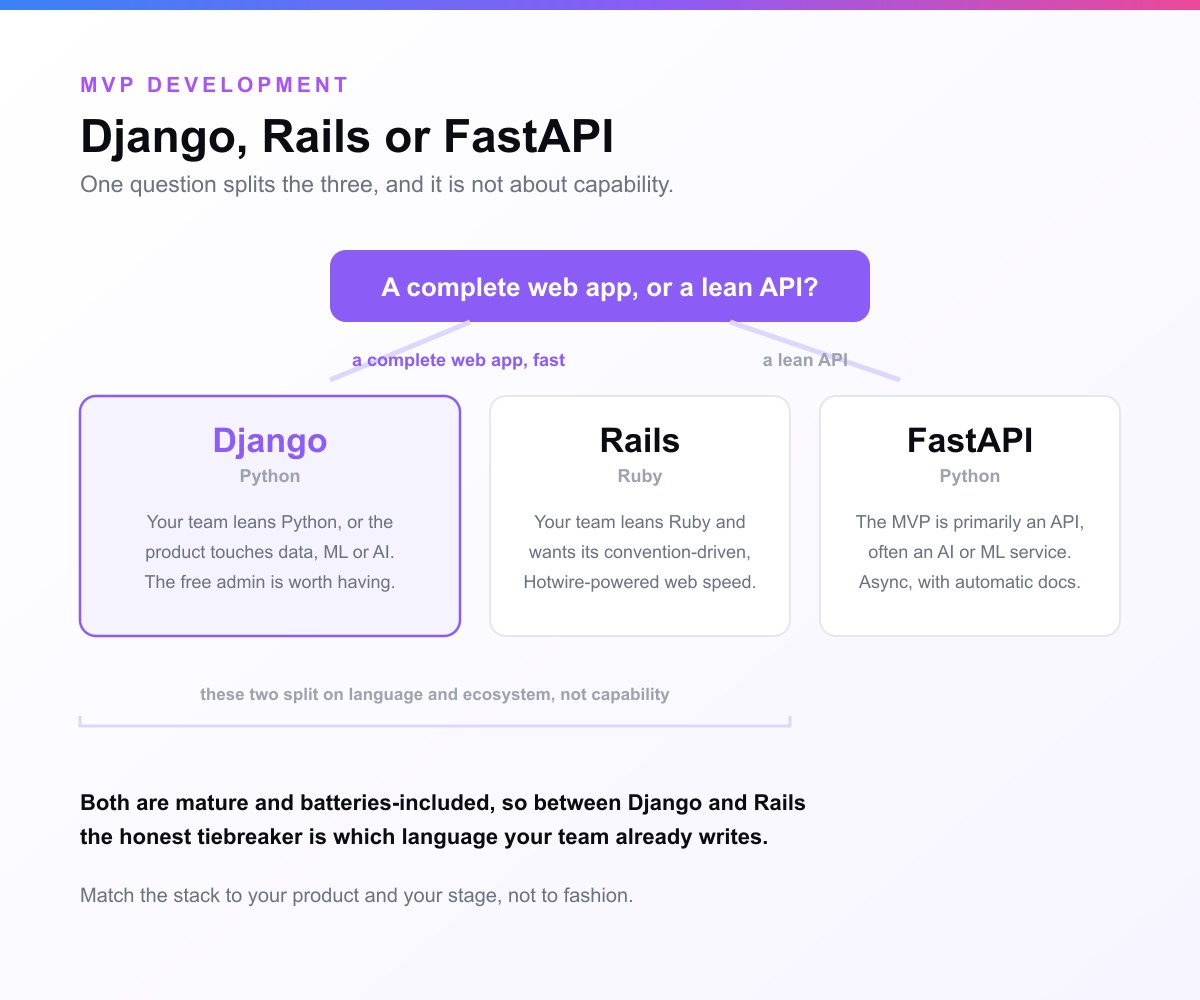
Whichever way you lean, match the stack to your product and stage, not to fashion.
When Django especially shines: AI and data MVPs
If your MVP has an AI, ML, or heavy data component, Django has a distinct edge: it keeps your web app and your data/ML code in the same language and ecosystem. You can call the same Python libraries your models use, wire background jobs with Celery, and manage everything through the admin.
For an AI MVP, that single-language simplicity removes a lot of friction other stacks introduce.
Limitations: when not to choose Django
Django is excellent, not universal. Consider alternatives when:
- Your product is heavily real-time. For live, high-concurrency features (chat, multiplayer, live collaboration), an async-first stack like Node or FastAPI can fit better.
- It is a mobile-first app. You will still need a native or cross-platform app, with Django serving as the API backend (see mobile app MVP).
- Your team has no Python experience and a tight deadline. Build in the language your team already knows.
- You want a rich, highly interactive JavaScript frontend. A Next.js stack may suit better, though HTMX closes much of this gap for Django.
None of these are knocks on Django in its sweet spot, they are reminders to choose the right stack.
Build your Django MVP with us
At MVP Development we build production-grade MVPs on the stack that fits your product, and for data-backed and AI-leaning web apps, Django is often the fastest path, precisely because it hands you an ORM, admin, auth, and Python's whole ecosystem out of the box. We ship a funding-ready Django MVP in about 3-4 weeks, on a fixed scope you approve up front, with full code ownership. We recommend Django when it is genuinely the right foundation for your idea, especially if AI or data is central, not as a default.
Explore our MVP web development service, or if you are choosing between stacks, our MVP consulting will help you decide first.
Thinking of building your MVP on Django? Ask us if Django is right for your MVP and we will answer from builds we have actually shipped on it.
Related guides
- MVP Tech Stack: how to choose the right stack for your MVP
- Rails MVP: the Ruby counterpart, compared above
- Laravel MVP: the PHP counterpart, strong for SaaS
- AI MVP: where Django's Python ecosystem is a real advantage
- How to Build an MVP: the end-to-end playbook
Frequently asked questions
Is Django good for an MVP?
Yes. Django is one of the best frameworks for a data-backed MVP. Its batteries-included design (ORM, migrations, auth, forms, security) and especially its auto-generated admin let a small team build and operate a real product in weeks. And because it is Python, it is the natural choice when your MVP involves AI, machine learning, or heavy data, since everything stays in one ecosystem.
How long does it take to build an MVP with Django?
A tightly scoped Django MVP typically takes about 3-4 weeks. Django removes most setup, and the admin gives you an entire operations back-office for free, which shortens the build considerably. As always, the main variable is scope, keeping the MVP to its core flow is what keeps it fast.
Django or Rails for an MVP?
Both are mature, batteries-included frameworks that build MVPs fast, so it comes down to language and ecosystem. Choose Django if your team leans Python or your product involves data science, ML, or AI, and if the auto-generated admin is valuable. Choose Rails if your team leans Ruby and wants its convention-over-configuration, Hotwire-driven web speed. Neither is better in the abstract, the right one fits your team and product.
Django or FastAPI for an MVP?
Use Django when you want a complete web app fast, it includes the admin, ORM, auth, and templates, so you build features, not plumbing. Use FastAPI when your MVP is primarily an API, especially an AI or ML service, where its async performance and automatic docs shine. A simple rule: full web product → Django; lean, high-performance API → FastAPI. Some AI MVPs even pair a FastAPI service with a Django app.
Is Django MVC, MVT, or MVP?
These are different things. "MVP" as an architecture pattern means Model-View-Presenter, but this guide uses MVP to mean Minimum Viable Product, the smallest launchable version of your product. Architecturally, Django follows its own MVT pattern (Model-View-Template), a close cousin of MVC. So you build a Minimum Viable Product (MVP) using Django, which internally uses the MVT pattern, the two senses of "MVP" are unrelated.
Can a Django MVP scale?
Yes. Instagram, Pinterest, and Disqus all scaled enormously on Django. Very high-scale products sometimes optimise specific paths later, but that is a success-stage decision, not an MVP concern. Building your MVP on Django does not limit you; it gets you to product-market fit quickly on a framework that is proven at massive scale.
Sources & references
- Django: official framework documentation
- Eric Ries, The Lean Startup: the validated-learning framework behind the MVP
- Y Combinator Library: founder guidance on building and launching early


