


TL;DR
MVP outsourcing means hiring an external team, an agency, a studio, or freelancers, to build your minimum viable product instead of building it with in-house staff. Done well, it gets a non-technical founder to market in weeks without a long hiring cycle. Done badly, it produces "spaghetti code," a misaligned product, and a rebuild, which is why many technical founders advise against it.
The honest answer is that outsourcing your MVP is right in some situations and wrong in others. If you are a technical founder who can build it, you almost always should, because the speed and control you keep are a startup's biggest advantages. If you are non-technical, on a deadline, and you hire a vetted, senior team that locks scope and hands over the code, outsourcing is often the fastest, lowest-risk path to a validated product. This guide covers the pros, the cons, the real costs, when each call is right, and how to outsource without getting burned.
Key Takeaways
- MVP outsourcing means hiring an external team to build your MVP instead of using in-house staff.
- Done well, it gets a non-technical founder to market in weeks without a long hiring cycle.
- Done badly, it produces spaghetti code, a misaligned product, and a rebuild.
- If you are a technical founder who can build it, you almost always should, for the speed and control you keep.
- If you are non-technical and on a deadline, a vetted senior team that locks scope and hands over the code is often the fastest, lowest-risk path.
More data: sourced MVP cost and timeline ranges are compiled in our MVP statistics for 2026.
What is MVP outsourcing?
MVP outsourcing is the practice of delegating the design and development of your minimum viable product to an external partner, rather than building it with employees you hire yourself. That partner is usually one of three things: a development agency or studio (a coordinated team), or independent freelancers (one or a few contractors). The goal is to get a working first version in front of real users without standing up an in-house engineering team first.
The appeal is speed and access. Hiring a senior in-house team takes two to four months and a large, long-term commitment, before your idea is even validated. An external team that has shipped MVPs before can start in days and bring product, design, engineering, and QA as one unit. For a founder racing a funding window or a competitor, that head start is the whole point.
The catch is that you are handing the most important early asset, your product's codebase and direction, to people who do not have equity in the outcome. That is the tension at the heart of every outsourcing decision, and the rest of this guide is about navigating it honestly.
The pros of outsourcing MVP development
Outsourcing earns its place for real reasons, especially for founders who cannot build the product themselves.
- Speed to market. A ready external team skips the two-to-four-month hiring cycle and starts in days. When your edge is being first or hitting a raise, that matters more than almost anything else.
- No hiring or overhead. You avoid recruiting, salaries, benefits, equity, and the management load of a permanent team, paying for a finished product instead of a payroll line you carry indefinitely.
- A complete, cross-functional team. A good studio brings product strategy, design, engineering, and QA together, so a non-technical founder is not stitching a designer here and a contractor there. (See the roles a build actually needs in our MVP development team guide.)
- Lower cost than a false start. For a non-technical founder, a scoped external build is usually cheaper than hiring a full-time senior team before the idea is validated, or worse, building the wrong thing in-house.
- Proven playbook. A team that has shipped many MVPs knows what to cut, which avoids the over-engineering that sinks first-timers.
These benefits are real, but notice they are strongest for non-technical founders and validated ideas. That is not an accident, as the cons make clear.
The cons of outsourcing MVP development
This is where honesty matters, because the risks of MVP outsourcing are real and well-documented. Among technical founders, the consensus leans skeptical for good reasons.
- Code quality and technical debt. The most common complaint. An external vendor optimizing for "done" can leave behind brittle, hard-to-maintain code, the infamous "spaghetti code", that you must rebuild to scale. Freelance developers report that rescuing botched outsourced MVPs is a large share of their work.
- Misaligned product vision. An outside team does not live your problem or talk to your users daily. Nuance gets lost, and you can end up with something that technically matches the spec but misses the point.
- Lost velocity and learning. Finding product-market fit is a fast loop of building, watching users, and changing direction. If every change has to route through an agency's queue, you lose the speed that is a startup's core advantage, and you do not build the deep understanding of your own system that fast iteration requires.
- No skin in the game. The vendor does not hold equity, so their incentive is to finish the contract, not to make your product succeed. That misalignment shows up under pressure.
- Hand-off and continuity risk. What if they lack capacity for your next sprint, raise prices, or go out of business? You can end up locked in, or facing a rebuild.
The sharpest version of the skeptical case: if you are a technical founder, you can build it yourself, you almost certainly should. Owning the engineering keeps your velocity, your understanding, and your code quality under your control, which is why Y Combinator pushes founders to be the actual builders. Outsourcing makes the most sense precisely when that option is not on the table.
MVP outsourcing pros and cons at a glance
| Pros | Cons | |
|---|---|---|
| Speed | Start in days, skip hiring | Iteration routed through a vendor queue |
| Cost | No salaries, equity, or overhead | Cheap vendors often mean costly rebuilds |
| Team | Cross-functional, proven playbook | No equity, no skin in the game |
| Code | Senior teams ship production-grade | Risk of spaghetti code and technical debt |
| Focus | You focus on the business | Vision can drift from the founder's intent |
The pattern: the pros dominate when you cannot build it yourself and you hire well; the cons dominate when you outsource the core of a product you could have owned, or you pick the cheapest vendor.
How much does it cost to outsource an MVP?
Costs vary enormously with scope and where the team is based, but the rough market ranges look like this:
- Freelancers: roughly $5,000, $30,000 for a typical MVP, with the widest quality spread. Founders report great results around $4,000, $10,000 with a vetted, hungry freelancer, and disasters at every price.
- Agencies and studios: commonly $20,000, $100,000+, depending on complexity. More accountable and coordinated, but the bill can climb with hourly billing.
- Offshore and nearshore teams: lower hourly rates, attractive when you have a technical founder to manage scope and review code closely, riskier without that oversight.
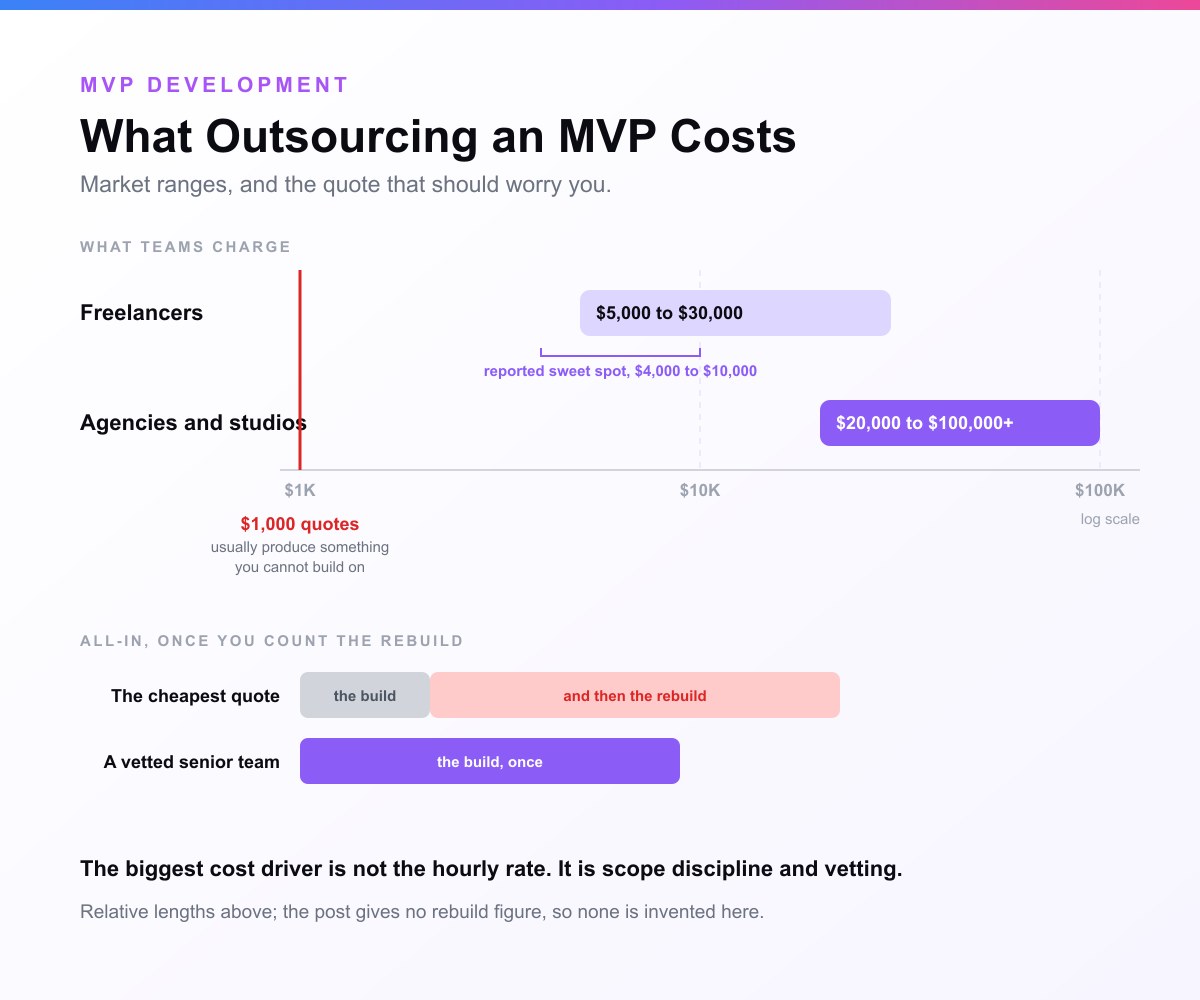
The single biggest cost driver is not the hourly rate, it is scope discipline and vetting. A tightly scoped MVP with a vetted senior team is far cheaper, all-in, than a cheap vendor whose code you rebuild. Beware quotes at the extreme low end ($1,000 "MVPs"); they usually produce something you cannot build on. For the full breakdown of what drives the number, see how much it costs to build an MVP.
A note on the model that protects you: a fixed, scoped quote you approve up front beats an open hourly meter, because it aligns the vendor with shipping the agreed scope rather than billing more hours.
When should you outsource your MVP?
The decision comes down to one question more than any other: can you (or a co-founder) build it yourselves?
Outsource your MVP when:
- You are non-technical and have no technical co-founder. Outsourcing removes the single biggest blocker between you and a live product. (Weighing it against your other options? See the guide for non-technical founders.)
- Speed is critical. A funding window or competitor means live this month beats perfect next quarter, and you cannot wait to hire.
- The idea is validated and the scope is clear. Outsourcing works best when you know what to build; an external team executes a defined scope far better than it discovers a vague one.
- You will hire a vetted, senior team that locks scope, ships production-grade code, and hands it over. The quality of the partner is the whole game.
Build it in-house (or yourself) when:
- You are technical. If you or a co-founder can build the MVP, you almost always should, to keep velocity, control, and code quality.
- The product's core is your IP. If the hardest technical part is the moat, owning it matters more than speed.
- You expect heavy iteration before product-market fit. Fast, founder-driven iteration is hard to outsource without losing the loop.
A useful gut check: outsourcing is delegation, not abdication. You can delegate the building; you can never delegate ownership of the product vision, the priorities, and the scope. Founders who hand over all of it tend to fail.
How to outsource your MVP without getting burned
If outsourcing is the right call, the difference between success and a rebuild is almost entirely in how you choose and run the partner. (For the full buyer's guide on this, see how to choose an MVP development agency.)
- Vet hard. Verify real case studies and shipped products, not just a portfolio page. Ask to speak to past clients. A team that has actually shipped MVPs is worth far more than the cheapest quote.
- Insist on a locked scope and a fixed quote. Agree the one core flow and a fixed price before the build starts, so scope creep and surprise invoices cannot derail you. See how to build an MVP for the scoping discipline.
- Demand full code ownership. You should own 100% of the source code, infrastructure, and documentation at hand-off, with no lock-in. This is non-negotiable for raising and for scaling later.
- Require weekly working demos. Visible progress every week lets you catch drift early, instead of discovering a misaligned product at the end.
- Keep the product-owner seat. You own the problem, the user, and the priorities. The vendor builds; you decide what gets built.
- Plan for after launch. Confirm post-launch support and a clean path to either keep working together or take the code in-house. Avoid partners who leave you stranded.
Get these right and most of the classic outsourcing horror stories simply do not happen, because they all trace back to a vague scope, a cheap unvetted vendor, or a founder who abdicated ownership.
Outsource your MVP the right way
MVP outsourcing is neither a silver bullet nor a trap. It is a tool that is right for non-technical founders with a validated idea and the discipline to hire well, and wrong for technical founders who would be giving up the velocity and control that are their biggest edge. The deciding factor is rarely outsourcing itself; it is who you outsource to and how you run them.
That is the gap we built MVP Development to fill. Instead of the cheap-vendor risk, you get a senior, pre-vetted team that ships a funding-ready MVP in 3 to 4 weeks, on a locked scope and a fixed quote you approve before we start, with 100% code ownership and weekly demos. You keep the product-owner seat; we bring the team, the playbook, and the production-grade code, so outsourcing gives you a foundation you can scale, not a rebuild.
If outsourcing is the right move for you, see how to hire our MVP developers, or if you are still deciding, start with a free MVP consultation, we will tell you honestly whether outsourcing fits your situation.
Thinking about outsourcing your MVP? Put the hard questions from this guide to us and judge the answers before you sign anything.
Outsourcing an MVP as a US company: the four things that are different
Most of this guide applies wherever you are. If your company is in the United States, four things change, and none of them is a reason not to outsource. They are reasons to do the paperwork in week one.
The tax form is a W-8BEN-E, not a W-9
A foreign vendor gives you a W-8BEN-E instead of a W-9. No 1099 at year end, and for work performed abroad, no withholding. Get it before the first invoice.
Section 174 treats foreign development differently
Since 2025, domestic software development is deductible in the year you spend it. Development performed outside the US is amortized over fifteen years. For a pre-revenue startup that changes nothing this year; for a profitable company it narrows the offshore price gap without closing it. Your CPA can price it in twenty minutes, and it belongs in the comparison. We explain the whole thing in Section 174 and software development.
The IP clause has to be present-tense
Under US copyright law the vendor owns the code until they assign it to you in writing, and “work for hire” does not reliably cover software from an outside company. The contract needs “hereby assigns,” and the repository needs to be in your organization from the first commit.
Overlap hours go in writing, in your timezone
The disputes US founders actually have with offshore teams are not legal. They are a two-minute question that took two days because nobody wrote down when the team was online in Eastern time. One page fixes it.
The full checklist, with the six questions to ask before signing, is in hiring offshore developers as a US company. If your product touches health data, add the BAA question from HIPAA-compliant MVP development.
Related guides
- How AI recommends MVP companies: what ChatGPT and AI Overviews actually pull from when someone asks who should build their MVP
- Hire MVP Developers: how to hire and vet an external MVP team
- MVP development contract: owning the code when someone outside your company writes it
- MVP development team: the roles and structure of a build team
- How much does an MVP cost?: the full cost breakdown
- MVP development challenges: the pitfalls that derail builds, and how to avoid them
Frequently asked questions
Is outsourcing MVP development a good idea?
It depends on whether you can build it yourself. If you are a technical founder, building in-house is usually the better choice, because it preserves the velocity, control, and code quality that are a startup's biggest advantages. If you are non-technical, on a deadline, and you hire a vetted, senior team that locks scope and hands over the code, outsourcing is often the fastest and lowest-risk path to a validated product. The bad outcomes almost always come from outsourcing the core of a product you could have built, picking the cheapest vendor, or abdicating ownership of the product vision.
How much does it cost to outsource MVP development?
Freelancers typically run $5,000, $30,000 for an MVP with a wide quality spread, agencies and studios commonly run $20,000, $100,000+, and offshore teams offer lower rates but need close oversight. The biggest cost driver is not the hourly rate but scope discipline and vetting: a tightly scoped MVP built by a vetted senior team is cheaper all-in than a cheap vendor whose code you have to rebuild. And if your users and investors are American, US MVP development covers the timezone and expectation side of that choice. Be wary of very low quotes; a $1,000 "MVP" usually produces something you cannot build on. A fixed, scoped quote you approve up front protects you better than an open hourly meter.
What are the risks of outsourcing your MVP?
The main risks are technical debt and "spaghetti code" from a vendor optimizing for done over quality, a product that drifts from your vision because the team does not live your problem, lost iteration velocity when every change routes through an agency queue, and misaligned incentives because the vendor has no equity in the outcome. There is also continuity risk if the partner lacks capacity, raises prices, or disappears. Most of these are avoidable by vetting hard, locking scope, demanding full code ownership, requiring weekly demos, and keeping the product-owner seat yourself.
Should a technical founder outsource their MVP?
Usually not. If you can build the MVP yourself, you almost always should, because owning the engineering keeps your development velocity, your understanding of the system, and your code quality under your control, which is exactly what lets you iterate fast toward product-market fit. Y Combinator and many technical founders advise that the founding team should be the actual product builders for this reason. A technical founder might still outsource a specific component or a non-core piece to cover a skill gap, but handing over the core MVP build rarely makes sense when you could own it.
Is it better to outsource or build an MVP in-house?
Build in-house when you are technical, when the product's core is your IP, or when you expect heavy iteration before product-market fit, control and velocity win there. Outsource when you are non-technical, speed is critical, and the scope is validated and clear, and when you can hire a vetted senior team. Building a full permanent in-house team before the idea is validated is usually the wrong move, because you carry salaries and equity for an unproven idea. A common middle path is a scoped external build to validate, then bringing the code and team in-house once it is working.
Sources & references
This guide draws on established startup practice and founder-community consensus:
- Eric Ries, The Lean Startup: validated learning and the speed of the build-measure-learn loop
- Y Combinator, Startup Library: why founders should be the product builders
- Atlassian, Minimum Viable Product: the MVP in agile product development
- CB Insights, Why Startups Fail: the role of no market need and execution in startup failure
The 3 to 4 week figure is drawn from our own delivery data on narrowly scoped builds.


