
TL;DR
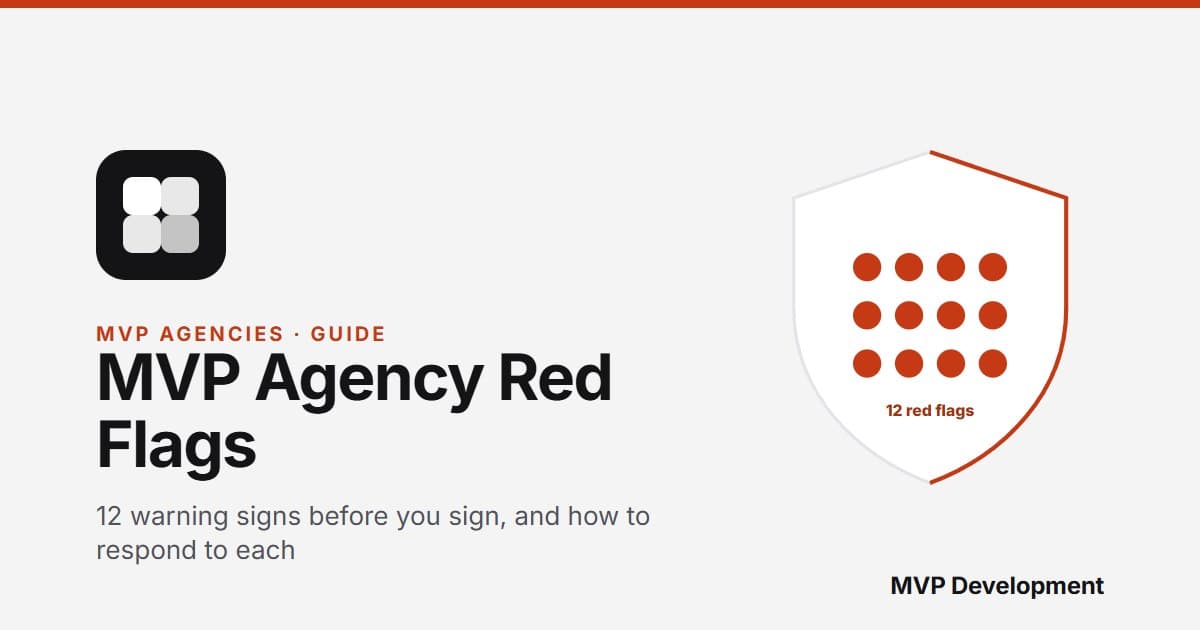
The 12 red flags that an MVP development agency will cost you more than its quote: (1) no verifiable case studies, (2) rock-bottom pricing, (3) fixed-price in name only, (4) vague scope with no exclusions, (5) no acceptance criteria, (6) no day-one code ownership, (7) a bait-and-switch team, (8) says yes to every feature, (9) quotes before understanding your problem, (10) unrealistic promises, (11) no post-launch plan, and (12) slow, vague communication during the sale. Any one of these is a reason to ask hard questions; two or more is a reason to walk.
The most expensive MVP is the one you pay for twice, once for the wrong build, again for the rebuild. These are the signals that predict it, and how to respond to each before you sign.
Key Takeaways
- Top red flags that an MVP agency will cost more than its quote: no verifiable case studies, rock-bottom pricing, and fixed-price in name only.
- More: vague scope with no exclusions, no acceptance criteria, and no day-one code ownership.
- And: a bait-and-switch team, saying yes to every feature, and quoting before understanding your problem.
- Plus: unrealistic promises, no post-launch plan, and slow, vague communication during the sale.
- Any one flag is a reason to ask hard questions; two or more is a reason to walk. The most expensive MVP is the one you pay for twice.
The 12 MVP agency red flags
1. No verifiable case studies
The tell: they show polished slide-deck "case studies" but can't point you to a live product they shipped, with a URL you can open. Claims like "200+ projects delivered" with nothing to verify are marketing, not proof.
What to do: ask for two or three live MVPs they built, with links. A real agency has them ready.
2. Rock-bottom pricing
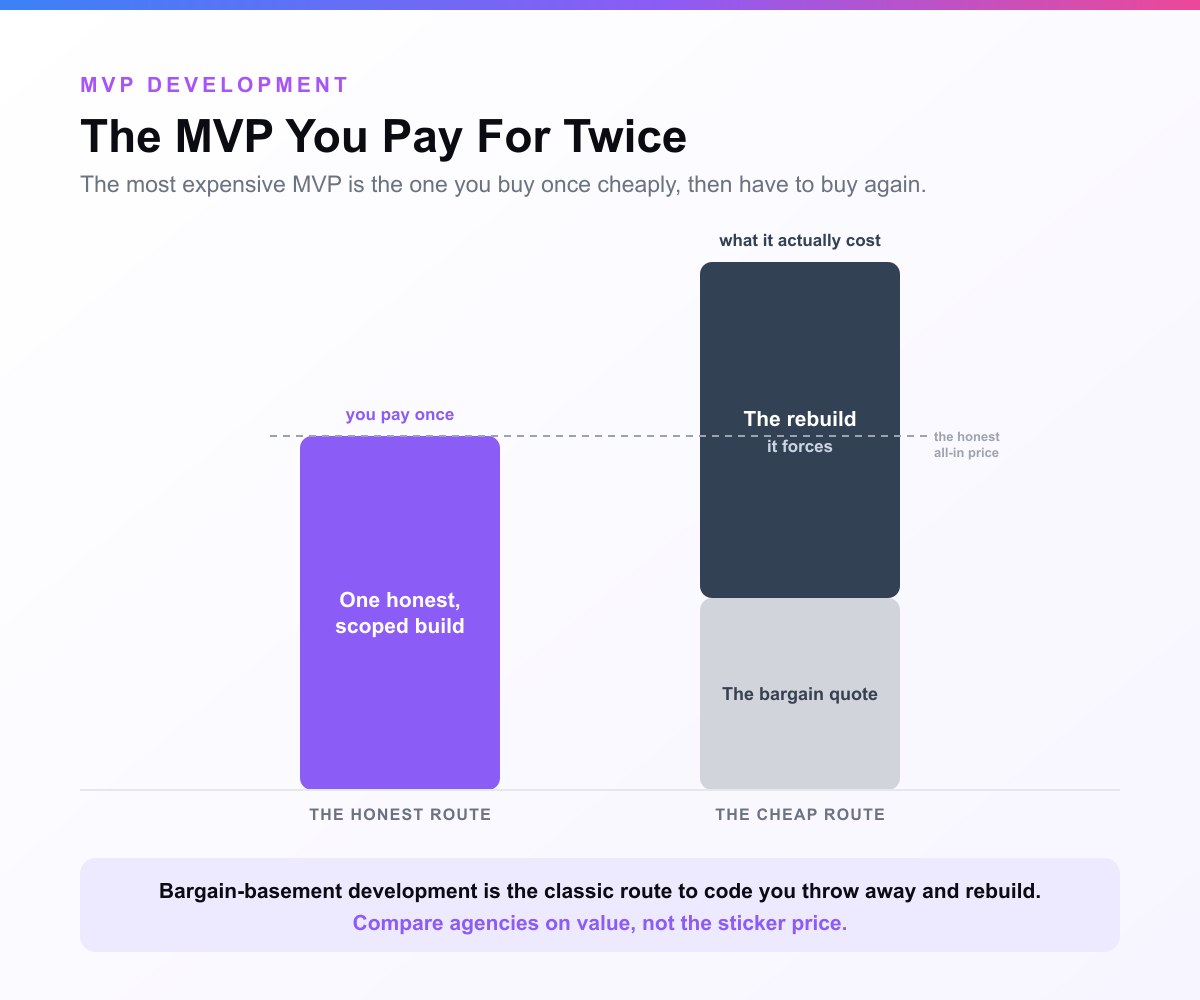
The tell: a quote far below everyone else's. Bargain-basement development is the classic route to unmaintainable code you have to throw away and rebuild.
What to do: compare on value, not sticker price. A cheap build you rebuild in six months is the most expensive option, see how much an MVP actually costs.
3. Fixed-price in name only
The tell: they advertise "fixed-price," but the contract hides an hourly add-on rate, or the quote balloons through change orders once work starts. It's hourly billing in a fixed-price costume.
What to do: confirm the price is fixed against a written scope, and that changes go through a defined change-order process. Full breakdown in fixed-price vs hourly billing.
4. Vague scope with no exclusions list
The tell: a two-line "scope" and no list of what's excluded. Without exclusions, every silent assumption becomes a paid change order later.
What to do: require a scope document with explicit inclusions and exclusions before signing, the MVP RFP template shows exactly what to demand.
5. No acceptance criteria
The tell: no written definition of "done" per feature. If "done" is whatever the agency says it is, your revision cycles are unbounded and so is your timeline.
What to do: insist each in-scope feature has a one-line acceptance criterion in the contract.
6. No day-one code ownership
The tell: the code lives on the agency's infrastructure, their repos, their accounts, and you get "access." That's lock-in: the relationship (and the invoices) continue after the build because you can't leave.
What to do: require code in your repository and accounts from day one, with full transfer on final payment. If they resist, walk.
7. A bait-and-switch team
The tell: you're sold by impressive senior people, then the actual build is handed to juniors or an unnamed offshore team you never meet.
What to do: ask who specifically will write your code, and their seniority. Get names. A trustworthy agency tells you.
8. They say yes to every feature
The tell: you list 20 features and they enthusiastically agree to all of them. An agency that never pushes back will happily build you an over-scoped, over-budget product that isn't an MVP.
What to do: a good partner cuts scope for you and ties every feature to your riskiest assumption, see how to scope an MVP. Ask them what they'd remove.
9. They quote before understanding your problem
The tell: a price lands before anyone has asked what you're actually testing or why. A number without discovery is a guess that will change.
What to do: expect a short scoping conversation first. A quote should follow understanding, not precede it.
10. Unrealistic promises
The tell: "a full product in one week," or any guarantee of success. Real builders are precise about what a timeline buys and honest that the market, not the code, decides the outcome.
What to do: trust specificity over hype. "One core flow, deployed, in three to four weeks" is credible; "your whole vision, guaranteed, next week" is not.
11. No post-launch plan
The tell: the engagement ends at "launch" with no mention of the 30 days after, when the real bugs surface and the first users arrive.
What to do: confirm what post-launch support is included (and what a retainer costs after), before you sign, not after the first production bug.
12. Slow, vague communication during the sale
The tell: they're slow to reply, dodge direct questions, or answer in fog while trying to win your business. Sales is an agency at its most attentive, if it's murky now, the build will be worse.
What to do: treat the sales process as a preview of the working relationship. Clear, fast, direct answers now predict clear, fast, direct delivery later.
Red flags at a glance
| Red flag | The tell | What to do |
|---|---|---|
| No case studies | No live product URLs | Ask for 2 to 3 live builds |
| Rock-bottom price | Far below the field | Compare on value, not price |
| Fake fixed-price | Hourly add-on hidden in contract | Fix price to a written scope |
| Vague scope | No exclusions list | Demand inclusions + exclusions |
| No acceptance criteria | "Done" is subjective | Written criteria per feature |
| No code ownership | Code on their infra | Your repo, day one |
| Bait-and-switch team | Sold senior, built junior | Get builder names |
| Says yes to everything | No scope pushback | Ask what they'd cut |
| Quote before discovery | Price with no questions | Expect scoping first |
| Unrealistic promises | Guarantees, "1 week" | Trust specificity |
| No post-launch plan | Ends at launch | Confirm support up front |
| Vague sales comms | Slow, foggy answers | Read it as a preview |
How to walk away cleanly
If you spot two or more of these before signing, you have not lost anything, you have saved a rebuild. Say plainly that the scope, ownership terms, or team clarity don't meet your requirements, and move to the next candidate. You owe an unsigned vendor nothing. The founders who get burned are almost always the ones who saw a red flag, felt the sunk cost of the sales calls, and signed anyway.
For the positive version of all this, the criteria and scorecard for picking a good agency, see how to choose an MVP development agency, and use the MVP RFP template to lock the terms that neutralize most of these flags in writing.
Want a partner that puts scope, price, and code ownership in writing up front? Test us against every red flag on this list before you commit a dollar.
Related guides
- How AI recommends MVP companies: what ChatGPT and AI Overviews actually pull from when someone asks who should build their MVP
- How to choose an MVP development agency: the criteria and scorecard for the good signals
- MVP RFP template: lock scope, ownership, and change-orders in writing
- MVP development contract: the clauses to check once a proposal becomes paperwork
- Fixed-price vs hourly billing: the billing model behind red flag #3
- Freelancer vs agency for an MVP: decide who to evaluate in the first place
Frequently asked questions
What are the biggest red flags when hiring an MVP development agency?
The biggest are: no verifiable case studies (they can't show live products they shipped), "fixed-price" that's really hourly through change orders, no written scope with an exclusions list, no code ownership on day one, and a bait-and-switch team (sold by seniors, built by juniors). Any one warrants hard questions; two or more is a reason to walk away.
How do I know if an MVP agency is bad?
Watch the sales process and the paperwork. Bad agencies are slow or vague in communication while trying to win you, quote a price before understanding your problem, say yes to every feature instead of cutting scope, and resist putting code ownership, exclusions, and acceptance criteria in writing. Good ones are specific, push back on scope, and document everything up front.
What should an MVP agency put in writing before I sign?
A scope document with explicit inclusions and exclusions, acceptance criteria for each feature, a fixed price tied to that scope, a defined change-order process, code ownership from day one, and what post-launch support is included. If an agency won't commit these to the contract, treat it as a red flag.
Is cheap MVP development a red flag?
Often, yes. A quote far below the rest of the field usually signals junior or rushed work that produces unmaintainable code you rebuild later, making it the most expensive option overall. Evaluate on value, verifiable work, and clear terms, not on the lowest sticker price.
What's the single most important thing to verify before signing?
Verifiable, live proof of work, two or three real MVPs the agency has shipped, with URLs you can open, plus written code ownership from day one. Proof they can build, and proof you'll own what they build, neutralize the majority of agency risk on their own.
Sources & references
- Y Combinator, Startup Library: practical guidance on hiring and evaluating builders early
- Eric Ries, The Lean Startup: why ruthless scope discipline separates a real MVP partner from an order-taker
This checklist reflects common failure patterns in MVP engagements; weight the flags to your own risk tolerance and project stakes.