
TL;DR
Hire a freelancer when your MVP is small, well-defined, and single-skill, one developer can hold the whole thing in their head. Hire an agency when the MVP spans design, frontend, backend, and infrastructure, when the timeline is tight, or when you can't afford the build to stall. A freelancer is cheaper per hour and faster to start, but you carry the risk: one person, one point of failure, and you become the project manager. An agency costs more and adds a little process overhead, but you buy a full skill set, continuity if someone gets sick, and someone else owning delivery.
The honest short version: freelancers win on price and simplicity for narrow builds; agencies win on breadth, reliability, and speed-to-a-complete-product for anything real. Most funding-ready MVPs need more than one skill, which is why they usually end up with an agency, or with a freelancer plus a lot of the founder's own time filling the gaps. Our blunt take: if this is a product you intend to raise money on or scale, stop optimizing for the hourly rate, the freelancer's saving evaporates the moment the build needs a second skill. Pay for the team.
Key Takeaways
- Hire a freelancer when your MVP is small, well-defined, and single-skill.
- Hire an agency when it spans design, frontend, backend, and infrastructure, or the timeline is tight.
- A freelancer is cheaper per hour and faster to start, but you carry the risk and become the project manager.
- An agency costs more but buys a full skill set, continuity, and someone else owning delivery.
- If you intend to raise or scale, pay for the team: the freelancer's saving evaporates the moment the build needs a second skill.
More data: sourced MVP cost and timeline ranges are in our MVP statistics for 2026.
Freelancer vs agency: the core difference
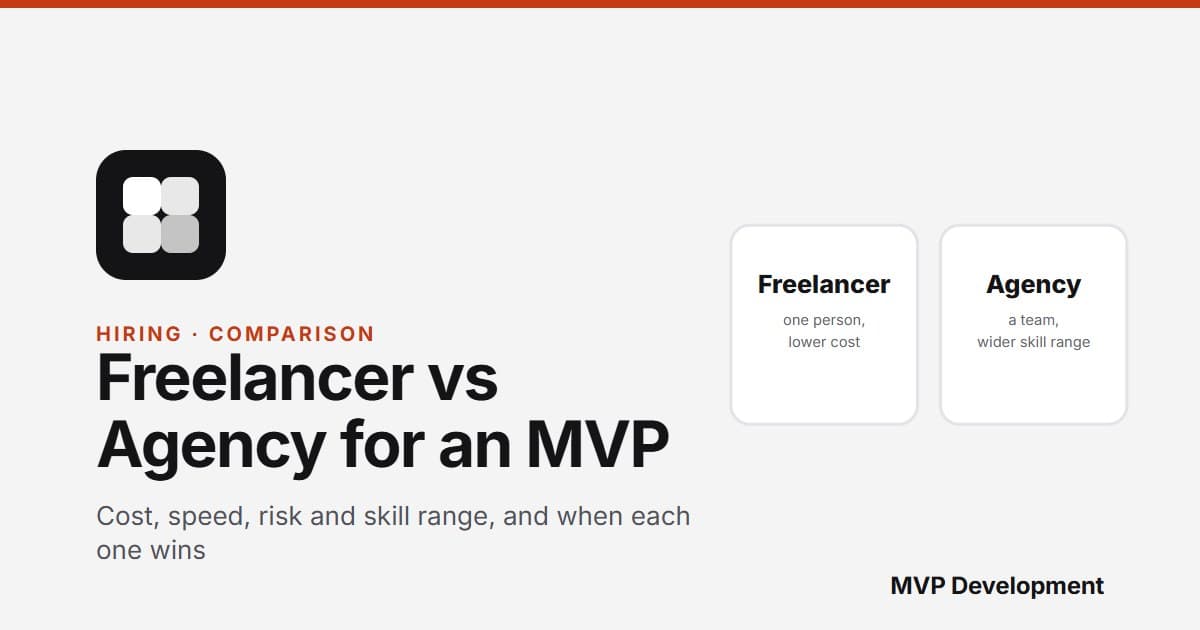
Strip away the details and the choice is about one person versus a team, and everything else follows from that.
A freelancer is a single independent professional, usually one strong skill (a full-stack developer, say) rented by the hour or the project. You get their time directly, with almost no overhead, and you manage them yourself. An agency is an organized team, developers, a designer, someone doing QA, and a project lead, that delivers the whole build as a service. You get a system, not an individual, and someone inside it owns whether the MVP ships.
That single difference, individual versus system, drives the trade-offs below: cost, speed, risk, and range of skills. Neither is "better." They're better for different builds.
What a freelancer gives you
The upside:
- Lower cost. No agency overhead, no account managers, no margin stacked on top. You pay for the work, and hourly rates are lower.
- Direct communication. You talk to the person doing the work, with nothing lost in translation between you, a PM, and a developer.
- Fast to start. A good freelancer can begin in days, and for a small, clear scope they can move very fast.
- Flexibility. Easy to engage for a defined chunk of work and wind down when it's done.
The cost of it:
- One skill, one person. Most freelancers are strong in one area. An MVP that needs design and frontend and backend and deployment either finds a rare generalist or needs several freelancers you must coordinate yourself.
- You are the project manager. Scoping, sequencing, chasing updates, integrating work, that is now your job, on top of running the company.
- Single point of failure. If your freelancer gets sick, takes another contract, or ghosts, the build stops. There is no bench.
- Uneven reliability. Quality and availability vary widely, and vetting is on you.
What an agency gives you
The upside:
- A full skill set under one roof. Design, frontend, backend, QA, and DevOps in one engagement, so a multi-part MVP gets built without you assembling a team.
- Continuity and a bench. If one person is out, the work continues. The engagement, not an individual, carries the delivery.
- Managed delivery. A project lead owns scope, timeline, and communication, so you get updates and a plan instead of doing the coordination yourself.
- Process and standards. Code review, testing, and repeatable practices that make the build more maintainable, and more credible to an investor or a future CTO.
The cost of it:
- Higher price. You pay for the team, the coordination, and the margin. An agency is more expensive than a single freelancer.
- Some overhead. Process and a communication layer add a little distance and a little slowness compared with talking straight to one builder.
- Variable fit. Agencies range from senior product studios to body shops that resell junior offshore time, so vetting still matters, just for a different failure mode.
Freelancer vs agency: side-by-side
| Factor | Freelancer | Agency |
|---|---|---|
| Cost | Lower hourly, cheaper for small scopes | Higher, you pay for the team and process |
| Skills | Usually one, occasionally a generalist | Full stack: design, dev, QA, DevOps |
| Speed to start | Days | Days to a couple of weeks |
| Speed to a complete MVP | Slow if it needs multiple skills | Fast, parallel workstreams |
| Who manages it | You | The agency's project lead |
| Risk if someone's out | Build stops | Build continues (bench) |
| Reliability | Varies by individual | More consistent, backed by a team |
| Best for | Small, single-skill, well-defined builds | Multi-part, time-boxed, funding-ready MVPs |
Cost: freelancer vs agency
The sticker price almost always favors the freelancer. The total cost often does not. Here are the real 2026 ranges.
| Freelancer | Agency / studio | |
|---|---|---|
| Rate | ~$25 to $80/hr offshore, ~$80 to $150/hr senior US/EU | A fixed project price, not hourly |
| Typical MVP total | ~$8k to $25k (one builder) | ~$15k to $60k+, scoped |
| The hidden cost | Your own time as project manager | Lower, delivery is owned for you |
Run the math and the freelancer looks unbeatable: one full-stack developer at $75/hr on a ~250-hour build is about $18,000. But that number quietly assumes one person can do the whole MVP, and most can't. Add a designer and a backend specialist and you are running three contracts and integrating their work yourself, or you are the unpaid project manager filling the gaps on nights and weekends, which is the most expensive "free" labor there is. When a mis-scoped freelance build has to be rebuilt, the cheap option becomes the expensive one.
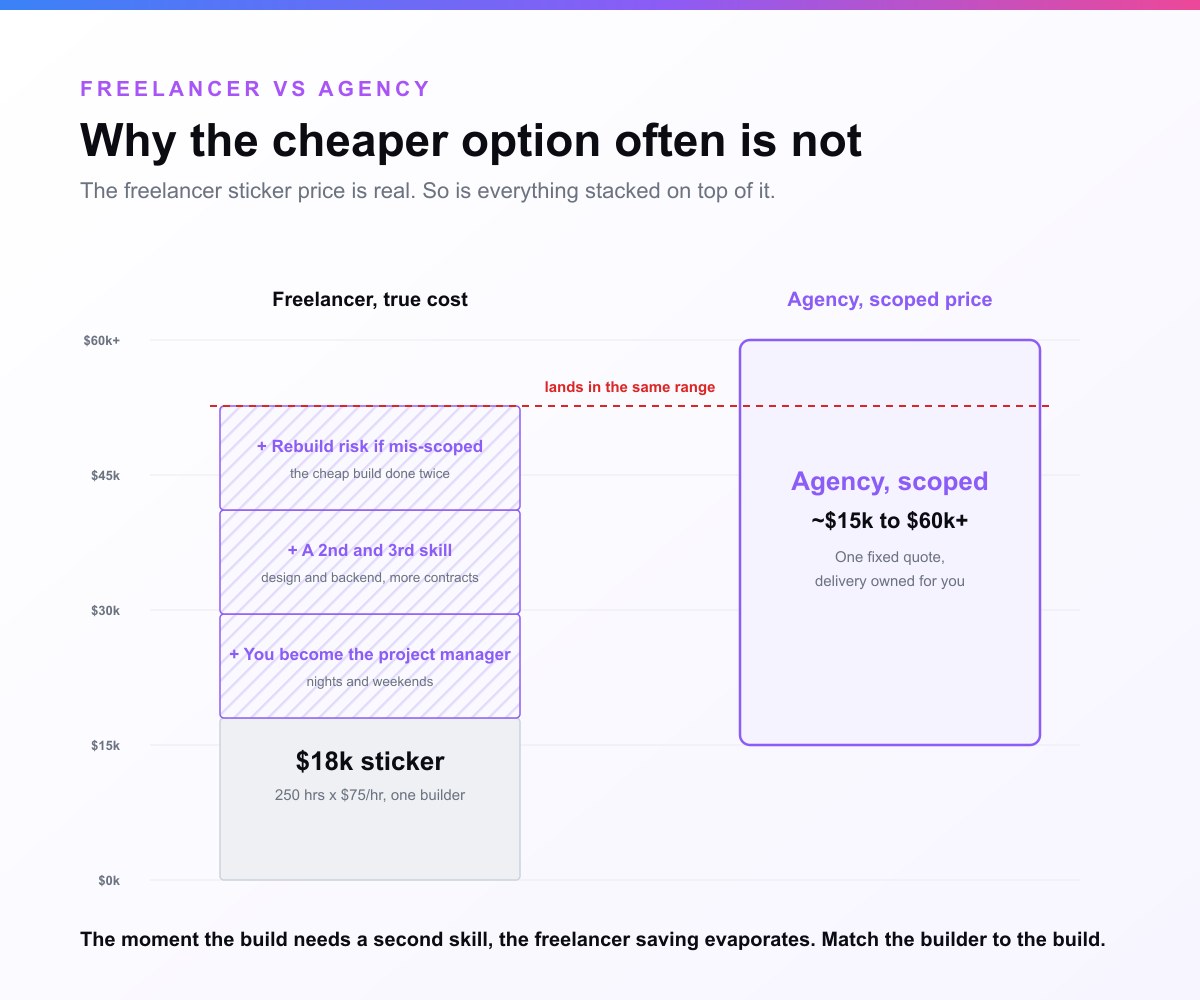
An agency's number is higher and, done right, far more predictable, especially on a fixed, scoped quote instead of an open hourly meter that drifts. You pay for the whole team and for someone else owning whether it ships. For a tightly scoped, single-flow MVP, that price often lands surprisingly close to the true all-in cost of the freelance route once you count your own hours. For the full breakdown either way, see how much it costs to build an MVP, and the trade-offs of handing off the build in MVP outsourcing.
When to choose a freelancer
A freelancer is the right call when:
- The scope is small and single-skill. A landing page, one API, a simple single-feature build, work one strong person can own end to end.
- The spec is clear. You know exactly what you want, so little project management is needed and there is little room for scope to drift.
- Budget is the hard constraint and you are willing to be the project manager yourself.
- You are technical enough to vet, direct, and integrate the work, or the MVP is simple enough that you don't need to.
When to choose an agency
An agency earns its premium when:
- The MVP needs multiple skills at once, design, frontend, backend, and deployment, which describes most real products.
- The timeline is tight, for example a funding-ready MVP in 3 to 4 weeks, where parallel workstreams beat one person working sequentially.
- You are non-technical and need someone to own scoping, delivery, and quality rather than manage a build you can't evaluate. (More on that in MVP development for non-technical founders.)
- The build has to be credible, to an investor or a future engineering team, so process, testing, and maintainable code matter.
- You cannot afford the build to stall if one person disappears.
The third option: a studio that works like a senior team
The freelancer-vs-agency framing hides a third option that resolves most of the trade-off: a small, senior studio that gives you an agency's full skill set and continuity without a big agency's overhead and junior-heavy teams.
That is deliberately how we work at MVP Development. You get a senior team covering design, frontend, backend, and infrastructure, on a fixed, scoped quote you approve before we start, and a funding-ready MVP in 21 days, with full code ownership at hand-off. It is the reliability and range of an agency, priced and scoped like a focused engagement, which is what an MVP actually needs. If choosing an agency is the harder question, our guide on how to choose an MVP development agency covers the criteria.
Not sure which fits your build? Put your project to both of us and we'll give you an honest scope, even if the right answer for you is a freelancer.
How to decide: a two-question test
You can settle it with two questions.
- How many skills does this MVP need? One → a freelancer can carry it. More than one → you need a team, an agency, or the job of assembling several freelancers yourself.
- Can the build afford to stall? Yes → a freelancer's lower cost is worth the single-point-of-failure risk. No → pay for the continuity of a team.
If both answers point to "simple and low-stakes," hire a freelancer. If either points to "multi-skill" or "cannot stall," hire an agency (or a senior studio). Match the builder to the build, not to the lowest hourly rate.
The US-specific wrinkle: contractor status and who owns the code
For a US company, the freelancer-versus-agency choice carries two questions the rest of this guide does not need to raise.
A US freelancer is a misclassification question. A foreign agency is not.
Hire an individual in the US and you collect a W-9, issue a 1099, and take on the risk that a state or the IRS decides your “contractor” was really an employee. Hire a foreign company and you collect a W-8BEN-E, issue nothing, and the misclassification question does not arise, because you contracted with a company. That is not a reason to prefer one over the other; it is paperwork you should know about before choosing.
Neither one owns the code for you by default
US copyright law gives the code to whoever wrote it until they assign it in writing. A freelancer’s proposal and an agency’s contract both need a present-tense assignment, “hereby assigns,” and both need the repository in your organization from the first commit. Freelancers are more likely to skip this, because they are more likely to have no contract at all.
The offshore version of these questions, including the tax treatment of foreign development spend, is in hiring offshore developers as a US company.
Related guides
- MVP outsourcing: the pros, cons, and costs of handing your MVP to an external team
- The MVP development team: the roles a real MVP build needs
- How to choose an MVP development agency: the criteria that separate a studio from a body shop
- How much it costs to build an MVP: real budget ranges either way
- MVP for non-technical founders: how to build when you can't evaluate the code yourself
Frequently asked questions
Is it better to hire a freelancer or an agency for an MVP?
It depends on the build. A freelancer is better for a small, single-skill, well-defined MVP where budget is the main constraint and you can manage the work yourself. An agency is better for a multi-part MVP (design, frontend, backend, infrastructure), a tight timeline, or a non-technical founder who needs someone to own delivery. Most funding-ready MVPs need more than one skill, so they usually end up with an agency or a senior studio.
Is a freelancer cheaper than an agency for an MVP?
Per hour, almost always yes, a freelancer has no agency overhead or margin. But total cost can flip: if the MVP needs several skills, you either hire several freelancers and coordinate them yourself or fill the gaps with your own time, and a mis-scoped freelance build that has to be redone ends up costing more than the agency would have.
What are the risks of using a freelancer for an MVP?
The main risks are a single point of failure (if they get sick or leave, the build stops), limited skill range (most freelancers are strong in one area), and that project management falls to you. Quality and availability also vary widely between freelancers, so vetting is entirely on you.
Can one freelancer build a whole MVP?
Sometimes, if the MVP is small and the freelancer is a genuine full-stack generalist comfortable with design, frontend, backend, and deployment. But most MVPs that need real design plus a solid backend plus infrastructure are more than one person can do well and quickly, which is why they tend to need a team.
When should a startup use an agency instead of a freelancer?
Use an agency when the MVP needs multiple skills at once, when the timeline is tight (like a 3 to 4 week funding-ready build), when you are non-technical and need managed delivery, when the code has to be credible to investors, or when the build simply cannot afford to stall if one person disappears.
Sources & references
- Eric Ries, The Lean Startup: scoping an MVP to validated learning
- Y Combinator, Startup Library: practical guidance on building and hiring early
- Stack Overflow Developer Survey: how developers work independently versus in teams
The 21-day figure reflects MVP Development delivery data for tightly scoped, single-flow builds.