


TL;DR
A non-technical founder does not need to learn to code, or find a technical co-founder, to build an MVP. You need to do two things well: choose the right build path, and manage the build even though you cannot do it yourself. Plenty of successful companies were started by founders who never wrote a line of production code, what they got right was the decision and the oversight, not the engineering.
This guide is not a list of tools, it is the decision-and-execution playbook for the non-coder. You have four realistic paths (no-code, AI-assisted, hiring a team, or a technical co-founder), and this guide covers how to choose between them, how to run a build you are not coding, and how to protect yourself from the specific ways non-technical founders get burned, bad code, lost IP, and runaway costs. For the deep dive on any single path, we link to its dedicated guide rather than repeat it here.
Key Takeaways
- A non-technical founder does not need to learn to code, or find a technical co-founder, to build an MVP.
- You need to do two things well: choose the right build path, and manage the build even though you cannot do it yourself.
- Plenty of successful companies were started by founders who never wrote a line of production code.
- You have four realistic paths: no-code, AI-assisted, hiring a team, or a technical co-founder.
- The specific risks to protect against are bad code, lost IP, and runaway costs.
Can a non-technical founder build an MVP?
Yes, unambiguously. The myth that you must be able to code (or must recruit a CTO before you can start) stops a lot of good founders before they begin, and it is wrong. Your job as a founder is not to write the software; it is to understand the customer, define the right thing to build, get it built, and validate it. The building can be done in several ways that do not require you personally to code. Founders who arrive here hoping to sell the idea instead should read how to sell an app idea; the paths converge on building the smallest version.
What a non-technical founder does need is different from engineering skill: clarity on the problem and the one core flow, the judgment to pick the right build path, and the discipline to manage scope, money, and quality. Those are founder skills, not developer skills. The rest of this guide is about applying them.
Your four paths (and how to choose)
There are four realistic ways for a non-technical founder to get an MVP built. The right one depends on your budget, how complex your product is, and your long-term plan. Here is the decision at a glance, each path links to its full guide:
| Path | Best when | Trade-off |
|---|---|---|
| No-code | Standard logic, tight budget, you want to build it yourself | Fast and cheap, but hits a ceiling |
| AI-assisted | You want a fast first draft and have some technical help to review it | Speed, but the code needs hardening |
| Hire a team / agency | Your product is custom or you want it built right the first time | Costs more, but you get production-grade code |
| Technical co-founder | You are building a deeply technical, long-term company | Slow to find the right person; you give up equity |
- Build it yourself, no-code. If your idea is a fairly standard app and your budget is tight, you can assemble a real product visually without engineers. This is the fastest, cheapest start for many non-technical founders, with the trade-off that you may outgrow the platform. See the full no-code MVP guide for tools and limits.
- AI-assisted build. AI tools can generate a working first draft from a description, dramatically faster than before, but the output needs a real engineer to review and harden before it touches real users. We cover the honest limits in vibe coding an MVP.
- Hire a team or agency. If your product needs custom code, or you want it built to a production standard the first time, you hire it out, an agency, a studio, or vetted developers. This is usually the right call once you are serious about a real, scalable product. See MVP outsourcing and how to hire MVP developers.
- Find a technical co-founder. A co-founder who codes is powerful for a deeply technical, long-term company, but finding the right one is slow and costs significant equity, and you should not let "I need a CTO first" stop you from validating with one of the faster paths now.
The honest default: most non-technical founders should validate with no-code or a hired build first, and only consider a technical co-founder once the idea is proven. You can almost always start without one.
How to actually choose
Run your situation through four questions, in order:
- How standard is your product? If your logic is common (sign-ups, listings, dashboards, payments), no-code can probably do it. If your core is genuinely novel or complex, you need custom code, hire or co-found.
- What is your budget? Tight budget and standard idea points to no-code. Real budget and a need for production quality points to hiring.
- What is your timeline? No-code and AI-assisted are fastest to a rough product; a hired build takes a little longer but produces something you can scale.
- What is your long-term plan? Validating an idea you will likely rebuild later favours the cheapest validation now. Building the actual company you intend to scale favours getting real, owned code from the start.
Notice none of these require you to code. They require you to think clearly about the business, which is your job anyway.
What you do not need to do
Three things non-technical founders wrongly believe are prerequisites:
- You do not need to learn to code. Learning enough to build a real product takes months you should spend on customers. Use that time to validate, not to half-learn engineering.
- You do not need a technical co-founder before you start. It is the most common reason founders stall. Validate first with a faster path; a great technical co-founder is far easier to attract to a proven idea anyway.
- You do not need to understand the code. You need to understand the product, the flows, the value, the metrics. Leave the implementation to whoever (or whatever) builds it, and judge it on outcomes.
How to manage a build you can't do yourself
This is the real skill, and the part no tool replaces. Managing a build you cannot personally do comes down to a few disciplines: It starts before the build, with the one-page brief in how to explain an app idea to a developer.
- Write a clear spec. You do not need technical language, you need an unambiguous description of the one core flow: what the user does, step by step, and what the product does in response. Clarity here prevents most disputes and rework. (See MVP scope.)
- Insist on small milestones. Break the build into visible chunks you can see and test, not one big "it'll be done in eight weeks." Frequent, working increments are how a non-coder keeps a build honest.
- Judge progress by working software, not status updates. The only real signal is something you can click and use. "90% done" is not a deliverable; a working sign-up flow is.
- Communicate in product terms. You steer with the what and why (the user need, the priority); leave the how to the builders. A good partner translates between the two.
- Keep the scope ruthless. Your biggest lever is saying no. Every feature you defer is time and money saved and a cleaner validation signal.
You are the product owner, not the engineer, and that role is entirely doable without coding.
How to protect yourself
Non-technical founders are more exposed to a few specific risks, because they cannot inspect the work themselves. Guard against them deliberately:
- Own your code and IP. Make sure your contract assigns all code, designs, and intellectual property to you (or your company), and that you receive the actual source code and accounts. Founders who skip this discover they do not own what they paid for.
- Avoid the cheapest dev shop. The most expensive MVP is the one you pay for twice. Bargain-basement development frequently produces unmaintainable "spaghetti code" you have to rebuild, the classic non-technical-founder horror story. Vet for quality and references, not just price.
- Get a clear, fixed scope and price. Vague, open-ended arrangements are where budgets balloon. Insist on a defined scope and a price you agree before work starts.
- Don't over-give equity out of fear. Handing a large equity stake to the first developer who says yes, because you feel you "need" them, is a costly long-term mistake. A hired build or a fair contract is often better than panic-equity.
- Build on something you can hand over. Whatever the path, make sure the result is something another team could pick up and continue, not a black box only the original builder understands.
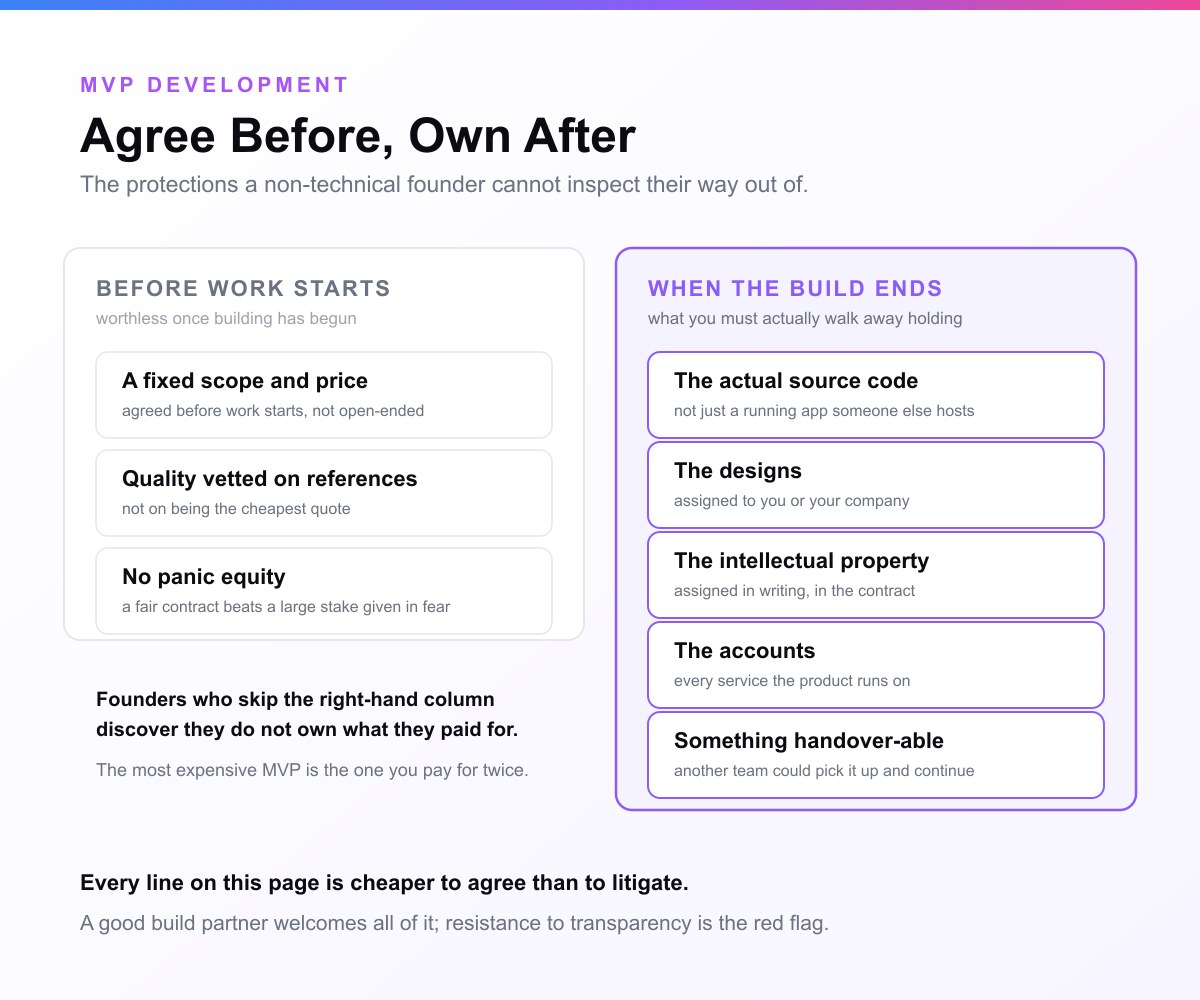
A good build partner will welcome all of this, transparency is a sign of quality, not distrust.
| Risk | Protection |
|---|---|
| Losing code ownership | Contract assigns all code, designs, and IP to you or your company |
| Unmaintainable "spaghetti code" | Vet for quality and references, not just price |
| Runaway costs | A fixed, defined scope and price agreed before work starts |
| Giving away too much equity out of fear | A hired build or fair contract instead of panic-equity |
| A build only the original developer understands | Insist on something another team could pick up and continue |
Common mistakes non-technical founders make
- Waiting for a technical co-founder to start. The single most common way to stall. Validate now with a faster path.
- Trying to learn to code first. Months better spent on customers and validation.
- Choosing the cheapest developer. Leads to a rebuild, the most expensive outcome of all.
- No clear spec or scope. Vagueness causes the disputes, delays, and cost overruns non-technical founders fear.
- Not securing code ownership. Paying for a product you do not legally own or cannot access.
- Over-building before validating. Being non-technical does not change the rule: ship the one core flow and learn first.
Build your MVP with us, no coding required on your side
You do not need to code, and you do not need a technical co-founder, to get a real, validated MVP. You need the right path and a team that runs the build for you, transparently.
That is exactly what we do at MVP Development for non-technical founders. We translate your idea into a clear scope, build a funding-ready MVP in 3 to 4 weeks by senior engineers, and hand you production-grade code that you fully own, on a fixed quote you approve before we start. You stay the product owner, no engineering required, while we handle the building.
Explore how to hire MVP developers, or if you want to validate the cheapest way first, the no-code MVP guide.
Have an idea but can't build it yourself? Explain your idea in plain words and we will carry every technical decision from there.
Related guides
- How AI recommends MVP companies: what ChatGPT and AI Overviews actually pull from when someone asks who should build their MVP
- No-code MVP: building it yourself, visually
- MVP outsourcing: hiring an external team to build it
- MVP scope: writing the clear spec your build needs
- How to build an MVP: the full process, end to end
Frequently asked questions
Can a non-technical founder build an MVP?
Yes. You do not need to write code yourself to get an MVP built. A non-technical founder has four realistic paths, building it visually with no-code tools, using AI-assisted development, hiring a team or agency, or bringing on a technical co-founder, and most founders can validate their idea with one of the first three without a co-founder at all. Your job is not the engineering; it is choosing the right path, defining the one core flow clearly, managing the build, and validating with real users. Those are founder skills, not developer skills, and they are entirely learnable.
Do I need a technical co-founder to build an MVP?
No, and waiting for one is the most common way non-technical founders stall. A technical co-founder is valuable for a deeply technical, long-term company, but finding the right one is slow and costs significant equity (we break down when you actually need a technical co-founder in a separate guide). For validating an idea, you can almost always move faster with a no-code build, an AI-assisted draft (reviewed by an engineer), or a hired team. A strong technical co-founder is also far easier to attract once you have a proven idea, so validating first with another path often makes recruiting one easier later, not harder.
How do I build an MVP without coding?
Pick the path that fits your product and budget: build it yourself with no-code tools if your logic is standard and your budget is tight; use AI-assisted tools for a fast first draft (with an engineer to harden it); or hire an agency or developers for a custom, production-grade build. Then manage it like a product owner, write a clear spec of the one core flow, insist on small visible milestones, judge progress by working software, and protect yourself by securing code ownership and a fixed scope. The building does not require you to code; the deciding and managing do require founder discipline.
How do I manage developers if I'm not technical?
You manage with the what and the why, not the how. Write an unambiguous description of the core flow (no technical language needed), break the build into small milestones you can see and test, and judge progress by working software you can actually click, not by status percentages. Communicate priorities in product terms and let the builders own the implementation. Protect yourself by agreeing a fixed scope and price up front and ensuring your contract gives you full ownership of the code and IP. A good build partner welcomes this structure; resistance to transparency is a red flag.
Should a non-technical founder learn to code first?
No. Learning enough to build a real product takes months, time better spent talking to customers and validating the idea. Coding is a skill you can hire or generate; understanding your customer and your core flow is not. If you enjoy coding and want to learn for its own sake, that's a fine hobby, but treating it as a prerequisite to starting is the single most common way non-technical founders stall.
Can I use AI tools like ChatGPT or Claude to build my MVP myself?
You can generate a working first draft this way, and it's dramatically faster than it used to be, but treat the output as a draft, not a shippable product. AI-generated code needs a real engineer to review it for security, data handling, and the parts that only matter once real users and real money are involved. See vibe coding an MVP for the honest limits of this path, it's a legitimate way to move fast, not a way to skip engineering entirely.
What's the biggest risk for non-technical founders building an MVP?
Not being able to inspect the work yourself, which makes you exposed to a few specific failure modes: losing ownership of your own code and IP, paying for unmaintainable "spaghetti code" that has to be rebuilt, and open-ended scope that lets budgets balloon. All three are avoidable with a fixed, defined scope, a contract that assigns you the code and IP outright, and vetting a partner on quality and references, not just price.
How do I know if my developer or agency is doing good work if I can't read code?
Judge by working software, not status updates or code you can't evaluate. Insist on small, visible milestones you can personally click and test, a working sign-up flow is a deliverable, "90% done" is not. A partner who resists breaking work into testable chunks, or who can't explain progress in product terms you understand, is a warning sign regardless of how good their code actually is.
How much does it cost for a non-technical founder to build an MVP?
The same range as any MVP, being non-technical doesn't change the price, it changes how carefully you need to manage the process. See our full MVP cost guide for the bands by complexity. What does change your cost risk specifically is scope creep and vague specs, both of which a non-technical founder is more exposed to without a clear, fixed-price agreement up front.
Is a technical co-founder better than hiring a development agency?
It depends on what you're optimizing for, not which is objectively better. A technical co-founder makes sense for a deeply technical, long-term company where you want a committed builder-owner, but finding the right person is slow and costs significant equity. Hiring an agency is faster to start, costs money instead of equity, and produces owned, production-grade code without the search. Most founders should validate with a hired build or no-code first, then decide whether a technical co-founder is worth the search once the idea is proven.
Sources & references
- Y Combinator Library: startup advice for first-time and non-technical founders
- Eric Ries, The Lean Startup: validating an idea before building in full
- Atlassian, Minimum Viable Product: scoping the MVP
The 3 to 4 week figure reflects MVP Development delivery data for tightly scoped builds.


