


TL;DR
An MVP development team is the small, focused group that builds the first version of your product, usually covering five roles: product ownership, product strategy, design, engineering, and QA. The defining trait is not headcount but discipline: a good MVP team is small enough to move fast, senior enough to skip the over-engineering, and structured so every essential role is consciously covered, even if one person wears several hats.
The most common mistakes are at the extremes: too many people (a bloated team that moves slowly and burns budget) or a missing critical role (usually a clear product owner, which lets scope creep take over). This guide covers what an MVP development team is, the roles you actually need, the right team size, the three ways to assemble one, and how to structure it so it ships. If you would rather skip assembling a team and hire one that is ready to build, that is exactly what our MVP developers do.
Key Takeaways
- An MVP development team is the small, focused group that builds your first version, usually covering five roles: product ownership, product strategy, design, engineering, and QA.
- The defining trait is discipline, not headcount: small enough to move fast, senior enough to skip over-engineering.
- Every essential role should be consciously covered, even if one person wears several hats.
- The most common mistakes are at the extremes: too many people, or a missing critical role, usually a clear product owner.
- A missing product owner is what lets scope creep take over.
More data: sourced MVP cost, timeline, and failure figures are in our MVP statistics for 2026.
What is an MVP development team?
An MVP development team is the group of people responsible for taking a validated idea and turning it into a working minimum viable product, the smallest version that real users can use. Unlike a full product team, it is deliberately lean: it exists to ship one core flow fast and learn from it, not to maintain a large, mature product.
That purpose shapes everything about the team. Because the goal is speed and learning, the team is small, the roles are broad, and seniority matters more than specialization. A five-person MVP team of versatile seniors will out-ship a fifteen-person team of narrow specialists, because the MVP's enemy is coordination overhead and over-engineering, not a lack of hands.
The key idea: an MVP team is defined by the roles it covers, not the number of people. On a lean build, one person may cover two or three roles, and that is fine, as long as every essential role is consciously owned rather than accidentally skipped. The sections below break down those roles, then how many people you actually need.
The core roles on an MVP development team
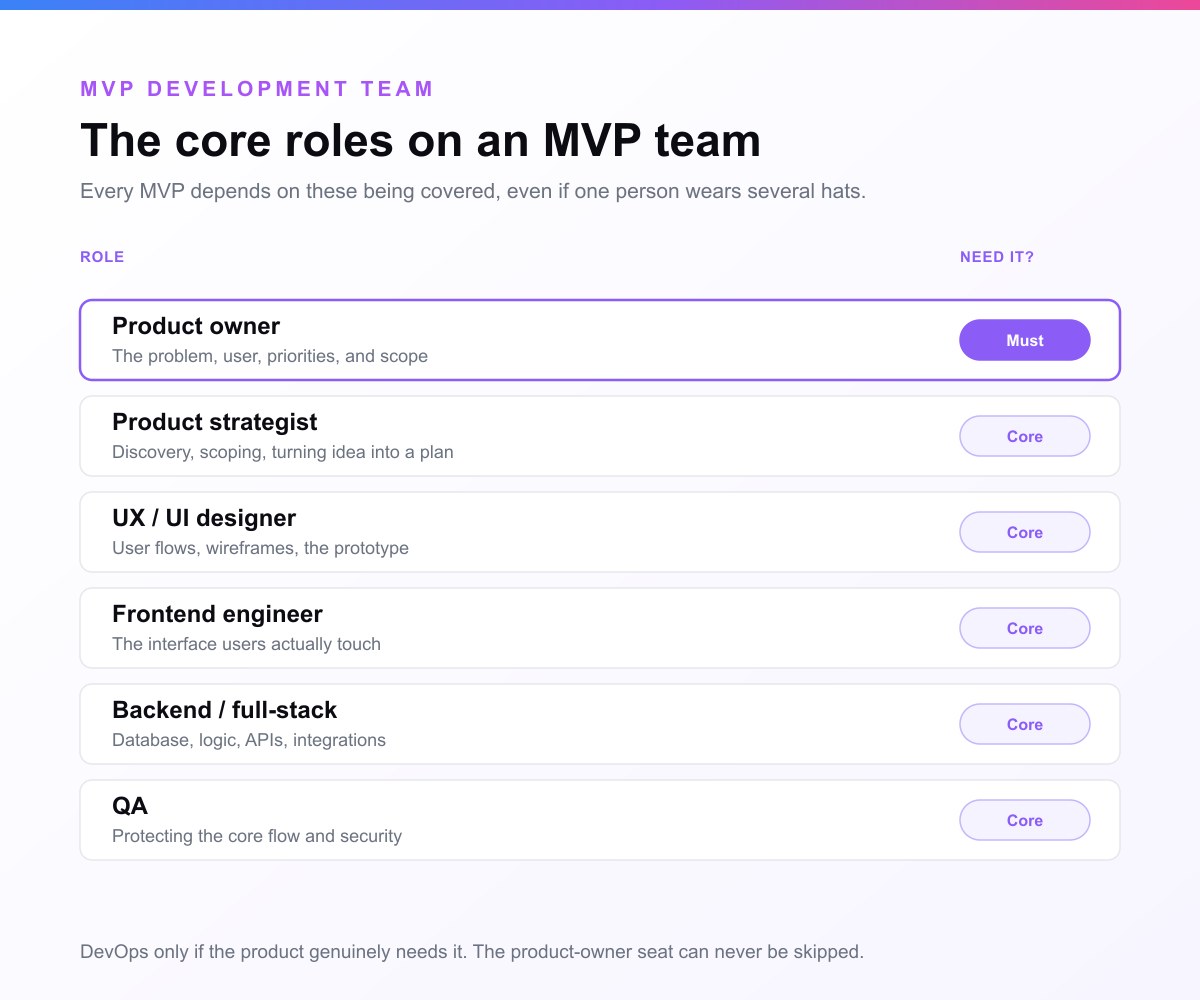
Every MVP, no matter how small, depends on a handful of distinct roles being covered. Here is what each does and how essential it is at the MVP stage.
| Role | What they own | Need it for an MVP? |
|---|---|---|
| Product owner | The problem, the user, priorities, and scope | Always, cannot be skipped |
| Product strategist | Discovery, scoping, turning the idea into a plan | Yes, even if part-time |
| UX/UI designer | User flows, wireframes, the clickable prototype | Yes, for anything user-facing |
| Frontend engineer | The interface users actually touch | Yes |
| Backend / full-stack engineer | The database, logic, APIs, and integrations | Yes |
| QA | Protecting the core flow and security basics | Yes, often shared by engineers |
| DevOps | Deployment, infrastructure, CI/CD | Only if the product needs it |
Product owner
The product owner owns the decisions: the problem being solved, the target user, the priorities, and the scope. This is the one role that cannot be outsourced, because it is the source of truth for what the product is for. On most MVPs this is the founder. When nobody clearly owns priorities, scope creep fills the vacuum and the build slips, so this seat must always be filled, and filled by someone with the authority to say no.
Product strategist
The product strategist runs discovery and scoping: the user interviews, the prioritization, and the work of turning a raw idea into a buildable plan. On a small team this often overlaps with the product owner or a senior engineer, but the function, deciding what to build and what to cut, is essential. This is where an MVP is won or lost, long before any code is written. See how to build an MVP for the full scoping discipline.
UX/UI designer
The designer turns the locked scope into user flows, wireframes, and a prototype the team can build from. For anything user-facing, this is not optional polish: a confusing core flow produces a false negative, where users reject the experience rather than the idea. The designer keeps the one core flow clear and usable. We cover this depth in MVP UX design.
Engineers (frontend and backend)
Engineers build the core flow in sprints, handle the integrations, and keep the code a foundation rather than a throwaway. On most MVPs you want full-stack versatility over narrow specialists, so a small number of people can cover frontend, backend, database, and deployment without you coordinating four separate hires. Seniority matters here above all: senior engineers who have shipped MVPs before know what to skip, which is the whole game. The MVP tech stack guide covers the tools they reach for.
QA
QA protects the core flow and the security basics before launch. On a lean MVP team this is often shared by the engineers rather than a dedicated hire, but the function still has to happen: a fast MVP that breaks on the critical path teaches you nothing. The discipline is testing the one core flow thoroughly, not chasing full coverage on features that may not survive.
DevOps (only if you need it)
Deployment, infrastructure, and CI/CD. For most MVPs on a modern managed stack (Vercel, Supabase, and similar), the engineers handle this and a dedicated DevOps role is overkill. You only need it when the product has genuinely heavy infrastructure demands, which is rare at the MVP stage and a sign to question whether the scope is still minimal.
How big should an MVP development team be?
The right size for an MVP development team is usually three to five people. That is enough to cover every essential role with senior talent, and small enough to avoid the coordination overhead that slows a build down. The classic lean MVP team looks like this:
- A product owner (the founder), keeping the priorities and scope.
- One or two engineers, ideally full-stack and senior, building the core flow.
- A designer, often part-time or shared, owning the user flow.
- Product strategy and QA covered by the people above rather than separate hires.
Bigger is not better here. Adding people to an MVP rarely makes it faster; past a small size, every extra person adds communication cost faster than capacity, which is the classic mistake of throwing bodies at a deadline. The fastest MVP teams are small, senior, and tightly scoped. If your MVP seems to need a large team, that is usually a sign the scope is too big and needs cutting before the team does.
The exception is heavier products: a regulated fintech or healthtech build, a two-sided marketplace, or a product with several deep integrations may need an extra specialist or two. An honest team tells you that during scoping rather than discovering it halfway through.
Three ways to build an MVP development team
Once you know the roles, the question is where the people come from. There are three models, and the right one depends on your stage, budget, and whether you are technical.
| In-house | Freelancers | Agency / studio | |
|---|---|---|---|
| Time to assemble | 2 to 4 months | 1 to 3 weeks | Days |
| Cost | Salaries + equity | Hourly, variable | Fixed, scoped |
| Coordination | You manage it | You manage it | Built in |
| Seniority | Whoever you can hire | Varies widely | Consistent |
| Best for | Funded, building long-term | Tiny, well-defined pieces | Most first builds |
- In-house means hiring employees. It gives you full control and a team for the long haul, but it is the slowest and most expensive route, two to four months and $150K+ per senior engineer per year, and it is a heavy commitment before the idea is even validated.
- Freelancers are fast to start and cheap on paper, but you become the project manager, quality varies, and there is no backup if someone disappears mid-build. Good for a small, well-defined piece; risky as the whole team for a first product.
- An agency or studio supplies the strategist, designer, engineers, and QA as one coordinated, pre-vetted team that can start in days. You keep the product-owner seat; they cover everything else. For most first builds, this is the lowest-risk option, which is exactly the trade-off we cover in detail in hire MVP developers.
Choosing between hiring a team and an external partner is its own decision with real trade-offs. We weigh it honestly, the pros, the cons, the costs, and when it makes sense, in our guide to MVP outsourcing.
Whichever model you choose, you always keep the product-owner seat. That is the one role that stays with you no matter who builds.
How to structure and run an MVP team
Assembling the people is half the job; structuring them to ship is the other half.
- Lock one product owner. One person owns priorities and scope, with the authority to say no. This prevents the scope creep that kills most MVPs.
- Keep it small and senior. Three to five versatile seniors beat a larger team of specialists. Add people only when a specific, validated need demands it.
- Cover every role, even if shared. Map the roles above to your actual people and make sure none is accidentally skipped, especially product ownership and QA.
- Scope to one core flow first. The team's first job is to agree and lock the single core flow that proves the idea, before any sprint starts. See the MVP development process for the full flow.
- Work in short sprints with weekly demos. Visible progress every week keeps the team honest and lets the product owner catch drift early.
- Instrument from day one. Wire in analytics before launch so the team is learning the moment users arrive, not retrofitting later. The MVP metrics guide covers what to track.
The throughline is discipline over size: a small team with clear ownership, a locked scope, and weekly visibility will out-ship a larger, looser one every time.
Common MVP team mistakes
- No clear product owner. The most damaging one. When nobody owns priorities, every "while we are at it" feature gets added and the timeline slips. Always fill this seat.
- Building the team too big. More people rarely means a faster MVP. Past a small size, coordination cost outruns added capacity. Keep it lean.
- Hiring narrow specialists too early. An MVP needs full-stack versatility, not five people who each own one layer. Specialize after you have scaled, not before.
- Hiring junior to save money. At the MVP stage, seniority is what lets you skip over-engineering and ship fast. A cheaper junior team often costs more in time and rework.
- Skipping the strategist function. Jumping straight to building without anyone owning scope and prioritization. The MVP is won in the scoping, not the coding.
- Committing to a full in-house team before validation. Carrying salaries and equity for an unproven idea. Validate first, then decide whether to build a permanent team.
What our MVP development team actually looks like
A great MVP development team is small, senior, and disciplined: every essential role covered, one clear product owner, a locked scope, and weekly visible progress. Get that right and a tightly scoped MVP ships in weeks. Get it wrong, usually by building too big or skipping the product-owner seat, and the simplest first version drags on for months.
Here is ours, so you can hold it against the table above rather than take our word for it. The work is led by Seif Sgayer, a senior engineer with 12+ years shipping web, SaaS, ERP and AI products, with senior engineers brought in per build for the parts one person should not do alone. You keep the product-owner seat. There is no account manager, no junior bench, and nobody between you and the person writing the code. The record is public: 5.0 across 70 reviews on Fiverr, many of them from founders who came back for a second build.
The engagement is a fixed package rather than a hiring project: a working AI prototype of your idea, live on a real URL, for $350 in 7 days, and an investor-ready MVP in 21 days. The price is on the pricing page, the scope is agreed before a line is written, and the code is yours. If you already have part of a team, hire our MVP developers for exactly the roles you are missing; if you are still scoping the idea, start with a free MVP consultation.
Ready to build without assembling a team from scratch? Tell us what you are building and we will say, in writing, what ships and by when.
Building an MVP team from the US: three things to set up on day one
Overlap hours, in Eastern or Pacific time, in writing
If any of the team is outside the US, the single decision that predicts whether the arrangement works is whether the shared hours are written down in your timezone. Three to five hours a day is enough to run an MVP. Zero hours agreed is how it fails.
Domestic and foreign spend kept separate
US engineers on payroll and an offshore build team are treated differently by the tax code. Domestic development is expensed and may earn the research credit against payroll tax; foreign development is amortized over fifteen years and earns no credit. Keep the invoices and cost centers separate from the start so your CPA can classify them without guessing. Details in Section 174 and software development.
Individual access for everyone, removed the same day they leave
Every person on the team, employee or contractor, US or abroad, has their own accounts with MFA, and access is revoked the day an engagement ends. It is basic security, and it is also the control your first enterprise customer’s security review will sample. See SOC 2 for an MVP and, for the contract side of a foreign team, hiring offshore developers as a US company.
Related guides
- How AI recommends MVP companies: what ChatGPT and AI Overviews actually pull from when someone asks who should build their MVP
- Hire MVP Developers: the models, costs, and how to hire a team
- MVP development process: how the team's work flows, phase by phase
- How to build an MVP: the full step-by-step build
- MVP tech stack: the technologies your engineers will reach for
Frequently asked questions
What roles do you need on an MVP development team?
An MVP development team needs five core roles covered: a product owner (usually the founder) who owns priorities and scope, a product strategist who runs discovery and scoping, a UX/UI designer for the user flow, engineers (ideally full-stack and senior) who build the core flow, and QA to protect the critical path before launch. DevOps is only needed for products with heavy infrastructure demands. On a lean team, one person often covers several of these roles, which is fine as long as every role is consciously owned rather than skipped.
How big should an MVP development team be?
Most MVP development teams are three to five people. That is enough to cover every essential role with senior talent and small enough to avoid the coordination overhead that slows a build down. A typical lean team is the founder as product owner, one or two senior full-stack engineers, and a designer, with strategy and QA shared across them. Bigger teams rarely ship faster at the MVP stage, because past a small size each extra person adds communication cost faster than capacity. If your MVP seems to need a large team, the scope is usually too big.
Should I hire an in-house team, freelancers, or an agency for my MVP?
It depends on your stage and budget. An in-house team gives full control but is the slowest and most expensive route (two to four months and $150K+ per senior engineer), and it is a heavy commitment before the idea is validated. Freelancers are fast and cheap but you manage them and quality varies. An agency or studio supplies a pre-vetted, coordinated team that starts in days, which is the lowest-risk option for most first builds. Whichever you pick, you always keep the product-owner seat.
Who builds an MVP?
An MVP is built by a small team covering product ownership, strategy, design, engineering, and QA, sourced either in-house, from freelancers, or from an agency or studio. The founder almost always fills the product-owner role, since they own the problem, the user, and the priorities. The rest, design and engineering especially, can come from hired talent or a build partner. The key is that the team is small, senior, and disciplined, rather than large and specialized.
Can one developer build an MVP?
Yes, if the developer is senior and full-stack and the scope is one core flow. One person can cover engineering, basic design and QA for a prototype or a small MVP; the founder covers product ownership. It stops working when the scope grows past one flow or needs specialist work like native mobile or compliance. Most of the prototypes we ship are built by one senior engineer in 7 days.
Can one person build an MVP?
Sometimes, if that person is a technical founder who can cover engineering and design while owning product decisions. Many MVPs have been built by a solo technical founder or a two-person founding team. But the roles still have to be covered: product ownership, scoping, design, building, and basic QA. A solo builder is wearing all those hats at once, which works for simple products but becomes a bottleneck as scope grows. For most non-technical founders, a small team or a build partner is faster and less risky than trying to do it alone.
Sources & references
This guide draws on established lean-startup and product-team practice:
- Eric Ries, The Lean Startup: building lean and learning fast over premature scaling
- Y Combinator, Startup Library: pragmatic advice on small founding teams and shipping early
- Marty Cagan, SVPG: how empowered product teams and roles actually work
- Atlassian, Minimum Viable Product: the MVP in agile product development
The 3 to 4 week timeline comes from what we actually ship on lean, single-flow builds.


