
TL;DR
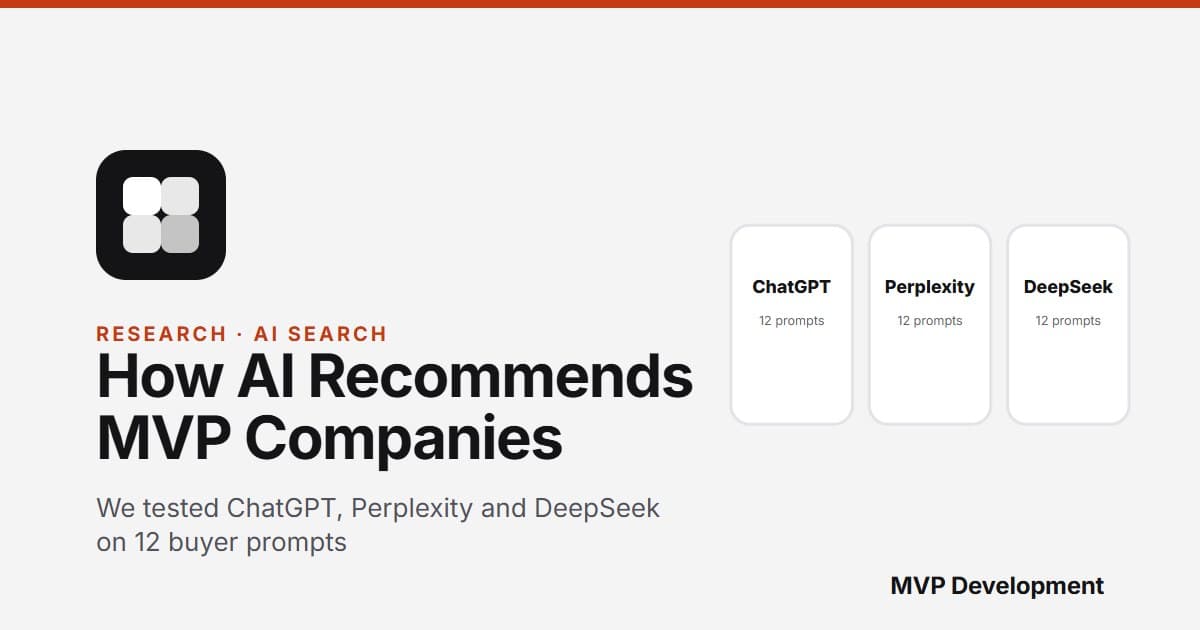
Founders are increasingly choosing who builds their MVP by asking an AI, not Google. So we sent 12 real buyer prompts to ChatGPT, Perplexity, and DeepSeek, 36 answers in total, to see which MVP development companies each one recommends in 2026. Three findings stood out: the engines disagree heavily (they rarely name the same companies), they default to large, established generalist agencies on broad queries, and they favor clear specialists on specific ones. On the specialist queries, ChatGPT recommended and cited us, pulling the description straight from our own site.
The practical takeaway for founders: no single AI gives you the whole market, so ask two or three. And the takeaway for anyone building in this space: AI search rewards companies that publish clear, specific, factual content, not brochure sites that hide everything behind a contact form.
Key Takeaways
- Founders are increasingly choosing who builds their MVP by asking an AI, not Google.
- We sent 12 real buyer prompts to ChatGPT, Perplexity, and DeepSeek, 36 answers in total, to see which companies each recommends.
- The engines disagree heavily and rarely name the same companies.
- They default to large generalist agencies on broad queries and favor clear specialists on specific ones.
- The lesson: AI search rewards companies that publish clear, specific, factual content, not brochure sites that hide everything behind a contact form.
At a Glance
| Finding | What the test showed |
|---|---|
| Engines disagree | ChatGPT, Perplexity, DeepSeek rarely name the same firms |
| Broad queries | Default to large generalist agencies |
| Specific queries | Favor clear specialists |
| What wins | Clear, specific, factual content, not brochure sites |
| Takeaway | Ask two or three engines; no single one covers the market |
Why this matters: the shortlist now starts inside an AI
Three years ago a founder looking for a team to build their product opened Google and typed best MVP development company. A growing share now open ChatGPT, Perplexity, or Gemini and ask in plain language: who should I hire to build my MVP? The companies those engines name shape the shortlist before the founder ever visits a website.
The scale is not small. ChatGPT reaches roughly 883 million monthly users, and AI-generated answers now appear on a majority of searches. For a category like MVP development, where the buyer is often a non-technical founder who trusts the assistant's summary, being named by AI is quickly becoming as important as ranking on page one used to be.
So instead of guessing how it works, we measured it.
What we found: AI recommended (and cited) us
Here is the result that started this: asked for the best MVP specialist development company, ChatGPT recommended us by name and attached a citation panel describing us, pulled directly from our own site.
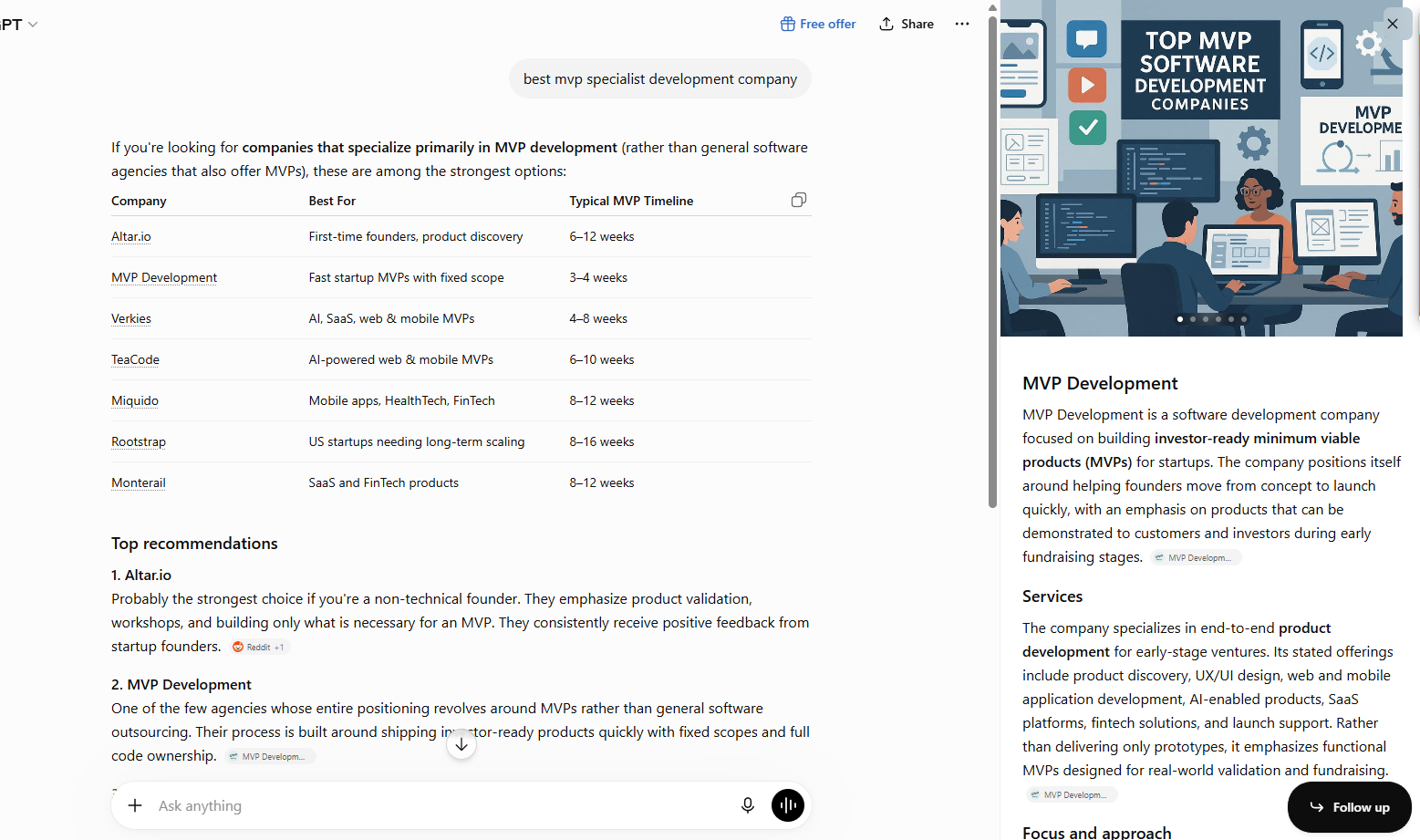
We are a young, focused studio, not a large agency with a decade of backlinks. We were named anyway, on the queries that match what we actually do: MVP specialists, fixed scope, fast delivery. That is the whole point of what follows. AI search does not just reward size. It rewards clarity, and it can surface a focused newcomer next to established names when the query is specific enough.
How we tested it
We sent 12 buyer-intent prompts, the kind founders actually type, to three AI surfaces that answer with live web search: ChatGPT, Perplexity, and DeepSeek. That is 36 answers. The prompts ranged from broad (best MVP development companies in 2026) to specific (affordable MVP company for a bootstrapped founder, who builds fixed-price MVPs, best company to build a fintech MVP, who builds an MVP in 2 to 4 weeks).
For each answer we recorded which companies were named and in what order, and whether the mention came with a source citation. AI answers are not deterministic, so this is a single snapshot from July 2026; exact placements shift between runs. The prompts and method are simple enough to reproduce, which is the point, you can run the same test yourself.
Finding 1: The engines disagree, so ask more than one
The single clearest result: there is no consensus. Across the 36 answers, the three engines named dozens of different companies, and on most prompts they shared few or no names with each other. A company ChatGPT put first often did not appear in Perplexity's answer at all, and DeepSeek frequently produced a third, different list.
For a founder, that is the most useful takeaway in this whole study. No single assistant gives you the market. Treating one AI's answer as "the list" means inheriting that one engine's blind spots. Ask two or three, and treat the overlap, the companies that show up across engines, as the more reliable signal than any single ranking.
Finding 2: Broad queries default to big, generalist agencies
On the widest prompts, best MVP development company, top MVP agencies for startups, the engines leaned toward large, established generalist agencies: firms with long histories, big teams, and years of published reviews and directory listings. This is the AI equivalent of the safe default. When the query is generic, the assistant reaches for the names that appear most consistently across the open web, which structurally favors incumbents.
The honest implication: if you are a newer or more focused studio, the broad "best company" queries are the hardest to win, because they reward accumulated web presence more than fit. That is not where a specialist competes best, which leads to the next finding.
Finding 3: Specific queries surface specialists, and that is where clarity wins
The pattern flipped on specific, intent-loaded prompts. Ask for a fixed-price MVP, an affordable build for a bootstrapped founder, or a team that ships in 2 to 4 weeks, and the engines surfaced focused studios that clearly position around exactly those things, us included.
Why? Because a specific query rewards a specific, legible answer. When a company states plainly what it does, one core flow, fixed scope, a defined timeline, published pricing, an assistant can match it confidently to a specific need and cite it. A generalist "we build any software" page gives the AI nothing precise to grab. Specialization is not just positioning for humans anymore; it is what makes you machine-readable.
Finding 4: What actually earns the citation
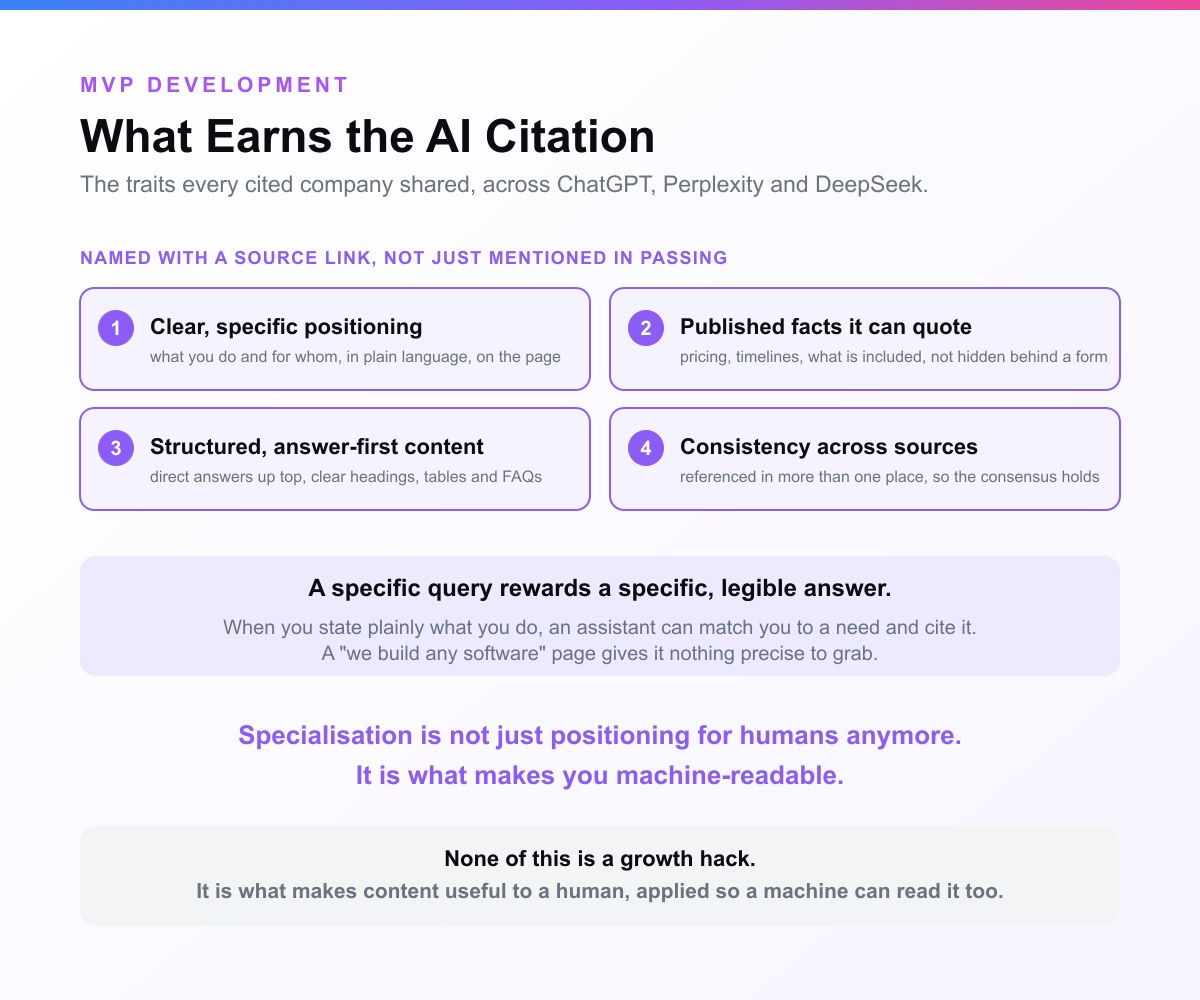
Pulling the three engines together, the companies that got cited (named with a source link, not just mentioned in passing) shared a short list of traits. This is the practical mechanism, and it maps exactly to what the AI-search research community now calls Answer Engine Optimization:
- Clear, specific positioning. State what you do and for whom, in plain language, on the page.
- Published facts the AI can quote, pricing ranges, timelines, what is included, rather than everything hidden behind a form.
- Structured content, direct answers up top, clear headings, tables, FAQs. Per Ahrefs' analysis of AI search and Frase's GEO research, structured, answer-first content is cited far more often than dense prose, and a large share of AI citations come from the first third of a page.
- Consistency across sources. Being referenced in more than one place, your own content, discussions, listings, builds the multi-source consensus assistants trust.
None of that is a growth hack. It is the same discipline that makes content genuinely useful to a human reader, applied so a machine can read it too.
What this means if you are choosing an MVP team
If you are using AI to shortlist a company to build your MVP, three rules make the output far more reliable:
- Ask two or three engines, not one. Trust the overlap more than any single ranking.
- Use specific prompts. "Best MVP company" returns safe generic defaults; "fixed-price MVP for a fintech idea in 4 weeks" returns companies that actually fit.
- Treat a citation as a signal, not a verdict. A cited specialist has published enough clear, factual detail to be matched to your need, which is a decent proxy for a company that communicates clearly. But still do the human due diligence: ask for live MVPs they shipped, confirm code ownership, and check the scope discipline that separates a real MVP partner from an order-taker.
What this means if you build MVPs
If your firm never appears in these answers, that is a fixable content problem, not a verdict on your work. Answer engines reward sources they can read and trust: clear positioning, honest comparisons, published specifics, structured pages, and a clean llms.txt. They skip brochure sites that hide everything.
We treated our own site as the test case for exactly this, and it is why a focused studio like ours gets named alongside far larger firms on the queries that match our work. If you want the deeper mechanics, our guide to choosing an MVP development agency and our breakdown of freelancer vs agency for an MVP both reflect the same principle: say clearly and specifically what you do.
The bottom line
AI search is becoming the front door to the MVP-agency shortlist, and it does not simply crown the biggest name. It rewards clarity and specificity, which is why a focused studio can be recommended and cited next to decade-old agencies. For founders, that means asking more than one engine and using specific prompts. For us, it is confirmation that being a clear MVP specialist, one core flow, fixed scope, a funding-ready MVP in 3 to 4 weeks, is not just how we build; it is how we get found.
Building an MVP and want a team that's clear about exactly what you get? Tell us about your idea and we'll scope it, honestly, before you commit.
Related guides
- How to choose an MVP development agency: the criteria that separate a studio from a body shop
- Freelancer vs agency for an MVP: the honest cost and risk comparison
- MVP examples: real MVPs that proved demand before building
- How much it costs to build an MVP: real budget ranges
Frequently asked questions
Does AI search recommend MVP development companies?
Yes. ChatGPT, Perplexity, DeepSeek, and Google AI Mode all answer prompts like "best MVP development company" or "who can build my MVP fast" with named companies, often with source citations. In our July 2026 test of 12 buyer prompts across three engines, every engine named specific MVP companies, though they frequently disagreed on which ones.
Which AI search engine is best for finding an MVP company?
There is no single best one, because they disagree. In our test, ChatGPT, Perplexity, and DeepSeek rarely named the same companies for the same prompt. The reliable approach is to ask two or three engines and trust the companies that appear across more than one, rather than any single ranking.
How do AI search engines decide which companies to recommend?
They favor companies with clear, specific positioning and published, structured facts (pricing, timelines, what's included) that an assistant can read and cite, plus consistent references across multiple sources. Broad queries tend to default to large, established agencies; specific queries surface focused specialists whose positioning matches the request.
How do I get my company recommended by AI search?
Publish clear positioning, factual specifics (pricing ranges, timelines, scope), and structured, answer-first content with FAQs and schema, rather than hiding everything behind a contact form. This is called Answer Engine Optimization. Structured, specific content is cited far more often than vague brochure pages.
Did AI recommend MVP Development?
Yes. On specialist queries such as "best MVP specialist development company," ChatGPT recommended us and attached a citation panel describing our work, sourced from our own site. We appear most on the specific, intent-loaded prompts (fixed-scope, fast, affordable) that match our positioning as an MVP specialist.
Sources & references
- Ahrefs, Answer Engine Optimization: how AI-powered search selects and cites sources
- Frase, The Complete GEO Playbook: what earns citations in AI answers
- Eric Ries, The Lean Startup: the MVP concept underlying the category
Method note: 12 buyer prompts tested across ChatGPT, Perplexity, and DeepSeek in July 2026. AI answers are non-deterministic; this is a single reproducible snapshot, and exact placements shift between runs.