


TL;DR
Rebuild your MVP only when the idea is already validated and the current codebase actively blocks the business, through unmanageable technical debt, a hard scaling ceiling, a real security risk, or a pivot the architecture cannot support. If you are still hunting for product-market fit, or the problems are cosmetic, you iterate instead. The expensive mistake is rewriting from scratch to chase a "clean" codebase while real users and revenue wait months for features. Most healthy MVPs never need a from-scratch rebuild; they get re-architected in place, one bottleneck at a time. When a true rebuild is warranted, scope it to the core flow your power users actually rely on, migrate progressively rather than in one big-bang launch, and expect three to six months.
Key Takeaways
- Rebuild only after the idea is validated; if you are still proving demand, iterate, do not rewrite.
- Four signals justify a rebuild: unmanageable technical debt, a hard scaling ceiling, a real security gap, or a pivot the architecture cannot support.
- A full rewrite is rarely the first move; most MVPs scale by re-architecting the bottleneck, not replacing everything.
- If you rebuild, cut ruthlessly to the core flow and migrate progressively, never in one big-bang release.
- Budget three to six months for a real rebuild, and keep shipping to users during it.
The honest default: most "we need to rebuild" moments are really "we need to fix one part." Reach for a full rewrite last, not first.
What "rebuild" actually means
Founders use "rebuild" to mean four very different things, and picking the wrong one is where the money gets wasted. Before you decide, name what you are actually considering:
- Iterate. Small, continuous changes to a working product: new features, flow tweaks, bug fixes, on the existing foundation. This is the default post-launch mode, covered in MVP iteration.
- Refactor. Cleaning up code without changing behaviour, so the next feature is faster to build. Invisible to users, low risk.
- Re-architect. Replacing specific parts that bottleneck (a database, a service, an integration) while the rest keeps running. This is how most products scale an MVP without stopping.
- Rebuild (full rewrite). Starting a new codebase, a version 2, and migrating users to it. Slow, risky, and the subject of this guide.
The rest of this article is about that last one: when a full rebuild is the right call, when it is a trap, and how to run it if you commit.
The one prerequisite: only rebuild a validated idea
The single most important rule: a rebuild is a scaling decision, not a validation decision. You rebuild because a product people already want is being held back by how it was built. You do not rebuild to find out whether people want it.
If you are still proving demand, a rewrite is almost always wrong. The whole point of an MVP is to learn cheaply, and a from-scratch v2 is the opposite of cheap. Founders who rebuild before product-market fit usually do it to avoid the harder, scarier work of talking to users and changing the product, polishing the engine of a car nobody has agreed to buy.
So the first question is not "is the code messy?" It is "have real users, strangers, not friends, shown they want this and come back?" If the answer is no, close this guide and go back to validation and iteration. If the answer is yes, read on.
Signs you should rebuild
When the idea is validated, four signals, especially in combination, justify a full rebuild. One alone is rarely enough; two or more is a strong case.
| Signal | What it looks like | Why a rebuild helps |
|---|---|---|
| Unmanageable technical debt | Every new feature takes weeks instead of days; one change breaks three other things | A clean foundation restores the velocity that debt has taxed away |
| A hard scaling ceiling | The database or platform buckles past a user threshold, and the limit is structural, not a config fix | Re-founding on scalable architecture removes the ceiling |
| A real security gap | The product handles payments or personal data but lacks the structure production security requires | A rebuild bakes in the security the original never had |
| A pivot the architecture cannot support | You are changing the core user or workflow, and the old data model simply does not fit | A new architecture matches the product you are actually building now |
The common thread: the codebase is actively costing the business, in shipping speed, reliability, trust, or the ability to build what comes next. Note that "a beginner or a rushed contractor wrote it" only matters if it produces one of these symptoms. Ugly code that ships features fine is not a reason to rebuild; the difference between the safe and dangerous kinds is the whole subject of MVP technical debt.
A special case worth naming: MVPs assembled on a no-code platform or built as a genuine throwaway prototype hit these ceilings sooner, because extending them eventually costs more than replacing them. That is the honest trade-off of building fast on rented foundations, and it is why building on production-grade, owned code from the start is what keeps a rebuild off the table for longer.
Signs you should iterate instead
Just as important is knowing when a rebuild is the wrong instinct. Keep the current codebase and iterate if:
- You are still validating. Demand is not yet proven, so the priority is learning, not re-engineering.
- The problems are cosmetic. The issues are UI polish, a confusing flow, or missing features, all fixable on the existing foundation.
- The core is stable and used. Customers are sticking around and using the main features; the engine works, it just needs tuning.
- The bottleneck is one part. If a single service or query is the problem, re-architect that piece, do not throw away the whole system.
Rewriting in these situations trades months of runway for a "cleaner" codebase users will never see, and it reintroduces bugs the original had already shaken out. That risk is real: a working product carries thousands of small fixes and edge cases you will silently lose in a rewrite.
Rebuild vs iterate: the decision
Strip it to one test: does the current codebase block the business, and is the idea already validated? Those two questions form a simple matrix, and your answer lands you in one of four squares:
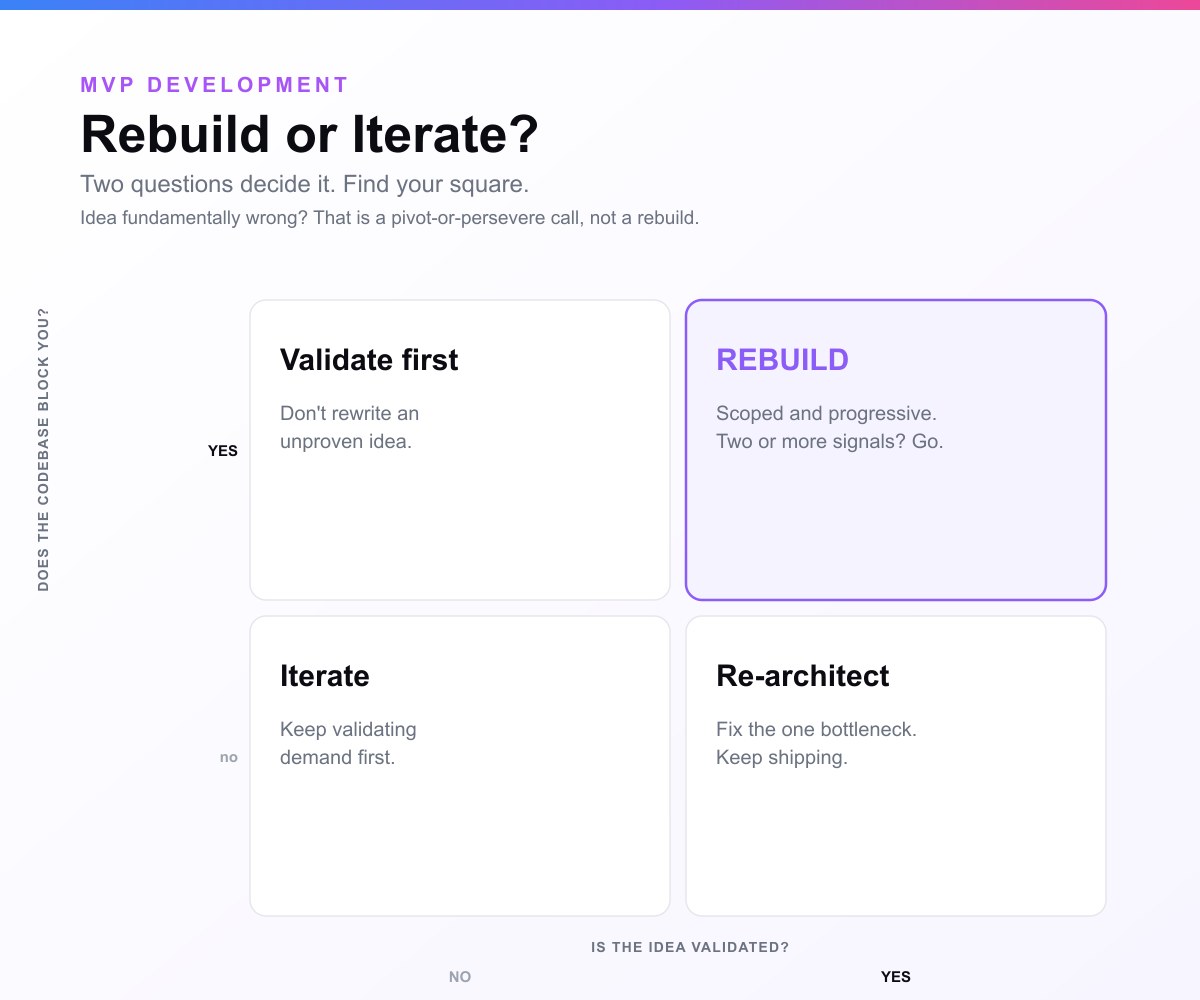
- Validated + actively blocked (two or more signals above): rebuild, deliberately and scoped.
- Validated + only strained in one place: re-architect that place, keep shipping.
- Not yet validated, whatever the code looks like: iterate and keep validating. A rebuild here is procrastination with a commit history.
- Not validated + fundamentally wrong idea: this is a pivot-or-persevere question, not a rebuild one. Change the product, not the codebase.
If you land on "rebuild," treat it as the serious, months-long investment it is, and plan it properly.
How to plan a rebuild without killing momentum
A rebuild fails when it becomes a quiet, feature-frozen "big bang" that ships in six months and breaks every habit your users had. Avoid that with four disciplines:
- Audit first. Document what genuinely works and the exact bottlenecks causing pain. You are keeping the validated lessons, not the code. Know precisely what you are solving before you start.
- Scope ruthlessly. Do not rebuild every feature. Rebuild the core flow your power users depend on, the same scope discipline that built the MVP in the first place. Everything else is a v2.1 list.
- Migrate progressively. Ship the new system in modules behind the scenes, moving traffic over piece by piece, rather than flipping a switch. Martin Fowler's strangler fig pattern is the canonical approach: the new system grows around the old until the old can be retired, with no risky all-at-once cutover.
- Keep shipping. Your users do not care that you are rebuilding. Keep fixing and improving the live product during the rebuild so you never go dark on the people who validated you.
Expect three to six months for a real rebuild, but you should be shipping improvements to users within the first, not disappearing until launch day.
Common rebuild mistakes
- Rewriting to escape, not to solve. Rebuilding because the code is unfamiliar or "not how I would do it," rather than because it blocks the business. Joel Spolsky's classic warning that a full rewrite is the single worst strategic mistake applies: you throw away years of embedded knowledge for a blank page.
- Rebuilding before fit. Polishing the engine before anyone has agreed to buy the car. Validate first.
- Rebuilding everything. Recreating every legacy feature instead of the core flow, which turns a three-month job into a year.
- The big-bang launch. A single high-risk cutover that breaks user habits and hides months of untested integration until the worst possible moment.
- No measurement afterward. Rebuilding, then not instrumenting the new version to confirm it actually fixed the bottleneck.
Build your MVP so you rarely have to rebuild it
The cheapest rebuild is the one you never need. Most from-scratch rewrites trace back to an MVP built as a disposable hack on a platform it would outgrow, which felt fast at the time and expensive a year later.
That is exactly what we build against at MVP Development. We ship MVPs on production-grade, fully-owned code, scoped to the one validated flow, so the product can be extended and hardened as you grow instead of thrown away:
- We build MVPs that are made to extend, not throwaway prototypes you rebuild after traction.
- We scale validated MVPs by re-architecting the parts that bottleneck, keeping the foundation and the velocity.
- You own production-grade code from day one, which is what keeps a full rewrite off the table for as long as possible.
The honest trade-off is scope, not quality: we build the one validated flow properly, which is what makes it worth keeping.
Facing a rebuild-or-iterate decision? Show us the codebase you are worried about and you will get a straight rebuild-or-refactor verdict.
Related guides
- The iterate side: MVP iteration and how to scale an MVP without a rewrite.
- Getting the foundation right: production-ready MVP and MVP tech stack.
- The decisions around it: pivot or persevere and why MVPs fail.
Frequently asked questions
When should you rebuild an MVP instead of iterating?
Rebuild only when the idea is validated and the codebase actively blocks the business, through unmanageable technical debt, a hard scaling ceiling, a real security gap, or a pivot the architecture cannot support. If you are still proving demand or the problems are cosmetic, iterate on the existing product instead.
Do you have to rebuild an MVP from scratch to scale it?
Usually no. Most MVPs scale by re-architecting the specific parts that bottleneck while keeping the validated foundation running. A full rewrite is only justified when the MVP sits on something with a hard ceiling, like a no-code tool you have outgrown or a throwaway prototype. See how to scale an MVP.
How long does an MVP rebuild take?
Plan for three to six months for a genuine rebuild, depending on scope and complexity. Crucially, you should keep shipping improvements to your live product during that window and migrate users progressively, rather than going dark until a single big-bang launch.
Is messy code a good enough reason to rebuild?
No, not on its own. Messy code only justifies a rebuild if it produces a real symptom: features that take weeks instead of days, frequent breakage, or an inability to build what comes next. Ugly code that ships features reliably is not a reason to rewrite.
What is the biggest risk of rebuilding an MVP?
Losing the thousands of small fixes and edge cases baked into the working product, and freezing features for months while competitors move. That is why a scoped, progressive rebuild beats a from-scratch big-bang rewrite almost every time.
Sources & references
- Martin Fowler, Strangler Fig Application, the canonical progressive-migration pattern.
- Joel Spolsky, Things You Should Never Do, Part I, on the risk of full rewrites.
- Eric Ries, The Lean Startup, on validated learning before scaling.
- Product-Market Fit Survey, on confirming fit before you invest in a v2.


