

How Much Proof Before You Build?
The MVP Evidence Ladder
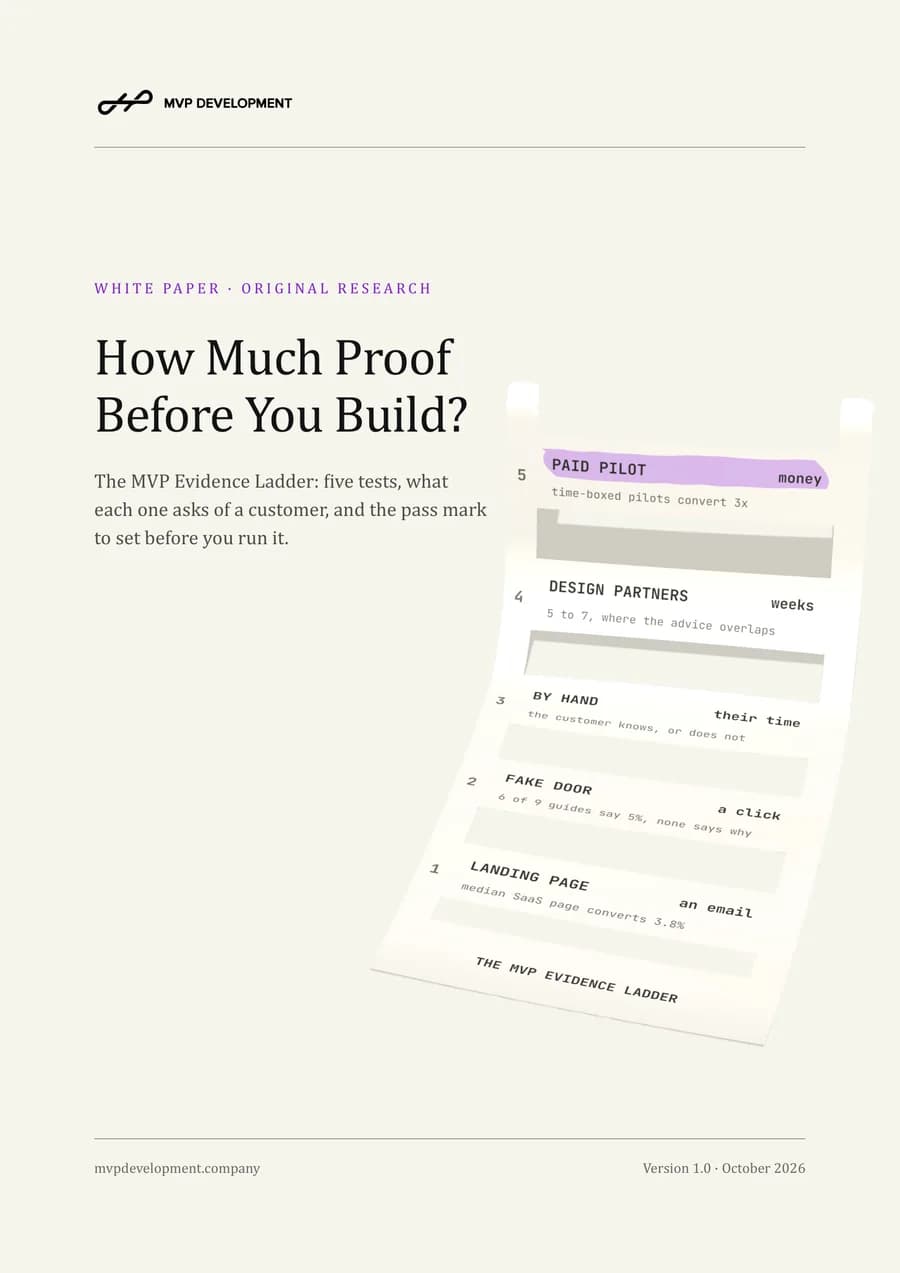
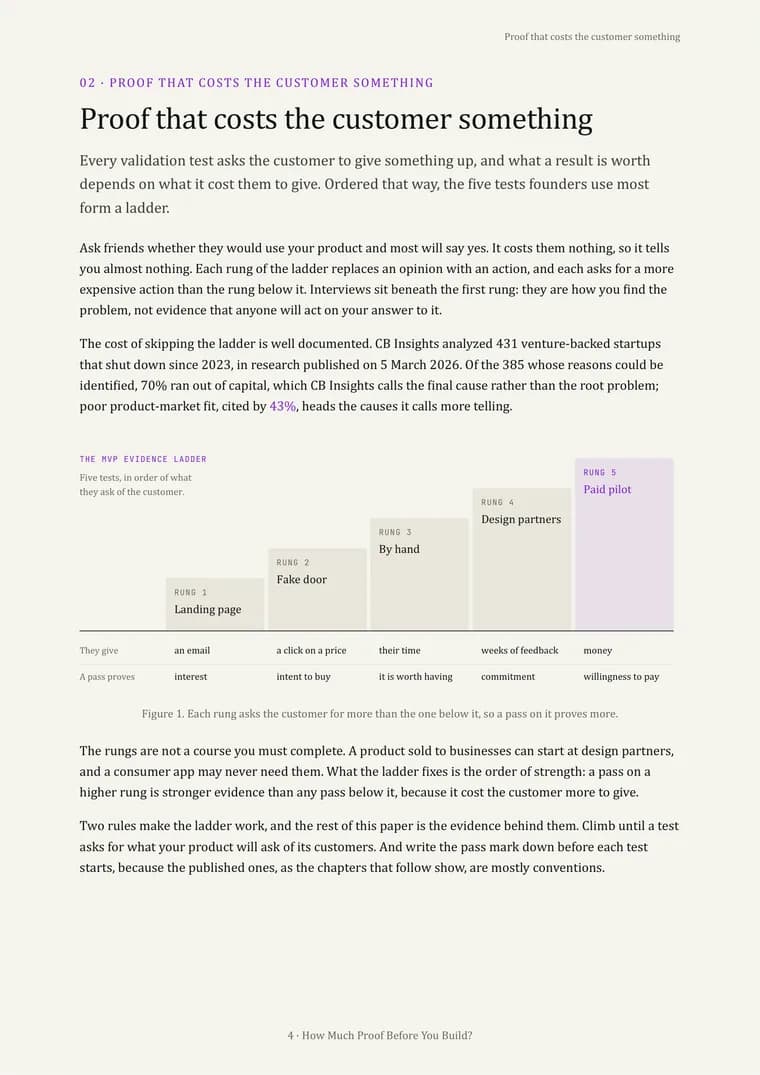
How do you know an idea is worth building? This free report orders the five tests founders use, from a landing page to a paid pilot, by what each asks of a customer, and gives each one the pass marks that hold up, with a worksheet to set yours before you test.
By MVP Development · October 2026 · Findings free to cite below
What you’ll learn
- What signup rate means a landing page has done its job
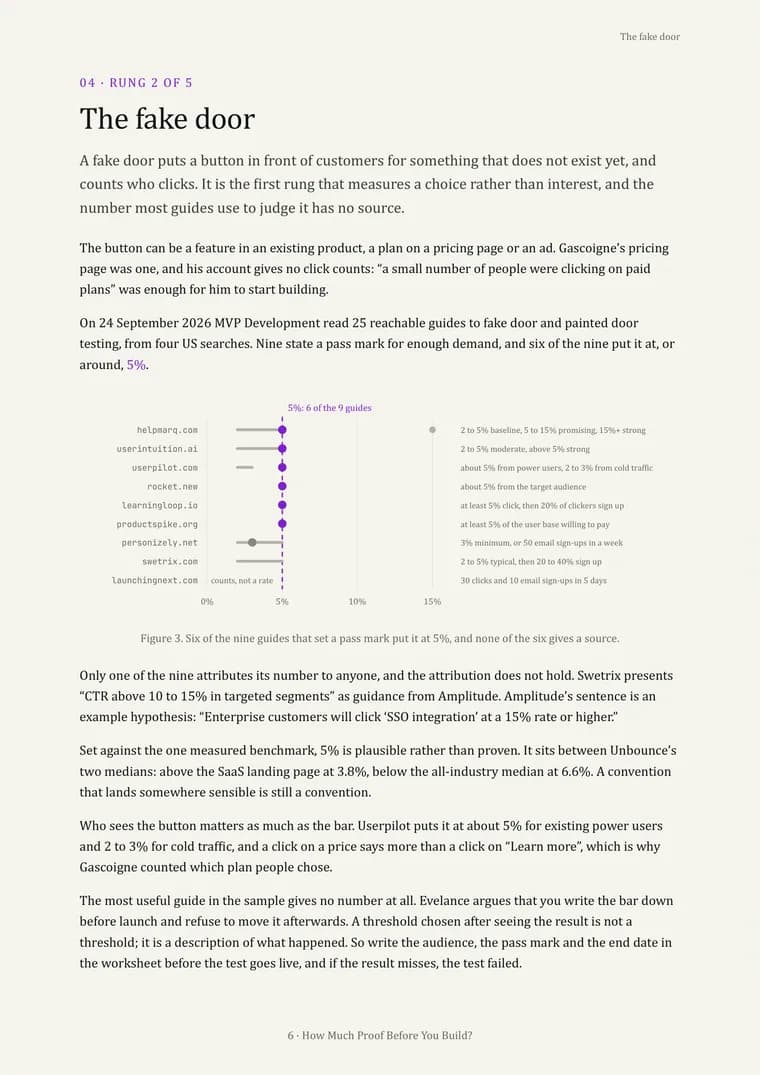
- What a fake door test should score, and why the 5% rule has no source
- What Dropbox, Buffer and Airbnb actually did, checked against the archive
- When to run a concierge MVP and when a Wizard of Oz
- How many design partners to recruit, and for how long
- How to turn a pilot into a paying customer, with a one-page worksheet
The findings, free to cite
Every figure links to the dataset it came from, or to the publisher it belongs to. Each one was read by a person against its source.
- 1
Across 25 guides to fake door testing, MVP Development found 9 set a pass mark for enough demand, and 6 of those 9 put it at about 5%. None of the 6 says where 5% comes from.
Dataset: fake-door-thresholds-2026-09-24.json - 2
The median landing page converts 6.6% of visitors and the median SaaS landing page 3.8%, in Unbounce's 2024 Conversion Benchmark Report of 41,000 pages. The 5% most fake door guides use sits between the two.
Source: Unbounce, 2024 Conversion Benchmark Report - 3
Of 5 companies routinely cited as landing page MVPs, MVP Development found 3 ran a page testing demand before the product existed. Airbnb's first archived page is already a working booking site, run by hand.
Dataset: landing-page-mvp-canon-2026-09-24.json - 4
Drew Houston's own slides date the Dropbox screencast to April 2007 and the beta video that took the waiting list from 5,000 to 75,000 in one day to March 2008: three steps over thirteen months, usually told as one.
Dataset: landing-page-mvp-canon-2026-09-24.json - 5
Concierge and Wizard of Oz MVPs differ in one thing: whether the customer knows. Across 16 explainers, MVP Development found 6 leave a reader unable to tell them apart, while every page that names Food on the Table or Wealthfront calls it concierge.
Dataset: concierge-mvp-definitions-2026-09-24.json - 6
Across 10 guides to design partner programs, MVP Development found 3 say how many partners to recruit: Glow 3 to 7, a16z 5 to 10 and Bessemer 5 to 12. All three overlap at 5 to 7.
Dataset: design-partner-metrics-2026-09-23.json - 7
None of the 10 design partner guides says what share of partners should convert to paid. Heavybit's research, cited by Glow, finds time-boxed proofs of concept convert to paying customers at three times the rate of open-ended pilots.
Dataset: design-partner-metrics-2026-09-23.json
Look inside
Who made this
MVP Development builds MVPs, and this report often tells founders not to build yet. Our own pages are in two of the samples, measured by the same code as everyone else: our fake door guide set no pass mark when the study ran, which is why the study exists, and both of our concierge pages state the difference plainly.
When an idea has cleared the rung its product needs, the next question is what building it costs. Our prices are public.
See all packagesWorksheet (CSV)
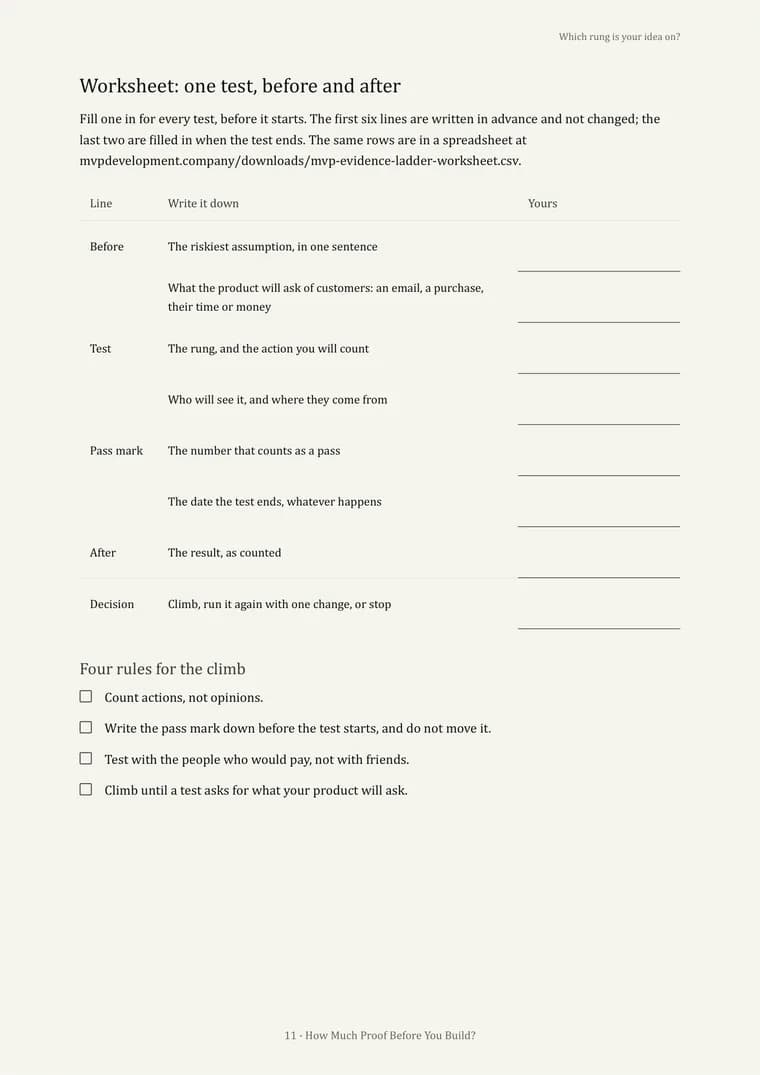
The five rungs with the published pass mark for each, and the worksheet rows. No email needed.
All 4 datasets
The raw data behind every figure, as JSON, with the definitions used.
How to cite
MVP Development, How Much Proof Before You Build? The MVP Evidence Ladder, October 2026, mvpdevelopment.company/research/mvp-evidence-ladder
Get the full report
14 pages on the five tests, and a one-page worksheet to set your pass mark before you test.