
TL;DR
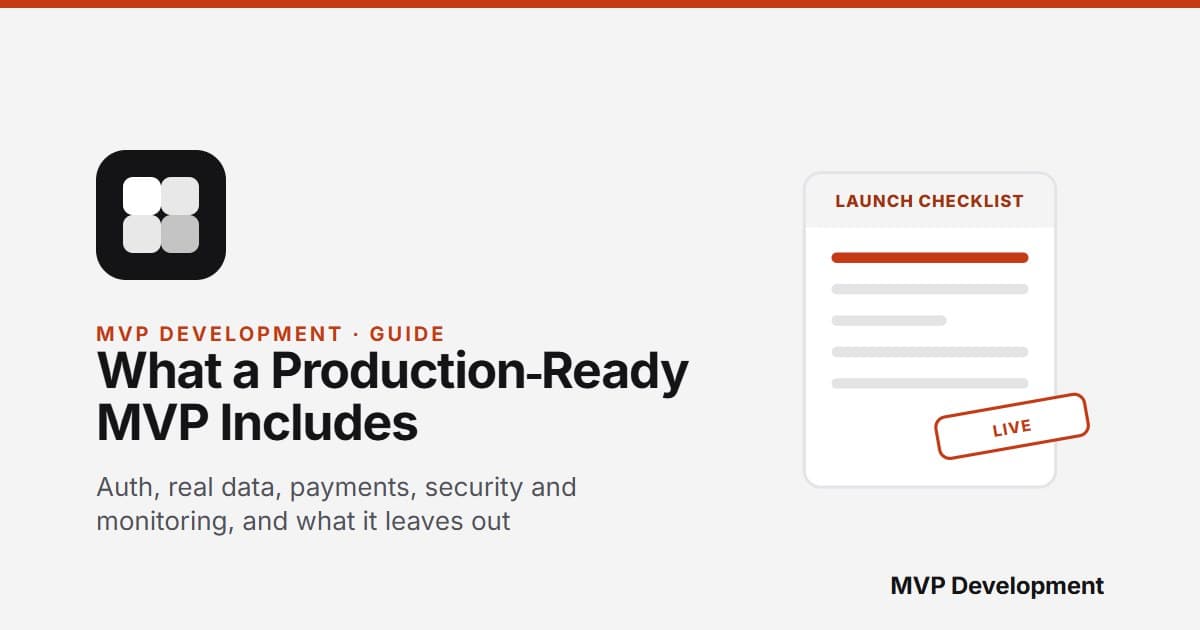
A production-ready MVP is the smallest version of your product that real users can rely on and pay through, not a demo. It must include: real authentication, persistent data (a real database), working payments if it charges, security basics (HTTPS, hashed passwords, input validation), proper error and empty states, deployment on live infrastructure with CI/CD, and monitoring (error tracking, analytics, backups). What it deliberately leaves out is feature breadth, scale for millions of users you don't have, and polish on non-core paths.
The distinction that matters: "minimum" describes the scope; "production-ready" describes the quality of that scope. A production-ready MVP does one core flow, but it does it to a standard a paying user and an investor can trust. A "toy MVP", a happy-path click-through with mock data, is where the most avoidable MVP failures come from.
Key Takeaways
- A production-ready MVP is the smallest version real users can rely on and pay through, not a demo.
- It must include real authentication, a real database, working payments if it charges, and security basics.
- It also needs proper error and empty states, live infrastructure with CI/CD, and monitoring.
- It deliberately leaves out feature breadth, scale you do not yet need, and polish on non-core paths.
- "Minimum" describes the scope; "production-ready" describes the quality of that scope.
What "production-ready" actually means
An MVP is not a prototype and not a demo. A prototype shows how something would work; a demo works only on the happy path in front of an audience. A production-ready MVP works for a real stranger who signs up unsupervised, enters real data, hits an edge case, and pays you. That's a fundamentally higher bar, and it's the bar that separates an MVP that produces real validation from one that produces a false signal.
Here's why the difference is expensive: if you ship a toy MVP and users churn because it broke, not because they disliked the idea, you learn the wrong lesson and may abandon a good idea over a bug. Production-readiness is what keeps your experiment honest, users react to your idea, not to a crash.
Crucially, production-ready does not mean feature-complete or built for scale. It means the one core flow you did build is real, reliable, and safe. Everything outside that flow stays deliberately minimal, that's the "minimum" doing its job.
What a production-ready MVP must include
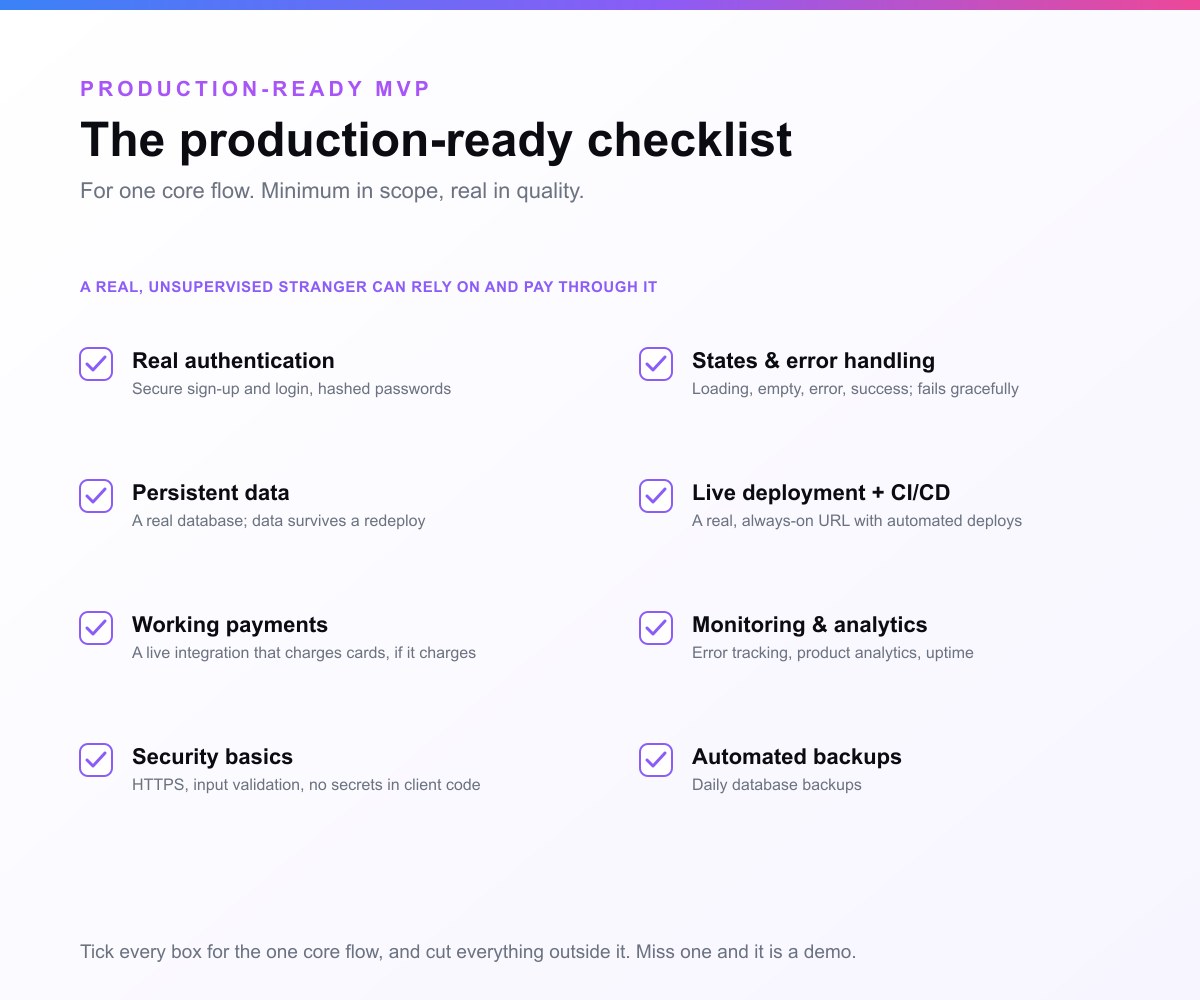
These are the components that make an MVP genuinely usable by real, paying strangers. Treat this as the checklist.
- Real authentication. Actual accounts with secure sign-up and login, not a hardcoded or fake login. Passwords hashed, sessions handled properly.
- Persistent data. A real database (e.g. PostgreSQL), so a user's data survives a refresh and a redeploy, not in-memory or mocked state that resets.
- Working payments (if it charges). A live payment integration (e.g. Stripe) that actually charges cards and handles subscriptions, not a fake "checkout" button. If you're testing willingness to pay, the payment has to be real.
- Security basics. HTTPS/TLS everywhere, hashed passwords, server-side input validation, no secrets in client code, sensible access controls. Not a full audit, but the fundamentals that prevent an obvious breach.
- Proper states and error handling. Loading, empty, error, and success states are all handled. The app fails gracefully, it doesn't show a blank screen or a stack trace when something goes wrong.
- Deployment on live infrastructure. A real, always-on URL with automated deploys (CI/CD), not "it runs on my laptop." Real users need it up when you're asleep.
- Monitoring and analytics. Error tracking (so you know when it breaks before users tell you), basic product analytics (so you can see if the core action happens), and uptime monitoring.
- Automated backups. Daily database backups, so a mistake doesn't erase your only proof of traction.
The right tech stack and a sound architecture make these cheap to include, most are a managed service away, which is exactly why a specialist can ship a production-ready MVP in weeks, not months.
What a production-ready MVP deliberately leaves out
Just as important as what's in, what's out. A production-ready MVP is narrow on purpose:
- Feature breadth. One core flow, not ten. Everything non-essential goes on the "later" list, see how to scope an MVP and feature prioritization.
- Scale for millions. Built cleanly for your first hundreds of users, not sharded databases and microservices for traffic you don't have. Premature scaling is a top cause of wasted runway.
- Polish on non-core paths. The core flow is production-grade; the edges are intentionally minimal.
- Admin tooling, integrations, and nice-to-haves. Deferred until the idea is validated.
The mistake founders make is inverting this: they polish ten shallow features (broad but toy-grade) instead of shipping one deep, reliable flow (narrow but production-ready). The second is what earns real usage data, and real funding.
Production-ready MVP vs a demo or prototype
| Demo / toy MVP | Prototype | Production-ready MVP | |
|---|---|---|---|
| Who can use it | You, on the happy path | Clickthrough, no real backend | A real stranger, unsupervised |
| Data | Mocked / resets | None (fake) | Persistent, real database |
| Auth & payments | Fake or none | None | Real, secure, live |
| Where it runs | Localhost | Design tool / stub | Live URL, CI/CD |
| Handles errors | No | No | Yes, gracefully |
| Produces valid signal | No (breaks skew data) | Tests desirability only | Yes, real usage + revenue |
| Scope | Often broad but shallow | Narrow, throwaway | Narrow, real, reliable |
A prototype is a legitimate early step for testing desirability cheaply. But to test whether people will use and pay, and to raise on it, you need production-ready.
Why production-readiness matters for funding
Investors in 2026 increasingly want proof, not a deck. A production-ready MVP is what turns "we think people will want this" into "look, real users are signed up, using it, and paying." A deployed product with working auth, a real core flow, and a live URL is the artifact that makes a pre-seed conversation credible, which is exactly what investors evaluate in an MVP. A demo that only works when you drive it does the opposite: it signals a project, not a product.
A quick production-readiness checklist
Before you call your MVP done, confirm:
If you can tick these, you have a production-ready MVP: minimum in scope, real in quality. If you can't, you have a demo, and a demo can't be trusted to give you a real answer.
Want a production-ready MVP, not a toy, shipped in weeks? That is the bar we build to: every item on the checklist above, real auth, a real database, live payments, security basics, monitoring, and backups, handled as part of the build rather than bolted on later. We scope the one core flow with you, fix the price up front, ship in 3 to 4 weeks, and hand you code you own. Hold our next build to this exact checklist and we'll scope yours against it.
Related guides
- What is an MVP?: the core definition this builds on
- How to build an MVP: the step-by-step process (this post is the quality bar)
- MVP vs prototype: why a prototype isn't a production MVP
- MVP tech stack: the stack that makes these components cheap to include
- How investors evaluate an MVP: why production-readiness makes you fundable
Frequently asked questions
What is a production-ready MVP?
A production-ready MVP is the smallest version of a product that real, unsupervised users can rely on and pay through. It has real authentication, a real database, working payments (if it charges), security basics, proper error handling, live deployment, and monitoring. It differs from a demo or prototype, which only work on the happy path, by being genuinely usable by strangers, which is what makes the validation it produces trustworthy.
What does a production-ready MVP include?
Real authentication, persistent data in a real database, live payments if it charges, security fundamentals (HTTPS, hashed passwords, input validation), handled loading/empty/error states, deployment on live infrastructure with CI/CD, monitoring (error tracking, analytics, uptime), and automated backups, all for a single core flow. It deliberately excludes feature breadth, scale for users you don't have, and polish on non-core paths.
Is a production-ready MVP the same as a finished product?
No. A production-ready MVP is narrow (one core flow) but reliable on that flow. A finished product is broad and feature-complete. "Production-ready" describes the quality of the small scope you shipped, not the size of it. The goal is one flow real users can trust, not a large product.
What's the difference between a production-ready MVP and a prototype?
A prototype demonstrates how a product would work and is usually a throwaway with no real backend, useful for testing desirability cheaply. A production-ready MVP is real software a stranger can use unsupervised, with persistent data, auth, and payments, so it can test actual usage and willingness to pay, and be raised on.
How do I know if my MVP is production-ready?
Run the checklist: a stranger can sign up and log in securely; their data persists; real payments work; HTTPS and basic security are in place; error states are handled; it's deployed on a live URL with automated deploys; you have error tracking and analytics; and backups run automatically, all for one core flow, with everything else deliberately cut. If any of these is missing, it's a demo, not a production-ready MVP.
How much testing does an MVP need?
Enough to protect one path, not the whole product. Test the core flow a stranger has to complete end to end, signup, the main action, and payment if you charge, plus anything touching money or data you could not recreate. Manual testing before each release is usually enough at this stage. Automated tests earn their place on the flows that would cost you a customer or a refund if they silently broke.
Sources & references
- Eric Ries, The Lean Startup: the "viable" in minimum viable product
- Y Combinator, Startup Library: shipping real products early
This reflects common production-readiness expectations for early-stage software; scale the security and infrastructure depth to your domain and risk.