


TL;DR
Most MVPs fail for the same handful of reasons, and almost none of them are about code. They fail because the team built something nobody wanted, built too much of it, skipped validation, measured the wrong things, ignored the feedback, scaled too early, or ran out of runway before they learned anything. The hard truth from the data: CB Insights found that 42% of startups fail because there was no market need for what they built, the single biggest killer.
The reassuring half of that truth: almost every one of these failure modes is a process problem, not a technical one, which means it is avoidable. This guide walks through the eight real reasons MVPs fail, what the data says, and how to sidestep each, so your MVP produces a clear answer instead of an expensive lesson.
Key Takeaways
- Most MVPs fail for the same handful of reasons, and almost none are about code.
- They fail from building something nobody wanted, building too much, skipping validation, or measuring the wrong things.
- Also: ignoring feedback, scaling too early, or running out of runway before learning anything.
- CB Insights found 42% of startups fail because there was no market need, the single biggest killer.
- Almost every failure mode is a process problem, not a technical one, which means it is avoidable.
More data: the full sourced breakdown behind these failure modes is compiled in our MVP statistics for 2026.
At a Glance
| Failure reason | Fix |
|---|---|
| No market need (42%, CB Insights) | Validate demand first |
| Built too much | Cut to one core flow |
| Skipped validation | Test before building |
| Measured the wrong things | Track activation and retention |
| Scaled too early | Wait for product-market fit |
| Ran out of runway | Learn faster, spend less |
Do MVPs really fail that often?
Yes, and it helps to be honest about it. Most startups fail, and the MVP stage is where that failure usually becomes visible, because the MVP is the first real contact between an idea and the market. The MVP is not what causes the failure; it is the moment the underlying problem (usually "nobody wanted this") finally shows up in the data.
That reframes "MVP failure" usefully. An MVP that reveals nobody wants the idea has not really failed, it did its job cheaply, before a full build wasted years and a budget. The real failures are the ones that waste the MVP itself: building too much, learning nothing, or never testing the idea at all. Those are the patterns below, and the good news is they are predictable enough to avoid.
1. You built something nobody wanted (no market need)
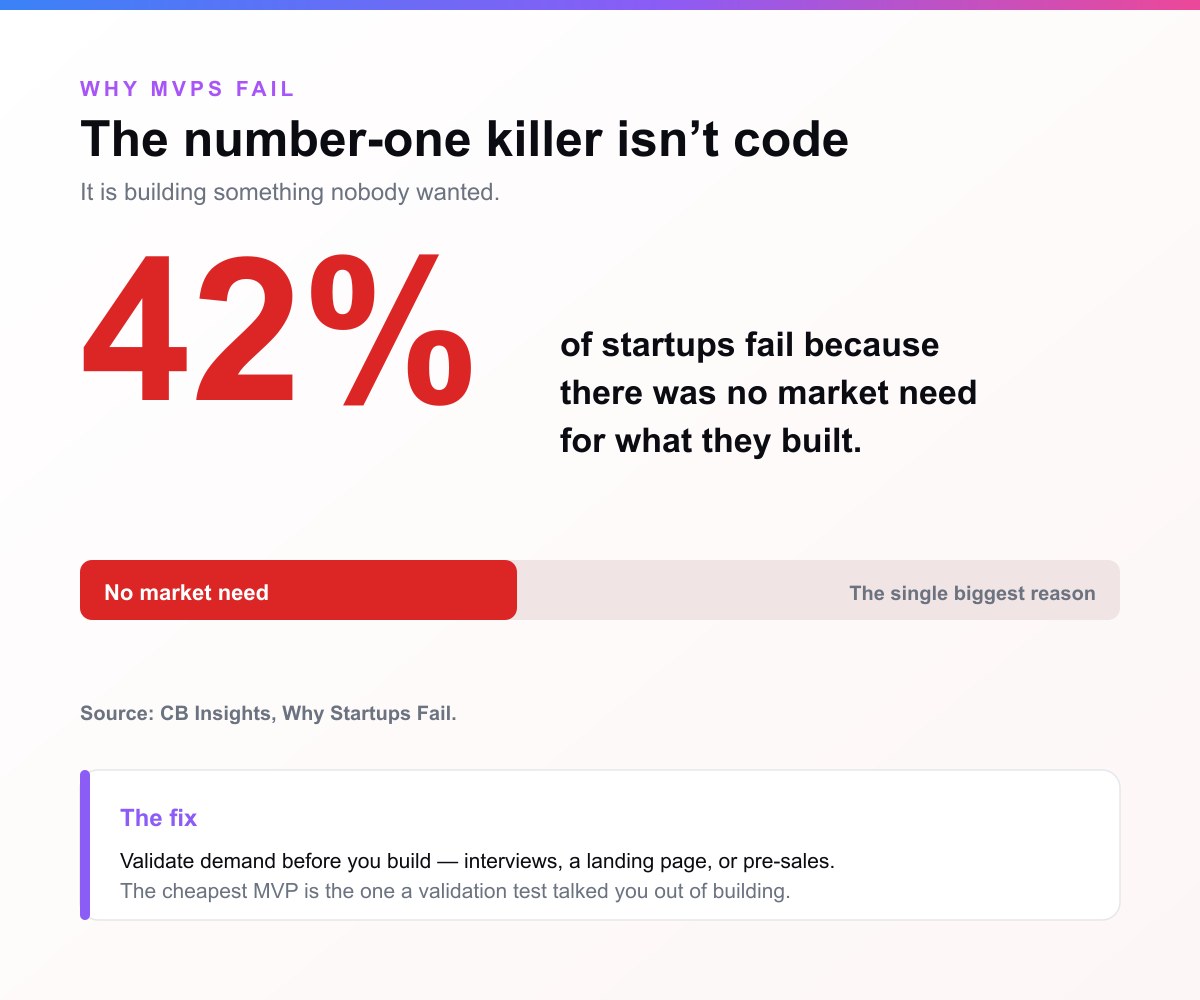
This is the number-one killer, and it is not close. Per CB Insights, 42% of startups fail because there is no market need for the product. The team executes well, ships a clean build, and discovers too late that the problem they solved was not painful enough for anyone to pay to solve.
This failure is invisible during the build, which is what makes it so dangerous, you feel productive the entire time, just productive in the wrong direction. The fix is not better engineering; it is validating demand before you build. Confirm real people have the problem and will act on a solution, through interviews, a landing-page test, or pre-sales, before writing code. We cover the full method in MVP validation. The cheapest MVP is the one a validation test talked you out of building.
2. You built too much (it was not actually minimal)
The "M" in MVP is the part founders quietly ignore. They set out to build a minimum viable product and end up building a small full product, ten features, polished edges, six months of work, because each addition felt reasonable at the time. This is scope creep, and it kills MVPs two ways: it burns the runway that should have funded learning, and it muddies the signal, because when a bloated MVP succeeds or fails, you cannot tell which feature drove the result.
The fix is ruthless scoping to a single core flow, the one path that tests your riskiest assumption, and a written "not building" list you treat as sacred. Often the leanest fix isn't a smaller build at all but a lighter type of MVP, a Wizard of Oz MVP or a concierge test can answer the demand question with almost no code. Every feature you cut buys speed and clarity. See how to build an MVP for the prioritization discipline.
3. You skipped validation and built on assumptions
Closely related to reason one, but distinct: some teams sense the market risk and still skip validation because building feels like progress and testing feels like delay. They treat their conviction as evidence. Then they ship, and the market delivers the verdict they could have gotten months earlier for a fraction of the cost.
The fix is to treat validation as a hard gate, not an optional step. A founder who skips it is not moving faster; they are spending their most expensive resource, engineering time, on a question a few interviews or a landing page could have answered first. Evidence before build, every time.
4. You measured the wrong things (or nothing at all)
An MVP that ships without instrumentation is not an experiment; it is just a small product you launched. If you cannot measure how real users behave, you cannot learn, and learning is the entire point. Worse, many teams do measure, but they track vanity metrics, total signups, downloads, page views, that always go up and prove nothing about whether anyone got value.
The fix is to instrument the MVP before launch and track actionable signals, activation (did users reach the core value?) and retention (did they come back?), not vanity totals. A thousand signups with no retention is a failure wearing a success costume. See MVP metrics for what to track and the benchmarks.
5. You ignored the feedback (never closed the loop)
Some MVPs gather real data and then nobody acts on it. The team is too attached to the original plan, or too busy building the next feature, to feed the lesson back into the product. The build-measure-learn loop only works if you close it: data that does not change what you build next is wasted.
This often shows up as refusing to pivot when the signals clearly say the current direction is not working. Treating the first idea as sacred is one of the most expensive mistakes a founder can make, because the MVP exists precisely so you can change course cheaply. The fix: decide in advance what result would make you persevere versus pivot, and then honor it.
6. You scaled too early
Some MVPs "fail" by succeeding too soon, in the founder's mind. A promising early signal triggers a hiring spree, a paid-acquisition push, and a full product build, before retention proves the value is real. Startup Genome found that premature scaling is one of the most common causes of startup failure: pouring fuel on a fire that was not actually lit yet.
The fix is sequencing. The MVP stage is the search for product-market fit, not the time to scale it. Scale comes after the fit signals (flattening retention, organic growth) are genuinely there, not after one encouraging week. Scaling before fit just makes you run out of money faster.
7. You shipped something too broken to judge (the false negative)
The opposite of building too much: shipping something so rough that users bounce off the experience, and you misread their rejection of the execution as rejection of the idea. This "false negative" can bury a genuinely good idea, especially in a crowded market where users have polished alternatives and zero patience.
The fix is remembering the "V" in MVP: viable, not broken. Minimum scope, but real quality on the one core flow it does deliver. The MVP should be narrow, not half-built, one thing done well beats five things done badly. (For when "usable" is not enough and you need "delightful," see MVP vs MLP.)
8. The team or the runway ran out
Finally, the executional failures. The wrong team builds the wrong thing slowly: junior-heavy teams that over-engineer, misaligned co-founders, or an outsourced vendor with no skin in the game shipping code the founder cannot maintain. And underneath everything sits runway, every week spent building the wrong thing, or building the right thing too slowly, is a week closer to zero, and CB Insights lists running out of cash among the top reasons startups die.
The fix is matching the team to the stage, small, senior, and fast, and protecting runway by keeping the MVP minimal and the loop quick. Who builds the MVP shapes everything; see the MVP development team and the honest trade-offs of MVP outsourcing. Reason 7, shipping something too broken to judge, is specifically what MVP testing exists to catch before launch, not after.
The pattern: MVP failures are process failures, not code failures
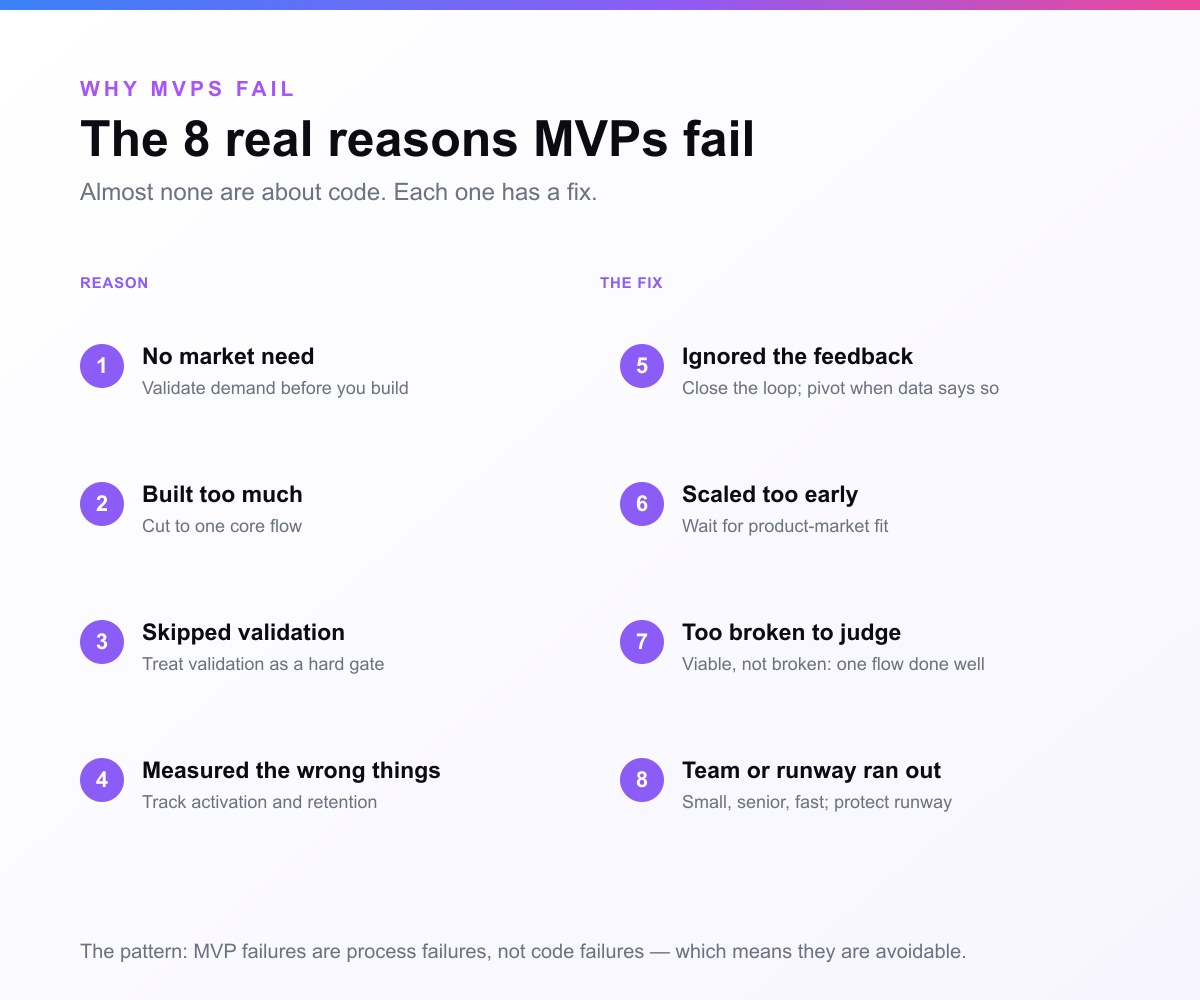
Step back and the eight reasons share a root: they are failures of process and discipline, not of engineering. No market need, too much scope, skipped validation, wrong metrics, ignored feedback, premature scaling, a broken build, a mismatched team, none of these are solved by writing better code. They are solved by validating first, scoping ruthlessly, instrumenting honestly, and acting on what the data says.
That is genuinely good news, because it means MVP failure is largely avoidable. The founders who succeed are rarely the best engineers; they are the ones who ran the build-measure-learn loop with discipline, learned fast, and were willing to change course. For the full operational playbook on dodging these traps, see MVP development challenges and how to solve them.
Avoid the failure modes, build to learn
Most MVP failures are not bad luck, they are the predictable result of building before validating, building too much, or building without measuring. Avoid those and an MVP does its real job: it gives you a clear, honest answer about your idea, cheaply and fast.
For founders, working with an experienced MVP development company is often what supplies that discipline, and it is what we build into every engagement at MVP Development. We ship a funding-ready MVP in 3 to 4 weeks, scoped to the one core flow that tests your riskiest assumption, instrumented from day one so you actually learn, on a fixed quote you approve before we start, with full code ownership. We will also tell you honestly when the right first step is to validate demand rather than build, because the cheapest failure to avoid is the one you never start.
Explore our MVP development services, or if you are unsure whether to build or validate first, start with a free MVP consultation.
Want to build an MVP that avoids these traps? Tell us your plan and we will point at the failure mode it sits closest to, while fixing it is still cheap.
Related guides
-
MVP user feedback: reading the signals early enough to act on them
-
MVP development challenges: the operational fixes for each failure mode
-
MVP validation: how to avoid the #1 killer, no market need
-
Build-measure-learn: the loop that turns failure into a cheap lesson
-
Product-market fit: the goal that scaling-too-early skips past
-
The MVP stage of a startup: where the MVP fits in the startup lifecycle
-
MVP examples: real MVPs that proved demand before building
-
Benefits of an MVP: why building one first pays off
Frequently asked questions
Why do most MVPs fail?
Most MVPs fail because the team built something there was no real market need for, which CB Insights identifies as the cause of 42% of startup failures. Around that sit a few other repeatable reasons: building too much (so it is not actually minimal), skipping validation, measuring vanity metrics instead of activation and retention, ignoring the feedback and refusing to pivot, scaling before product-market fit, and shipping something too rough to judge fairly. Almost none of these are engineering problems, they are failures of process and discipline, which is why they are avoidable.
What is the number one reason MVPs fail?
No market need, by a wide margin. CB Insights found 42% of startups fail because there was no real demand for what they built. The product can be well-engineered and on time and still fail because the problem it solves was not painful enough for anyone to pay to solve. The defense is validating demand before building, through customer interviews, a landing-page test, or pre-sales, so you confirm people actually want the solution before you spend months building it.
Is a failed MVP always a bad thing?
No. An MVP that reveals nobody wants the idea has done its job: it produced that lesson cheaply, before a full build wasted years and a budget. That is the whole point of an MVP, to fail cheaply and learn fast rather than fail expensively and late. The genuinely bad failures are the ones that waste the MVP itself: building too much, learning nothing because you did not measure, or never testing the idea at all. A cheap, fast "no" is a successful experiment.
How do you avoid MVP failure?
Validate demand before you build, scope ruthlessly to one core flow so the MVP stays truly minimal, instrument it before launch so you measure activation and retention rather than vanity metrics, act on what the data shows (including pivoting when it says to), and do not scale until the product-market-fit signals are real. Match the team to the stage, small, senior, fast, and protect runway by keeping the loop quick. Most failure modes are process problems, so the fix is discipline, not better code.
Why do MVPs fail even when the product works well?
Because "works well" is not the same as "wanted." A technically excellent MVP still fails if there is no market need, if it was built for the wrong user, or if it tested the wrong assumption. Engineering quality cannot rescue a product nobody wants. This is why validation and the right metrics matter more than polish at the MVP stage: they tell you whether you are building something people will actually use and pay for, which is the question that determines success.
Sources & references
This guide draws on startup-failure research and lean-startup practice:
- CB Insights, Why Startups Fail: the top reasons startups fail, led by no market need (42%)
- Startup Genome: premature scaling as a leading cause of failure
- Eric Ries, The Lean Startup: validated learning and failing cheaply
- Y Combinator, Startup Library: talking to users and avoiding common early mistakes
The 3 to 4 week figure reflects MVP Development delivery data for tightly scoped builds.


