


TL;DR
MVP technical debt is the set of shortcuts you take on purpose to ship faster: simplified architecture, skipped edge cases, manual back-office steps, and rough UI. Taken deliberately, it is not a mistake; it is the price of speed, and speed is the whole point of an MVP. The skill is telling safe debt from dangerous debt. Safe debt lives on the surface (basic design, unhandled rare cases, manual operations) and is cheap to fix later. Dangerous debt is structural (no auth or security, a data model that cannot grow, no backups or error logging) and gets exponentially more expensive the longer it sits. Manage it by writing it down, keeping the dangerous kind out from the start, and scheduling a focused paydown once you have real traction, not before.
Key Takeaways
- MVP technical debt is deliberate shortcuts taken for speed; taken on purpose, it is a tool, not a failure.
- Safe debt is on the surface (basic UI, skipped edge cases, manual ops) and is cheap to fix later.
- Dangerous debt is structural (no security, a rigid data model, no backups or logging) and compounds fast.
- Unmanaged debt shows up as a velocity death spiral: simple features start taking weeks instead of days.
- Track every shortcut, refuse the dangerous kind up front, and pay down deliberately after product-market fit.
The rule of thumb: cut corners on what users forgive and you can change later. Never cut them on security, data structure, or the ability to know what is happening in production.
What MVP technical debt actually is
Technical debt is the future cost of a shortcut you take today. The metaphor, coined by Ward Cunningham and popularised by Martin Fowler, is exact: you "borrow" speed now by writing simpler or rougher code than the ideal, and you pay it back later with "interest", the extra effort every future change costs because of that shortcut.
In an MVP this is not only normal, it is the strategy. The entire point of a minimum viable product is to learn whether people want the thing before you over-invest, so writing a perfectly engineered, infinitely scalable system for an idea you have not validated is its own kind of waste. Deliberate, well-chosen debt is how you ship in weeks instead of months.
The distinction that matters is deliberate versus accidental. Debt you take knowingly, name, and plan to repay is a lever. Sloppy code written without intention is just poor work wearing the word "debt" as an excuse. This guide is about the first kind, and about keeping the second kind out.
Why MVPs accumulate debt (on purpose)
Three forces make debt the right call at the MVP stage:
- Speed to market. Validating the idea beats polishing the code. A week saved on architecture is a week sooner to a real answer about demand.
- Limited runway. Startups have finite time and money. Spending either on robustness an unproven product may never need is a poor bet.
- Genuine unknowns. You do not yet know which features users will keep, so building temporary "glue" and hardcoded paths avoids over-engineering something you may delete next month.
None of this means "build carelessly." It means spend your quality budget where it counts, on the one core flow that has to work, and take shortcuts on the rest. That is the same discipline behind good MVP scope: do the core properly, defer everything else.
Safe debt vs dangerous debt
Here is the line that decides whether debt helps or hurts. Safe debt is on the surface and reversible. Dangerous debt is structural and compounds. Cut corners freely on the left column; refuse them on the right.
| Safe to defer (cheap to fix later) | Dangerous (fix before you ship) |
|---|---|
| Basic or unpolished UI and layout | No real authentication or security model |
| Rare edge cases and error states | Storing secrets or user data unsafely |
| Manual back-office and ops tasks | A data model that cannot grow with the product |
| Hardcoded settings and config | No backups, no error logging, no monitoring |
| Limited test coverage on the periphery | An untested, unreliable core flow |
The pattern: safe debt is what users forgive and you can change without a teardown; dangerous debt is what betrays trust, loses data, or forces a rebuild. A clunky screen is a Tuesday fix. A leaked customer record, or a schema you have to unpick after ten thousand users, is an existential event. When in doubt, ask "if this is wrong, is it a patch or a teardown?" Patches are safe debt. Teardowns are not.
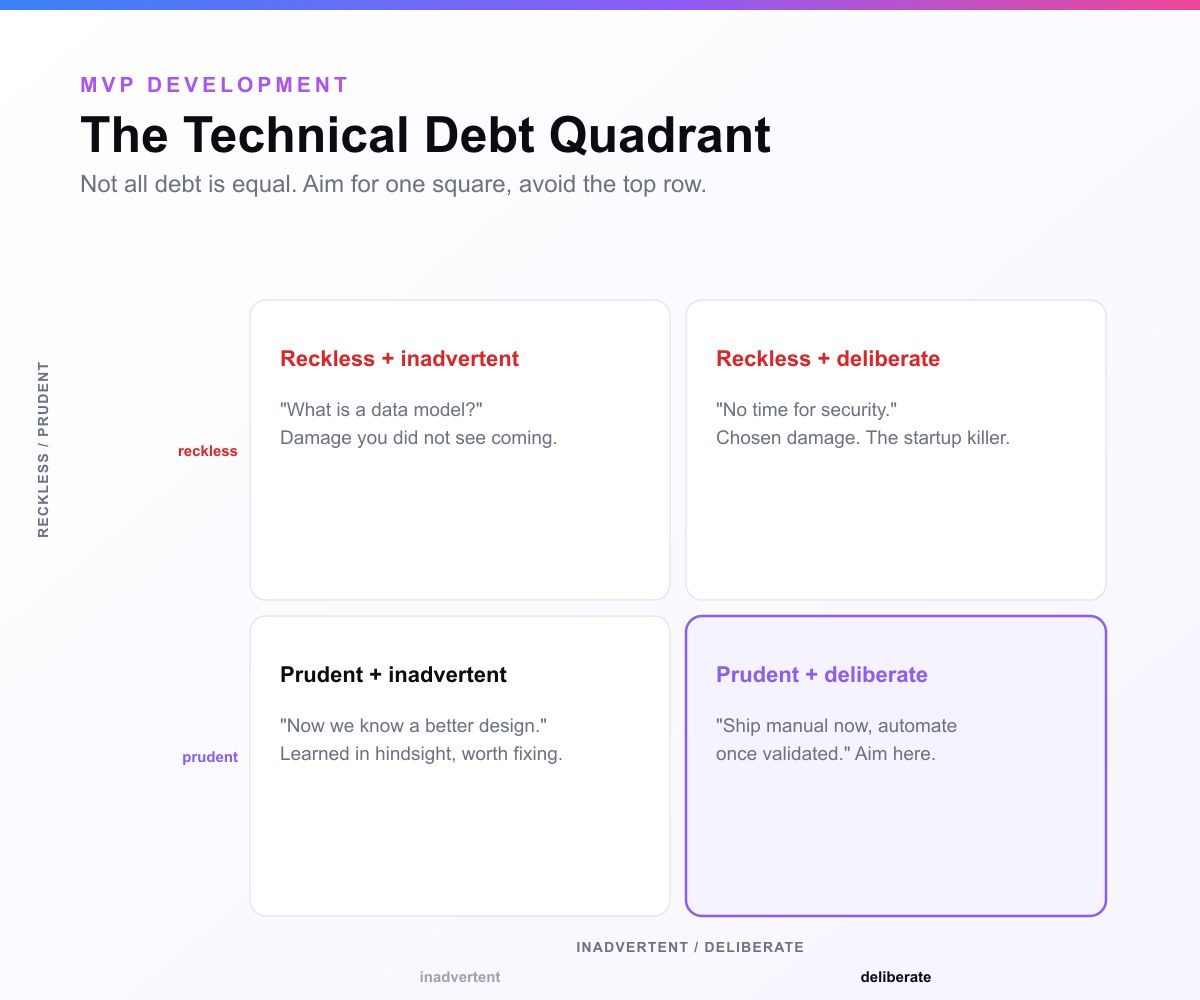
A useful frame from Fowler is the technical debt quadrant: debt can be reckless or prudent, and deliberate or inadvertent. The debt you want is prudent and deliberate, "we ship the manual version now and automate once it is validated." The debt that sinks startups is reckless, whether you chose it or stumbled into it.
How the interest compounds
Left unmanaged, the interest on debt does not add up, it multiplies. Three symptoms tell you it is compounding:
- The velocity death spiral. Code becomes so tangled that a change in one place breaks two others. Features that once took days start taking weeks, and the team spends more time fighting the codebase than building.
- Performance rot. Shortcuts that were invisible at ten users, an unindexed query, an unoptimised call, become loading spinners at ten thousand. The product feels slow exactly as it starts to matter.
- Talent drain. Good engineers avoid brittle codebases. Debt that never gets paid down quietly raises the cost of every hire and the risk of every departure.
This is why "we will deal with it later" fails as a plan: the longer dangerous debt sits, the more code is built on top of it, and the more expensive the eventual fix becomes. If it compounds far enough, the only remaining option is the most expensive one of all, a full rebuild, which is exactly the outcome disciplined debt management exists to avoid. Unmanaged technical debt is one of the most common reasons MVPs fail after a promising start.
How to manage MVP technical debt
You do not eliminate debt; you manage it, the way you would a loan. Four practices keep it from owning you:
- Write it down. Keep a simple debt register: every deliberate shortcut, what it costs, and what fixing it would take. Debt you have named is debt you can decide about. Debt that lives only in one engineer's head is a landmine.
- Refuse the dangerous kind up front. Security, the core data model, backups, and basic error logging are not "later." They are cheap to do at the start and ruinous to retrofit. Draw a hard line: safe debt is welcome, structural debt is not.
- Watch the debt ratio. Track roughly how much of your team's time goes to fighting old code versus building new value. When maintenance starts eating the majority of your weeks, the debt is calling in its loan.
- Pay down deliberately, after fit. Once you have real traction and know the product is worth investing in, schedule a focused cleanup of the dangerous structural debt, the same moment the MVP stage gives way to scaling. Do it before, and you are polishing an unproven idea; do it much later, and you are paying compound interest.
The goal is not zero debt. It is known, bounded, and mostly-safe debt, with the dangerous kind kept out from day one.
Build an MVP whose debt is a choice, not an accident
The difference between debt that speeds you up and debt that sinks you is almost always set on day one, in how the MVP is built. An MVP thrown together as a disposable hack accumulates the dangerous, structural kind by default. One built on production-grade, owned code, with the core flow done properly and shortcuts confined to the safe surface, carries debt you can actually manage.
That is exactly how we build at MVP Development:
- We take debt deliberately, not accidentally. The one validated flow is built to production quality in our custom MVP builds; shortcuts live where they are cheap to reverse, and the tech stack is chosen for exactly this.
- We keep the dangerous kind out from the start. Security, a data model that can grow, backups, and logging are in from day one, because retrofitting them is where startups drown.
- You own production-grade code, so scaling later is a scheduled cleanup, not a from-scratch rebuild.
The honest trade-off is scope, not structural quality: we cut features, not foundations.
Worried your MVP is built on the dangerous kind of debt? Show us the corner you are afraid you cut and we will tell you which debts to pay and which to keep carrying.
Related guides
- When debt wins: when to rebuild your MVP and why MVPs fail.
- Building to avoid it: production-ready MVP, MVP tech stack, and MVP scope.
- After launch: MVP iteration and how to scale an MVP.
Frequently asked questions
What is technical debt in an MVP?
It is the deliberate shortcuts you take to ship an MVP faster: simplified architecture, skipped edge cases, manual operations, and rough UI. Taken on purpose and tracked, it is a legitimate trade of long-term polish for speed to validation. The cost is "interest", the extra effort every future change takes because of the shortcut.
How much technical debt is acceptable in an MVP?
As much as you can take on the safe, surface-level side (basic UI, rare edge cases, manual ops) without touching the dangerous, structural side (security, data model, backups, logging). A practical test: if a shortcut being wrong means a patch later, it is acceptable; if it means a teardown or a data loss, it is not.
What is the difference between safe and dangerous technical debt?
Safe debt is reversible and on the surface, users forgive it and you can change it without rearchitecting. Dangerous debt is structural: missing security, a rigid data model, or no backups and logging. Safe debt is cheap to fix later; dangerous debt compounds and can eventually force a full rebuild.
When should you pay down MVP technical debt?
After you have validated the idea and have real traction, not before. Paying down debt on an unproven product is polishing something you might delete. Once product-market fit is real and you are moving from the MVP stage to scaling, schedule a focused sprint to clear the dangerous structural debt first.
Can technical debt kill a startup?
Yes, when it is the dangerous, structural kind left unmanaged. It shows up as a velocity death spiral (features take weeks not days), performance rot at scale, and engineers leaving. Compounded far enough, it forces an expensive rebuild. Managed debt, tracked and bounded, does the opposite: it gets you to validation faster.
Sources & references
- Martin Fowler, Technical Debt, the definitive explanation of the metaphor.
- Martin Fowler, Technical Debt Quadrant, reckless vs prudent, deliberate vs inadvertent.
- Eric Ries, The Lean Startup, on speed to validated learning as the MVP's purpose.


