


TL;DR
Build-measure-learn is the core feedback loop of the lean startup method: you build a small product, measure how real users respond, learn from the data, and repeat, and your MVP is the "build" that powers the whole cycle. The loop exists to convert assumptions into evidence as fast as possible, so the speed of the loop is what matters most, not the size of what you ship.
The single most important idea: the goal is not to build, it is to learn, and the MVP is just the cheapest way to start learning. Founders who treat the MVP as the deliverable miss the point; the MVP is one turn of a loop you will run many times. This guide explains the loop, the MVP's role at its center, how to run each phase for an MVP, and how to keep the loop fast, which is the real lean-startup advantage.
Key Takeaways
- Build-measure-learn is the core feedback loop of the lean startup method: build a small product, measure how users respond, learn, and repeat.
- Your MVP is the "build" that powers the whole cycle.
- The loop exists to convert assumptions into evidence as fast as possible, so the speed of the loop matters most.
- The goal is not to build, it is to learn; the MVP is just the cheapest way to start learning.
- The MVP is one turn of a loop you will run many times, not the final deliverable.
At a Glance
| Phase | What you do | Goal |
|---|---|---|
| Build | Ship the smallest product (your MVP) | Create something to test |
| Measure | Collect real user behavior | Get evidence, not opinions |
| Learn | Decide: persevere, pivot, or kill | Turn data into the next build |
What is the build-measure-learn loop?
Build-measure-learn is the three-step feedback loop at the heart of the lean startup method, popularized by Eric Ries in The Lean Startup: you build the smallest thing that tests an idea, measure how real users respond, and learn whether your assumption held, then feed that learning into the next build. It runs in a circle, not a line, because a startup is a series of experiments, not a single plan executed to completion.
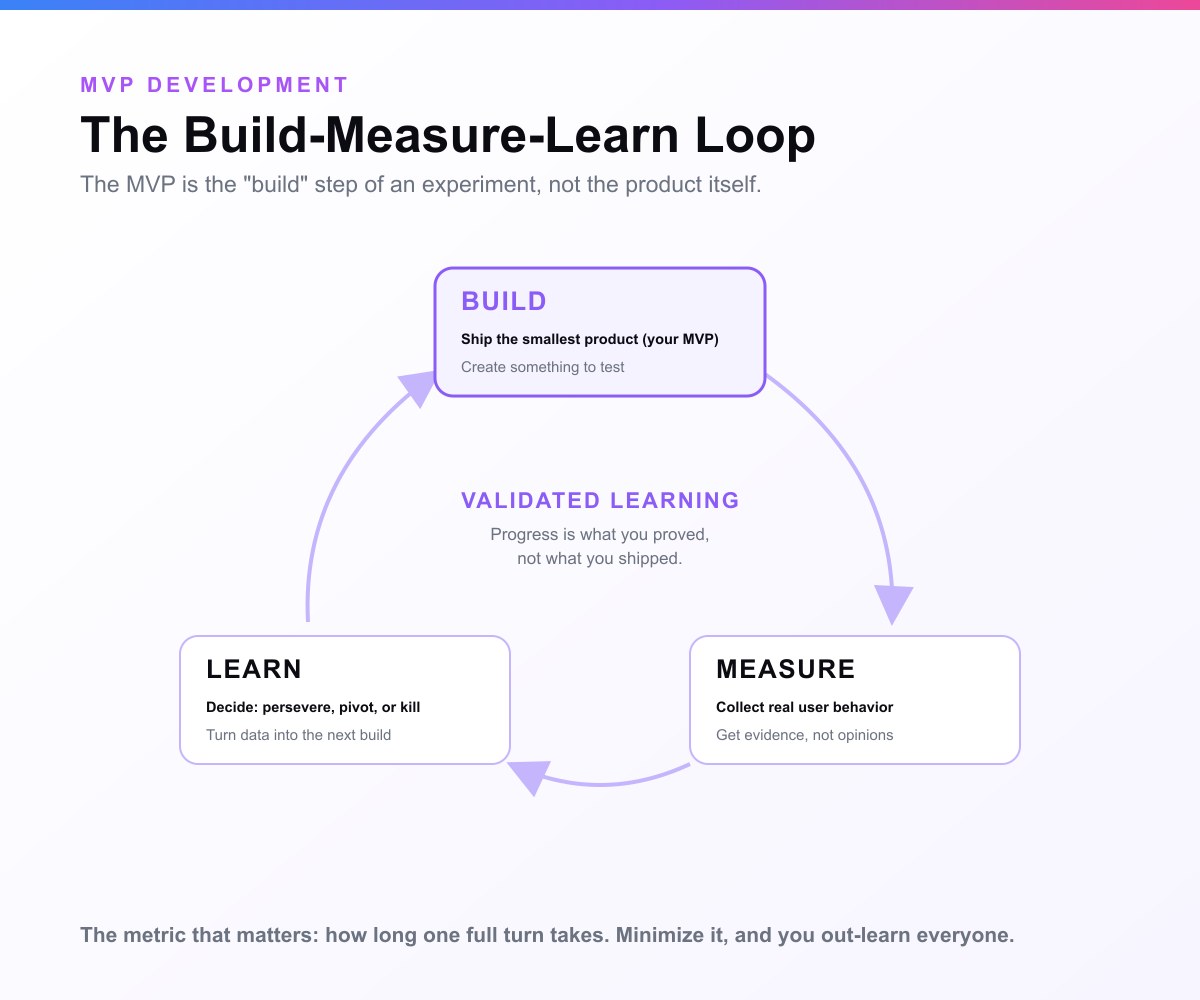
The loop is a reaction against the traditional way of building products: spend months (or years) building the "complete" product behind closed doors, launch it, and only then discover whether anyone wanted it. That approach bets everything on a single untested guess. Build-measure-learn replaces the one big bet with many small, fast experiments, each one cheap enough to be wrong.
Read the loop in the order you execute it (build → measure → learn), but plan it in reverse: decide what you need to learn, define what you will measure to learn it, then build the least you can to produce that measurement. That reversal is what keeps the loop lean, you build only what a specific question requires.
Where the MVP fits: it is the "build"
Here is the connection that matters for us: the MVP is the "build" step of build-measure-learn. It is not a separate concept that happens to be lean-adjacent; the MVP was defined, by Ries, precisely as the version of the product that lets you run one turn of this loop with the least effort.
That reframes what an MVP is for. An MVP is not a small version of your product you ship and move on from. It is the apparatus for one experiment in an ongoing loop, the cheapest thing you can build to measure a real user response and learn something true. This is why an MVP must be minimal (so the loop is fast and cheap) but also viable (so the measurement is real and the learning is honest). Too big, and the loop is slow and expensive. Too broken, and you measure your bugs instead of your idea.
It also reframes success. A "successful" turn of the loop is not a polished launch, it is a clear lesson, even a negative one. An MVP that proves nobody wants the idea has succeeded at its real job: it produced validated learning cheaply, before you spent a year and a budget finding out the hard way.
The three phases, applied to your MVP
Build: ship the smallest real experiment
The build phase is where you create the MVP, scoped to the single core flow that tests your riskiest assumption, and nothing more. The discipline is subtraction: every feature you add slows the loop and muddies the signal. If a feature is not required to run this experiment, it does not belong in this turn of the loop. For the full method, see how to build an MVP and the MVP development process.
The lean point is that "build" is the means, not the end. The faster and cheaper you can produce something measurable, the more turns of the loop you get per month, and the number of loops you complete is what determines how fast you find a product that works.
Measure: get an honest signal from real users
Once the MVP is live, you measure how real users actually behave, not what they say in a survey, what they do. This is where instrumentation matters: the MVP must be wired to capture activation, retention, and the core action before launch, or the loop stalls with opinions instead of data. The trap here is vanity metrics (signups, page views) that rise and prove nothing; you want actionable signals that reveal whether users got value. The full set is covered in MVP metrics.
Learn: validated learning, then iterate or pivot
The learn phase is the actual point of the whole loop. Ries calls the output validated learning: a factual lesson about your business, backed by real user behavior, not a guess. You compare what happened to the assumption you were testing and you make a decision: persevere (the assumption held, iterate and go deeper) or pivot (it did not, change direction). Then you feed that decision into the next build, and the loop turns again. This is the same evidence-first discipline behind MVP validation.
Validated learning: the real output of the loop
The reason build-measure-learn beats "just build the product" is a single idea: validated learning is progress, and shipped features are not. In a normal project, you measure progress by how much you have built. In a lean startup, you measure it by how much you have learned about what customers actually want, because building the wrong thing efficiently is still failure.
This is liberating and uncomfortable at once. Liberating, because a "failed" MVP that taught you the idea was wrong is a win, you bought that lesson cheaply. Uncomfortable, because it means a beautiful, on-time, on-budget build that taught you nothing is a loss. The loop forces you to value the lesson over the artifact, which is exactly the mindset that separates founders who find a working product from those who polish a doomed one.
Speed is the whole advantage: minimize loop time
If validated learning is the output, then the metric that matters most is how long one full turn of the loop takes. Ries's guidance is explicit: minimize total time through the build-measure-learn loop. A startup that completes the loop in two weeks will out-learn, and usually out-last, one that takes six months, even if the slower team writes better code.
This is the deepest reason to keep your MVP small. A minimal MVP is not about doing less work for its own sake; it is about getting more turns of the loop, because each turn is a chance to learn something that changes your direction. The founders who win are rarely the ones who built the most, they are the ones who learned the fastest, and loop speed is how you learn fast. It is also why an MVP that takes six months to build is a contradiction in terms: by the time you measure, the market has moved and you have only run one experiment.
How build-measure-learn relates to product-market fit
The loop is not endless for its own sake, it has a destination: you run build-measure-learn until you reach product-market fit. Each turn either gets you closer to a market that genuinely wants the product, or tells you to change course. Fit is the signal that the search phase is over and the scaling phase can begin.
So the full picture connects cleanly: the MVP is the build, metrics are the measure, validated learning drives the iterate-or-pivot decision, and product-market fit is what the whole loop is searching for. Build-measure-learn is the engine; PMF is the destination; the MVP is the vehicle.
Common build-measure-learn mistakes
- Treating the MVP as the finish line. Shipping the MVP and stopping, instead of running the next turn of the loop. The MVP is one experiment, not the project.
- Building too much per loop. A bloated "MVP" makes each turn slow and expensive, and muddies which change caused which result. Keep each build minimal.
- Skipping measure. Launching with no instrumentation, so you "learn" from opinions and gut feel instead of real behavior. Instrument before you launch.
- Chasing vanity metrics. Measuring signups and downloads, which always go up, instead of activation and retention, which tell the truth.
- Not closing the loop. Gathering data but never feeding the lesson into the next build. Learning that does not change what you build next is wasted.
- Refusing to pivot. Treating the original idea as sacred when the loop keeps saying no. The loop only works if you act on what it tells you.
Build a loop that actually turns
Build-measure-learn is simple to describe and hard to live, because it demands that you value learning over building and act on evidence even when it contradicts your plan. The teams that get it right are the ones that can complete the loop fast: ship a real, instrumented MVP, read honest signals, and iterate, in weeks, not quarters.
That speed is what we are built to give founders at MVP Development. We ship a funding-ready MVP in 3 to 4 weeks, scoped to the one experiment that matters and instrumented from day one, so your first turn of the build-measure-learn loop happens in weeks instead of months, on a fixed quote you approve before we start, with full code ownership. The faster your loop turns, the faster you learn what to build next.
Explore our MVP development services, or if you are still scoping the experiment, start with a free MVP consultation.
Ready to start the loop? Show us where your loop is stuck and we will find the measurement that unsticks it.
Related guides
-
MVP user feedback: how to actually run the measure phase when you only have a handful of users
-
What is an MVP?: the "build" at the center of the loop
-
MVP validation: the evidence-first discipline behind "learn"
-
MVP metrics: how to "measure" honestly
-
Product-market fit: what the whole loop is searching for
Frequently asked questions
What is the build-measure-learn loop?
Build-measure-learn is the central feedback loop of the lean startup method: you build the smallest product that tests an idea, measure how real users respond, and learn whether your assumption held, then use that learning to decide what to build next. It runs as a continuous cycle rather than a one-time sequence, because a startup is a series of experiments. The point of the loop is to turn assumptions into evidence as cheaply and quickly as possible, and the MVP is the "build" step that makes each turn affordable.
How does an MVP fit into build-measure-learn?
The MVP is the "build" step. Eric Ries defined the minimum viable product as the version of the product that lets you complete one turn of the build-measure-learn loop with the least effort. So an MVP is not a standalone deliverable; it is the apparatus for one experiment, the cheapest thing you can ship to measure a real user response and learn something true. That is why an MVP must be minimal (to keep the loop fast and cheap) yet viable (so the measurement is real), and why a single MVP is usually just the first of several turns of the loop.
What is validated learning?
Validated learning is the output of the build-measure-learn loop: a factual lesson about your business backed by real user behavior, rather than a guess or an opinion. In the lean startup method, validated learning is the true measure of progress, more than features shipped, because building the wrong thing efficiently is still failure. A "failed" MVP that proves nobody wants the idea has produced validated learning and therefore succeeded at its real job: it bought that lesson cheaply, before a full build wasted a year and a budget.
Why is loop speed so important?
Because the number of times you complete the loop is what determines how fast you find a product that works. Each turn is a chance to learn something that changes your direction, so a team that completes the loop in two weeks out-learns one that takes six months, even if the slower team writes better code. This is the deepest reason to keep your MVP small: a minimal build is not about doing less work, it is about getting more turns of the loop and therefore learning faster. Minimizing total time through the loop is the core lean-startup advantage.
Is build-measure-learn the same as the lean startup?
Not exactly. The lean startup is the broader methodology, a way of running a startup as a series of experiments under uncertainty, and build-measure-learn is its central feedback loop, the practical engine that drives it. Other lean concepts (validated learning, the MVP, innovation accounting, pivot-or-persevere) all orbit that loop. For a founder, the most useful way in is the loop itself, because it is concrete: build the smallest experiment, measure real behavior, learn, repeat.
Sources & references
This guide draws on the foundational lean-startup writing:
- Eric Ries, The Lean Startup: the build-measure-learn loop, validated learning, and minimizing loop time
- Lean startup (overview): the methodology and its core concepts
- Y Combinator, Startup Library: iterating and talking to users early
- Atlassian, Minimum Viable Product: the MVP's role in lean, agile product development
The 3 to 4 week figure reflects MVP Development delivery data for tightly scoped builds.


