


TL;DR
A mobile app MVP is the smallest working version of your app, one core flow, on the platforms that matter, that you ship to real users to validate the idea before building the full product. The two decisions that define it are scope (which single flow proves your idea) and platform (native vs cross-platform, iOS, Android, or both).
The short version: a mobile app MVP follows the same lean logic as any MVP, but mobile adds real constraints a web app does not have, app-store review, a higher quality bar, push-driven retention, and the cost of two platforms. The single biggest lever for managing that is building cross-platform from one codebase instead of two native apps. This guide covers what a mobile app MVP is, why mobile is different, mobile vs web, how to choose your build approach, what it costs, and how to validate one.
Key Takeaways
- A mobile app MVP is the smallest working version of your app, one core flow, on the platforms that matter, shipped to validate the idea.
- The two decisions that define it are scope (which single flow proves your idea) and platform (native vs cross-platform, iOS, Android, or both).
- Mobile adds constraints a web app does not have: app-store review, a higher quality bar, push-driven retention, and the cost of two platforms.
- The biggest lever for managing that is building cross-platform from one codebase instead of two native apps.
- It follows the same lean logic as any MVP: validate one flow before building the full product.
At a Glance
| Decision | Guidance |
|---|---|
| Scope | The single flow that proves your idea |
| Platform | Native vs cross-platform (iOS, Android, or both) |
| Biggest lever | Cross-platform from one codebase |
| Extra constraints | App-store review, higher quality bar, push retention |
| Logic | Same lean MVP rules as web |
What is a mobile app MVP?
A mobile app MVP (minimum viable product) is a deliberately minimal native or cross-platform app that delivers one core piece of value to real users on their phones, built to test whether the idea works before you invest in the full app. It is real, working software on the App Store or Google Play (or in beta), not a prototype or a mockup, just narrow.
The defining discipline is the same as any MVP: pick the one core flow that tests your riskiest assumption and build only that, to a real standard. What makes it a mobile MVP is the environment, you are shipping to phones, through app stores, to users who expect app-grade polish and who you keep through notifications. That environment changes some of the rules, which is the rest of this guide.
Why a mobile app MVP is different from a web MVP
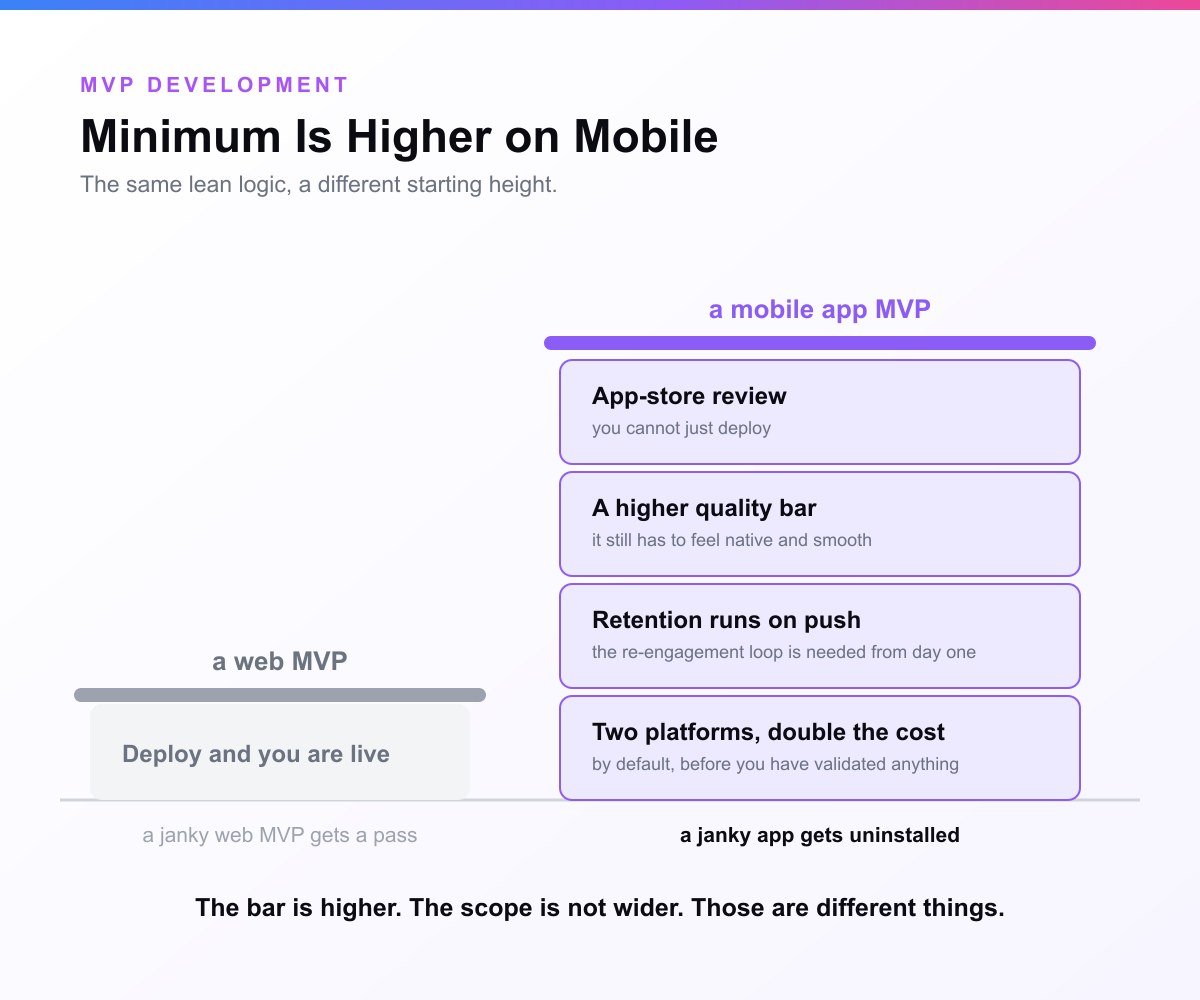
Mobile carries constraints a web MVP does not, and ignoring them is how mobile MVPs stall:
- App-store review. You cannot just deploy. Apple and Google review submissions against their guidelines, which adds time and a quality floor you must clear. You plan releases around it.
- A higher quality bar. Users judge apps harder than websites. A janky web MVP gets a pass; a janky app gets uninstalled and one-star reviews. "Minimum" on mobile still has to feel native and smooth.
- Retention runs on push. Mobile products live or die on whether users come back, and push notifications are the core re-engagement loop. A mobile MVP usually needs that loop from day one to produce a real retention signal.
- Two platforms, double the cost, by default. iOS and Android are separate native ecosystems. Building both natively means two codebases and often two teams, before you have validated anything. This is the single biggest cost decision in a mobile MVP, and the reason most start cross-platform (below).
None of this means build more. It means the minimum viable bar on mobile sits a little higher, and your build-approach choice matters more than on the web.
Mobile app MVP vs web app MVP: which first?
Before assuming you need an app at all, decide whether your MVP should even be mobile. The test is where the value genuinely lives:
- Build a mobile app MVP when the product is fundamentally a phone experience, it needs the camera, GPS, push, offline use, or it is something people use on the go, repeatedly. If "there's an app for that" is the whole point, you need the app.
- Build a web app MVP first when the value works in a browser. A web MVP ships faster, has no app-store gatekeeping, and is cheaper to iterate, so if you can validate the idea on the web, do that before committing to mobile. Many founders validate on web (or even a landing page) and build the app only once demand is proven. A progressive web app sits in between: one web codebase that installs to the home screen and, since iOS 16.4, can send push notifications once installed.
The honest default: do not build a mobile app just because apps feel "real." Build one when the phone is genuinely where your product has to be.
Native vs cross-platform: the build decision
This is the decision that defines a mobile MVP's cost and speed, and for most MVPs the answer is cross-platform.
- Cross-platform (one codebase → iOS + Android). Frameworks like React Native and Flutter let one team ship both platforms from a single codebase, roughly halving the time and cost versus native. For the vast majority of startup mobile MVPs, this is the right call, the savings at the validation stage are too large to ignore, and both are production-grade, so the MVP scales rather than being a throwaway.
- React Native MVP: JavaScript/TypeScript and the React ecosystem; the natural pick if your team knows React or web.
- Flutter MVP: Dart, with pixel-perfect, consistent UI and strong performance.
- Fully native (Swift / Kotlin). Reserve native for MVPs where the product is the performance, heavy graphics, intensive device-hardware use, or a feature that genuinely demands platform-native code. It is rarely necessary at the MVP stage, and it costs the most.
For the full stack around your app (backend, auth, push, analytics), see the MVP tech stack guide. The headline: pick cross-platform unless you have a specific reason not to.
How to scope a mobile app MVP
Scope is where mobile MVPs are won. Anchor to your riskiest assumption, reduce to the one core flow, and cut hard, but remember the mobile floor:
- Keep: the single core flow, real (not faked) on-device, plus the minimum that makes it feel like a real app (smooth navigation, push for the retention loop, sign-in if the value needs it).
- Cut for now: secondary screens, settings, profile customization, every "nice to have," and usually all but one platform's edge cases. Start with one core flow, not ten.
- Decide platforms deliberately: you can even launch on one platform first (often iOS for consumer, depending on your audience) to halve the surface while you validate, then add the other.
The goal is the smallest app that produces a real signal, not a small version of the whole roadmap.
What a mobile app MVP costs and how long it takes
Cost is the question founders ask most, and the honest answer is: it depends on scope and build approach, but cross-platform is what keeps it reasonable. Because one codebase serves both platforms, a tightly scoped cross-platform mobile MVP, one core flow, senior team, ships in about 3 to 4 weeks, on a managed backend that keeps infrastructure cost near zero until you have users. Going fully native roughly doubles the build (two codebases); adding scope extends it. The main cost driver is engineering time, not infrastructure, which is exactly why cross-platform (one team, one codebase) is the budget lever. For the full breakdown across stacks and approaches, see how much it costs to build an MVP.
How to validate a mobile app MVP
Validation on mobile has a few wrinkles web does not:
- Use beta channels first. TestFlight (iOS) and Google Play testing tracks let you get the app to real users before a public store launch, faster iteration, no review friction on every change.
- Instrument from day one. Wire in analytics and crash reporting so you can measure activation and, crucially, retention (do users come back on day 7?), the truest signal a mobile product is working. See MVP metrics.
- Watch the store signals too. Reviews, ratings, and uninstall rate are real qualitative and quantitative feedback unique to mobile.
- Lead with retention, not downloads. Downloads are a vanity metric; a small number of users who keep coming back beats a spike that churns.
Common mobile app MVP mistakes
- Building native two-up before validating. Two codebases double the cost to answer a question one cross-platform codebase could answer. Default to cross-platform.
- Building an app when a web MVP would do. If the value works in a browser, validate there first.
- Cutting quality to "MVP" levels that feel broken. Mobile users judge apps harshly, the core flow must feel native and smooth.
- Skipping push and analytics. Without the retention loop and instrumentation, you cannot read whether the MVP worked.
- Over-scoping across both platforms. Launching on one platform first is a legitimate way to validate faster.
Build your mobile app MVP with us
A mobile app MVP is the lean playbook applied to phones: one core flow, shipped to real users on iOS and Android, fast, without the cost of two native builds or the polish-debt that gets apps uninstalled.
That is how we build mobile at MVP Development. We ship funding-ready mobile MVPs in 3 to 4 weeks, cross-platform from one codebase (React Native or Flutter), with push and analytics wired in for day-7 retention, by senior engineers, on a fixed quote you approve before we start, with full code ownership. We help you scope to the one flow that proves your idea, and pick the platform approach that fits your budget.
Explore mobile app MVP development, or see how to build an MVP for the full process.
Building a mobile app? Tell us what your app must do on day one and we will cut everything that can wait until day ninety.
Related guides
- React Native MVP: cross-platform from one codebase, the React way
- Flutter MVP: cross-platform with pixel-perfect UI
- MVP tech stack: the full stack around your app
- How much an MVP costs: the numbers in detail
Frequently asked questions
What is an MVP in mobile app development?
An MVP in mobile app development is the smallest working version of an app, one core flow that delivers real value, that you ship to real users on iOS and/or Android to validate your idea before building the full app. It is real, functioning software (on the app stores or in beta), not a mockup, just deliberately narrow. The point is to test your riskiest assumption, will people actually use and value this, fast and cheaply, rather than spending months and a large budget building a complete app nobody has validated. The two key decisions are scope (which single flow to build) and platform (native vs cross-platform, and which platforms first).
How much does a mobile app MVP cost?
It depends on scope and build approach, but the biggest cost lever is native versus cross-platform. Building cross-platform (one codebase for both iOS and Android, using React Native or Flutter) roughly halves the cost of building two separate native apps, which is why most startup mobile MVPs go that route. A tightly scoped cross-platform MVP built by a senior team typically ships in about 3 to 4 weeks, with infrastructure costs near zero at the validation stage thanks to managed backends. The real cost is engineering time, so the tighter your scope and the more you share one codebase, the cheaper it is. See our full cost guide for detailed ranges.
Native or cross-platform for a mobile app MVP?
For the vast majority of mobile MVPs, cross-platform is the right choice. Frameworks like React Native and Flutter build both iOS and Android from a single codebase, roughly halving time and cost versus native, and both are production-grade, so the MVP scales into a real product rather than being thrown away. Choose React Native if your team knows React or web development; choose Flutter if you want pixel-perfect, consistent UI and strong performance. Reserve fully native (Swift/Kotlin) for MVPs where performance or deep device-hardware use is the actual product, which is rare at the validation stage and costs the most.
Should I build a mobile app MVP or a web app MVP first?
Build a mobile app MVP when the product is fundamentally a phone experience, it needs the camera, GPS, push notifications, offline use, or it is something people use on the go and repeatedly. Build a web app MVP first when the value works in a browser, because web ships faster, avoids app-store review, and is cheaper to iterate. Many founders validate the idea on the web (or even a landing page) and only build the app once demand is proven. Do not build an app just because it feels more "real", build one when the phone is genuinely where your product has to live.
Sources & references
- Eric Ries, The Lean Startup: validating fast and cheaply
- Apple App Store Review Guidelines: the review bar a mobile MVP must clear
- Atlassian, Minimum Viable Product: scoping the MVP
- Stack Overflow Developer Survey: mobile framework adoption
The 3 to 4 week figure reflects MVP Development delivery data for tightly scoped builds.


