


TL;DR
MVP testing is how you put a built minimum viable product in front of real users to learn whether it works, whether they can use it, whether they keep using it, and whether the core idea holds, using a small set of methods: usability testing, A/B testing, beta testing, and smoke tests. It is not one activity; it is a lean process of running the smallest tests that answer your biggest questions, fast.
The short version: MVP testing sits between validating demand (proving people want it) and measuring (tracking the numbers). It is the practical playbook for testing the actual product, watching real users complete the core flow, comparing variants, releasing to a beta group, and checking the core path actually works, so you learn what to fix or build next. This guide covers what MVP testing is, how it differs from validation and metrics, the core testing methods, a minimal testing process, and exactly what to test (and what not to).
Key Takeaways
- MVP testing is putting a built product in front of real users to learn whether it works, whether they can use it, and whether they keep using it.
- The core methods are usability testing, A/B testing, beta testing, and smoke tests.
- It is a lean process of running the smallest tests that answer your biggest questions, fast.
- It sits between validating demand (proving people want it) and measuring (tracking the numbers).
- The job is to learn what to fix or build next by watching real users complete the core flow.
What is MVP testing?
MVP testing is the practice of evaluating a built MVP with real users to confirm it works, is usable, and delivers the value you assumed, before you invest in building more. Where a normal QA pass asks "is it bug-free," MVP testing asks the bigger questions: can a real person complete the core flow, do they understand it, do they come back, and does the result support your hypothesis?
The point is the same as the MVP itself: learn the most, with the least. You are not running an exhaustive test suite; you are running the smallest tests that answer your riskiest questions. A handful of users completing (or failing) your one core flow tells you more than weeks of internal polishing, because it is real behaviour, not opinion.
MVP testing vs validation vs metrics
These three get blurred constantly, and keeping them straight is what makes testing useful:
- MVP validation asks do people want this at all? It proves market demand, often before you build, with landing pages, fake doors, or pre-sales.
- MVP testing (this guide) asks does the built product work, and can people use it? It is the methods you run on the MVP itself, with real users.
- MVP metrics ask what do the numbers say? They are what you measure, activation, retention, conversion, to read the results.
In practice they chain together: validate that the idea is wanted, build the MVP, test it with real users using the methods below, and read the metrics to decide what to do next. Testing is the hands-on middle step.
Why testing your MVP matters
Skipping MVP testing is how teams ship something that technically runs but nobody can actually use, or that "works" but answers none of the questions the MVP existed to answer. Testing matters because:
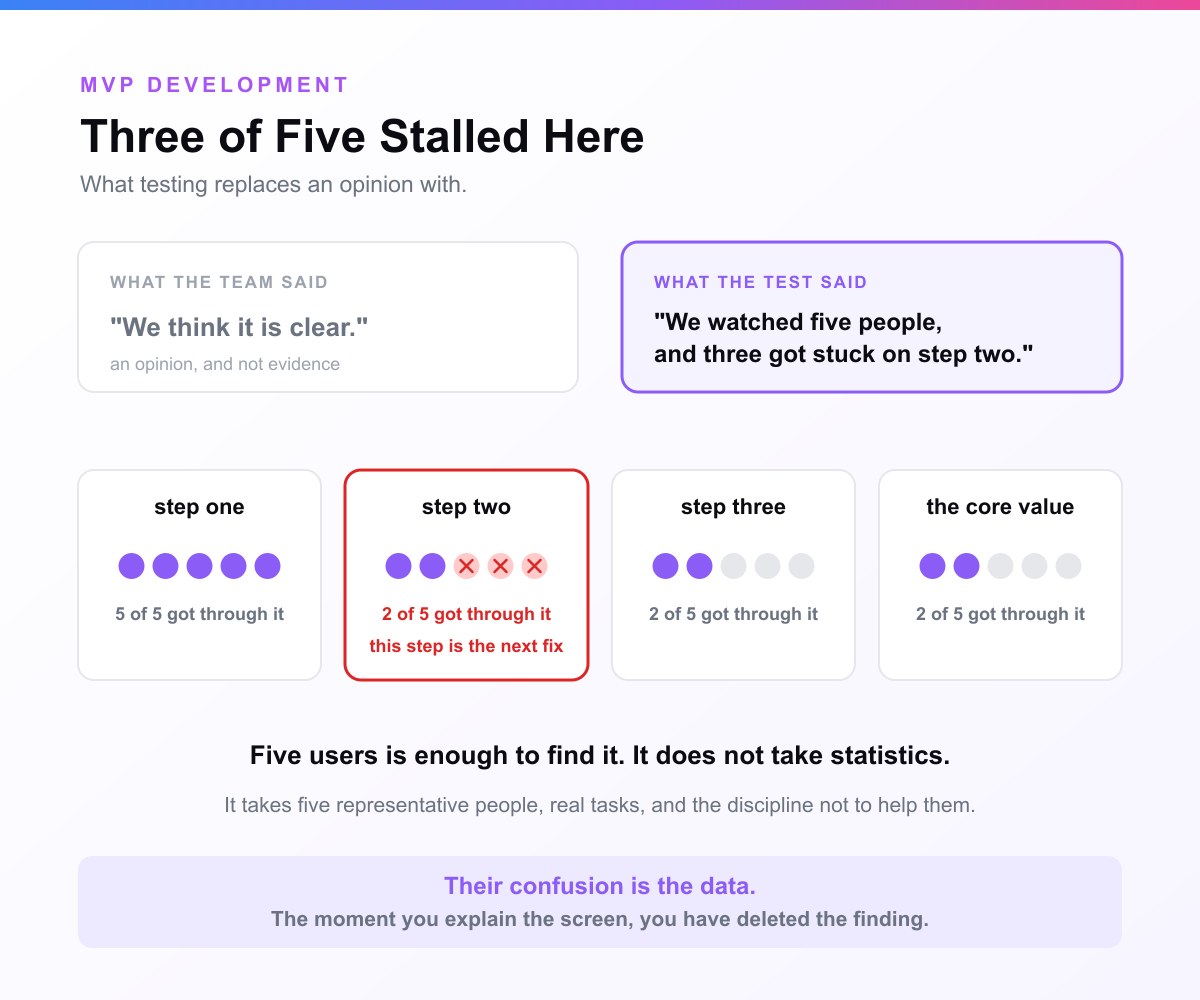
- Opinions are not evidence. What you and your team think is obvious is routinely confusing to a first-time user. Testing replaces "we think it's clear" with "we watched five people, and three got stuck on step two."
- It is cheap to fix now. A flow problem caught in testing costs minutes; the same problem caught after a full build costs days and lost users.
- It tells you what to build next. Testing surfaces the real friction and the real value, which is exactly the input your roadmap and iteration need.
The core MVP testing methods
There are a handful of methods, and most MVPs need only two or three. Pick by the question you are answering.
1. Usability testing
Watch real users try to complete your core flow, and say nothing. Usability testing answers "can people actually use this?" You give a person a real task, "sign up and create your first report," then observe where they hesitate, misread, or give up. The classic usability finding is that about five users surface the large majority of serious problems, so you do not need a big sample, you need five representative users and real tasks. This is the single highest-value MVP test, and it overlaps with the testing you should already be doing at the design stage.
Usability testing comes in two flavours, and both work for an MVP: moderated (you, or a researcher, watch live, in person or over a call, and can ask "what are you thinking?") gives you the richest insight; unmoderated (the user runs the tasks alone through a tool, with their screen recorded) is faster and cheaper to run at slightly lower depth. For an early MVP, a handful of moderated sessions usually teaches you the most.
2. A/B testing
Show two variants (of a screen, a flow, a headline) to different users and compare which performs better on a real metric. A/B testing answers "which version works better?" It is most useful once you have enough traffic for a meaningful result, so it tends to come a little later than usability testing, but even simple A/B tests on onboarding or pricing can resolve debates with data instead of opinion.
3. Beta testing
Release the MVP to a limited group of real users before a public launch. TestFlight (iOS) and Google Play testing tracks let you run closed or open betas on mobile; web MVPs use invite-only access or a waitlist cohort. Beta testing answers "does it hold up with real users in the real world?", surfacing bugs, edge cases, and friction you cannot see internally, while keeping the blast radius small. It is also how you gather the first real retention signal.
4. Smoke testing
Before anything fancy, confirm the core flow actually works end to end, every time. A smoke test is the simplest check: can a user get from entry to the core value without the path breaking? For an MVP, the core flow is the product, so a broken core flow is not a bug, it is a non-product. Smoke-test the one path that matters relentlessly.
5. Functional and QA testing
Before users can judge whether they like the product, it has to actually work. Functional (QA) testing checks that features behave correctly, inputs validate, errors are handled gracefully, and the core flow does what it should across the common cases and the obvious edge cases. For an MVP you keep this proportionate: thoroughly test the one core flow and the paths real users will actually hit, and skip exhaustive edge-case coverage of features that barely matter yet. The goal is a core flow that is genuinely reliable, not a bug-free cathedral, over-investing in QA for an unvalidated feature is just another form of over-building.
6. Manual "concierge" testing
Sometimes the fastest way to test an MVP is to do the work by hand behind the scenes, a concierge or Wizard of Oz approach, so you can test the value before you have automated it. This tests whether the outcome is wanted, separate from whether the software is finished.
MVP testing tools
You do not need an expensive stack, a few well-chosen tools cover most MVP testing. Pick one per job you actually need:
| Job | What it does | Common tools |
|---|---|---|
| Usability testing | Recruit testers, set tasks, record sessions | Maze, UserTesting, Lookback |
| Behaviour analytics | See where real users hesitate or drop | Hotjar, FullStory, UXCam |
| A/B testing | Split traffic, compare variants | PostHog, VWO, Optimizely |
| Beta distribution | Ship to a closed test group | TestFlight, Google Play testing, Firebase App Distribution |
| Product analytics | Activation, funnels, retention | PostHog, Mixpanel, Amplitude |
At the MVP stage, a single product-analytics tool plus a way to record a few usability sessions covers most of what you need, resist standing up the whole list. (Tools change; the categories above do not.)
| Method | Typical sample size | Why |
|---|---|---|
| Usability testing | ~5 users | Surfaces most serious problems; more users mostly repeat the same findings |
| Beta testing | 20 to 100 users | Enough to catch edge cases and get an early retention read |
| A/B testing | Depends on traffic and effect size | Needs statistical significance, often hundreds of users per variant |
| Smoke testing | 1 (you) | Confirms the path works at all before any real user sees it |
What good testing results look like
Testing only helps if you know what a "pass" looks like. Rough signals by method:
- Usability: a high task-success rate (most testers complete the core flow unaided), few serious errors, and little confusion. If three of five testers stall at the same step, that step is your next fix.
- A/B: a clear, statistically meaningful difference on a real metric, not a tiny lift on a handful of users. Do not call a winner before the result is significant.
- Beta: a stable, crash-light experience and, crucially, early retention, do beta users come back? That is the truest signal the product works.
- Smoke / functional: the core flow completes reliably, every time, with no broken paths.
The throughline: you are looking for evidence the product works and is wanted, not a perfect score. A few real users completing the core flow and returning beats a flawless internal demo.
The minimum viable testing process
You do not need a heavyweight QA process, you need a lean loop that fits the MVP. A workable minimal process:
- Name the question. What is the riskiest thing you need this test to tell you? (Can they use it? Will they come back? Which variant wins?)
- Pick the lightest method that answers it. Usability for "can they use it," beta for "does it hold up," A/B for "which is better."
- Recruit a few representative users. Five is enough for usability. Real target users, not friends and family.
- Give real tasks and watch, do not lead. Resist explaining; their confusion is the data.
- Instrument it. Pair qualitative observation with analytics so you have both the "why" and the "how many."
- Decide and iterate. Fix the friction, or build the next thing the test pointed to. Then repeat on the next riskiest question.
The discipline is the same as the MVP: smallest test, biggest question, fast loop.
How to test an MVP, step by step
Putting it together, testing an MVP looks like this:
- Smoke-test the core flow so it works end to end before any user sees it.
- Run usability tests with ~5 users on the one core flow, and watch where they struggle.
- Fix the serious friction those tests surfaced.
- Release to a beta group (TestFlight, Play testing, or invite-only web) to catch real-world issues and gather early retention.
- A/B test the highest-leverage decisions (onboarding, pricing) once you have traffic.
- Read the metrics alongside the qualitative findings, and feed both into your next iteration.
What to test (and what not to)
The MVP rule applies to testing too: be ruthless about focus.
- Test: the one core flow, the riskiest assumption, the moment users reach (or miss) the core value, and whether they return.
- Don't over-test: secondary screens, edge cases, settings, and features you have not validated demand for. Exhaustively testing things that should not be in the MVP is just a slower way to over-build.
You are testing whether the core idea and core flow work, not certifying a finished product.
Common MVP testing mistakes
- Confusing testing with validation. Testing whether people can use it is not the same as proving people want it, do both.
- Only testing internally. Your team is too close. Real, representative users are the only honest test.
- Leading the user. Explaining the flow during a usability test destroys the result. Watch in silence.
- Skipping instrumentation. Without analytics, you get the "why" but not the "how many", you need both.
- Over-testing the wrong things. Polishing and testing features that should not be in the MVP at all.
Test your MVP the right way, with us
Good MVP testing is the difference between shipping a product that runs and shipping one that actually works for users and answers your real questions, fast, without over-building.
That is built into how we work at MVP Development. We ship funding-ready MVPs in 3 to 4 weeks, instrumented for testing from day one, scoped to the one core flow worth testing, with usability, beta, and analytics baked in, by senior engineers, on a fixed quote you approve before we start, with full code ownership.
Explore our MVP development services, or see MVP validation and MVP metrics for the demand and measurement sides.
Building an MVP worth testing? Tell us what scares you about your current build and we will design the tests that settle it.
Related guides
- MVP validation: proving demand before you build
- MVP metrics: what to measure and the benchmarks
- MVP UX design: testing the design before you build
- MVP iteration: turning test findings into improvements
Frequently asked questions
What is MVP testing?
MVP testing is the practice of putting a built minimum viable product in front of real users to learn whether it works, whether they can use it, and whether it delivers the value you assumed, before you invest in building more. It is broader than ordinary QA: rather than just checking for bugs, it asks whether a real person can complete the core flow, understands it, and comes back. It uses a small set of methods, usability testing, A/B testing, beta testing, and smoke testing, run as a lean loop. The goal is the same as the MVP itself: learn the most with the least, by running the smallest tests that answer your riskiest questions.
How do you test an MVP?
Start by smoke-testing the core flow so it works end to end. Then run usability tests with about five representative users on that one flow, giving real tasks and watching silently where they struggle. Fix the serious friction, then release to a beta group (TestFlight, Google Play testing, or invite-only web) to catch real-world issues and gather early retention. Once you have traffic, A/B test the highest-leverage decisions like onboarding or pricing. Throughout, pair what you observe with analytics so you have both the "why" and the "how many," and feed the findings into your next iteration.
What are the main MVP testing methods?
The core methods are: usability testing (watch real users complete the core flow to find where they get stuck, about five users surfaces most serious problems); A/B testing (compare two variants on a real metric once you have traffic); beta testing (release to a limited real-user group via TestFlight, Play tracks, or invite-only access to catch real-world issues); and smoke testing (confirm the core flow works end to end every time). A manual concierge or Wizard of Oz approach can also test whether the value is wanted before the software is finished. Most MVPs need only two or three of these, chosen by the question you are answering.
Is testing necessary for an MVP?
Yes, but proportionate to the MVP. You are not running an exhaustive test suite; you are running the smallest tests that answer your riskiest questions about whether the product works and people can use it. Skipping testing is how teams ship something that technically runs but confuses every first-time user, or that "works" but answers none of the questions the MVP existed to answer. At minimum, smoke-test the core flow and run a quick round of usability testing with a few real users, those two cheap tests catch the problems that would otherwise cost you days and lost users later.
What is the difference between MVP testing and QA?
QA (quality assurance) asks "is it bug-free and technically correct?" MVP testing is broader: alongside that functional check, it asks whether real users can actually use the product, whether they want it, and whether it answers your riskiest questions. So QA is one part of MVP testing, the functional and smoke-testing part, while the rest, usability, beta, and A/B testing, is about real-user behaviour, not just code correctness. For an MVP you do enough QA to make the core flow genuinely reliable, then spend most of your testing energy learning from real users, because a product can be perfectly bug-free and still be something nobody can use or wants.
What is MVP pilot testing?
A pilot is a controlled MVP test with a small, chosen group of real users, often under a direct agreement rather than open sign-up, used when the product needs hands-on support or oversight during early use, common in enterprise, healthcare, and fintech MVPs. It sits between internal QA and a public launch: real users, real conditions, but a group small enough to support closely and learn from directly.
How do you run user testing on an MVP?
Recruit users who match your actual target, not friends and family, give them a real task tied to the core flow, and watch rather than explain. The value is in what confuses them and where they stop, not in a survey score at the end. Five to eight sessions per round is usually enough to surface the pattern, and testing the core flow this way, before and after launch, is cheaper than discovering the same confusion in your churn numbers.
How many users do I need to test my MVP?
It depends on the method. For usability testing, five is the well-established benchmark, about five representative users surface the large majority of serious problems, and adding more mostly finds the same issues repeated. For beta testing you want a larger group, often 20 to 100 depending on your product, enough to catch edge cases and get an early retention read. For A/B testing, the number depends entirely on your traffic and the size of the effect you're trying to detect, sometimes hundreds of users per variant before a result is meaningful.
What tools do I need to test an MVP?
At most five categories, and most MVPs only need two or three: a usability-testing tool (Maze, UserTesting, or Lookback) for moderated or unmoderated sessions, a behavior-analytics tool (Hotjar, FullStory) to see where users hesitate, an A/B testing tool (PostHog, VWO) once you have traffic, beta distribution (TestFlight, Google Play testing tracks) for mobile, and a product-analytics tool (PostHog, Mixpanel, Amplitude) to track activation and retention. Resist standing up the full list before you need it.
Can you test an MVP before it's fully built?
Yes, and you often should. A clickable prototype lets you usability-test the flow before writing production code, and a Wizard-of-Oz or concierge version lets you test whether the outcome delivers value while you run the back end manually. These pre-build tests are cheaper to run and catch flow and value problems before you've spent engineering time on the wrong thing, though they can't tell you whether the finished, automated product actually holds up technically, that still needs real testing after the build.
Sources & references
- Nielsen Norman Group, How Many Test Users: the "five users" usability finding
- First Round Review, The Minimum Viable Testing Process: a lean testing process
- Eric Ries, The Lean Startup: validated learning
- Atlassian, Minimum Viable Product: scoping the MVP
The 3 to 4 week figure reflects MVP Development delivery data for tightly scoped builds.


