


TL;DR
Angular is Google's full-featured, TypeScript-first framework, and unlike React (a UI library) it is a complete, batteries-included framework, which makes it an excellent MVP choice in some situations and overkill in others. It fits when you want structure out of the box; React or a lighter option is faster for simpler MVPs.
Angular is Google's full-featured, TypeScript-first web framework, and unlike React, which is only a UI library, Angular is a complete, batteries-included framework. That difference shapes the whole question of whether to build your MVP with it. The honest answer: Angular is an excellent MVP choice in specific situations, and overkill in others. This guide covers when it is smart, when React or a lighter option is faster, the modern Angular MVP stack, and how to build one.
Key Takeaways
- Angular is Google's full-featured, TypeScript-first web framework.
- Unlike React, which is only a UI library, Angular is a complete, batteries-included framework.
- It is an excellent MVP choice in specific situations, and overkill in others.
- It fits when you want structure and a full framework out of the box; React or a lighter option is faster for simpler MVPs.
- It is a spoke of the wider MVP tech stack.
At a Glance
| Aspect | Angular for an MVP |
|---|---|
| Type | Full, batteries-included framework |
| Language | TypeScript |
| Best for | Structured apps that want convention out of the box |
| Overkill for | Simple MVPs (React or a lighter option is faster) |
| Backer |
Angular is a full framework, not a library
This is the key thing to understand. React is a library that renders UI and leaves routing, forms, HTTP, and structure to you. Angular is the opposite: a complete framework that ships with a router, a powerful forms system, an HTTP client, dependency injection, a testing setup, and a first-class CLI, all in one opinionated, consistent package.
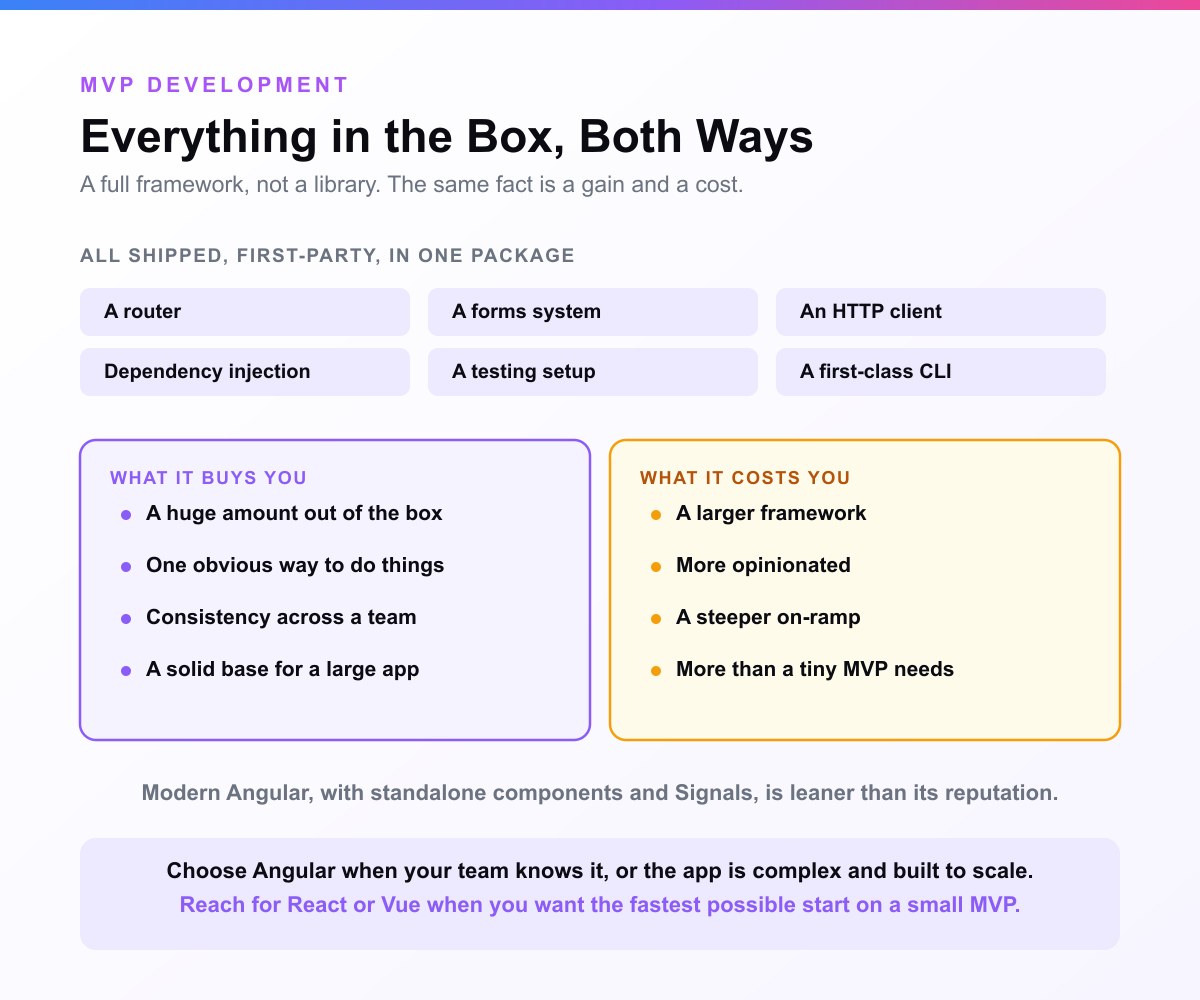
For an MVP, that cuts both ways. You get a huge amount out of the box and one obvious way to do things (great for consistency and teams), but the framework is larger and more opinionated, so it has a steeper on-ramp than the lighter options.
When Angular is a smart MVP choice
Angular genuinely shines for an MVP when:
- Your team already knows Angular. This is the biggest factor. A team fluent in Angular will ship an MVP fast in it, the "best stack" is very often the one your people already know well.
- The MVP is complex or enterprise-facing. For data-heavy, forms-heavy, or large structured apps, Angular's opinionated architecture, typing, and tooling pay off early and prevent the mess that flexible stacks can drift into.
- You expect it to grow into a big, long-lived product with a team. Angular is built for exactly this: consistency, maintainability, and strong typing at team scale, so the MVP you validate on is a solid base for a large application.
- You value one consistent way of doing things. Angular's conventions mean less bikeshedding and easier handover.
Modern Angular (with standalone components and Signals) has also cut a lot of the old boilerplate and made reactivity simpler, so it is leaner today than its reputation suggests.
The honest caveat: when React or a lighter option is faster
For a truly minimal MVP, especially a small, simple app built by a lean startup team, Angular can be more framework than you need. React (via Vite or Next.js) or Vue typically offer faster initial velocity and a larger startup-side talent pool. If your MVP is tiny, your timeline is tight, and your team does not already know Angular, a lighter stack is usually the quicker path.
So the rule is simple: choose Angular when your team knows it or the app is genuinely complex and built to scale; reach for React/Vue when you want the fastest possible start on a small MVP. We would not talk a team out of Angular if it is their strength, and we would not push a solo founder toward it for a simple idea.
What you can build fast with Angular
Angular is strongest for structured, ambitious web apps:
- Enterprise and B2B SaaS: data- and forms-heavy tools with roles and complex state.
- Dashboards and admin-heavy products: where structure and typing keep a growing app sane.
- Large, long-lived applications: anything you expect a team to maintain and extend for years.
If your MVP is a simple content site or a tiny app, Angular is usually more than you need, use a lighter path.
The Angular MVP stack (2026)
A lean, modern Angular MVP stack:
- Angular (v19+): with standalone components, Signals for reactivity, and the new control-flow syntax, all of which reduce boilerplate.
- TypeScript: first-class and mandatory in Angular, which is a strength for a growing codebase.
- Angular Material or PrimeNG: polished, ready-made component libraries for a fast, consistent UI.
- Angular CLI: scaffolding, generators, build, and test tooling out of the box.
- A BaaS backend: Firebase (via AngularFire, a natural Google pairing; see Firebase MVP) or Supabase, so you skip building a server.
- NestJS (optional backend): if you want your own API,
The seam between frontend and backend is usually where a stack changes language. Here it does not.
NestJS is an Angular-style, TypeScript backend framework, so your whole stack stays in one language and one mental model.
- Stripe: payments and subscriptions.
- Deployment: Firebase Hosting, Vercel, Netlify, or Cloudflare.
The Angular + Firebase (or Angular + NestJS) combination lets a small team ship a complete app with almost no custom infrastructure.
How to build an MVP with Angular
- Scaffold with the Angular CLI.
ng newgives you a structured, standalone-components project instantly. - Generate the core building blocks. Use the CLI to create the components and services for the one user flow that proves your idea, and resist building everything.
- Manage state with Signals. Use Signals for local and shared state, the simplest, most performant option in modern Angular.
- Wire a backend without a server. Connect Firebase (AngularFire) or Supabase for data, auth, and storage, or stand up a NestJS API if you need your own.
- Add payments if needed. Integrate Stripe for revenue.
- Deploy early. Ship to Firebase Hosting or Vercel in the first few days and keep deploying.
The discipline that matters most is scope: Angular gives you a lot, so build the one core flow, ship it, and let real usage guide what comes next.
Cost and timeline
For a team that knows Angular, a well-scoped Angular MVP ships in about 3-4 weeks, in line with our guides on MVP cost and timeline. The caveat is the learning curve: if your team is new to Angular, budget extra time, whereas an Angular-fluent team moves very fast because the framework and CLI remove so many decisions.
Proof: Angular's track record
Angular is built and used by Google, powering interfaces like the Google Cloud console and the Firebase console, and it is a mainstay of enterprise web development, used by large organisations across finance, media, and software where long-lived, maintainable applications matter. Its enterprise pedigree is exactly why it suits complex, growth-minded MVPs: the framework you validate on is proven to scale into serious, team-maintained products.
Angular vs React vs Vue for an MVP
- Angular: a full, opinionated framework (router, forms, HTTP, DI, CLI all included), TypeScript-first, strongest for complex, team-scale, long-lived apps. Steeper learning curve; smaller startup-side talent pool than React.
- React: a flexible UI library with the largest ecosystem and talent pool; usually the fastest start for a lean MVP, via Vite (SPA) or Next.js (fullstack).
- Vue: a middle ground: more batteries than React, lighter than Angular; great if your team knows it.
For most lean startup MVPs, React or Vue give faster initial velocity. Angular wins when your team is Angular-fluent or the product is complex and built to scale. As always, match the stack to your team and product.
Limitations: when not to choose Angular
- A truly minimal or simple MVP. Angular is more framework than a tiny app needs, use React/Vite or Vue for faster velocity.
- Your team has no Angular experience and a tight deadline. The learning curve is real; build in what your team knows.
- A mobile app. Angular is web-focused; for mobile use React Native or Flutter (Angular can pair with Ionic for hybrid mobile, but that is a narrower path).
- Content sites needing simple SEO. A lighter SSR setup is usually simpler.
None of these are knocks on Angular in its sweet spot, they are reminders to choose the right stack.
Build your Angular MVP with us
At MVP Development we build production-grade MVPs on the stack that fits your product and team. When Angular is the right call, a team fluent in it, or a complex, enterprise-grade app built to scale, we ship a funding-ready Angular MVP in about 3-4 weeks, on a fixed scope you approve up front, with full code ownership. And when a lighter stack would get you there faster, we will tell you, because the goal is your validated product, not a particular framework.
Explore our MVP web development service, or if you are weighing stacks, our MVP consulting will help you choose first.
Thinking of building your MVP on Angular? Ask us whether Angular fits your build and you will get an answer tied to your roadmap, not our preferences.
Related guides
- React MVP: the lighter, library-based alternative (and when it is faster)
- MVP Tech Stack: how to choose the right stack for your MVP
- Firebase MVP: the natural Google backend to pair with Angular
- How to Build an MVP: the end-to-end playbook
Frequently asked questions
Is Angular good for an MVP?
Yes, in the right situation. Angular is an excellent MVP choice when your team already knows it, or when the MVP is a complex, enterprise-facing, or long-lived app that benefits from Angular's opinionated structure, strong typing, and comprehensive tooling. For a truly minimal MVP built by a lean team that does not know Angular, React or Vue usually offer faster initial velocity. Choose Angular for complexity and consistency at scale; choose lighter stacks for the fastest small start.
Is Angular MVC or MVP (the architecture pattern)?
This is a common source of confusion, because "MVP" has two meanings. In this guide, MVP means Minimum Viable Product, the smallest launchable version of your product. As an architecture pattern, "MVP" means Model-View-Presenter, which is different again. Angular itself is component-based and often described as MVVM/MVC-style, not MVP the pattern. So you build a Minimum Viable Product (MVP) using Angular; the two senses of "MVP" are unrelated.
Angular or React for an MVP?
For most lean startup MVPs, React gives faster initial velocity, it is a lighter library with the largest ecosystem and talent pool, used via Vite (SPA) or Next.js (fullstack). Angular is the better choice when your team is already fluent in it, or when the product is complex and built to scale, where its batteries-included framework and strong typing pay off. Neither is universally better; the deciding factors are your team's skills and the product's complexity.
How long does it take to build an MVP with Angular?
For a team that knows Angular, a tightly scoped Angular MVP typically takes about 3-4 weeks, the framework's CLI and included tooling remove a lot of setup. The main variable, beyond scope, is familiarity: a team new to Angular should budget extra time for the learning curve, while an Angular-fluent team moves very quickly.
What is the best Angular stack for an MVP?
A lean modern stack is Angular v19+ with standalone components and Signals, TypeScript, a component library like Angular Material or PrimeNG for fast UI, the Angular CLI for scaffolding, and a BaaS backend, Firebase via AngularFire (a natural Google pairing) or Supabase, so you avoid running a server. Add Stripe for payments, or NestJS if you want your own TypeScript API, and deploy to Firebase Hosting, Vercel, or Netlify.
Can an Angular MVP scale?
Yes, and this is one of Angular's core strengths. It is designed for large, long-lived, team-maintained applications, and is used at enterprise scale by Google and major organisations. An MVP built on Angular sits on a foundation proven to grow into a serious product, which is exactly why it suits complex, growth-minded MVPs even if it is heavier than a lighter stack at the very start.
Sources & references
- Angular: official framework documentation
- Eric Ries, The Lean Startup: the validated-learning framework behind the MVP
- Y Combinator Library: founder guidance on building and launching early


