


Most MVP advice quietly assumes a consumer product: launch it, drive traffic, and watch the signup and retention numbers to see if people want it. That playbook breaks the moment you sell to businesses. A B2B MVP has a handful of high-value buyers, not a flood of self-serve users, and "did it work?" is answered by a signed pilot or a design partner who won't stop using it, not a dashboard of signups. This guide covers what actually changes when your customer is a company, and how to build and validate a B2B MVP without the consumer-launch assumptions that mislead most founders.
TL;DR
A B2B MVP is the smallest version of a product sold to businesses, validated through a few design partners and paid pilots rather than mass signups. Because B2B buyers are few, high-value, and multi-stakeholder (the person who buys is rarely the person who uses), you validate with depth, not volume: 3 to 5 committed customers can prove a B2B MVP, and the signals that matter are whether they adopt it inside their account, keep paying, and expand. The build stays as narrow as any MVP, one core workflow, but the path to the signal is sales-led and relationship-driven, not a launch.
If you're building B2B SaaS specifically, pair this with our SaaS MVP guide, that covers the subscription and product mechanics, while this page covers the B2B buyer and validation dimension that applies to any business product.
Key Takeaways
- A B2B MVP is validated through a few design partners and paid pilots rather than mass signups.
- B2B buyers are few, high-value, and multi-stakeholder: the person who buys is rarely the person who uses.
- You validate with depth, not volume: 3 to 5 committed customers can prove a B2B MVP.
- The signals that matter are whether they adopt it inside their account, keep paying, and expand.
- The build stays as narrow as any MVP, but the path to the signal is sales-led and relationship-driven, not a launch.
At a Glance
| Aspect | B2B MVP |
|---|---|
| Validated by | 3-5 design partners and paid pilots, not mass signups |
| Buyer | Few, high-value, multi-stakeholder (buyer is not the user) |
| Signals | Adoption inside the account, renewals, expansion |
| Path | Sales-led and relationship-driven, not a launch |
| Build scope | As narrow as any MVP: one core workflow |
What is a B2B MVP?
A B2B MVP is the smallest working version of a product sold to other businesses, built to validate that companies will adopt and pay for it, using a small number of real design-partner customers instead of a public launch. Like any minimum viable product, it's scoped to the one core workflow that delivers the value and exists to produce validated learning. What's different is who you're learning from: not thousands of anonymous users, but a few businesses whose buying decision involves multiple people, real budget, and a longer commitment.
That single fact, few high-value buyers instead of many small ones, changes how you validate, what you build, and how you read success. Everything below follows from it.
Why a B2B MVP is different (from B2C and from a generic MVP)
A generic MVP tests "do people want this?" with volume. A B2B MVP can't, because it will never have volume at the MVP stage, it might have five customers. So the differences are structural:
- Validation is depth, not volume. You can't A/B test your way to a signal with five accounts. You validate through direct relationships, watching whether a real business adopts the workflow and pays.
- The buyer is not the user. In B2C the person who decides and the person who uses are the same. In B2B, a manager or exec buys, IT or security approves, and a team actually uses it, three or more different people with different needs, all of whom your MVP has to satisfy enough.
- The sales cycle is long. A B2C user decides in seconds. A B2B deal takes weeks to months, so validation timelines stretch, and "launch and measure" is replaced by "sell and observe."
- Each customer is high-stakes. Losing one of five design partners is a real dent. That raises the bar on reliability, even for an MVP, a broken core action can cost you a validation slot you can't easily replace.
- Some "enterprise" requirements arrive early. Security, access control, and integrations that a consumer MVP defers can be non-negotiable for a business to even trial you.
The upshot: a B2B MVP is just as narrow as any MVP, one workflow, but it's validated sales-led, and it has to clear a higher trust bar to get through the door.
How to validate a B2B MVP: design partners and pilots
This is the heart of B2B MVP validation, and where it diverges most from consumer advice. You don't launch a B2B MVP, you sell it to a few businesses before or as you build it.
- Design partners. Recruit 3 to 5 target companies to build with you. They commit to using the MVP, giving detailed feedback, and shaping the core workflow in exchange for early access, influence, and often a discount. A handful of engaged design partners is the single most valuable validation asset a B2B founder can have.
- Paid pilots. A pilot, a time-boxed, paid trial with success criteria agreed up front, is the strongest B2B signal short of a full contract. Money changing hands, even a small pilot fee, proves far more than a free trial ever will.
- Letters of intent (LOIs). Before you build, a signed LOI ("we'll pay $X/month if it does Y") validates demand and willingness to pay at once, and de-risks the build. Pre-selling a B2B MVP is not just possible, it's best practice.
- Concierge delivery early. For the first customers, deliver the value manually behind the scenes, a concierge or wizard-of-oz approach, before automating. B2B buyers care that the outcome happens, not that it's fully automated on day one.
The pattern: get a small number of real businesses to commit (attention, feedback, and ideally money), then build the one workflow they need, with them.
The small-N math: why 3 to 5 customers can validate a B2B MVP
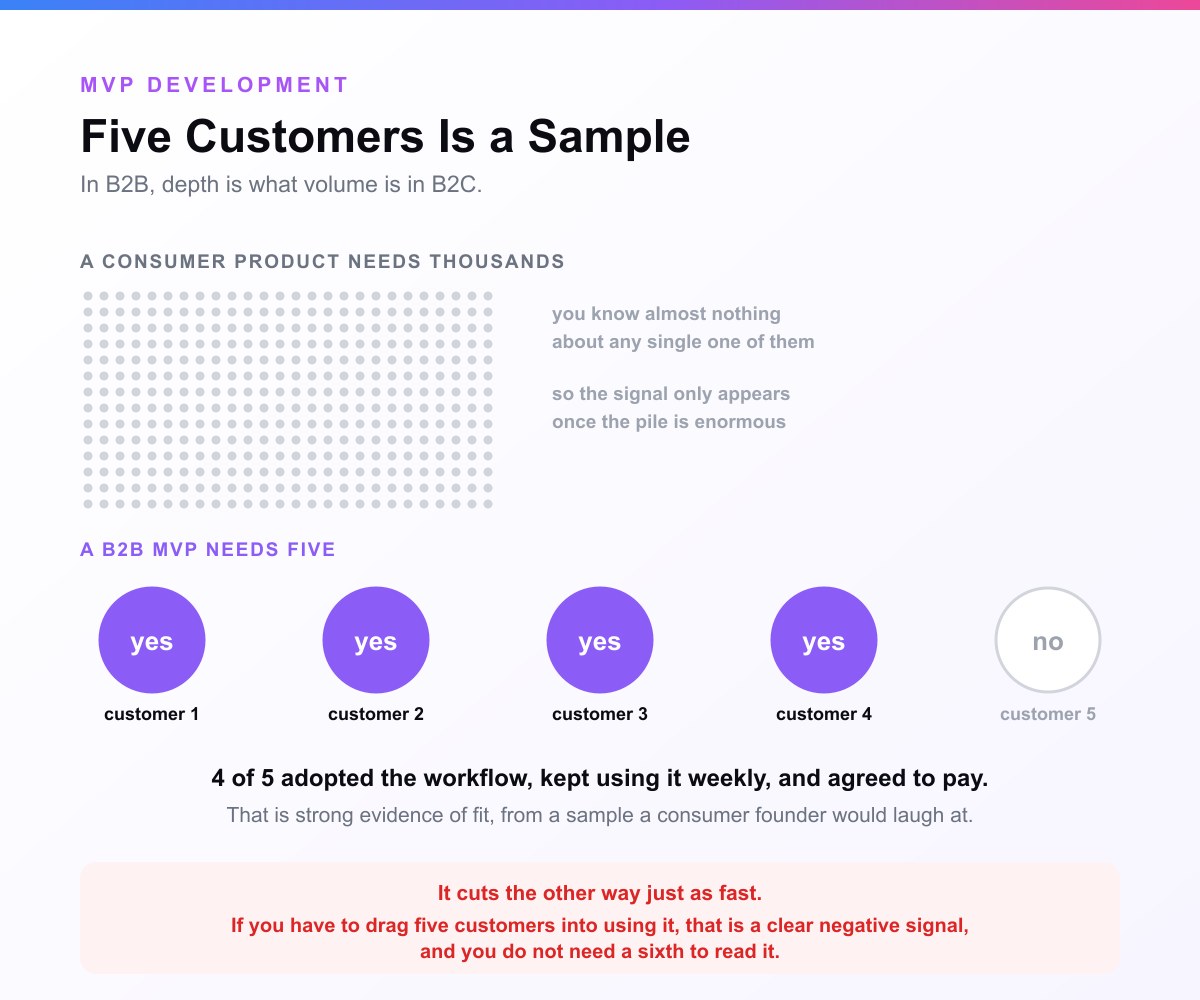
Founders trained on consumer metrics panic at "only five customers." In B2B, five can be plenty, because each one is a real, revenue-bearing signal with a face and a reason. If four of five design partners adopt the core workflow, keep using it weekly, and agree to pay, you have strong evidence of product-market fit, evidence a B2C product would need thousands of users to match. Conversely, if you have to drag them to use it, that's a clear negative signal from a tiny sample. B2B validation trades statistical volume for qualitative depth, and at the MVP stage, depth is the better currency.
Buyer vs user: who are you actually building for?
The multi-stakeholder buy is the trap that sinks B2B MVPs. You typically have to satisfy:
- The economic buyer: the manager or exec with budget, who cares about ROI, cost, and risk.
- The champion: the person who wants it and pushes it internally; often a lead user. Your MVP has to make them look good.
- The end users: the team who'll use it daily; if they won't adopt it, the deal dies at renewal.
- The gatekeepers: IT, security, procurement, who can block a purchase over a missing control.
A B2B MVP has to deliver enough for each of these, which is why "one workflow" for B2B means one workflow that the users love, the champion can sell internally, the buyer sees ROI on, and security will approve. Scope to that, not to a feature list.
Enterprise requirements at MVP stage: build vs fake
The hardest B2B MVP judgment call: some "enterprise" needs can't be deferred the way a consumer MVP defers them, but building all of them upfront kills your speed. The rule is to match the requirement to who you're selling to:
- Selling to SMBs / small teams: you can defer most of it. Basic auth, a simple permissions model, and one key integration are usually enough.
- Selling to mid-market / enterprise: SSO, audit logs, role-based access, and security posture (even a basic one) may be table stakes to trial you at all. Build the minimum that gets you through security review, and fake the rest manually where you can.
- Integrations are often the real core value in B2B, the product has to fit the customer's existing stack. One deep, working integration usually beats five shallow ones.
Ask each design partner early: "what would stop you from even piloting this?" Their answer is your true MVP requirement list, and it's often shorter than you fear.
How to measure product-market fit for a B2B MVP
Consumer PMF leans on activation and volume; B2B PMF is read from a few accounts, qualitatively:
- Adoption inside the account: are the end users actually using the core workflow weekly, not just the champion?
- Retention and renewal intent: do pilots convert to paying, and would they renew? Renewal is the truest B2B signal.
- Willingness to pay and expand: will they pay now, and is there pull to add seats or use cases (expansion)?
- The champion's "very disappointed" test: would your champion be very disappointed if they lost the product? A strong yes from even a few champions is real fit.
- Unprompted pull: are design partners asking for more, referring peers, or trying to expand usage on their own?
You won't get a clean number. You'll get a pattern across a few accounts, and in B2B, that pattern is the product-market fit signal.
A worked example: a B2B ops tool
Say you're building a tool that automates invoice approvals for finance teams.
- The wrong (consumer) approach: build a polished self-serve app, launch it, run ads, and watch signups. You'd get a trickle of curious individuals, no real accounts, and no honest signal, finance teams don't adopt tools that way.
- The B2B MVP approach: find 4 finance leaders willing to be design partners. Get one to sign an LOI. Scope the MVP to one workflow, submit an invoice → route for approval → mark paid, integrated with the one accounting system your partners use. For the first weeks, run the routing logic manually behind the scenes (wizard-of-oz) while the interface looks finished. Watch whether the finance teams (not just your champion) actually route invoices through it, and whether the pilot converts to a paid plan.
Four accounts, one workflow, one integration, delivered partly by hand, tells you more than a thousand consumer signups would. That's a B2B MVP.
Building B2B SaaS specifically
If your B2B product is SaaS (subscription software), everything above applies, and you layer on the SaaS-specific mechanics: the subscription model, the product-led vs sales-led decision, the SaaS tech stack, and charging from day one. We cover those in depth in the SaaS MVP guide, treat this page as the B2B buyer and validation half, and that one as the SaaS product half. Together they cover a B2B SaaS MVP end to end.
Common B2B MVP mistakes
- Validating like a consumer product. Launching and watching signups for a product only a few businesses will ever buy. You need design partners, not traffic.
- Building for the buyer or the user, not both. A tool the buyer loves but users won't touch dies at renewal; one users love but the buyer sees no ROI in never gets bought.
- Over-building "enterprise" upfront. Adding SSO, SOC 2, and every integration before you have a single paying pilot. Build the minimum that gets you through the door of your design partners.
- Free pilots with no success criteria. A free, open-ended trial proves nothing. Agree on what success looks like, and charge for the pilot, so the signal is real.
Cost, timeline, and building it with us
A B2B MVP fits the usual focused-build range, roughly 3 to 4 weeks for one core workflow and one key integration, though the enterprise requirements your specific buyers demand can add scope. The bigger investment in B2B is the relationship work, recruiting design partners and running pilots, which happens in parallel with the build. See how much an MVP costs and how long it takes for the ranges.
At MVP Development we build B2B MVPs the sales-led way: scope the one workflow your design partners need, build the one integration that matters, get you through security review, and ship something a business will actually pilot, in about 3 to 4 weeks on a fixed quote you approve up front.
Explore our B2B MVP development service, or if you're still lining up design partners, our MVP consulting will help you scope the smallest thing they'll commit to.
Building for business customers? Describe your buyer and their sign-off chain and we will scope an MVP that survives procurement.
Related guides
- SaaS MVP: the SaaS product mechanics (subscriptions, product-led, stack) to pair with this
- Martech MVP: the same buyer-versus-user problem, sharpened by needing access to customer data
- Concierge MVP: delivering B2B value by hand for your first customers
- MVP Validation: the wider validation toolkit
- Product-Market Fit: reading PMF signals
- How Investors Evaluate an MVP: what traction looks like in B2B
Frequently asked questions
What is a B2B MVP?
A B2B MVP is the smallest working version of a product sold to other businesses, built to validate that companies will adopt and pay for it. Unlike a consumer MVP validated by mass signups, a B2B MVP is validated through a small number of design-partner customers and paid pilots, because B2B buyers are few, high-value, and multi-stakeholder. The build is as narrow as any MVP, one core workflow, but the validation is sales-led and relationship-driven.
How do you validate a B2B MVP?
Through design partners and pilots, not launch metrics. Recruit 3 to 5 target companies to build with you and use the MVP, secure a letter of intent or a paid pilot to prove willingness to pay, and for the first customers deliver the value partly by hand (concierge / wizard-of-oz) before automating. Then read the signal from those accounts: do the end users adopt the workflow, does the pilot convert to paying, and would they renew and expand?
How many customers do you need to validate a B2B MVP?
Often just 3 to 5 engaged design partners. Because each B2B customer is a real, revenue-bearing signal, a small sample can validate (or invalidate) the MVP with confidence a consumer product would need thousands of users to match. If four of five design partners adopt the core workflow, keep using it, and agree to pay, that's strong product-market-fit evidence.
How is a B2B MVP different from a B2B SaaS MVP?
A B2B MVP is any MVP for a product sold to businesses; a B2B SaaS MVP is the subset where that product is subscription software. Everything about B2B validation, design partners, buyer-vs-user, enterprise requirements, applies to both. B2B SaaS adds the SaaS-specific layer: the subscription model, product-led vs sales-led growth, and the SaaS tech stack, which we cover in our SaaS MVP guide.
What enterprise features does a B2B MVP need?
Only the ones that would stop your specific design partners from piloting you. For SMBs, basic auth, a simple permissions model, and one key integration are usually enough. For mid-market or enterprise buyers, SSO, audit logs, role-based access, and a basic security posture may be table stakes just to get through security review. Ask each design partner "what would stop you from even piloting this?" and build the minimum that clears their answer, faking the rest manually where you can.
Sources & references
- Eric Ries, The Lean Startup: the validated-learning framework behind the MVP
- Y Combinator Library: founder guidance on building and launching early
- First Round Review: operator interviews and early-stage practice


