


TL;DR
An ecommerce MVP is the smallest version of an online store that can take a real order and charge a real card, so you learn whether people will pay before building the rest. Most ecommerce ideas die from building a polished store, wishlists, loyalty points, and reviews, before anyone buys, so the discipline is knowing what to cut.
Most ecommerce ideas die from the same mistake: the founder spends months and a big budget building a polished store with wishlists, loyalty points, reviews, and recommendation engines, before finding out whether anyone will actually buy the product. An ecommerce MVP flips that. It is the smallest version of an online store that can do the one thing that matters, take a real order and charge a real card, so you learn whether people will pay before you build the rest.
This guide covers what an ecommerce MVP is, what to include and (more importantly) what to cut, which platform to launch on, and how to get one live fast. It is the practical companion to our ecommerce MVP development service.
Key Takeaways
- An ecommerce MVP is the smallest version of an online store that can take a real order and charge a real card.
- It exists so you learn whether people will pay before you build the rest.
- Most ecommerce ideas die from building a polished store (wishlists, loyalty points, reviews, recommendations) before anyone buys.
- The discipline is knowing what to cut, not just what to include.
- Get one live fast on the right platform, then add features only once orders prove demand.
At a Glance
| Include (core) | Cut (for now) |
|---|---|
| Take a real order | Wishlists |
| Charge a real card | Loyalty points |
| One product or a few | Reviews and ratings |
| A simple checkout | Recommendation engines |
| A basic product page | Advanced merchandising |
What is an ecommerce MVP?
An ecommerce MVP (minimum viable product) is the smallest, functional version of an online store, one that lets a real customer find a product, pay for it, and receive it, built to test whether people will actually buy before you invest in a full store. Its job is to prove demand and willingness to pay with the least possible time and money.
The defining line for an ecommerce MVP is simple: it must be able to complete a real transaction. A landing page can test interest, but an ecommerce MVP tests purchase: real money changing hands. Everything beyond that first completed sale is a feature you can add later, once you know the demand is real.
What makes an ecommerce MVP different
Unlike a SaaS MVP (a subscription tool) or a marketplace MVP (a two-sided platform),
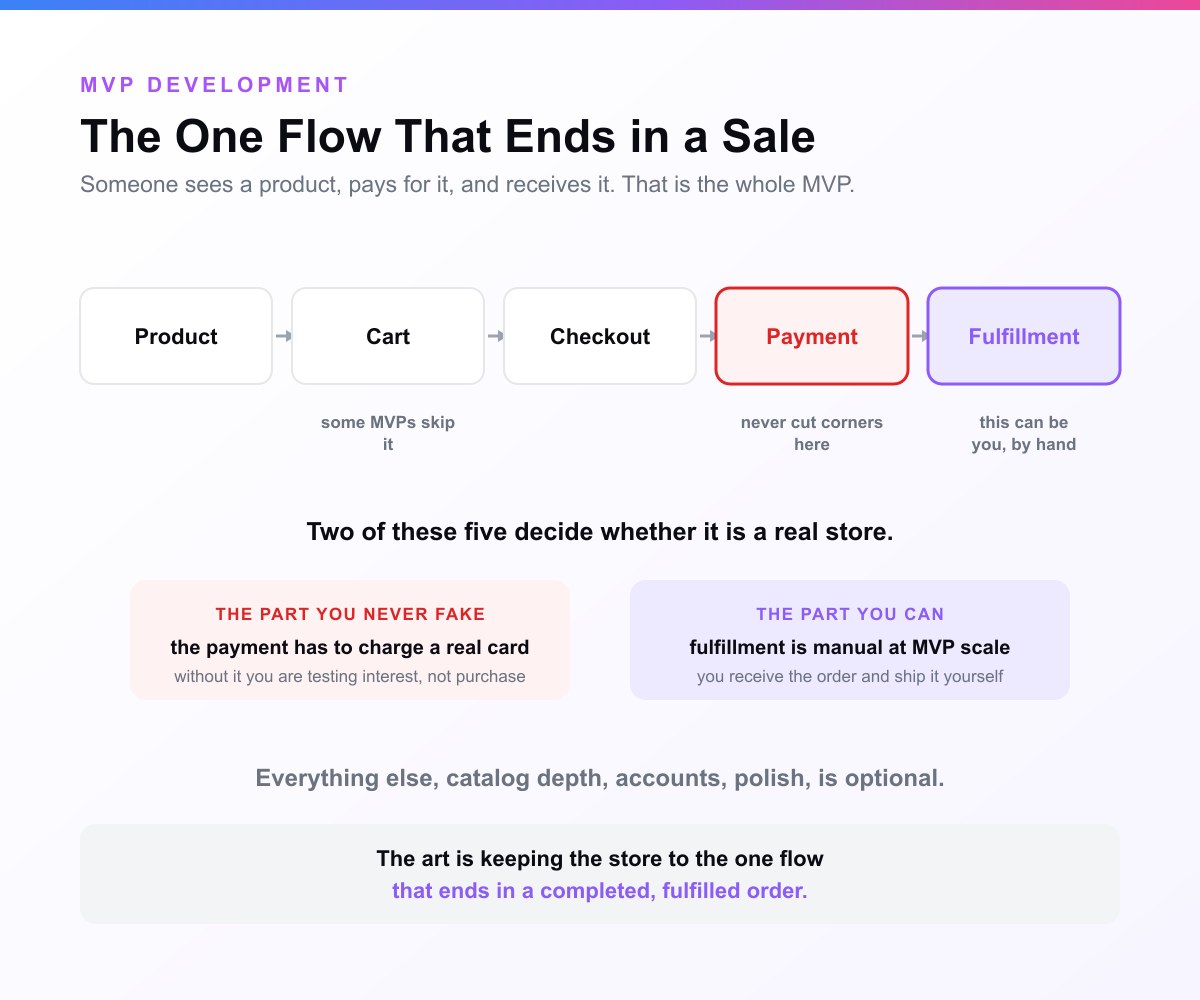
an ecommerce MVP is a single-seller store: you sell your own products to buyers. That focuses the whole MVP on one conversion flow, product → cart → checkout → payment → fulfillment, and it means two things a lighter MVP can skip are non-negotiable here:
- A working payment path. The MVP has to charge a real card (via Stripe, PayPal, or the platform's built-in checkout). Without that, you are testing interest, not purchase.
- Order fulfillment. Someone has to actually get the product to the customer, and for an MVP that someone can be you, packing and shipping by hand.
Everything else, the catalog depth, the account system, the polish, is optional at MVP stage. The art is keeping the store to the one flow that ends in a completed, fulfilled order.
The core elements of an ecommerce MVP
Only the must-haves for a customer to buy:
- A product catalog: even a single-product page, with clear photos, a description, and a price. It does not need hundreds of SKUs; it needs one thing worth buying.
- A simple cart: basic and intuitive (some single-product MVPs skip the cart and go straight to checkout).
- Secure checkout: a reliable payment gateway (Stripe, PayPal, or the platform's checkout). This is the part you never cut corners on.
- Order fulfillment: a process to get the product to the buyer. At MVP scale this is usually manual: you receive the order and ship it yourself.
That is the whole MVP: someone can see a product, pay for it, and receive it. Notice what is not on the list.
What to cut from an ecommerce MVP
The features that feel essential but are not, for a first version:
- Loyalty and rewards programs
- Product reviews and ratings
- Recommendation engines ("customers also bought")
- Wishlists and saved carts
- Accounts (guest checkout is fine for an MVP)
- A large catalog, filters, and complex search
- Multiple shipping options and international tax logic
Every one of these can be added later, guided by real customer behaviour, once the core purchase is validated. Adding them up front is how a lean test becomes a six-month build for a store nobody has bought from yet.
Ecommerce MVP vs marketplace MVP
These get confused, and building the wrong one wastes the experiment:
- An ecommerce MVP is a single-seller store, you own the inventory and sell to customers. The risk you are testing is: will people buy my product?
- A marketplace MVP is two-sided, you connect independent sellers and buyers, and the hard problem is the chicken-and-egg of getting both sides. The risk is liquidity, not just demand.
If you are selling your own products, build an ecommerce MVP (this guide). If you are enabling others to sell, you have a marketplace, start with the marketplace MVP guide instead, because the validation problem is fundamentally different.
How to build an ecommerce MVP
You almost never build an ecommerce MVP from scratch, existing platforms get you selling in days:
- Validate before you build. Test demand first with a landing page, a waitlist, a pre-order, or even a post in a relevant community. If nobody signs up or pre-orders, you have learned it cheaply. This is the same validation discipline behind every MVP.
- Pick the fastest platform for your case:
- Hosted store (Shopify): the fastest way to a real, payment-taking store with almost no technical work. The default for most ecommerce MVPs.
- No-code / low-code (Webflow, Squarespace): for a more custom storefront without building from scratch.
- Social commerce (Instagram/Facebook shops): the ultra-lean option: test selling before you even have a dedicated site.
- Custom build: only when your model genuinely does not fit the platforms (unusual checkout, deep integrations); most MVPs do not need this.
- Wire up real payments. Stripe, PayPal, or the platform's checkout, so you can take actual money.
- Fulfil manually. Pack and ship orders yourself at first; do not build warehouse or logistics software for an MVP.
- Launch to a small, real audience and watch what happens.
The lean play: fake the back end, not the purchase
The smartest ecommerce MVPs keep the storefront real but the operations manual, the classic "concierge" approach. The most famous example is Zappos: before building any inventory or logistics, the founder photographed shoes in local stores, put them online, and when an order came in, bought the pair at retail and shipped it himself, sometimes at a loss. The customer's experience (browse, buy, receive) was completely real; the back end was a person doing it by hand. That validated "will people buy shoes online?" for almost nothing.
Your ecommerce MVP can do the same: real product, real checkout, real payment, manual everything behind the curtain. The purchase must be genuine; the operations can be faked until demand justifies automating them.
Metrics that matter for an ecommerce MVP
Judge it by purchase behaviour, not vanity traffic:
- Conversion rate: of visitors who reach the store, how many actually buy? The core signal.
- Average order value (AOV): what a customer spends per order.
- Customer acquisition cost (CAC): what it costs to get one buyer, and whether AOV can eventually cover it.
- Repeat purchase rate: do buyers come back? Early signal of a real business, not a one-off.
These tell you whether you have a viable store or just curious browsers. See MVP metrics for the wider framework.
Cost and timeline
Because you launch on an existing platform and fulfil by hand, an ecommerce MVP is one of the cheapest and fastest MVPs to get live, a Shopify or Webflow store can be selling within days, and a more custom build still fits the usual 3-4 weeks for a tightly scoped MVP. See how much an MVP costs and how long it takes for the full picture. The biggest cost lever is not building custom when a hosted platform would prove the idea just as well.
Common ecommerce MVP mistakes
- Over-building the store. Loyalty, reviews, and recommendations before a single sale is the classic trap.
- Building custom when Shopify would do. Months of development to replicate what a hosted platform gives you in an afternoon.
- Skipping validation. Launching a full store before testing whether anyone wants the product.
- Automating operations too early. Building fulfillment or inventory software before demand justifies it, do it by hand first.
- Testing interest instead of purchase. A waitlist is a start, but the ecommerce MVP's real job is to prove people will pay.
Build your ecommerce MVP with us
At MVP Development we help founders launch ecommerce MVPs the lean way, on the right platform, with a real checkout, scoped to the one flow that proves people will buy, and only building custom when the model genuinely needs it. When you do need a custom store or deeper integrations, we ship a production-grade, fully-owned build in about 3-4 weeks.
Explore our ecommerce MVP development service, or if you are still choosing an approach, our MVP consulting will help you decide before you spend.
Thinking of launching an ecommerce MVP? Describe what you are selling and to whom and we will scope the storefront that proves demand.
Related guides
- Foodtech MVP: physical goods with a perishability and time-window constraint
- Marketplace MVP: if you are enabling others to sell (two-sided), not selling your own products
- Supply Chain MVP: the fulfillment and delivery layer most ecommerce MVPs eventually plug into
- The Zappos MVP: the classic fake-the-backend ecommerce validation story
- MVP Validation: proving demand before you build the store
- Webflow MVP: a no-code route for a custom storefront
Frequently asked questions
What is an MVP in ecommerce?
An MVP in ecommerce is the smallest functional version of an online store, one that lets a real customer find a product, pay for it, and receive it. Its purpose is to test whether people will actually buy, and pay, before you invest in a full-featured store. The defining requirement is that it can complete a real transaction: unlike a landing page that only tests interest, an ecommerce MVP charges a real card.
How do you build an ecommerce MVP?
Validate demand first (a landing page, waitlist, or pre-order), then launch on the fastest platform for your case, usually a hosted store like Shopify, a no-code builder like Webflow or Squarespace, or even a social-commerce shop. Wire up a real payment gateway (Stripe, PayPal, or the platform's checkout), fulfil orders manually at first, and launch to a small real audience. You rarely need a custom build to validate an ecommerce idea.
What features does an ecommerce MVP need?
Only the must-haves for a customer to buy: a product catalog (even a single product) with clear photos, description, and price; a simple cart; a secure checkout with a real payment gateway; and a way to fulfil the order (manual is fine at MVP stage). Cut everything else, loyalty programs, reviews, recommendations, wishlists, accounts, and large catalogs, until real purchase behaviour tells you what to add.
What is the difference between an ecommerce MVP and a marketplace MVP?
An ecommerce MVP is a single-seller store: you own the products and sell to customers, and the risk you test is whether people will buy your product. A marketplace MVP is two-sided: it connects independent sellers with buyers, and the hard problem is liquidity, getting enough of both sides at once (the chicken-and-egg problem). If you sell your own products, build an ecommerce MVP; if you enable others to sell, build a marketplace MVP, because the validation challenge is different.
What is the best platform for an ecommerce MVP?
For most founders, Shopify is the fastest way to a real, payment-taking store with minimal technical work. Webflow or Squarespace suit a more custom storefront without coding, and social-commerce shops (Instagram, Facebook) are the leanest way to test selling before building a site at all. A custom build is only worth it when your model genuinely does not fit these platforms, most MVPs validate perfectly well on a hosted store.
How much does an ecommerce MVP cost?
Because you can launch on an existing platform and fulfil orders by hand, an ecommerce MVP is one of the cheapest MVPs to get live, often just the platform subscription and payment fees to start selling within days. A more custom build (unusual checkout, deep integrations) still fits the typical 3-4 week MVP range. The biggest saving is resisting a custom build when a hosted platform would validate the idea just as well.
Sources & references
- Eric Ries, The Lean Startup: the validated-learning framework behind the MVP
- Y Combinator Library: founder guidance on building and launching early
- Minimum viable product: origin and definition of the term


