


The MVP asks "does this work, and do people want it?" But a growing view says that in 2026, working is not the bar, the experience is. Enter the MVE, the Minimum Viable Experience: instead of shipping the smallest thing that functions, you ship the smallest thing whose whole user journey feels smooth, intuitive, and satisfying. This guide compares MVP vs MVE honestly, shows how MVE differs from the other "experience-first" concepts, and helps you decide which one your market actually rewards.
TL;DR
An MVP (Minimum Viable Product) is the smallest version you build to test whether an idea works and is wanted, accepting rough edges. An MVE (Minimum Viable Experience) is the smallest version whose entire user experience, usability, design, and emotional response, is smooth and satisfying from the first session. The MVP optimizes for validated learning with tolerant early adopters; the MVE optimizes for experience quality across the whole journey, for a broader, less forgiving audience. Same narrow scope, but the MVE holds the bar at "how does using this feel?" rather than "does it technically function?"
The honest answer to "which do I need?" is: an MVP when your risk is demand and your early users are tolerant, and an MVE when you're in a crowded, consumer-facing market where a rough experience gets you abandoned before you learn anything.
Key Takeaways
- An MVP is the smallest version built to test whether an idea works, accepting rough edges.
- An MVE (Minimum Viable Experience) is the smallest version whose entire user experience is smooth and satisfying from the first session.
- The MVP optimizes for validated learning with tolerant early adopters; the MVE optimizes for experience quality across the whole journey.
- Build an MVP when your risk is demand and early users are tolerant; build an MVE in a crowded, consumer-facing market where a rough experience gets you abandoned.
MVP vs MVE: the difference that matters most
The one-line version: an MVP tests whether the product works, an MVE tests whether the experience is good enough that people stay.
An MVP is happy to be rough because its early adopters forgive missing polish, they're there for the idea. An MVE assumes a broader, less tech-savvy audience who will judge the product by how it feels to use: is it intuitive, is the journey smooth, is it pleasant? So the MVE spends its effort making the whole experience coherent, not just the core function operational.
What is an MVP?
A minimum viable product is the smallest version of a product that lets you test your riskiest assumption with real users, for the least time and money. Its purpose is validated learning: ship the core, watch how people respond, and decide whether to persevere or pivot. The MVP deliberately cuts polish, because its bet is that early adopters will look past rough edges to the underlying value, and what you learn matters more than how refined it looks.
What is an MVE (Minimum Viable Experience)?
A Minimum Viable Experience is the smallest version of a product whose entire user journey, usability, visual design, and emotional response, is smooth and satisfying from the first use. Where the MVP asks "does it function?", the MVE asks "how does the user feel while using this?" It keeps the scope just as narrow, but treats the experience, onboarding, flow, clarity, and polish across the whole path, as part of the product, not a later refinement.
The bet behind the MVE is that most modern users are not forgiving early adopters. They're a broad audience with alternatives and short patience, and they abandon products that feel clunky, even functional ones. So the MVE delivers a complete experience on a narrow scope, rather than a complete function with a rough experience.
MVP vs MVE: side-by-side comparison
| MVP (Minimum Viable Product) | MVE (Minimum Viable Experience) | |
|---|---|---|
| Core question | Does it work, and do people want it? | How does using it feel? |
| Optimizes for | Validated learning, technical viability | A smooth, satisfying whole journey |
| The bar | It functions | The experience is coherent and pleasant |
| Audience | Tolerant early adopters | A broader, less forgiving audience |
| Feedback centers on | Do the core features work? | Functionality and how users feel |
| Main risk | Churn from a neglected experience | Polishing an experience nobody wanted |
The core trade-off: function vs experience
MVP and MVE bet on different risks:
- The MVP bets your biggest risk is demand, so getting a functional version in front of users fast, even a rough one, is the quickest honest test. Experience polish can wait for a "yes."
- The MVE bets your biggest risk is abandonment, that a broad audience will bounce off a clunky experience and you'll misread it as "no demand." So the experience is what you're testing.
Pick the wrong bet and you waste the release: ship a rough MVP to a mainstream audience and they leave before they see the value; polish an MVE before validating demand and you've perfected a journey no one wanted to take.
When to choose an MVP (and when an MVE)
Choose an MVP when your market is new or underserved, your early users are tolerant (design partners, technical early adopters), demand itself is the open question, or your budget only stretches to answering "do they want it?"
Choose an MVE when you're building consumer-facing apps or SaaS for non-technical users, your market is crowded and experience drives adoption, or retention and first-session loyalty are paramount, cases where a rough experience produces a false negative because the audience never gets past it.
MVE vs the "experience-first" family (MAP, MDP, MLP, EVP, SLC)
Here's where founders get tangled, because MVE joins a crowded family of "raise the bar above bare-bones" concepts, and they overlap heavily. The honest truth is the label matters less than the emphasis:
- MVE (Minimum Viable Experience): the whole user journey being smooth and satisfying, end to end, for a broad audience.
- MAP (Minimum Awesome Product): one memorable "wow" moment in the core flow.
- MDP (Minimum Delightful Product): the interaction is delightful; MAP's near-twin.
- MLP (Minimum Lovable Product): the emotional love and retention it earns.
- EVP (Exceptional Viable Product): willing to delay launch for a polished, market-ready product.
- SLC (Simple, Lovable, Complete): a small thing that is whole rather than a fragment.
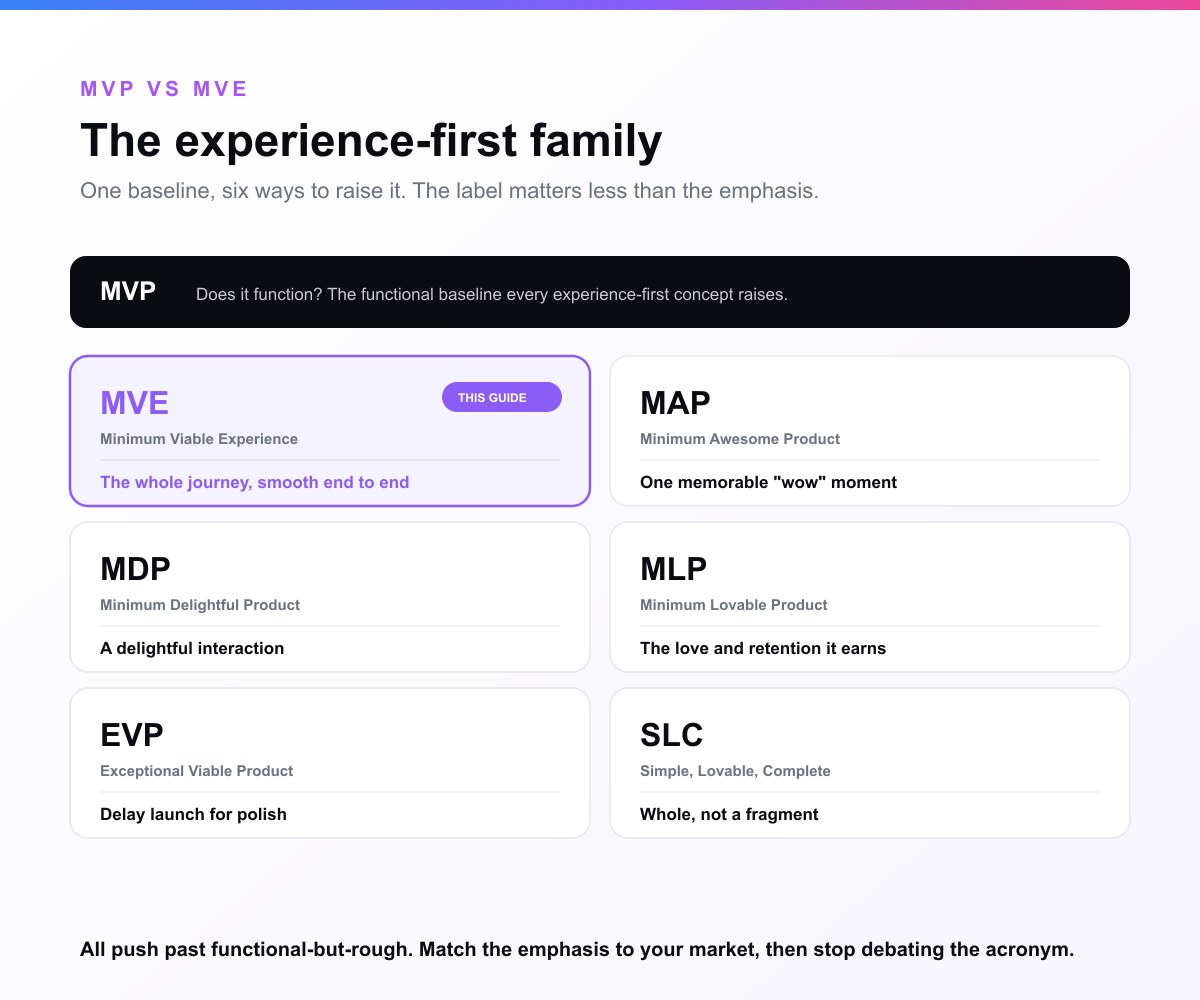
The through-line is identical: all of them push back on shipping something purely functional-but-rough, and argue a minimal product should still feel good. MVE's specific emphasis is the end-to-end experience for a broad, non-technical audience rather than a single delightful moment or the emotion it evokes. In practice teams use these terms interchangeably, so don't agonize over which one, match the emphasis to your market and move on.
Is an MVE just a polished MVP?
Largely, yes, and it's worth being honest about that. An MVE is an MVP held to an experience standard instead of a purely functional one. The reason the term exists is a real MVP failure mode: a too-rough MVP shown to a mainstream audience produces a false negative, people abandon it for the clunky experience, and you conclude "no demand" when you only ever tested an unpleasant version. The MVE is the correction, keep it minimal, but make the minimum something that feels good to use.
A worked example: a budgeting app
Say you're building a personal budgeting app.
- The MVP: connect a bank, show a dashboard of transactions and a monthly total. It works, and a technical early adopter can confirm the concept. But a mainstream user opens it, finds the setup confusing and the dashboard plain, and never returns, so you learn nothing true about demand.
- The MVE: same narrow scope, connect a bank and see your spending, but the whole journey is considered: a friendly two-step onboarding, a clean dashboard, and one clear, reassuring insight ("you're on track this week"). Same feature. But the experience is smooth enough that a non-technical user actually sticks around, so the signal you get is real.
The MVE didn't add features. It made the one core journey feel good, which, for a broad audience, is what determines whether they stay.
Common mistakes founders make
- Shipping a rough MVP to a mainstream audience. Early-adopter tolerance doesn't transfer; a broad audience judges on experience and leaves.
- Confusing "experience" with "more features." An MVE polishes the journey on a narrow scope, it doesn't widen it. Adding features is the opposite move.
- Building an MVE before validating demand. Perfecting an experience for a product no one wants is the classic over-build, just dressed as UX. If demand is unproven, that's an MVP job.
- Endless polishing. The MVE mindset can slide into never shipping. Set an experience bar and a date, then launch.
Build your MVP or MVE with us
At MVP Development we help founders pick the right bar, a lean MVP when demand is the question, or a Minimum Viable Experience when your audience judges on how the product feels, and then build it, scoped to one core journey, polished where your market demands it, shipped in about 3-4 weeks on a fixed quote you approve up front.
If you're not sure which bar your market rewards, our MVP consulting will help you decide before you spend, and our UX design is where a "viable product" becomes a "viable experience."
Building for a broad, experience-driven audience? Tell us the experiment you are itching to run and we will build only what the data needs.
Related guides
- MVP vs MAP: Minimum Awesome Product, the single-"wow"-moment cousin
- MVP vs EVP: Exceptional Viable Product, the delay-for-polish strategy
- MVP vs MLP: Minimum Lovable Product
- MVP vs SLC: Simple, Lovable, Complete
- MVP UX Design: how to make the experience good without bloat
Frequently asked questions
What is the difference between an MVP and an MVE?
An MVP (Minimum Viable Product) is the smallest version you build to test whether an idea works and is wanted, and it accepts a rough experience because early adopters forgive it. An MVE (Minimum Viable Experience) is the smallest version whose whole user journey, usability, design, and emotional response, is smooth and satisfying from the first session, because it targets a broader, less forgiving audience. Same narrow scope; the MVE just holds the bar at "how does this feel to use?" instead of "does it function?"
What does MVE stand for?
MVE stands for Minimum Viable Experience, the smallest version of a product whose entire user experience is polished and satisfying, rather than merely functional. It shifts the focus of a minimal product from technical viability to the quality of the user's journey.
Should I build an MVP or an MVE?
It depends on your audience and market. If your early users are tolerant technical adopters and your real risk is demand, a lean MVP that answers "do they want it?" fast is the right, cheaper call. If you're building consumer-facing software for a broad, non-technical audience in a crowded market, where a clunky experience gets you abandoned before you learn anything, an MVE's investment in a smooth experience can be worth it. Only choose an MVE once demand is at least plausible; polishing an experience before validating demand is an expensive way to be wrong.
Is an MVE the same as an MLP or MAP?
They're close cousins that overlap heavily. MVE emphasizes the whole end-to-end experience/journey for a broad audience; MLP (Minimum Lovable Product) emphasizes the emotional love and retention a product earns; MAP (Minimum Awesome Product) emphasizes a single delightful "wow" moment. In practice teams use the terms interchangeably, so the useful move is to match the emphasis to your market rather than debate the acronym. See our MVP vs MLP and MVP vs MAP comparisons for those angles.
Is an MVE just a polished MVP?
Essentially, yes, an MVE is an MVP held to an experience standard rather than a purely functional one. The term exists because a too-rough MVP shown to a mainstream audience can produce a false negative: people abandon it for the clunky experience, and you misread that as "no demand." The MVE keeps the product minimal but makes the minimum feel good to use, so the signal you get from a broad audience is honest.
Sources & references
- Eric Ries, The Lean Startup: the validated-learning framework behind the MVP
- Y Combinator Library: founder guidance on building and launching early


