


The classic advice is to ship a scrappy MVP and learn fast. But in a crowded 2026 market, a growing camp of founders argues the opposite: don't launch bare-bones at all, delay until you have something genuinely exceptional, because a rough first impression in a saturated category gets you deleted before you learn anything. That's the EVP, the Exceptional Viable Product. This guide compares MVP vs EVP honestly, and helps you decide which strategy your market actually rewards.
TL;DR
An MVP (Minimum Viable Product) launches the smallest thing that works, to learn whether people want it, fast and cheap. An EVP (Exceptional Viable Product) deliberately delays launch to ship a polished, premium, market-ready product that makes a strong first impression. The MVP optimizes for speed and validated learning; the EVP optimizes for first-impression quality in competitive markets where users expect polish. They're two go-to-market strategies with opposite bets: the MVP bets that learning beats polish, the EVP bets that in a crowded market, polish is the thing you're testing.
The honest answer to "which do I need?" is: an MVP when your market is new or unproven and your risk is demand, and an EVP when the category is saturated, users have polished alternatives, and a rough launch would be rejected for the wrong reason.
(Note: in esports, "EVP" means an Exceptionally Valuable Player award, this guide is about the product-development term, Exceptional Viable Product.)
Key Takeaways
- An MVP launches the smallest thing that works, to learn whether people want it, fast and cheap.
- An EVP (Exceptional Viable Product) delays launch to ship a polished, premium, market-ready product.
- The MVP optimizes for speed and learning; the EVP optimizes for first-impression quality in competitive markets.
- Build an MVP when the market is new and your risk is demand; build an EVP when the category is saturated and a rough launch would be rejected.
MVP vs EVP: the difference that matters most
The one-line version: an MVP asks "what's the least we can ship to learn?", an EVP asks "what's the least we can ship that's genuinely excellent?"
An MVP is happy to launch rough and iterate in public, because its job is to answer a question cheaply. An EVP refuses to launch rough at all: it holds the release until the product is polished enough to impress, accepting more time and cost in exchange for a strong debut. The MVP treats the first version as an experiment; the EVP treats it as a first impression you only get once.
What is an MVP?
A minimum viable product is the smallest version of a product that lets you test your riskiest assumption with real users, for the least time and money. Its purpose is validated learning: ship the core, watch how people respond, and decide whether to persevere or pivot before over-investing. The MVP deliberately cuts polish and secondary features, because its bet is that what you'll learn matters more than how refined the first version looks.
What is an EVP (Exceptional Viable Product)?
An EVP (Exceptional Viable Product) is a product launched only once it delivers a polished, high-quality experience on a focused set of features, delaying release to make a strong, lasting first impression in a competitive market. Instead of the smallest thing that works, an EVP is the smallest thing that's genuinely excellent: a refined, market-ready product with a narrow but premium scope. The bet is that in saturated categories, where users have plenty of good alternatives, a barely-functional launch won't be forgiven, so you invest the extra time and money upfront to debut something people love on sight.
An EVP isn't a bloated product with every feature. Like an MVP, its scope is narrow. The difference is the quality bar and the willingness to delay launch to clear it.
MVP vs EVP: side-by-side comparison
| MVP (Minimum Viable Product) | EVP (Exceptional Viable Product) | |
|---|---|---|
| Core question | Does anyone want this? | Will people be impressed on day one? |
| Optimizes for | Speed & validated learning | First-impression quality |
| Launch timing | As early as possible | Delayed until it's polished |
| The bar | It works | It's excellent |
| Cost & time | Lower | Higher |
| Best for | New/unproven markets, seed stage | Saturated markets, funded companies, strong-brand plays |
| Main risk | A rough launch buries a good idea | You polish (and delay) something nobody wanted |
The core trade-off: learning vs first impression
MVP and EVP are really a bet on which risk is bigger:
- The MVP bets that your biggest risk is demand, so the fastest, cheapest way to a real answer wins, even if the product is rough. Getting to the truth quickly is worth more than a good first impression.
- The EVP bets that your biggest risk is the first impression itself, that in your market, a rough launch produces a false negative (people reject the roughness, not the idea) and burns a launch you can't repeat. So polish is the experiment.
Pick the wrong bet and you waste the release: launch a rough MVP into a polished, crowded category and users bounce; delay for an EVP in an unproven market and you spend months perfecting something nobody wanted.
When to choose an MVP (and when an EVP)
Choose an MVP when the market is new or underserved, your early users are tolerant (design partners, early adopters), demand is genuinely unproven, or your budget only stretches to answering "do they want it?" In those cases, polish is premature, spend it after you have a yes.
Choose an EVP when the category is crowded and users compare you to refined incumbents, first impressions drive retention (most consumer apps), you're funded enough to invest in quality upfront, or your brand and reputation are core to the strategy. Here, a rough launch teaches you nothing true, because it's testing a version no one in that market would accept.
EVP vs the "minimal but great" family (MAP, MLP, MDP, SLC)
Here's where founders get tangled, because the EVP joins a small family of "raise the bar above bare-bones" concepts. The key distinction: EVP is the one that's willing to delay launch for exceptional quality, while the others keep shipping minimal, just minimal-and-great.
- EVP (Exceptional Viable Product): delay launch to ship something polished and market-ready; the most quality-and-timing-focused of the set.
- MAP (Minimum Awesome Product): ship minimal but delightful; the first-impression "wow" on a small scope.
- MLP (Minimum Lovable Product): ship minimal but emotionally loved, the least people would be sad to lose.
- MDP (Minimum Delightful Product): ship minimal but delightful; MAP's near-twin.
- SLC (Simple, Lovable, Complete): ship something small but whole rather than a fragment.
- MVE (Minimum Viable Experience): ship minimal but with the whole user journey polished, for a broad audience.
The through-line: MAP, MLP, MDP, and SLC all keep the MVP's ship-something-small-now instinct and raise the quality bar within it. The EVP is the outlier that says, in some markets, don't ship small-and-rough at all, wait and ship excellent. Match the emphasis to your market, and don't agonize over the acronym.
Is an EVP just a polished MVP?
Almost, but the distinction is the launch decision. A polished MVP still ships as early as it can; an EVP explicitly withholds launch until the quality bar is met, trading time and money for a better debut. So an EVP is best understood not as a different artifact but as a different go-to-market strategy: same narrow scope, higher quality bar, later launch. If your market punishes rough launches, that trade can be worth it; if it doesn't, you've just made your MVP slower and more expensive for no gain.
A worked example: a project-management app
Say you're launching yet another project-management tool, one of the most saturated software categories there is.
- The MVP approach: ship a bare-bones task list in three weeks, launch it, and learn. The problem: buyers in this category already use Asana, Linear, and Notion. A rough task list doesn't teach you whether your idea is good, it just gets ignored, because the bar to earn a switch is high. You get a false negative.
- The EVP approach: spend eight weeks instead of three, but launch a genuinely delightful, fast, beautifully-designed tool that does one thing (say, effortless client-facing task sharing) better than any incumbent. Same narrow scope, one workflow, but polished to the point that people who try it want to switch. In a saturated market, that first impression is the experiment.
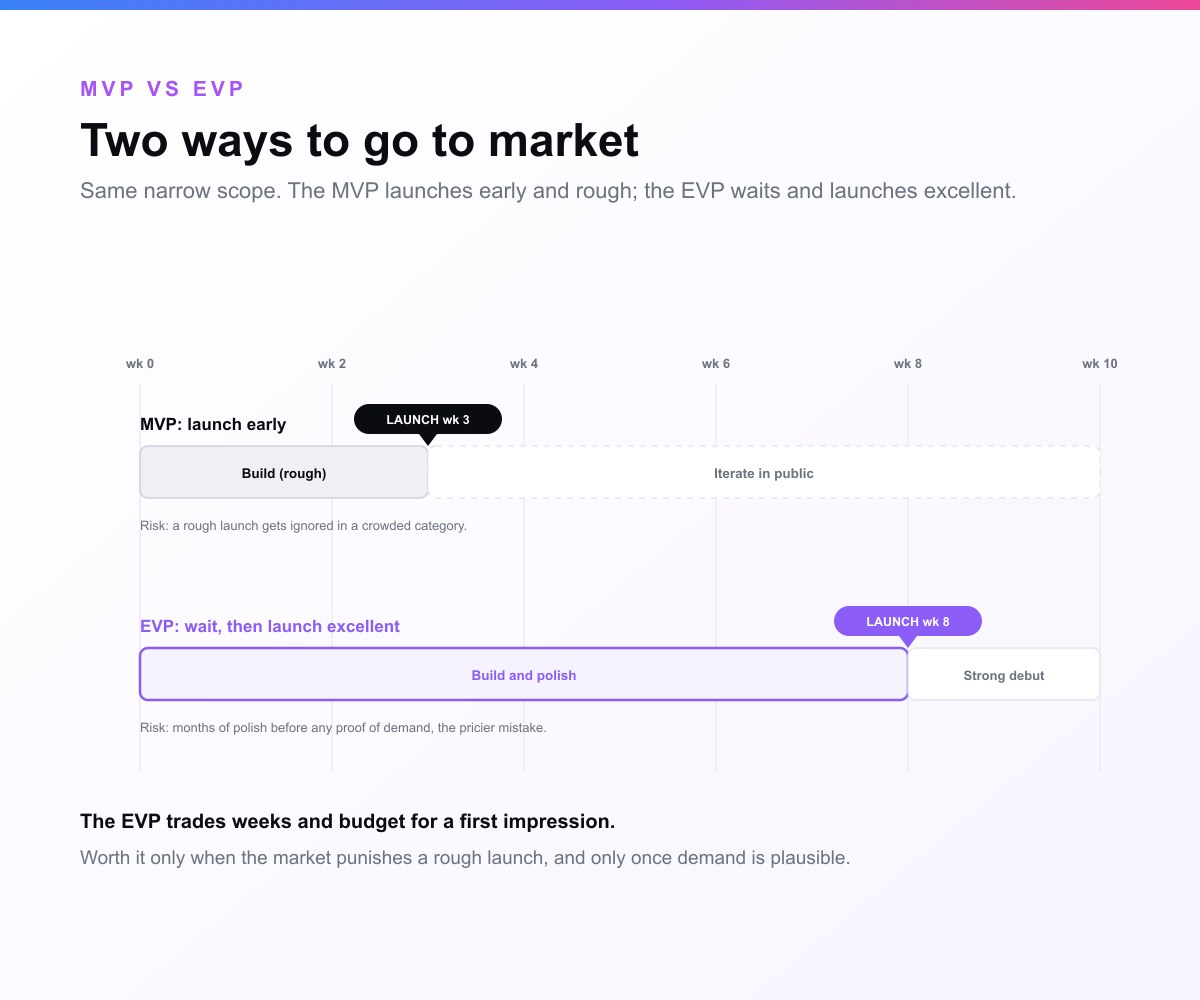
In a new category, the MVP wins, learn fast, polish later. In this crowded one, the EVP's bet, that excellence is what you're actually testing, is the smarter one.
The risks of each
- MVP risk: the false negative. A too-rough launch in a demanding market gets rejected for its polish, and you kill a good idea that was never fairly tested.
- EVP risk: the expensive false start. You delay for months and pour budget into polishing a product before you have real evidence anyone wants it, the classic over-building failure, just dressed up as "quality."
The EVP's danger is the more expensive one, which is why it only makes sense once demand is plausible. Polishing to perfection before validating demand is how founders run out of runway.
Common mistakes founders make
- Using an EVP to avoid the scary test. "We need it to be perfect before we launch" is often fear of the market's verdict, dressed as quality. If demand is unproven, that's an MVP job.
- Shipping a rough MVP into a polished category. The opposite error: launching bare-bones where users expect refinement, and misreading the rejection as "no demand."
- Confusing "exceptional" with "more features." An EVP is narrow and polished, not broad and adequate. Adding features is not the same as being excellent.
- Never shipping. The EVP mindset can slide into endless polishing. Set a quality bar and a date, then launch.
Build your MVP or EVP with us
At MVP Development we help founders make the right call, a lean MVP when demand is the question, or a polished, market-ready first version when your category punishes rough launches, and then build it, scoped to one core flow, refined where your market demands it, shipped in about 3-4 weeks on a fixed quote you approve up front.
If you're unsure which bar your market rewards, our MVP consulting will help you decide before you spend, and our UX design is where "viable" becomes "exceptional."
Launching in a competitive market? Show us the vision you are carrying and we will scope the exceptional slice of it worth shipping first.
Related guides
- MVP vs MAP: Minimum Awesome Product, the "minimal but delightful" cousin
- MVP vs MLP: Minimum Lovable Product
- MVP vs SLC: Simple, Lovable, Complete
- MVP vs Full Product: the other end of the scale
- MVP UX Design: how to add polish without bloat
Frequently asked questions
What is the difference between an MVP and an EVP?
An MVP (Minimum Viable Product) launches the smallest thing that works to learn whether people want it, as fast and cheap as possible, accepting a rough first version. An EVP (Exceptional Viable Product) deliberately delays launch to ship a polished, premium, market-ready product that makes a strong first impression. The MVP optimizes for speed and validated learning; the EVP optimizes for first-impression quality in competitive markets. Same narrow scope, but a higher quality bar and a later launch.
What does EVP stand for in product development?
EVP stands for Exceptional Viable Product, the smallest, most focused version of a product that is genuinely polished and excellent, launched only once it can make a strong first impression. (In esports, "EVP" means an Exceptionally Valuable Player award, a different, unrelated use of the acronym.)
Should I build an MVP or an EVP?
It depends on your biggest risk. If your market is new or unproven and the risk is demand, build an MVP, learning fast and cheap beats polishing something nobody may want. If your category is saturated, users compare you to refined competitors, and a rough launch would be rejected for its quality rather than its idea, an EVP's investment in a strong first impression can be worth it. Crucially, only choose an EVP once demand is at least plausible, polishing before validating is the most expensive way to be wrong.
Is an EVP just a better MVP?
Not quite, the difference is the launch decision. A polished MVP still ships as early as it can; an EVP explicitly withholds launch until it meets a high quality bar, trading time and money for a better debut. So an EVP is really a different go-to-market strategy: same narrow scope, higher quality bar, later release. In a market that punishes rough launches it can be worth it; in one that doesn't, it just makes your MVP slower and more expensive.
When is an EVP the wrong choice?
When demand is still unproven. Delaying launch and spending more to perfect a product you haven't validated is the classic over-building trap, you can pour months and budget into an exceptional product nobody wanted. In new or underserved markets, or any time your real risk is "does anyone want this?", a lean MVP that answers that question fast is the smarter, cheaper call. Save the EVP for crowded markets where first impressions genuinely decide the outcome.
Sources & references
- Eric Ries, The Lean Startup: the validated-learning framework behind the MVP
- Y Combinator Library: founder guidance on building and launching early


