


TL;DR
An MVP is the smallest usable version of a product, built to validate whether people want it. A full product is the complete, polished, scalable version built to serve a mass market once that demand is proven. They are not two competing options, they are two points on the same journey: you build the MVP first to learn cheaply, then grow it into the full product once you know what to build.
The core difference is purpose: an MVP exists to learn, a full product exists to scale. Building the full product first means betting a large budget and many months on assumptions you have not tested. This guide covers the full MVP vs full product comparison, what each is, how they differ, which to build first, and how an MVP becomes a full product.
Key Takeaways
- An MVP is the smallest usable version built to validate whether people want a product.
- A full product is the complete, polished, scalable version built to serve a mass market once demand is proven.
- The core difference is purpose: an MVP exists to learn, a full product exists to scale.
- They are two points on one journey: build the MVP first to learn cheaply, then grow it into the full product.
MVP vs full product: the difference that matters most
If you remember one thing, make it this: an MVP and a full product answer two different questions, at two different stages.
An MVP answers "do people actually want this, and does the core idea work?" It is deliberately minimal, just the essential flow, put in front of real users so you can learn before you invest heavily. Its success is measured in learning and early traction.
A full product answers "how do we serve a whole market really well and grow?" It is complete and polished, with the wider feature set, reliability, and depth a mainstream audience expects. Its success is measured in scale: adoption, revenue, and retention at volume.
So the two are sequential, not interchangeable. The MVP de-risks the idea for a fraction of the cost; the full product is what you build on top of a validated MVP to capture the market. Confusing them, and jumping straight to a full build, is one of the most expensive mistakes an early team can make, because you pour a year and a large budget into something the market never confirmed it wanted.
What is an MVP?
An MVP, or minimum viable product, is the smallest version of your product that lets real users complete the core job your idea promises, so you can learn whether the market actually wants it. It is missing most features on purpose, but the ones it has genuinely work, and a real user can complete the core flow end to end.
The point of an MVP is validated learning, not a finished product. It is built quickly and cheaply, shipped to early adopters, and judged by their behaviour. For the full definition, see our guide to what an MVP is; for why teams build one first, see the benefits of an MVP.
What is a full product?
A full product is the complete, mature version of your product, the one ready to serve a mainstream market at scale. Where an MVP is intentionally bare, a full product has the depth people expect: a broad feature set, polish and design refinement, reliability and performance under load, security, integrations, support, onboarding, and the edge cases handled.
A full product is not simply "an MVP with more features." It is built for a different job: not to learn whether the idea works, but to win and keep a large audience now that you know it does. That means investing in the things an MVP deliberately skips, the completeness, robustness, and experience that a paying mainstream customer takes for granted.
Key characteristics of a full product:
- Purpose: serve and scale to a mainstream market, not test an idea.
- Scope: the complete feature set, including secondary flows and edge cases.
- Quality bar: polished, reliable, secure, performant at volume.
- Audience: the broad market, not just early adopters.
- Cost and time: substantially higher, often many months to well over a year.
MVP vs full product: side-by-side comparison
| Dimension | MVP | Full product |
|---|---|---|
| Core purpose | Validate demand and learn | Serve and scale a mass market |
| Scope | The single core flow only | The complete feature set |
| Audience | Early adopters | The mainstream market |
| Quality bar | Usable and reliable at the core | Polished, robust, secure at scale |
| Cost | Low, a fraction of a full build | High, the full investment |
| Time | Weeks (a tight one, ~3-4) | Many months to a year or more |
| Main risk it removes | "Does anyone want this?" | "Can we serve the whole market well?" |
| Success measured by | Learning + early traction | Adoption, revenue, retention at scale |
| Comes | First | After the MVP validates the idea |
The comparison categories that matter
Purpose. This is the heart of it: an MVP exists to learn, a full product exists to scale. Every other difference flows from that. Judge an MVP by what it taught you; judge a full product by how well it serves the market.
Scope. An MVP is the one core flow that proves the idea. A full product is everything, the secondary features, the settings, the integrations, the edge cases. Trying to give an MVP full-product scope is how "MVPs" balloon into year-long builds.
Quality and completeness. An MVP must be genuinely usable, but it can leave gaps. A full product cannot: mainstream users expect polish, reliability, and support. The bar is simply higher because the audience is wider and less forgiving.
Cost and time. An MVP is cheap and fast by design. A full product is a real, sustained investment. The whole financial argument for an MVP is that it lets you spend the small amount first, and only commit the large amount once the idea is proven.
Risk. An MVP removes market risk cheaply. A full product built first carries that same market risk, but at ten times the cost, which is exactly why "build the full thing first" is so dangerous for an unproven idea.
The big misconception: an MVP is not a worse full product
The most damaging way to misread this comparison is to think an MVP is just a cheaper, lower-quality version of the full product, and the full product is "the MVP once it is finished." That framing leads teams to either ship a broken MVP (thinking quality does not matter) or to keep piling features onto the MVP until it quietly becomes a bloated full build with none of the validation.
The truth is they have different jobs. An MVP is a learning tool: minimal in scope, but genuinely working at its core. A full product is a market-serving product: complete and polished. You do not "upgrade" an MVP into a full product by adding features blindly, you evolve it, guided by what the MVP and its users taught you. The features you add to reach a full product should be the ones the evidence tells you matter, not the ones you assumed at the start.
MVP → full product: the journey
An MVP is not the opposite of a full product, it is the first step toward one. The healthy path runs through stages, each adding completeness as the evidence justifies it:
- MVP: validate the core idea with early adopters.
- Iterate: improve based on real usage (see MVP iteration and the build-measure-learn loop).
- More complete versions: as you add polish and reach, you pass through stages some teams name explicitly, like a minimum marketable product or a minimum lovable product.
- Scale toward the full product: once you have product-market fit, you invest in completeness, robustness, and growth (see how to scale an MVP and what comes after the MVP).
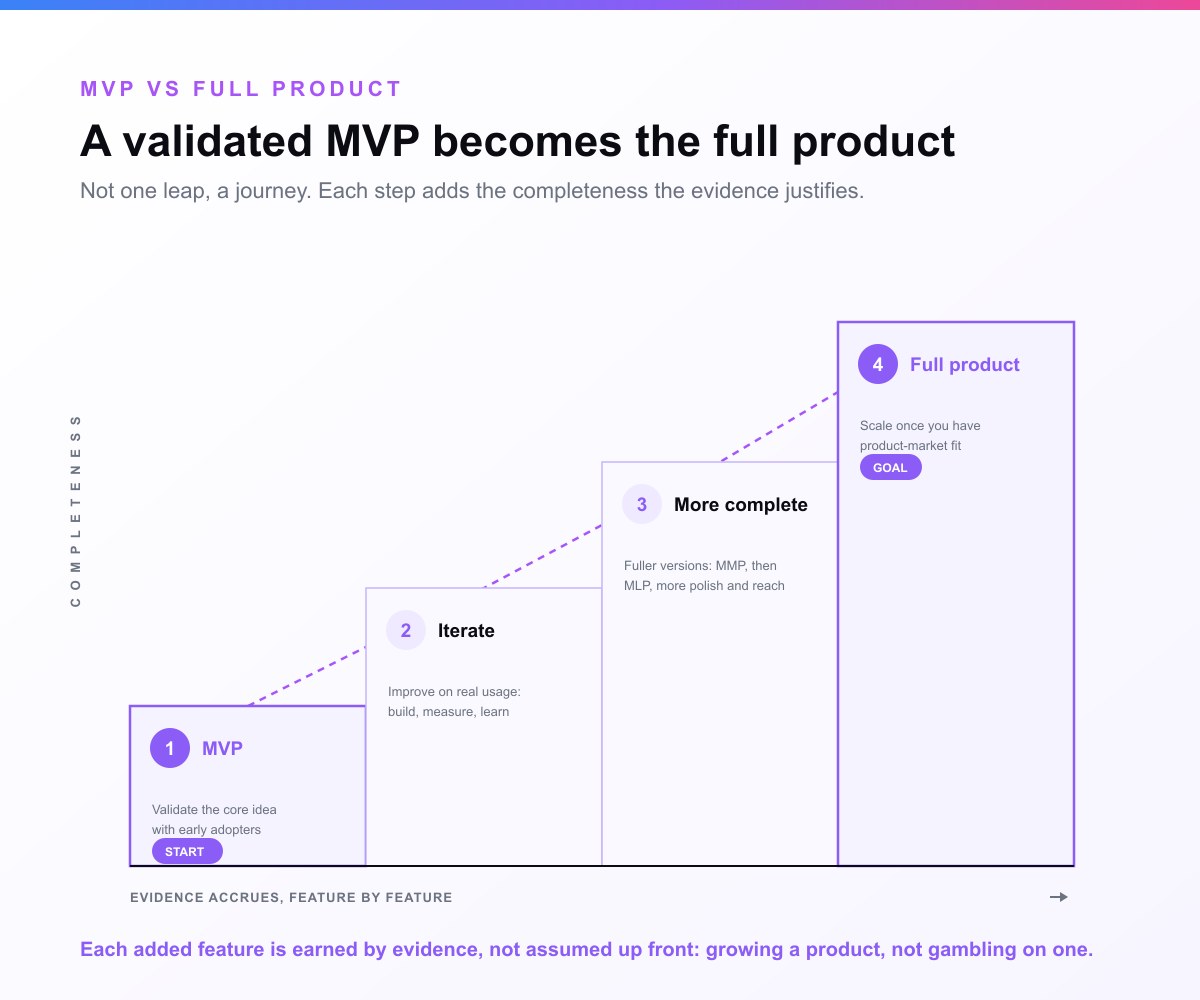
So the full product is what a validated MVP becomes, feature by feature, with each addition earned by evidence rather than assumed up front. That is the difference between growing a product and gambling on one.
Which should you build first?
Almost always the MVP. The deciding question is simple: how sure are you that people want this?
- If there is real doubt about demand, build the MVP first. Scaling an unproven idea into a full product is gambling with a large budget. Validate cheaply, then commit.
- If demand is already strongly proven, for example you are replacing an existing product you know people use, or serving a market you already understand deeply, a more complete first build can be justified. Even then, most teams benefit from launching a focused core first.
The expensive error is defaulting to the full product because it feels more "serious." A full build for an unvalidated idea is the single most common way startups burn their runway, exactly the failure the MVP approach exists to prevent, and a top reason MVPs (and full builds) fail.
A concrete example
Imagine a founder who wants to build a project-management tool for creative agencies. The full product vision is huge: tasks, timelines, file sharing, time tracking, invoicing, client portals, reporting dashboards, integrations with a dozen other tools, mobile apps, and permissions for large teams. Building all of that first would take well over a year and a large budget, all riding on the assumption that agencies will switch tools at all.
The MVP strips that to the single riskiest, most valuable flow: say, a shared task board built specifically around how creative agencies handle client revisions, the one thing existing tools do badly. No invoicing, no dashboards, no mobile app, just that core workflow, genuinely working, shipped to ten agencies in a few weeks.
If those agencies adopt it and keep using it, the founder has learned the crucial thing, agencies will switch for a better revision workflow, for a fraction of the full-build cost. Now the journey to the full product begins: add time tracking because users keep asking for it, then reporting, then integrations, each feature earned by evidence. If the agencies do not adopt it, the founder has saved a year and a fortune, and can pivot cheaply.
Notice what the MVP was not: it was not a broken, throwaway prototype, the task board actually worked. And notice what the full product is: not a random pile of features, but the validated MVP grown deliberately into the complete tool the market confirmed it wanted.
When building the full product first can make sense
To be fair, the MVP-first rule is not absolute. A more complete first build can be reasonable when:
- The market and demand are already well understood (you are entering a proven category or replacing a tool you know your users rely on).
- A minimal version genuinely is not viable or safe, some regulated, safety-critical, or infrastructure products cannot ship a bare-bones version responsibly.
- The core experience only works when it is complete, where a stripped-down version would test the wrong thing.
Even in these cases, teams usually still scope tightly and launch a focused first version rather than the entire vision at once. "Full product first" almost never means "build absolutely everything before launching."
Common mistakes founders make
- Building the full product first for an unproven idea. The classic, expensive error, months and a large budget spent before learning whether anyone wants it.
- Shipping a broken MVP. Treating "minimum" as "low quality." The core flow must actually work, or you learn nothing useful.
- Never evolving the MVP. Launching an MVP and treating it as the finished product, ignoring the journey toward completeness the market is asking for.
- Feature-creeping the MVP into a full build. Piling on features until the "MVP" is a year-long project with none of the validation, the worst of both worlds.
- Adding features by assumption, not evidence. Growing toward a full product based on the original guesses instead of what the MVP actually taught you.
How we approach MVP and full product
When founders come to us, we start by separating the two: the full-product vision (which can be as big as you like) and the MVP first step (which should be as small as the core bet allows). We scope and ship a genuinely usable MVP, production-grade, fully owned code, in about 3-4 weeks, so you learn from real users fast and cheaply. Then, if the evidence supports it, we grow that same codebase toward the full product deliberately, adding the features the data justifies rather than the ones assumed at the start. The MVP is built to be kept and scaled, not thrown away, so the path from validated MVP to full product is a continuous one, not a rebuild.
A quick decision checklist
- Am I confident people want this, or am I assuming? If assuming, build the MVP first.
- Have I separated the full-product vision from the MVP first step?
- Is my MVP scoped to the single core flow, not a mini version of everything?
- Does the MVP's core actually work well (usable, not broken)?
- Do I have a plan to grow the MVP toward the full product based on evidence, not guesses?
Related guides
- What Is an MVP?: the definition and how a minimum viable product works
- Benefits of an MVP: why building an MVP first beats a full build
- How to Scale an MVP: growing a validated MVP toward the full product
- Post-MVP: What Comes Next: the stage where the journey to a full product begins
Frequently asked questions
What is the difference between an MVP and a full product?
An MVP (minimum viable product) is the smallest usable version of a product, built to validate whether people want it, minimal in scope but working at its core, and aimed at early adopters. A full product is the complete, polished, scalable version built to serve a mainstream market once demand is proven, with the wider feature set, reliability, and depth a broad audience expects. In short: an MVP exists to learn, a full product exists to scale, and the MVP comes first.
Should I build an MVP or a full product first?
Almost always the MVP, unless demand is already strongly proven. Building a full product first means committing a large budget and many months to assumptions you have not tested; if the market does not want it, that investment is lost. An MVP validates the idea cheaply and quickly, so you can then invest in the full product with confidence. The exception is when you are entering a well-understood market or a minimal version genuinely is not viable, and even then teams usually launch a focused first version.
Is an MVP just a cheaper version of the full product?
No. An MVP is not a lower-quality full product, it is a different tool with a different job. An MVP is built to learn (minimal scope, but working at its core), while a full product is built to serve a market (complete and polished). You do not turn an MVP into a full product by blindly adding features, you evolve it deliberately, adding the features your users and data show actually matter.
How does an MVP become a full product?
Through a journey, not a single leap. You launch the MVP, iterate on it using real user feedback (the build-measure-learn loop), pass through more complete stages as you add polish and reach, and, once you have product-market fit, invest in the completeness, robustness, and growth of a full product. Each feature you add on the way should be earned by evidence from the MVP, so the full product is the validated MVP grown deliberately rather than a fresh, assumption-driven build.
Is an MVP the same as a prototype or a beta?
No. A prototype is a rough, often non-functional mock-up used to test design; an MVP is a real, working product used to test demand; a beta is a near-complete product tested for bugs before general release; and a full product is the complete, scaled version. They sit at different points on the path from idea to mature product. See our MVP vs prototype and MVP vs beta comparisons for the details.
When is it worth building the full product first?
Rarely, but it can make sense when demand is already well proven (a known market or a replacement for a tool people clearly rely on), when a minimal version is not viable or safe (some regulated or safety-critical products), or when the core experience only works when complete. Even then, most teams still scope tightly and launch a focused first version rather than the entire vision at once, because unvalidated scale is the most expensive kind of risk.
If you want a partner who helps you separate the full-product vision from the smallest first step, then ships a production-grade MVP you fully own and grows it deliberately toward the full product, that is what we do. MVP development at MVP Development ships your investor-ready MVP in 3-4 weeks and scales it from there. Bring us the full-product spec you are tempted by and we will mark the 20% that earns funding for the rest.
Sources & references
- Eric Ries, The Lean Startup: the validated-learning framework behind the MVP
- Y Combinator Library: founder guidance on building and launching early
- Minimum viable product: origin and definition of the term


