


TL;DR
To find a technical co-founder, work in this order: (1) build the scrappiest possible version of your product first, so you're recruiting on traction instead of an idea; (2) list everyone you already know who writes code and genuinely enjoys it, not just people who manage engineers; (3) test the working relationship on a small shared project before you commit to anything; (4) make one firm, specific offer (a real equity split, plus salary if you can), rather than the vague "want to build something together?" dance; and (5) if your own network comes up empty, use co-founder matching platforms or put yourself where strong engineers already are.
The single biggest mistake is waiting. The best moment to attract a technical co-founder is after you've shown you can move the idea forward on your own, not before. And if an honest search turns up no one, that is useful signal, not failure. A technical co-founder is one way to get a product built. It is not the only one, and this guide ends with the realistic alternative.
Key Takeaways
- Build the scrappiest possible version first, so you recruit on traction instead of an idea.
- List everyone you know who writes code and genuinely enjoys it, not just people who manage engineers.
- Test the working relationship on a small shared project before you commit.
- Make one firm, specific offer (a real equity split, plus salary if you can), not a vague "build something together?"
- If your network comes up empty, use co-founder matching platforms; the biggest mistake is waiting.
Do you actually need a technical co-founder?
Before you spend months searching, be honest about whether you need one at all, because the answer changes what you do next. It depends almost entirely on what you are building:
- Deep or regulated technology (novel ML, hardware, biotech, anything where the technology is the product): yes, you need serious technical depth on the founding team, and probably a co-founder rather than a hire.
- A standard web or mobile app (most SaaS, marketplaces, consumer apps): you can get a first version in front of real users without a technical co-founder at all, using no-code tools or a small build team. Here a technical co-founder is a strong accelerant, not a prerequisite for starting.
If you're in the second bucket, you don't have to solve "find a co-founder" before you do anything else. You can start now and recruit from a position of strength later. For the full set of paths open to a non-technical founder, see MVP for non-technical founders. This guide focuses only on one of those paths: actually finding the co-founder.
CTO or technical co-founder: which one you are actually looking for
Founders type “how to find a CTO” and “how to find a technical co-founder” for the same reason, but they are two different offers, and the search goes badly when you make the wrong one. A technical co-founder is a partner: large equity, little or no salary early, shares the risk, owns the technical vision, and is usually the person writing the first version. A CTO is a role: it can be filled by that co-founder, by a senior hire once you have money, or by a part-time fractional CTO paid in cash while you keep the equity.
The honest way to decide is to ask what you can pay with. If you have no money and an unproven idea, you are looking for a co-founder, and the rest of this guide is about that search. If you have raised or have revenue, you are looking for a hire, and the search is a normal senior recruitment: a job description, a salary band, a smaller equity grant with vesting, references. If you have neither money for a senior salary nor a co-founder yet, the third route is to skip the search for now: get the first working version built at a fixed price, and go looking for a CTO with a live product and users, which is the single strongest co-founder magnet there is. We build that version for $350 in 7 days; the section below on building something first explains why it changes the search.
| You are looking for | What you offer | Where they come from | What to read |
|---|---|---|---|
| A technical co-founder | Near-equal equity, vested, little or no salary early | Your network, founder-matching programmes, building in public | This guide, and how much equity a technical co-founder gets |
| A CTO as a hire | Senior salary plus a small equity grant | Recruiters, your investors’ networks, senior engineers you have worked with | The offer section below applies; the equity is a fraction of a co-founder’s |
| A fractional CTO | Cash retainer or day rate, no equity | Fractional CTO firms, ex-CTOs consulting, referrals | What a fractional CTO does and what one costs |
| Nobody yet: the product first | A fixed price for a working prototype | A build partner | Build something first, below |
Build something first: the best co-founder magnet there is
The founders who land strong technical co-founders almost never do it with a deck and an idea. They do it with something already moving. A live landing page with a waitlist, a scrappy no-code MVP with a few real users, a manual version of the service delivered by hand: any of these changes the conversation completely.
Here's why it works. A talented engineer is picking between many options, and "join me, I have an idea" is the weakest possible pitch, because ideas are cheap and unproven. "Join me, I already have 200 people on a waitlist and 15 paying users I onboarded manually" is a different offer entirely. You've de-risked the two things they'd worry about most: whether anyone wants it, and whether you can execute. As documented in the Y Combinator library, founders have repeatedly patched together a launch with non-coder tools first, and only then convinced a technical person to come aboard. Traction is the recruiter.
So the counterintuitive first step in finding a technical co-founder is often to stop looking for one, and go build the smallest thing that proves demand. Then the search gets far easier.
Where to find a technical co-founder
There is a rough order of hit-rate here. Start where trust already exists and work outward.
| Source | Why it works | The catch |
|---|---|---|
| People you already know | Existing trust and known working style. Highest success rate by far. | Your network may simply not contain the right person. |
| Co-founder matching platforms | Built for exactly this (e.g. YC Co-Founder Matching). Large pool, filterable. | You start as strangers, so vetting takes longer. |
| Working at a strong-engineering company | You meet excellent engineers daily and can test compatibility for real. | Slow (months), and requires you to take the job. |
| Communities, hackathons, open source | You see how someone actually builds, live. | Hit-or-miss; most contacts stay contacts. |
| Your users and early fans | Sometimes an engineer is your ideal customer and already believes. | Rare, but the strongest possible match when it happens. |
Start with your own network first. Make a genuine list: everyone from school, past jobs, and side communities who can write code and enjoys it. That second part matters more than it sounds, and it's the next section.
How to evaluate a technical co-founder (it's not "can they code")
"Can they code" is table stakes and the least useful filter. The real evaluation is on four things:
- Do they love building, or do they manage building? A senior engineering manager or a CTO title does not mean the person still enjoys, or is even current at, shipping code hands-on. For an early startup you need someone who wants to build, at least for the first couple of years. Ask what they've shipped recently, personally.
- Do they actually ship? Plenty of strong engineers over-engineer and never launch. You need someone who gets a rough version out and iterates. Look at their track record: finished side projects beat impressive-sounding unfinished ones.
- Can you two work together under stress? A co-founder relationship is closer to a marriage than a hire. You need to know how they handle disagreement, bad news, and long grind, before you're legally and financially bound. Which is why you test it (next section).
- Are they complementary, not a clone? The best pairings cover each other's gaps: you bring market, sales, and product judgment; they bring technical depth. Two of the same person is a weakness, not a bond.
Test the relationship before you commit
Do not go from "nice conversation" straight to "co-founders." Work on something small together first: a weekend project, a rough prototype, even a non-coding task that has a real deadline and a real deliverable. You're not testing whether they can code. You're testing whether the two of you build well together: how they communicate, whether they follow through, whether disagreements resolve cleanly.
A short, low-stakes trial like this surfaces mismatches while they're cheap to walk away from. Skipping it is how founders end up with a co-founder breakup a year in, which is one of the most expensive failures a startup can have.
What a technical co-founder is actually thinking
This is the part most non-technical founders miss, and engineers in founder communities make the point over and over: good developers are flooded with co-founder pitches, and almost all of them sound the same. "I have an idea, you build the whole thing for free, you should be as skilled as a senior engineer at a top company, and you'll be paid in future equity that might be worth nothing." They have learned to discount that instantly, because saying yes to every "promising" idea unpaid would leave them broke. There are far more founders looking for a technical co-founder than there are technical people willing to be one, so the engineer is the one choosing, not you.
That flips the whole dynamic: you are the one selling. A strong technical person is quietly asking three things about you:
- Have you proven anyone wants this? Traction, even a scrappy no-code MVP with a handful of paying users, answers the risk they care about most and does more than any pitch.
- What are you actually offering, specifically? Vague future upside reads as "no offer." Real equity, plus salary if you have it, reads as serious.
- Is this a problem I'd genuinely enjoy? Many good engineers are bored in their day jobs and are hunting for an interesting technical challenge, not just any startup. If the problem itself excites them, half your recruiting is already done.
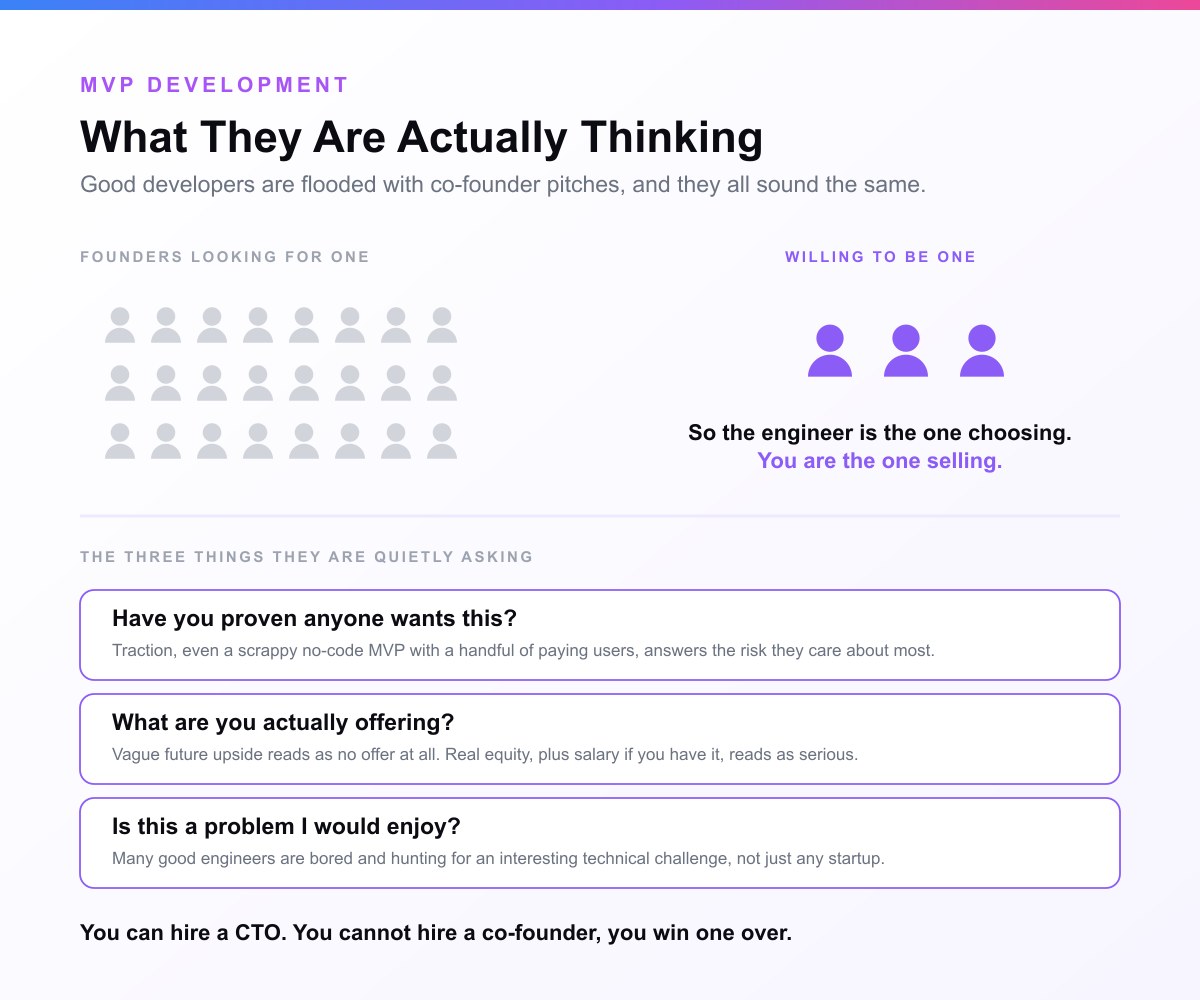
And a distinction founders constantly blur: you can hire a CTO, but you cannot hire a co-founder. A CTO is a role you fill with a salary and a job post. A co-founder is a partner you win over with belief, respect, and a fair stake. Treat the search like recruiting a peer who has other options, not like filling a vacancy, and your odds climb sharply.
How to make the offer (make them say yes or no)
When you've found the right person, most non-technical founders sabotage themselves with vagueness. They do an endless ambiguous dance ("we should totally build something sometime") because a real offer feels scary to make. Don't. Make a firm, specific offer and force a clear yes or no:
- Be concrete about equity and salary. Say the actual numbers. For a genuine co-founder who joins early and takes real risk, the equity is substantial, often close to an equal split. If you can pay some salary, include it; if you can't and they don't need it, a near-equal equity split is the honest starting point. (For the full breakdown of the numbers, see how much equity a technical co-founder should get.)
- Don't pitch a finished idea. Brainstorm the next version together. Handing someone a fully-formed plan makes them an employee. Shaping the idea with them makes them an owner. Great co-founder relationships usually start with building on the idea together, not signing off on yours.
- Frame the decision, not just the dream. "Here's the offer, here's the risk, here's why I think it's worth it, can you give me a yes or no by Friday?" A clear ask respects their time and gets you a real answer instead of a slow fade.
What to do if you genuinely can't find one
Sometimes you search honestly, for months, and the right technical co-founder just isn't there. That's common, and it is not the end of your startup. You have two realistic moves, and they combine well:
1. Keep the search warm, but stop blocking on it. Don't let "I have no co-founder" freeze the company. Keep meeting engineers and keep making progress in parallel, so that when the right person appears, you're recruiting on traction.
2. Get the product built another way, keep your equity, validate, and recruit later. A technical co-founder is expensive: you're giving away a large share of the company, permanently, to someone whose fit you can't fully know yet. The alternative is to hire a specialist team to build your first version, keep 100% of your equity, get real users, and then decide whether you even still need a co-founder, or attract a much better one on the back of proven traction. Even Y Combinator lists "should I use a dev shop?" as a legitimate question for founders in exactly this spot.
3. Hire the skill now, and let a co-founder emerge later. You do not have to jump straight from "no co-founder" to handing half the company to someone you barely know. A common middle path is to bring on a strong senior developer, a tech lead, or a specialist team to get the product built now, and let a genuine co-founder relationship grow from a proven working relationship if the fit turns out to be real. A fractional CTO can cover senior technical judgment in the meantime. This keeps you moving, keeps your equity intact, and often surfaces a better long-term partner than a cold search ever would, because you have worked together first.
This is the honest case for building first, and it is what we do. While you keep looking for the right co-founder, a small senior team gets your product live: we scope the core flow with you, fix the price up front, and ship it in 3 to 4 weeks with auth, payments, and deployment done, and code you own. That does two things at once: it de-risks the idea, and it turns your co-founder pitch from 'join my idea' into 'join something with real users.' You do not give up half the company to find out whether it works. If the search has you stalled, get the build moving while you keep searching.
Common mistakes founders make
- Searching before building anything. Recruiting on an idea instead of traction, which is the weakest possible pitch.
- Confusing a title with hands-on skill. Assuming a "CTO" or "engineering manager" still wants to build, or still can.
- Skipping the trial. Committing to a co-founder you've never actually built alongside.
- The ambiguous dance. Never making a real, numbers-on-the-table offer, so nothing ever happens.
- Under-valuing the equity. Trying to hand a true co-founder a tiny slice; real risk warrants real ownership.
- Blocking the whole company on the search. Letting "no co-founder yet" stop all forward progress for months.
Related guides
- MVP for non-technical founders: all four paths to a built product, of which finding a co-founder is one
- Freelancer vs agency for MVP: the two main ways to get it built if you hire out
- MVP development team: who you actually need to build an MVP
- How investors evaluate an MVP: why investors care about technical capability on the team
- No-code MVP: build the first scrappy version yourself to attract a co-founder
Frequently asked questions
How do I find a technical co-founder with no network?
Start by building the scrappiest version of your product you can, with no-code tools or a small build team, so you have real traction to recruit on. Then use dedicated co-founder matching platforms (such as YC Co-Founder Matching) to reach engineers outside your circle, and consider taking a role at a company with a strong engineering culture so you can meet and evaluate potential co-founders in person. Traction plus a specific, honest offer beats a cold "join my idea" every time.
Where do founders usually find technical co-founders?
Most successful matches come from an existing network first: former colleagues, classmates, and people from side communities who both write code and enjoy it. When the network comes up short, the next best sources are co-founder matching platforms, working inside strong-engineering companies, and technical communities, hackathons, and open-source projects where you can see how someone actually builds.
Should I pay a technical co-founder a salary?
If you can, some salary helps, especially if the person has outside financial commitments. But a true co-founder is compensated mainly in equity, not pay, because they're taking founder-level risk. If you have no money and they don't require a salary, a near-equal equity split is the honest starting point. The key is to make the offer concrete rather than vague.
How much equity does a technical co-founder get?
A genuine technical co-founder who joins early and shares the risk typically gets a large, often close to equal, share of the company, not a small slice. The exact split depends on timing, contribution, and whether salary is involved, and it's worth structuring carefully with vesting so both sides are protected. Undervaluing a real co-founder's equity is a common and damaging mistake.
Can I start a startup without a technical co-founder?
Yes, for most standard web and mobile products. You can validate demand and even launch a first version using no-code tools or a specialist build team, keep full ownership, and get real users, then decide whether you still need a technical co-founder or can attract a stronger one on the back of that traction. Deep-tech and heavily regulated products are the main exception, where founding-team technical depth is usually essential from day one.
Why is it so hard to find a technical co-founder?
Because good engineers are in high demand and are flooded with equity-only offers from founders who have just an idea, no traction, and no salary, so they discount them by default. There are far more founders seeking a technical co-founder than there are technical people willing to join one, which means the engineer is the one choosing. You improve your odds by showing real traction, making a concrete offer (meaningful equity, plus salary if possible), and pitching a problem they would personally find interesting, rather than asking them to build your idea for free.
How do I find a CTO for my startup?
Decide first whether you are recruiting a co-founder (equity, no salary) or hiring a CTO (salary plus a small grant), because they come from different places. Co-founders come from your network, founder-matching programmes and building in public; hired CTOs come from recruiters and your investors’ networks once you have funding. If you have neither equity to give nor money for a salary, get a working version built first and search with a live product.
Sources & references
This guide draws on established startup and lean-product guidance:
- Y Combinator, How to Find a Technical Co-Founder: building a scrappy launch first, evaluating for people who love to build, and making a firm offer
- Y Combinator Co-Founder Matching: a free platform for finding a co-founder outside your network
- Eric Ries, The Lean Startup: validated learning and shipping a minimal version early
The 3 to 4 week figure reflects MVP Development delivery data for tightly scoped builds.


