


TL;DR
A fractional CTO is a senior technology leader who works with a startup part-time, on a fractional basis, instead of as a full-time hire. They set the technical strategy, make architecture and hiring decisions, oversee the build, and give a non-technical founder real technical credibility (including with investors), without the full-time salary or the large equity stake of a co-founder or full CTO.
The one thing to understand before you hire one: a fractional CTO leads and advises, they usually do not build your product themselves. That distinction decides whether you actually need one right now. If you have engineers or a build partner and need senior direction, a fractional CTO is a strong, low-commitment option. If you are pre-product and mostly need the thing built and validated, a fractional CTO manages a team you may not have yet, and a build team is usually the better first move. This guide covers what a fractional CTO does, what they cost, how they compare to a technical co-founder, and when a founder genuinely needs one.
Key Takeaways
- A fractional CTO is a senior technology leader who works with a startup part-time instead of as a full-time hire.
- They set technical strategy, make architecture and hiring decisions, oversee the build, and give a non-technical founder real technical credibility.
- They cost far less than a full-time CTO's salary or a co-founder's equity stake.
- The key distinction: a fractional CTO leads and advises; they usually do not build your product themselves.
- If you are pre-product and mostly need the thing built and validated, a build team is usually the better first move.
What is a fractional CTO?
A fractional CTO is an experienced Chief Technology Officer who works for your company a fraction of the time, typically a few days a month or a set number of hours, on an ongoing basis. Think of it as renting senior technical leadership rather than employing it full-time. For a founder deciding whether to look for a partner at all before hiring anyone, solo founder vs co-founder comes first.
They are usually seasoned engineers or former startup CTOs who split their time across several companies. For an early-stage startup, especially one led by a non-technical founder, a fractional CTO fills the "who owns technology decisions?" gap without the two things a full CTO or a technical co-founder demands: a full-time salary and a significant, permanent equity stake.
The key difference from a technical co-founder is commitment and ownership. A co-founder is a permanent partner who lives and dies with the company. A fractional CTO is a paid professional providing a service, engaged for as long as you need them and gone when you do not.
What does a fractional CTO actually do?
A good fractional CTO covers the senior technical responsibilities a non-technical founder cannot, and should not try to fake. Typically that includes:
- Technical strategy and architecture. Choosing the right stack, designing a system that fits your stage, and avoiding decisions that become expensive later.
- The technical roadmap. Turning your product vision into a sequenced, realistic plan, and pushing back on scope that will blow the timeline.
- Hiring and managing engineers. Interviewing and evaluating developers (the thing a non-technical founder famously struggles to do well), and leading the team once it exists.
- Overseeing an external build. If you are working with an agency or freelancers, a fractional CTO is your technical representative, keeping the vendor honest on quality, timeline, and cost.
- Investor credibility. Speaking to the technical side of your business in a fundraise, answering an investor's engineering questions, and supporting technical due diligence.
- Security, scaling, and risk guidance. Making sure the fundamentals are handled before they become emergencies.
Just as important is what a fractional CTO usually does not do: sit and write the bulk of your code, hands-on, day to day. They are a leader and decision-maker, not the person shipping the whole product themselves. That is the distinction that trips up founders who are pre-product, and it is why the "do I need one yet?" question matters.
Fractional CTO vs technical co-founder vs full-time CTO
These three roles solve overlapping problems with very different commitment and cost.
| Fractional CTO | Technical co-founder | Full-time CTO | |
|---|---|---|---|
| Commitment | Part-time, ongoing | Full-time, permanent partner | Full-time employee |
| Cost | Cash (retainer or hourly) | Large equity, little/no salary early | Full salary + equity |
| Owns the vision? | No, hired expert | Yes, shares the risk | Partly, senior leader |
| Builds hands-on? | Rarely | Often, early on | Sometimes |
| Best for | Senior direction without giving up equity | Deep-tech, long-term engineering company | Funded company scaling a team |
The honest summary: a technical co-founder is right when the company is fundamentally an engineering company for the long haul and you want that capability as a committed owner (see do you need a technical co-founder?). A fractional CTO is right when you need senior technical judgment now, without giving away a permanent slice of the company, often during fundraising or while managing a build. A full-time CTO usually comes later, once you are funded and scaling a real engineering team.
Outsourced CTO vs fractional CTO vs CTO as a service: which one you actually need
Three labels for roughly one idea, senior technical leadership you pay for in cash rather than equity, sold in three different packages. The names matter less than what is inside the package, so here is what each one usually means when a firm uses it.
| Fractional CTO | Outsourced CTO services | CTO as a service (CaaS) | |
|---|---|---|---|
| Who you get | One named senior person, part-time | A firm supplies the CTO function, often alongside its own delivery team | A productised subscription: a tier, a set of hours, sometimes a rotating person |
| How you pay | Retainer or day rate | Monthly fee, sometimes bundled with development | Fixed monthly plan |
| Builds the product? | Rarely; leads and reviews | Sometimes, if the firm’s engineers are part of the deal | No; advisory and oversight |
| Conflict of interest | Low: they are not selling you engineering hours | Real: the person judging the build works for the company doing the build | Low, but the relationship is thin |
| Best for | A team or build partner that needs senior direction | A funded company that wants leadership and delivery from one vendor | Occasional senior judgment on a budget |
The one distinction worth paying attention to is the conflict of interest in the middle column. An outsourced CTO who also sells you the engineering is grading their own homework, which is fine when the firm is good and expensive when it is not. If you are buying the build from someone, the value of a CTO is that they sit on your side of the table. And if what you actually need is the product built rather than led, none of the three is the answer yet; the section on just getting the MVP built is.
What does a fractional CTO cost?
Less than a full-time CTO by a wide margin, and it is a cash cost you can stop any month rather than a permanent share of the company. Rates depend on seniority, days per week, whether they advise or actively manage your contractors, and where they are. The full breakdown by pricing model, with current ranges, what moves the price, a worked pre-seed budget and the comparison against simply having the MVP built, is in fractional CTO cost.
When does a non-technical founder actually need a fractional CTO?
A fractional CTO earns their fee in specific situations:
- You are raising and need technical credibility. Investors will probe the technical side. A fractional CTO who can speak to architecture, scaling, and the roadmap can be the difference in a room where you cannot answer those questions yourself. This ties directly to what investors evaluate in an MVP.
- You already have engineers or a build partner, but no senior leadership. Someone needs to set direction, review the work, and keep quality honest. That is the classic fractional CTO job.
- You are outsourcing the build and feel out of your depth. A fractional CTO is your technical advocate against the agency, protecting you from bad code, lost IP, and runaway cost.
- You need senior judgment on a few big decisions, without a full-time hire or an equity partner.
And when you probably do not need one yet:
- You are pre-product with just an idea. A fractional CTO leads a team and oversees a build. If there is no team and nothing built, you are paying an executive to manage work that does not exist. What you need first is the product built and the idea validated.
- Your product is fairly standard and you can manage the build yourself. For a straightforward app, a clear spec, milestones, and a good build partner may cover you without adding a fractional executive.
The catch: a fractional CTO leads, they don't build
This is the point most "hire a fractional CTO" articles skip, and it is the one that matters most for an MVP-stage founder. A fractional CTO gives you leadership, judgment, and credibility. They do not, in most engagements, sit down and build your product. So if you are a non-technical founder with an idea and no product yet, hiring a fractional CTO first often solves the wrong problem: you get a part-time executive to lead engineers you have not hired, on a product that does not exist.
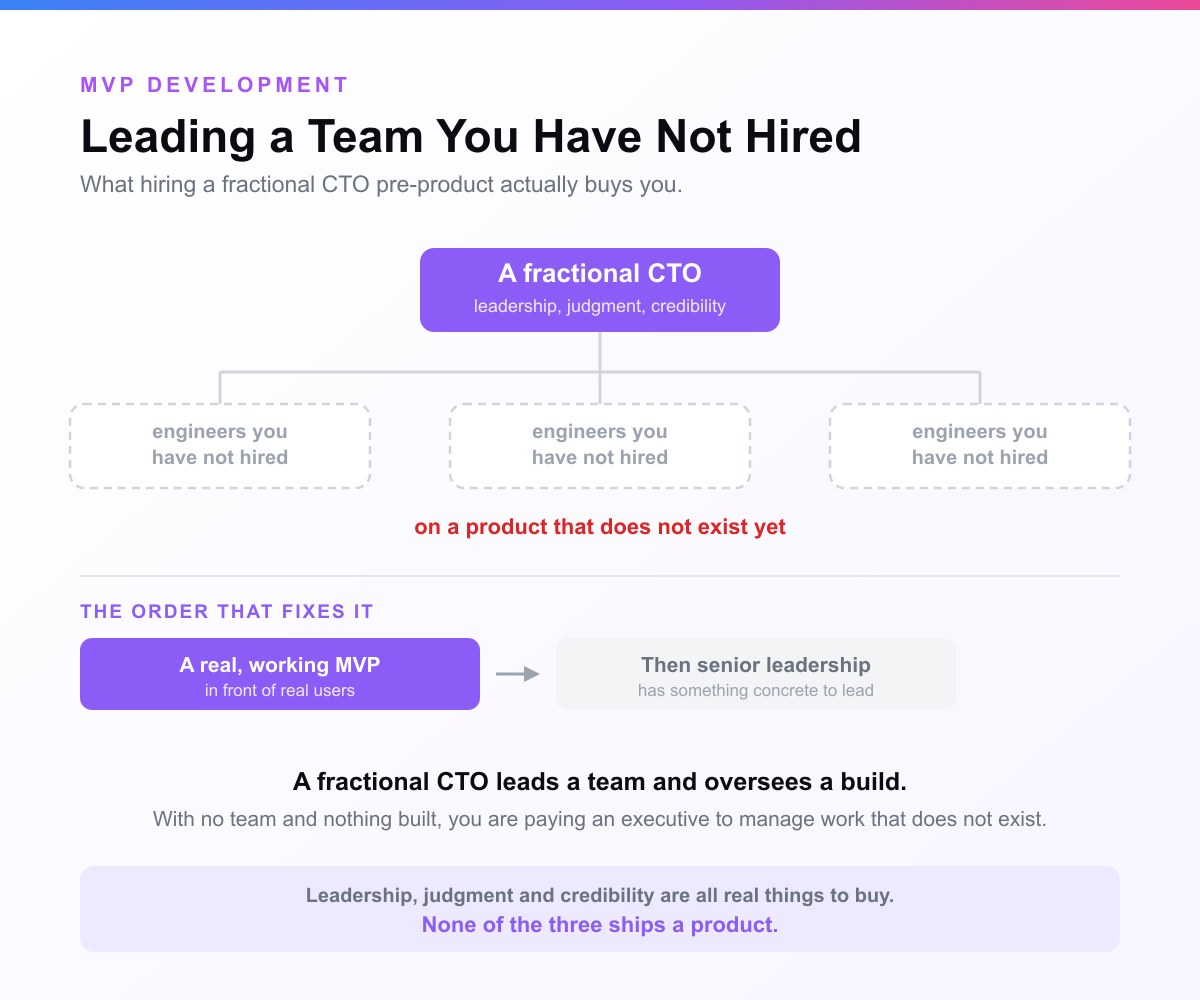
At the earliest stage, what usually moves the company forward is not senior management overhead, it is a real, working MVP in front of users. Once you have that, and real usage to reason from, senior technical leadership (fractional or full-time) has something concrete to lead. Order matters.
Fractional CTO vs just getting the MVP built
For a pre-product founder, the more useful comparison is often not "fractional CTO vs co-founder," but "fractional CTO vs just getting it built." A product-focused build team can do something a fractional CTO alone cannot: actually ship your MVP, while bringing the senior technical judgment into the build itself, choosing the right stack, keeping the scope honest, and handing you production-grade, owned code.
That is the difference in what we do: the senior architecture and stack calls a CTO would make, we make them while building the thing, not in a slide deck. We scope the core flow with you, fix the price up front, and ship a real product in 3 to 4 weeks with auth, payments, and deployment handled, and code you own. So instead of paying a part-time executive to oversee a team you have not hired, you get the actual product a fractional CTO would only advise on. A fractional or full-time CTO makes far more sense later, layered on top of a validated product. If you are weighing one against just getting built, ask us what a build-first path would look like.
How to find and vet a fractional CTO
If your situation does call for one, a few basics:
- Look in the right places. Specialist fractional-executive networks, warm intros from other founders and investors, and startup communities beat cold outreach.
- Check for shipped products, not just titles. You want someone who has actually built and scaled real startup products recently, not only managed large teams.
- Confirm availability and fit. Fractional means shared time. Make sure they have genuine capacity for you, and that your working styles fit, before committing.
- Define the scope in writing. Days per month, responsibilities, and what "done" looks like, so the engagement does not drift.
Common mistakes founders make
- Hiring a fractional CTO before there is anything to lead. Paying for senior management of a non-existent team and product.
- Expecting them to build the product. A fractional CTO leads and decides; they are not your development team.
- Using one to avoid understanding your own product. You still need to own the product vision and the business; the fractional CTO owns the technology, not the company.
- No defined scope. Vague engagements drift, and executive time is expensive to waste.
- Choosing on title, not on shipped work. Impressive-sounding leadership experience is not the same as recently building real products.
Related guides
- Do you need a technical co-founder?: the bigger decision a fractional CTO is one answer to
- How to find a technical co-founder: if you decide you want a committed partner instead
- How much equity should a technical co-founder get?: the cost of the co-founder route
- MVP development team: who you actually need to build an MVP
- How investors evaluate an MVP: where technical credibility matters most
Frequently asked questions
What is a fractional CTO?
A fractional CTO is an experienced Chief Technology Officer who works with your company part-time, on an ongoing basis, rather than as a full-time employee. They provide senior technical leadership, setting strategy, making architecture and hiring decisions, overseeing the build, and giving technical credibility to investors, without the full salary of a full-time CTO or the large equity stake of a technical co-founder. In short, it is renting senior technology leadership instead of employing or co-founding it.
What does a fractional CTO do?
A fractional CTO sets the technical strategy and architecture, owns the technical roadmap, hires and manages engineers (or oversees an external build partner), supports fundraising by speaking credibly to the technology, and guides security, scaling, and risk decisions. What they typically do not do is write the bulk of your code hands-on, day to day. They are a senior leader and decision-maker, not your development team, which is the key thing to understand before hiring one.
Does a fractional CTO build the product?
No. A fractional CTO leads: architecture, stack, hiring, reviewing contractors, answering investors. The building is done by engineers you also pay for, or by a build partner. Founders who hire one with nothing to lead end up paying for advice about a product nobody is making; what that costs, and when it is worth it, is covered in fractional CTO cost.
Fractional CTO vs technical co-founder: which do I need?
Choose a technical co-founder when the company is fundamentally a long-term engineering company and you want a committed owner who shares the risk and often builds hands-on early. Choose a fractional CTO when you need senior technical judgment and credibility now, without giving away permanent equity, for example during a fundraise or while managing a build. A co-founder is a permanent partner paid mostly in equity; a fractional CTO is a paid professional you can engage and end as needed.
When should a startup hire a fractional CTO?
Hire one when you have engineers or a build partner that need senior direction, when you are raising and need technical credibility, or when you are outsourcing a build and need a technical advocate. Hold off when you are pre-product with just an idea and no team, because a fractional CTO leads work that does not exist yet. At that stage, getting a real MVP built and validated usually moves the company forward more than adding part-time executive oversight.
Do I need a fractional CTO to build my MVP?
Usually not, on its own. A fractional CTO provides leadership and oversight, but does not build the product, so for a pre-product founder the more direct need is getting the MVP built. A product-focused build team can ship your MVP and bring the senior technical decisions into the build itself, which is often what founders actually need first. A fractional CTO makes more sense once there is a product and a team to lead, or specifically to add technical credibility during a fundraise.
What are outsourced CTO services?
Outsourced CTO services are senior technical leadership supplied by a firm rather than an employee: technical strategy, architecture decisions, hiring and vendor oversight, paid as a monthly fee. They differ from a fractional CTO, who is one named person on a retainer, and from CTO as a service, a productised subscription. The main thing to check is whether the same firm is also selling you the development, because then the person reviewing the build works for the builder.
Sources & references
This guide draws on established industry practice around fractional and interim technology leadership. Rates and engagement models vary widely, so treat figures as general market ranges.
- The Pragmatic Engineer, Fractional CTOs: how fractional CTO engagements work in practice
- Y Combinator, Startup Library: technical leadership, hiring, and fundraising for early-stage startups
This article is general educational information, not legal or financial advice. The right technical leadership setup depends on your stage, product, and funding path.


