


TL;DR
You need a technical co-founder when the technology is the product (deep tech, novel ML, hardware), when you're raising venture capital from investors who require one, or when you can't evaluate or manage a build at all. You don't need one (at least not yet) when you're building a fairly standard app where tech is a platform rather than the core, you want to validate demand before giving away equity, and you can manage a build even though you can't do it yourself.
The honest nuance most hot takes miss: a technical co-founder genuinely correlates with success for venture-track tech companies, so don't dismiss the idea. But you almost never need to solve "find a co-founder" before you validate. The biggest mistake is freezing the whole company because you don't have one. If you need to cover the technical gap without a co-founder, there are five realistic ways to do it, covered below.
Key Takeaways
- You need a technical co-founder when the technology is the product, when investors require one, or when you cannot evaluate or manage a build at all.
- You do not need one yet for a fairly standard app where tech is a platform rather than the core.
- Validate demand before giving away equity; you can manage a build even if you cannot do it yourself.
- A technical co-founder correlates with success for venture-track tech companies, so do not dismiss the idea.
- The biggest mistake is freezing the whole company because you do not have one; there are five realistic ways to cover the gap.
The honest short answer (both sides)
This question has become a fight between two camps, and both are partly right.
The case for: Y Combinator, having funded thousands of startups, is direct that companies lacking a technical co-founder underperform, and many investors treat "has a technical co-founder" as a simple filter before they'll even consider funding. Paul Graham made the underlying point years ago: a non-technical founder can't easily tell good programmers from bad ones, and the best engineers rarely want to just implement someone else's vision. For a genuinely technical company, that gap is real and expensive.
The case against: the same forces that make a technical co-founder attractive to investors make them scarce for founders. The best engineers have their own ideas and their own lucrative options, so the odds of a non-technical founder recruiting one are low. Meanwhile, for many products the technology is a platform, not the hard part, and demand validation, marketing, and product judgment are what actually decide the outcome. In those cases, insisting on a technical co-founder up front is solving the wrong problem.
So the real question isn't "co-founder: yes or no?" It's "what does my specific company actually need, and when?"
When you genuinely DO need a technical co-founder
Get one (or become one) if any of these is clearly true:
- The technology is the product. Deep tech, novel machine learning, hardware, robotics, infrastructure, anything where the core innovation is technical. Here the build is the risk, and you need senior technical depth on the founding team, not a hire you can't evaluate.
- You're raising VC and your target investors require it. Some funds simply won't invest without a technical co-founder; it's their thesis. If you're going down that exact path, the co-founder is close to a prerequisite, and no amount of arguing changes an investor's filter.
- You cannot evaluate or manage technical work at all. If you can't tell whether the build is good, whether the person building it is competent, or whether the timeline is honest, you're exposed. A technical partner who owns that judgment de-risks the whole company.
- It's a long-term engineering company, not a quick validation. If the company is fundamentally about building and scaling hard technology for years, you want that capability as an owner, fully committed, not as a service you rent.
If two or more of these are true, stop debating and prioritize the technical co-founder (or becoming technical yourself).
When you DON'T need one (or not yet)
You can move without a technical co-founder, at least through validation, when:
- Tech is a platform, not the core. Most SaaS, marketplaces, and consumer apps use fairly standard technology. The hard part is demand and distribution, not the build.
- You want to validate before giving away equity. Equity is finite and permanent. Spending a large slice of your company to find out whether the idea works is expensive when cheaper validation exists.
- You can manage a build. If you can write a clear spec, insist on small milestones, and judge outcomes, you can run a build you can't personally code, using a hired team or tools.
- Speed matters more than ownership right now. Getting a real product in front of users this quarter often beats spending six months searching for a co-founder who may never appear.
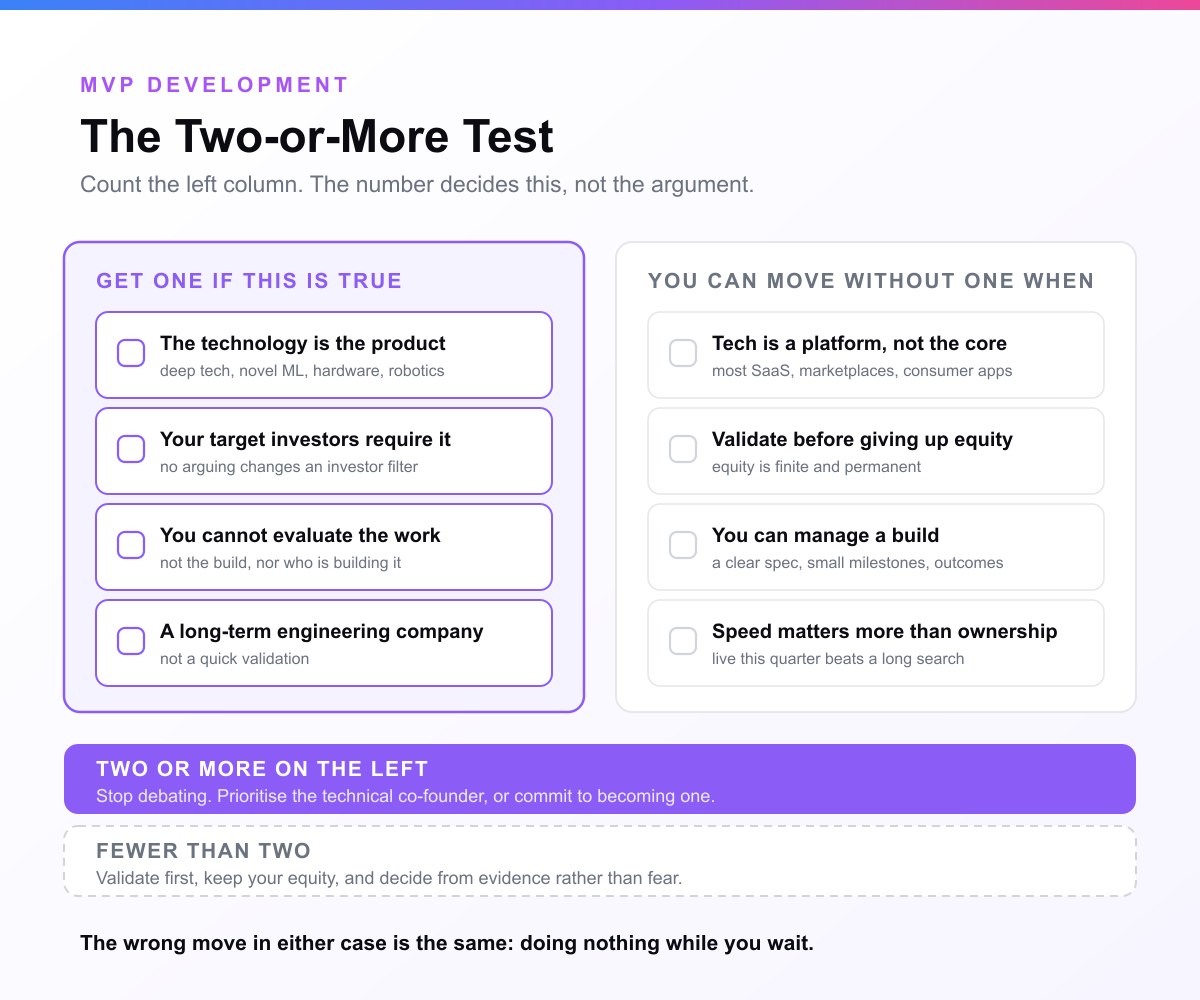
In these cases, the smart sequence is: validate first, keep your equity, and decide on long-term technical leadership from evidence, not fear. A strong technical person is also far easier to attract to a proven idea, which is the whole argument in how to find a technical co-founder.
The trap: waiting for a co-founder before you start
The single most common way non-technical founders stall is treating "I need a technical co-founder first" as a gate on everything else. Months disappear in the search while the idea sits unvalidated.
Flip it. The best thing you can do for both your startup and your co-founder search is to make progress now: a landing page with real signups, a scrappy first version, a few paying users you onboarded by hand. Traction de-risks the idea, and it's exactly what turns a cold "join my idea" into an offer a good engineer will actually consider. Waiting produces neither a product nor a co-founder.
If you don't get a co-founder: 5 ways to cover the technical gap
You will need technical capability on the team eventually. "Co-founder" is only one way to get it. The realistic options, roughly from most-founder-effort to most-outsourced:
| Option | Best when | The catch |
|---|---|---|
| Become technical yourself | You have time, and the first version is simple | A learning curve; AI-generated code still needs real review before it scales |
| Technical advisor (small equity) | You need credibility and occasional guidance | Part-time; won't build or own the roadmap |
| Fractional CTO | You need senior technical judgment for fundraising and direction, without giving up big equity | Rented, not committed; costs cash |
| Senior developer / founding engineer (hire) | You want the product built and owned in-house, keeping equity | Costs salary; may or may not grow into a co-founder |
| Product-focused build team / agency | You want a real MVP shipped fast while you validate, keeping 100% equity | Must be a product partner, not a code-for-dollars shop |
A few honest notes on these:
- Becoming technical is more viable than ever with AI tools, and plenty of founders have vibe-coded a working first version. But be clear-eyed: AI-generated code is often fragile beyond the happy path, and a vibe-coded MVP can struggle in technical due diligence. It's great for validation; it usually needs real engineering eyes before you scale or raise on it.
- A fractional CTO or advisor is an underused middle path: you get senior technical credibility (including for investor conversations) without handing a large, permanent equity stake to someone whose fit you can't yet know.
- The build-team route has one critical filter. The failure mode investors warn about is a code-for-dollars agency that turns your scope into code and calls it done, with no interest in whether you built the right thing. What you actually want is a partner whose default advice is "build less", who pushes you toward validation and scopes the smallest thing that tests the idea. That mindset, not raw coding, is the difference that matters.
What investors actually want (it's not literally "a co-founder")
Investors don't want a technical co-founder as a checkbox; they want confidence the company can execute technically as it scales. Who fixes it when it breaks at 2am with real users? Who passes the security audit? Who refactors the AI-generated code when it needs it?
A technical co-founder is the cleanest answer, which is why investors like it, but it's not the only one. Deep domain expertise, genuinely commoditized technology, or enough traction that the business proof outweighs the team gap can all substitute in specific cases. This is the lens covered in how investors evaluate an MVP: they're underwriting execution risk, and there's more than one way to retire it.
The honest recommendation
- Deep tech, hardware, or a VC path that requires it: get a technical co-founder, or commit to becoming one. Here the conventional wisdom is right.
- A fairly standard app where the hard part is the market: don't let the co-founder search block you. Validate first with the smallest real product, keep your equity, cover the technical gap with a hire, a fractional CTO, or a product-focused build team, and decide on long-term technical leadership once you have real usage and revenue to reason from.
The wrong move in either case is the same: doing nothing while you wait for a mythical do-everything technical co-founder to appear.
This is exactly the spot we're built for. The mechanism is simple: instead of trading equity for code, a small senior team scopes the one core flow with you, agrees a fixed price you approve before any work starts, and ships it in 3 to 4 weeks as production-grade code you own outright, with real auth, payments, and deployment included. What that buys you is not just speed; it is reaching the co-founder decision with a live product and real users in hand, so you choose (or skip) a partner from evidence instead of fear. If that is where you would rather be standing, tell us the product the co-founder was supposed to build.
Common mistakes founders make
- Blocking the whole company on the co-founder search. The most common and most expensive delay.
- Chasing a "tech griffin." Expecting one person to code, lead the team, set strategy, pitch investors, and do it all for equity. That person is rare and usually building their own thing.
- Offering a token equity slice for enormous work. 0.5% to "build the whole platform" signals you don't understand the ask, and no serious engineer will take it.
- Assuming AI removes the need entirely. AI speeds up coding, not product judgment or scaling, and it can even increase the need for real technical oversight.
- Ignoring investor requirements on your actual path. If your target VCs require a technical co-founder, arguing the principle won't fund you.
- Hiring a code-for-dollars shop and calling it product development. Getting scope turned into code with no validation focus burns runway on the wrong thing.
Related guides
- How to find a technical co-founder: once you've decided you want one
- How much equity should a technical co-founder get?: what a co-founder actually costs you
- MVP for non-technical founders: the four paths to a built product
- Freelancer vs agency for MVP: comparing the paid build options
- How investors evaluate an MVP: the execution risk investors are really pricing
Frequently asked questions
Do I need a technical co-founder to raise venture capital?
Sometimes, and it depends entirely on your investors and your product. Many VCs, including Y Combinator, strongly favor a technical co-founder and some treat it as a hard filter, especially for deep-tech companies where the build is the risk. But founders do raise without one, usually by pairing a working product with real traction, deep domain expertise, or a fractional CTO who can speak credibly to technical questions. If your specific target investors require a technical co-founder, that requirement is effectively non-negotiable for that path. What that route costs month to month, and when it is worth it, is in fractional CTO cost.
Can you start a startup without a technical co-founder?
Yes, for most standard web and mobile products. You can validate demand and even launch a first version using no-code tools, a hired developer, or a specialist build team, keep full ownership, and gather real usage and revenue. Then decide whether you need a technical co-founder for the long term or can attract a stronger one on the back of that traction. The main exceptions are deep-tech and heavily regulated products, where founding-team technical depth is usually essential from the start.
Do I need a technical co-founder or can I just hire developers?
For many products, hiring is a perfectly good answer, at least early on. A co-founder is an equity partner who shares the risk and commitment for years; a developer or tech lead is someone you pay to build. If what you need is the product built and you can keep managing direction, hiring (or a fractional CTO) lets you keep your equity and move now. If the company is fundamentally an engineering company for the long haul, an owner-level technical partner is worth more than a hire, and worth the equity.
When should I bring on a technical co-founder?
Ideally when you have enough validation that a strong engineer sees a real opportunity rather than just an idea, and when the company clearly needs owner-level technical leadership for the long term. Bringing one on too early means giving away a large, permanent equity stake before you know whether the idea works or whether you two work well together. Bringing one on too late (for a genuinely technical company) can stall your ability to build and scale. Validate first where you can, then recruit from strength.
Is a fractional CTO a good alternative to a technical co-founder?
Often, yes, especially in the validation and early fundraising phase. A fractional CTO gives you senior technical judgment and credibility, including for investor conversations, without handing over a large permanent equity stake to an unproven partner. The trade-off is that they're rented rather than committed and cost cash. For a deep-tech company that needs a fully committed technical owner long term, a fractional CTO is a bridge rather than a destination, but it's an effective bridge.
Sources & references
This guide synthesizes established startup guidance and the wider founder-community debate on the technical co-founder question.
- Y Combinator, Why You Really Do Need a Technical Co-Founder: the case that venture-track companies without a technical co-founder underperform
- Paul Graham, How to Start a Startup: why a non-technical founder struggles to evaluate and recruit strong engineers
- Y Combinator, Startup Library: co-founders, validation, and fundraising fundamentals
This article is general educational information, not legal or financial advice. The right choice depends on your specific product, market, and funding path.


