


TL;DR
A technical co-founder who joins early, before real funding, and takes genuine risk usually gets somewhere between 20% and 50% of the company, and most often lands near an equal split when they're building the entire product from scratch. The number moves down as the non-technical founder has already removed risk (a working product, paying customers, money raised, a prior exit) and as the technical person takes a real salary. It moves up the earlier they join, the more the business depends on what they build, and the less cash they're paid.
Two things matter more than the exact percentage: get it in writing with a vesting schedule (typically four years with a one-year cliff), so neither side is trapped or robbed, and treat this as general guidance, not legal advice, a startup lawyer should paper the actual split. The rest of this guide gives you the range, the factors that move it, a simple way to reason about your own number, and the alternative if giving away a large slice of your company feels wrong.
Key Takeaways
- A technical co-founder who joins early and takes real risk usually gets 20% to 50%, often near an equal split when building the entire product.
- The share moves down as the non-technical founder has removed risk (a working product, customers, money raised) and as the technical person takes a salary.
- It moves up the earlier they join, the more the business depends on what they build, and the less cash they are paid.
- Get it in writing with a vesting schedule, typically four years with a one-year cliff.
- Treat this as general guidance, not legal advice; a startup lawyer should paper the actual split.
The honest starting point: near-equal
For a true co-founder who joins early and shares the risk, the honest default is to start the conversation near an equal split, not at a token 5% or 10%. This surprises many non-technical founders, especially when the company is built on their idea, so it's worth being blunt about why.
Ideas are cheap; execution is what creates value. A startup is worth nothing until something is built, shipped, and used, and in most software companies that work falls on the technical founder. A strong engineer can usually build a product on their own and go find a business partner later, which means when they join you, they're giving up the option to keep 100% for themselves. The equity is what makes that trade worth it. Undervaluing it is one of the most common reasons good non-technical founders stall for months: they try to hand over 5%, no serious engineer accepts, and the product never gets built.
That does not mean every technical co-founder gets 50%. It means 50% is the honest starting point for two people taking similar risk and making similar contributions, and you adjust from there based on what each side actually brings.
What moves the number up or down
The split is really a question of relative risk and contribution. Here's what pushes a technical co-founder's share in each direction.
| Pushes their share DOWN (you've de-risked it) | Pushes their share UP (more risk on them) |
|---|---|
| There's already a working product | They join at the idea stage, nothing built |
| There are paying customers or real traction | No traction yet, they build it from zero |
| You've raised funding | No funding, they work unpaid |
| You take little or no salary too | They forgo salary while you're paid |
| You have a prior exit or strong track record | Neither founder has a track record |
| You bring the money, network, and sales | You bring mainly the idea |
| They take a meaningful salary | They take equity in place of salary |
The logic is consistent: every risk you've already removed is worth equity you get to keep. If you show up with a live product, paying users, and money in the bank, the technical co-founder is joining something far safer, so their fair share is smaller. If they're the one turning a blank page into a real product with no salary, their share is larger.
A simple way to reason about your number
One widely cited approach (popularized by Nathan Hurst) is to reason subtractively: start both founders at roughly equal, then reduce the incoming technical co-founder's share for each meaningful way you, the non-technical founder, have already reduced the company's risk. A working prototype you paid to build, paying customers, capital raised, a prior successful startup: each of these is a real de-risking event, so each trims the slice the technical person needs in order to be fairly compensated for the risk they're taking now.
A worked example, in that spirit and with round numbers:
- Start the technical co-founder near 50% (equal risk, equal contribution assumed).
- You already have a working product built: trim it (say to ~40%).
- You have early paying customers: trim again (say to ~30%).
- You've raised a small round: trim again (say to ~20% to 25%).
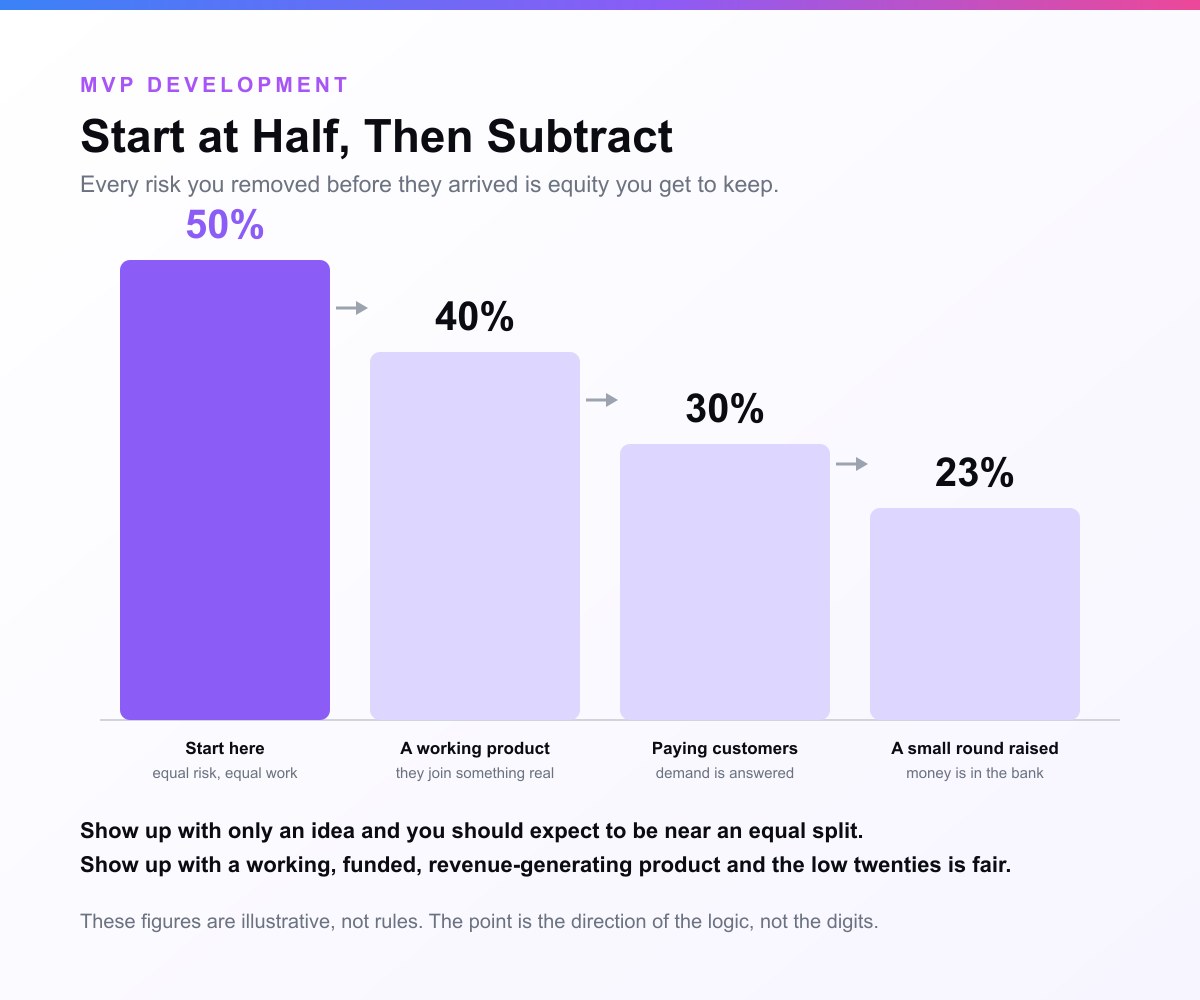
So a non-technical founder who shows up with a working, revenue-generating, funded product might fairly offer a strong technical co-founder in the low-20s percent, while one who shows up with only an idea should expect to be near an equal split. These are illustrative, not rules: the point is the direction of the logic, not the exact digits.
Real-world ranges founders actually agree on
Advice essays give principles; here's roughly where real early-stage deals tend to land, based on how founders and engineers consistently talk about it. Use it as a sanity check, not a formula.
| Situation | Typical technical co-founder share |
|---|---|
| Joins at idea stage, builds everything, no salary, no traction | 40% to 50% |
| Joins early, builds the product, small or no salary, little traction | 25% to 40% |
| Joins with some traction and/or a modest salary | 15% to 25% |
| Joins after the product exists and is funded, takes a real salary | 5% to 15% |
Notice the pattern: the more they build, the earlier they join, and the less cash they take, the closer to half they should be. Below roughly 10% for someone building and running all the technology, you're offering a lead developer package, not a co-founder one, and strong candidates will read it that way and pass.
When the technical partner is doing all the work
The most common version of this question is not “how do we split it” but “I have the idea and the technical person is going to build the entire product, so how much equity should they get?” It deserves its own answer, because the honest one makes some founders uncomfortable.
If one person is writing every line of the product, full time, for no salary, and the other is contributing the idea and part-time effort, the technical partner is not a hire you are compensating. They are the founder of the product. In that situation the ranges founders actually agree on sit between 40 and 60 percent for the technical partner, and the number moves toward the top of that range the longer the other founder stays part-time or unpaid-but-not-building.
Three things pull it back down, and each has to be real rather than promised:
- Money. If the non-technical founder is funding the build from their own pocket, that capital is a contribution the technical partner is not making, and it is usually priced in as a reduction of 5 to 15 points depending on the amount.
- Customers. If the non-technical founder is bringing signed pilots, a distribution channel or a sales background that will land the first ten customers, that is worth as much as the code. Ideas are not; demonstrated demand is.
- Time. If the non-technical founder is also full time, on the same terms, the split moves back toward equal. If they are keeping a job while the technical partner is not, it does not.
What does not pull it down is the idea. An idea without a product, customers or capital behind it is worth very little on a cap table, and a technical partner who is asked to take 10 to 20 percent for building the whole thing will either say no or leave at month eight, taking the knowledge of the codebase with them. If you cannot bring yourself to offer a real founder’s share for a founder’s amount of work, the honest alternative is below: pay for the build and keep the equity.
Salary versus equity: the core trade-off
Equity and salary are the two levers, and they move against each other. A technical co-founder taking founder-level risk with no salary is entitled to more equity, because their compensation is entirely a bet on the future. If you can pay a real salary, it's fair for their equity to be lower, because you've removed their personal financial risk.
The honest framing for your offer: decide what cash you can pay (often between zero and a lean "ramen" salary early on), then set equity to match the risk that's left. What you should not do is pay nothing and offer a tiny equity slice, that's asking someone to take all the risk for almost none of the upside, and it's exactly the offer serious engineers have learned to decline instantly.
Always vest: protect both sides
Whatever percentage you agree on, it must vest. Vesting means the equity is earned over time rather than granted all at once, and it protects everyone:
- Standard is four years with a one-year cliff. Nothing vests for the first year; if the co-founder leaves (or it doesn't work out) in month six, they keep nothing. After the cliff, equity vests gradually, usually monthly.
- It protects you from the nightmare of a co-founder walking away in month three still owning a huge, permanent chunk of your company.
- It protects them by making the commitment real and mutual, and it's what investors will expect to see anyway.
Handing over un-vested equity on a handshake is one of the most damaging mistakes early founders make. Get a cap table, a vesting schedule, and written terms, and have a startup lawyer set it up. This is the part where "we trust each other" is not a substitute for structure.
The agreement that protects a technical co-founder’s equity
A percentage on a whiteboard protects nobody. The equity only exists, and only holds up when someone leaves, raises money or sells, if it is written into documents that the company actually signs. For a technical co-founder there are six things that need to be on paper before the first serious commit, and they are the same six a lawyer will ask about the moment an investor appears.
1. A founders’ agreement, or its equivalent inside the company documents
Who owns what percentage, on what vesting schedule, with what roles and what decision rights. Before incorporation this is a founders’ agreement between people; after incorporation it lives in the stock purchase agreements and the shareholders’ agreement or operating agreement. The point is not the format. It is that the split, the vesting and the roles are signed by everyone, not remembered by everyone.
2. Vesting with a cliff, written into the grant
The four-year, one-year-cliff schedule above only works if it is in the stock purchase agreement and the company has the right to buy back unvested shares when someone leaves. A verbal “we’ll vest” is not vesting.
3. An IP assignment
This is the one technical co-founders forget and the one that hurts most. Every line of code, every design and every piece of work must be assigned to the company by the person who created it, in writing, usually through an invention assignment agreement signed at the same time as the equity grant. Without it, the founder who wrote the product owns the product personally, which is a problem for the company when they leave and a problem for the founder when the company argues about it later. Investors will not fund a company whose code belongs to an individual. The same principle applies when an outside team builds the product: the development contract has to assign the work to the company.
4. Leaver terms
What happens to vested and unvested equity if a founder leaves voluntarily, is asked to leave, or is removed for cause. Good-leaver and bad-leaver provisions, and whether the company can repurchase vested shares and at what price, are the clauses that decide whether a departure is a paperwork exercise or a lawsuit.
5. Acceleration
Whether vesting speeds up if the company is acquired (single trigger) or if it is acquired and the founder is then let go (double trigger). Double trigger is the standard that protects the founder without scaring acquirers.
6. The tax election, if you are in the US
US founders receiving restricted stock that vests generally have 30 days from the grant to file an 83(b) election with the IRS. Missing it can mean paying income tax on the shares as they vest at whatever the company is worth then, rather than on the near-zero value at grant. It is a one-page form and a hard deadline, and it is the single most expensive thing a technical co-founder can forget to do in the first month.
None of this requires a large legal bill. Standard startup counsel and the common incorporation platforms produce all six as a package for an early-stage company. What it requires is doing it before the code is written rather than after, because every one of these documents is easy to sign when everyone is happy and impossible to sign when they are not. The wider question of protecting the idea itself is a separate one; these documents protect the company and the people in it.
Remember: you're recruiting a partner, not buying code
A recurring confusion is treating equity as the price of the code, as if you're paying for a deliverable. You're not. A co-founder's equity reflects partnership and shared risk over years, not the hours to build version one. This is the difference between a co-founder and a hire: you can hire a developer or even a CTO for salary, but a co-founder is someone taking the journey with you, and their stake has to reflect that. If what you actually want is the product built, without giving away a large, permanent share of the company, that's a different decision, and a legitimate one (next section). For how to actually find and vet that partner in the first place, see how to find a technical co-founder.
The alternative: keep your equity, build it with a team
Here's the honest counter-question worth asking before you give away 20% to 50% of your company forever: do you need a co-founder, or do you need the product built? Whether to have a co-founder at all, before the question of how much they get, is covered in solo founder vs co-founder.
If it's mainly the latter, there's another path. You can hire a specialist team to build your MVP, keep 100% of your equity, get real users, and then decide whether you even still need a technical co-founder, or attract a much stronger one on the back of proven traction. Giving away half your company to someone whose fit you can't yet know is a permanent decision made at the point of maximum uncertainty. Building first, and keeping your equity, defers that decision until you have real information.
That is the alternative we offer: instead of signing away 20% to 50% of the company to get a product built, you keep all your equity and pay a fixed price for the build. We scope the core flow with you, agree the price before any work starts, and ship it in 3 to 4 weeks, with auth, payments, deployment, and code you own outright. Then you validate, and decide on a co-founder, if you still want one, from a position of traction, where the equity you would give up buys far more. If you are weighing an equity offer against just getting it built, price the build before you price the equity.
Common mistakes founders make
- Offering a token slice to a real co-founder. 5% to someone building and running all the technology won't attract anyone good, and signals you don't value the work.
- Skipping vesting. Granting equity outright, then watching a co-founder leave early with a permanent chunk.
- Paying nothing and offering little equity. All risk, no reward: the fastest way to get ignored by strong engineers.
- Treating equity as the price of code. It's the price of partnership and years of risk, not of building version one.
- Doing it on a handshake. No cap table, no written terms, no lawyer, which is how co-founder disputes and lawsuits start.
- Anchoring to your region's low salaries. Fair equity for co-founder-level risk doesn't shrink because cash is cheap where you are.
What the numbers above are worth, and where ours now come from
Everything in this guide until now is practitioner judgement. That is worth saying plainly, because most of what a founder reads on this question is the same thing wearing a citation.
Across 13 pages answering how much equity a technical co-founder should get, MVP Development found all 13 state a percentage and 4 attach any of it to a named source. Of those four attributions, one survives a check. Read 24 September 2026.
The check was simply opening the source. Three separate pages attribute three different numbers to Carta for the same measure, the share of two-founder teams that split equity equally: 73%, 55% and 45.9%. Only 45.9% appears anywhere on a Carta page.
The other two are attributed to Carta publications that do not exist under the titles given. One cites a “2024 Co-Founder Equity Report”; Carta’s founder series is the Founder Ownership Report. Another credits “State of Private Markets”, a real Carta series about deal terms rather than founder splits.
The same page cites a Cooley “2024 Startup Formation Survey” and a First Round Capital “2024 State of Startups Report”. Neither was findable. First Round’s State of Startups ran from 2015 to 2018.
What Carta does say
Carta’s Peter Walker reported on 20 February 2025 that 31.5% of two-person founding teams split their equity equally back in 2015, and that in 2024 the figure was 45.9%.
Carta reported on 18 June 2026 that the rate for two-founder teams reached 44.6% in 2025, its highest point of the past decade. Across all team sizes and more than 32,000 companies incorporated between 2015 and 2024, about 24% split equally.
Carta also reported, on that June 2026 page, that among startups founded from 2016 to 2018, more than 40% of two-founder teams had experienced a breakup within eight years. Between 25% and 35% parted ways within five.
That last figure is the one worth carrying out of this section. The vesting schedule above is not paperwork for an unlikely event. It is paperwork for something that happened to more than four in ten two-founder teams in Carta’s data.
What went wrong, and what this does not measure
Five reachable pages did not render their body text to a plain fetch, so their counts would have been zeroes that meant nothing. They are excluded from the 13 rather than counted as silent. One page returned HTTP 404.
Carta’s own two pages are not perfectly consistent. February 2025 puts 2024 at 45.9%, and June 2026 calls 44.6% in 2025 a decade high. Both cannot describe the same series as Carta now states it, and the likely reason is restatement as more companies file.
None of this measures whether the advice is good. A correctly attributed number can still be wrong for your company, and an unattributed range can still be sound practice from someone who has done this many times.
We are in the sample and we failed the check. This page states fourteen percentages of its own and attributes none of them, under a sources note saying it “synthesizes widely used startup equity frameworks and common practitioner guidance”. They are practitioner judgement, as the top of this section says, and the Carta figures above are what changed on 24 September 2026.
How to cite these figures
The page counts are ours and free to quote with attribution. The Carta figures belong to Carta and should be cited to them.
Across 13 pages answering how much equity a technical co-founder should get, MVP Development found all 13 state a percentage, 4 attribute it to a named source, and 1 attribution survives a check (read 24 September 2026). https://mvpdevelopment.company/blog/technical-co-founder-equity
The dataset carries every attributed sentence verbatim, the verdict on each with its reason, and the pages that could not be read: equity-claims-2026-09-24.json.
Sources: Carta, a shift is underway in how startup co-founders split their equity, Peter Walker, 20 February 2025. Carta, equity math for two-founder teams, 18 June 2026.
Related guides
- How to find a technical co-founder: where to look, how to vet, and how to make the offer
- MVP for non-technical founders: all four paths to a built product
- Freelancer vs agency for MVP: the paid alternatives to giving up equity
- MVP development team: who you actually need to build an MVP
- How investors evaluate an MVP: why a clean cap table and real technical capability matter for raising
Frequently asked questions
How much equity should a technical co-founder get?
A technical co-founder who joins early, before meaningful funding, and takes real risk typically gets between 20% and 50%, and often close to an equal split when they build the entire product with little or no salary. The share drops as you (the non-technical founder) have already removed risk (a working product, paying customers, raised capital, a prior exit) and as the technical person takes a salary. Below roughly 10% for someone building and running all the technology, you're offering a lead-developer package, not a co-founder one.
Is a 50/50 split with a technical co-founder a good idea?
An equal split is the honest default for two people joining at the same early stage, taking similar risk, and contributing similarly, and it keeps both sides fully motivated. It becomes less appropriate when one founder has already de-risked the business substantially (built the product, found customers, raised money) or is putting in far more time or capital. The key is that the split reflects real relative risk and contribution, and that it vests over time regardless of the percentage.
Should a technical co-founder get salary and equity, or just equity?
It's a trade-off. A co-founder taking no salary is entitled to more equity, because their entire compensation is a bet on the future. If you can pay a real salary, it's fair for their equity to be somewhat lower, since you've removed their personal financial risk. Early on, cash is usually between zero and a lean salary, so equity carries most of the compensation. What's not fair is offering neither meaningful salary nor meaningful equity.
How much equity for a technical co-founder when there's no funding?
With no funding and no salary, a technical co-founder building the product from scratch is taking maximum risk, so their fair share is high, often in the 30% to 50% range depending on traction and what the other founder brings. If some risk has already been removed (a working prototype, early users) the number comes down accordingly. The absence of funding generally pushes the equity up, because the technical person is effectively investing unpaid time.
What if the technical person joins after the product is already built?
Then they're joining something more de-risked, so their co-founder equity is lower, commonly in the 5% to 20% range, especially if they also take a salary. It also raises a real question: are they a co-founder or a senior hire? If they'll own and drive all technology as a genuine partner, co-founder equity (with vesting) makes sense. If they're maintaining and extending an existing product for pay, a lead-developer or founding-engineer package may fit better than a co-founder split.
Does the equity need a vesting schedule?
Yes, always. The standard is four years with a one-year cliff: nothing vests in the first year, then equity vests gradually. Vesting protects you if the co-founder leaves early (they don't keep a large permanent stake) and protects them by making the commitment mutual and real. Investors expect it. Granting un-vested equity on a handshake is one of the most damaging early mistakes founders make.
What agreement does a technical co-founder need to protect their equity?
Six documents, signed before serious work starts: a founders’ agreement or the equivalent terms in the company’s stock purchase and shareholders’ agreements (split, vesting, roles, decision rights); a vesting schedule with a cliff written into the grant, with a company right to repurchase unvested shares; an IP or invention assignment agreement so the code belongs to the company rather than the person who wrote it; leaver terms covering vested and unvested shares; acceleration terms for an acquisition, usually double trigger; and, for US founders receiving restricted stock, an 83(b) election filed within 30 days of the grant.
How much equity should a technical partner get if they are doing all the work?
Between 40 and 60 percent is the range founders actually agree on when one person is building the entire product full time and the other is contributing the idea and part-time effort. It moves down if the non-technical founder is funding the build, bringing signed customers or a distribution channel, or working full time on equal terms. It does not move down for the idea alone. Offering 10 to 20 percent for building the whole product usually ends with the technical partner leaving.
Does a technical co-founder need an IP assignment agreement?
Yes, and it is the document most often missed. Without a written assignment, the person who wrote the code owns it personally, not the company. That blocks investment, complicates any departure and can put the product itself in dispute. It is normally signed alongside the equity grant as an invention assignment agreement.
What is an 83(b) election and does a technical co-founder need one?
In the US, a founder who receives restricted stock that vests can elect to be taxed on its value at grant, when it is near zero, instead of as it vests, when the company may be worth far more. The election must be filed with the IRS within 30 days of the grant and cannot be filed late. Most technical co-founders receiving vesting stock in a US company should file it; the deadline is the reason to sort the paperwork before writing code.
How much equity does a CTO get at seed stage?
It depends on whether the CTO is a co-founder or a hire. A co-founding CTO is in the near-equal range this guide describes, typically 30 to 50 percent before investors, vested over four years. A CTO hired after a seed round is an employee: a salary plus an option grant that is commonly in the low single digits, with the higher end for a first technical leader joining pre-product. If the person is building the first version in exchange for shares rather than a co-founder title, that is a different document, a sweat equity agreement, and the number is usually far lower than a co-founder’s.
Sources & references
This guide synthesizes widely used startup equity frameworks and common practitioner guidance. Equity splits vary widely, so treat these as principles to reason with, not fixed rules, and have a startup lawyer paper the actual agreement.
- Nathan Hurst, How Much Equity a Technical Cofounder Should Get: the subtractive "start near equal, reduce for de-risking" model
- Y Combinator, Startup Library: co-founder equity and splitting equity fairly
- Y Combinator Co-Founder Matching: finding a co-founder in the first place
This article is general educational information, not legal, tax, or financial advice. Consult a qualified startup attorney before finalizing any equity split or vesting agreement.


