


TL;DR
A technical co-founder is a partner: they share the vision and the risk, take founder-level equity (in 2025, 44.6% of two-founder teams split it equally, by Carta’s count), work for little or no salary early on, and help set product and company direction. A founding engineer is an early employee: they take a market-rate salary plus a smaller equity slice (a 1.54% median for a first engineer, per Carta), and their job is to build the product fast, not to co-own the company. Same technical work, very different role, risk, and stake.
Which you need comes down to one question: do you need a partner, or an execution hire? If the company is fundamentally a long-term engineering company and you want someone who shares the risk and the upside, that's a co-founder. If you mostly need someone to build the product and you can pay a salary (usually after some funding or revenue), that's a founding engineer. This guide covers the exact differences, the equity, when to hire which, and the honest catch for pre-funding founders.
Key Takeaways
- A technical co-founder is a partner: they share the vision and risk, take founder-level equity, and help set direction. Carta counts 44.6% of two-founder teams splitting equity equally in 2025.
- A founding engineer is an early employee: market-rate salary plus a smaller equity slice, a 1.54% median for a first engineer (Carta, December 2025), focused on building fast.
- Same technical work, very different role, risk, and stake.
- The deciding question: do you need a partner, or an execution hire?
- Choose a co-founder for shared long-term risk and upside; choose a founding engineer when you mainly need someone to build and can pay a salary.
What is a founding engineer?
A founding engineer is usually the first technical hire at a startup: a senior individual contributor who joins very early (often at pre-seed or seed, sometimes before you close funding) to build the product hands-on. They write most of the initial code, choose the stack, set up the infrastructure, and iterate fast on user feedback.
The defining traits:
- They code, most of the time. Building the product is the primary job, not managing people or setting three-year strategy.
- They wear many hats. Frontend, backend, DevOps, and sometimes talking to customers. They thrive in ambiguity.
- They help hire the next engineers and shape the early engineering culture, without being a formal manager.
- They're an employee, not an owner. "Founding" refers to being early and foundational to the product, not to founder status. They take a salary and a modest equity grant, not a co-founder's stake.
In short: a founding engineer is the person who ships the thing, hired for velocity, at the earliest stage.
Founding engineer vs technical co-founder: the real differences
Both are senior technical people at an early startup.
The difference is role, risk, and stake, not coding ability.
| Founding engineer | Technical co-founder | |
|---|---|---|
| Role | Early employee who builds the product | Partner who co-owns the company |
| Equity | An option grant: 1.54% median for a first engineer (Carta); 0.50% to 2.00% is the range most often advertised | Founder equity: 44.6% of two-founder teams split equally in 2025 (Carta) |
| Salary | Market-rate (or close), from day one | Little or none early on ("sweat equity") |
| Decision power | Executes the vision, owns technical architecture | Sets product, engineering, and company direction |
| Commitment | Full-time employee; can leave like any hire | All-in owner, tied to the company for years |
| Financial risk | Low (paid a salary) | High (bets years on uncertain equity) |
| How it evolves | Can grow into a CTO or Principal Engineer role | Stays an owner; leads or hands off as it scales |
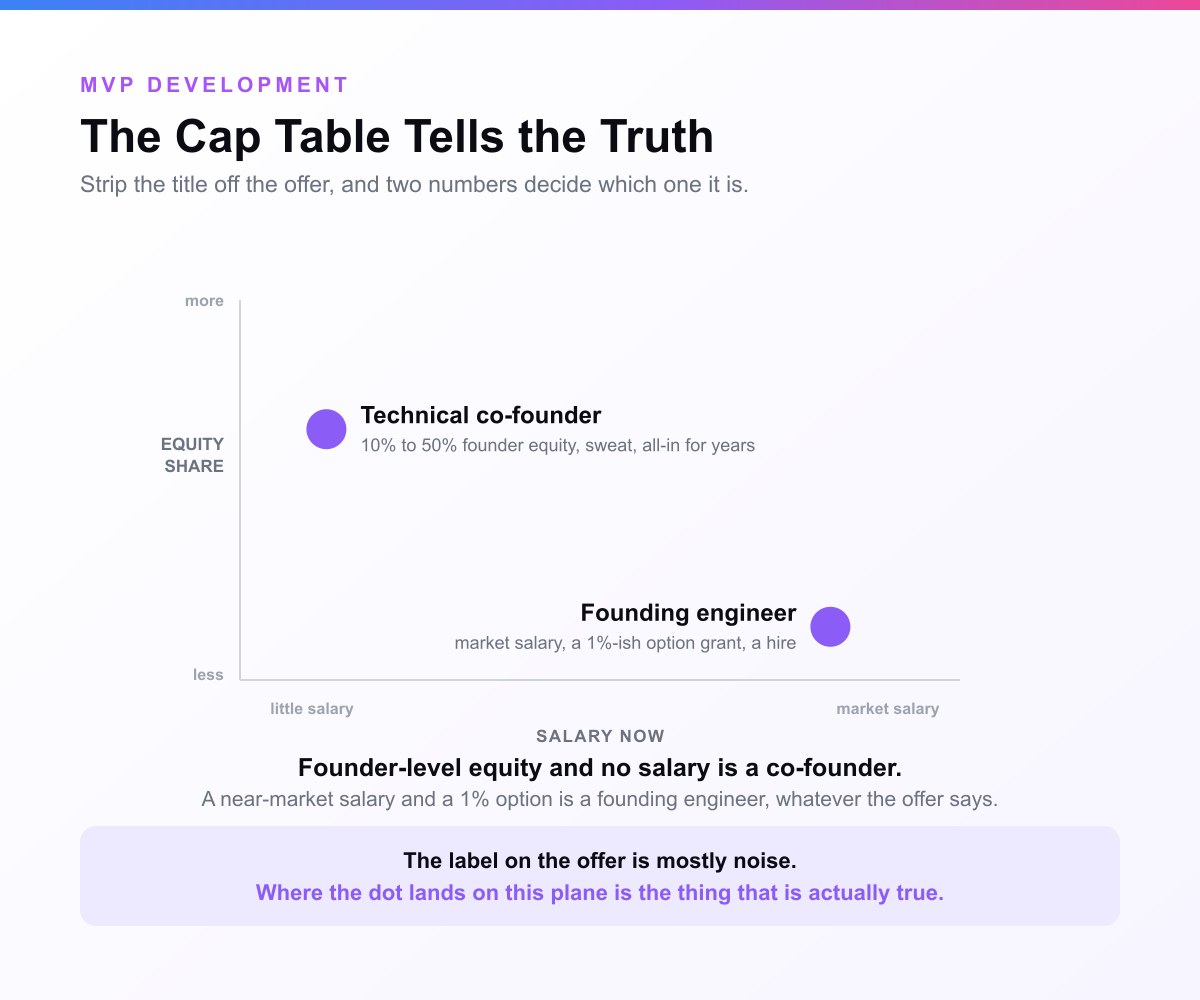
The single clearest signal, if you strip away titles: equity and salary. Someone taking founder-level equity and forgoing salary is a co-founder. Someone taking a near-market salary and a 1%-ish option grant is a founding engineer, no matter what the title on the offer says. As founders on Hacker News and r/ycombinator repeatedly point out, the label is mostly noise; the cap table tells the truth.
When to hire a founding engineer (vs look for a co-founder)
Reach for a founding engineer when:
- You can pay a salary. Usually this means you have some funding or revenue. A founding engineer is a hire, and hires expect to be paid.
- You need velocity, not a partner. You already own the product vision and direction; what you need is someone to build it well and fast.
- You want to keep your equity. A founding engineer costs a few percent, not tens of percent. If you don't need a co-owner, you shouldn't pay co-owner prices.
- You can lead the technical direction (or have someone who can). A founding engineer executes; they don't usually set the whole strategy alone.
Look for a technical co-founder instead when:
- It's a deeply technical, long-term company where you want owner-level technical leadership committed for years (see do you need a technical co-founder?).
- You can't pay salaries yet and need someone to take the risk with you for equity.
- You need a genuine partner to share the load, the decisions, and the emotional weight of building, not just an executor.
The honest rule: if you can pay and you mostly need building done, a founding engineer is cheaper and keeps your equity. If you need a committed partner and can only offer equity, that's a co-founder.
Founding engineer equity: what’s fair (Carta data, December 2025)
The number most founders carry around, “about 1%”, is now below the middle of the market. Carta’s analysis of first-engineer grants over the past two years puts the median at 1.54%, with the middle half of grants starting at 0.61%. The page gives the top of that middle half twice and differently, 3.5% in its summary and 4.13% in its text; the median is the same in both. It falls fast after that: by the second and third engineering hire the median is down around 0.61%. The founding engineer is paid for being first, and the premium is real.
The grant is usually stock options vesting over four years with a one-year cliff, and it moves with cash: an engineer joining pre-seed on a below-market salary belongs near the top of that range or above it, one joining at seed on full pay belongs nearer the median. What it is not is a co-founder’s slice. If you’re offering 15% to 50%, you’re offering a co-founder deal and you should expect co-founder commitment in return. Offering 0.5% to someone you’re asking to build the entire product as a “co-founder” is the classic mistake that makes serious engineers walk; at 0.5% you are now below Carta’s 25th percentile for a plain first hire. For the co-founder side of this, see how much equity a technical co-founder should get.
What about a CTO? (the quick distinction)
People often lump in a third title. A CTO is a technical executive: they mostly manage engineers, own technology strategy, and rarely write production code day to day. That role fits later (typically Series A and beyond, once you have five or more engineers), not at the idea or MVP stage. Hiring a CTO too early means paying executive money to manage a team that does not exist yet.
So at the earliest stage your realistic technical hires are a founding engineer (full-time builder) or a co-founder (owner-builder), not a CTO. If you specifically want senior technical judgment part-time without a full hire, that is a fractional CTO, which is a different tool again.
Founding engineer vs technical co-founder vs CTO: side by side
The three titles get used interchangeably in job posts and pitch decks, and they are three different deals. Here is the whole comparison in one place.
| Founding engineer | Technical co-founder | CTO | |
|---|---|---|---|
| What they are | First engineering hire, an employee | An owner who also builds | A technical executive who mostly manages |
| Equity | Median 1.54%, 25th percentile 0.61% (Carta) | A founder split; 44.6% of two-founder teams split equally in 2025 (Carta) | An option grant when hired later; a co-founder CTO holds founder equity instead |
| Cash | Salary, often below market pre-seed | Little or none until a round closes | Executive salary |
| Decides | How to build what has been decided | What to build, with you | Technology strategy, hiring, architecture at scale |
| Writes code | All day | Most of the day, until there is a team | Rarely, past a handful of engineers |
| Right time | Pre-seed to seed, once there is some cash | Idea stage, before there is anything to hire into | Series A and beyond, typically five or more engineers |
| If you can’t afford it | An agency builds the MVP on a fixed quote instead | Build the first version with an agency, recruit a co-founder with traction in hand | A fractional CTO a few hours a week |
Read the “right time” row against your own stage before you write the job post. The most common mismatch we see is a founder with no funding advertising for a founding engineer at 0.5%, which is a co-founder’s job at a fraction of a first hire’s median, and the second most common is a two-person startup hiring a CTO to manage a team that does not exist. The investor view of these roles is worth knowing too: at pre-seed, investors back a technical co-founder or a shipped product; a title on an org chart moves nothing.
The honest catch for pre-funding founders
Here's what the "just hire a founding engineer" advice skips: a founding engineer wants a salary and a real equity grant, and the good ones are scarce. Pre-funding, with no salary to offer, you're competing for the same rare senior engineers that everyone wants, and you often can't afford or attract one yet.
That's the same wall as the co-founder search, just with cash instead of equity.
So for many founders the practical sequence is: get the product built and validated first, then hire a founding engineer once you have traction or funding to pay and attract one. Building first is what gives you the two things that make a founding engineer hire realistic, money to pay them, and a real product they'd be excited to join.
That is the gap we fill. Rather than spend months trying to attract, and afford, a founding engineer before you have funding, you hand the build to a small senior team: we scope the core flow, agree a fixed price up front, and ship it in 3 to 4 weeks as production-grade code you own, with auth, payments, and deployment included. You come out with a live product and real usage, which is exactly what makes a founding-engineer hire realistic later: you are recruiting on traction and able to pay, not pitching an idea. If you are stuck between 'find someone' and 'get it built,' bring us the version where it just gets built.
Common mistakes founders make
- Calling an employee a co-founder (or vice versa). The title should match the equity and commitment. Mismatches cause disputes and confuse investors.
- Offering co-founder work for founding-engineer equity. Asking someone to build the whole product for 0.5% "as a co-founder" won't attract anyone good.
- Trying to hire a founding engineer with no salary. Without cash, you're really looking for a co-founder, so pitch it honestly as one.
- Hiring a CTO at the idea stage. Paying executive salary to manage a team that doesn't exist yet is expensive overhead.
- Waiting to hire before there's a product or funding. Build and validate first; that's what makes the hire both affordable and attractive.
What startups actually advertise for a founding engineer
Carta measures what first engineers are granted. Nobody had read what startups put in the job post, which is the number a founder is competing with when they write their own.
Across 12 companies advertising a founding engineer role with an equity range, MVP Development found the most common range was 0.50% to 2.00%, and the median midpoint 1.25%. Read 28 September 2026.
The advertised midpoint sits a little under Carta’s 1.54% median grant. Offers and grants measure different things, so read the two side by side rather than as one number.
Where the ceiling sits
10 of the 12 companies cap the range at 2% or less. The two that go higher, to 5%, both pay less cash: $80,000 to $120,000 at one and $50,000 to $90,000 at the other. The ten capped at 2% top out at a median salary of $200,000.
That is the trade in one line. A founding engineer paid close to market takes about 1% to 2%; one taking a salary cut gets offered more, and a founder who can offer neither is asking for a co-founder.
How the sample was built
Every live job post titled “Founding” engineer or developer that could be read without an account on Y Combinator’s public job pages and Wellfound’s founding engineer pages: 18 posts from 14 companies, of which 12 published equity. Companies with several identical posts are counted once.
It is small because the public pages are. Y Combinator’s full job board needs an account, which we do not create, and seven founding engineer posts found by search had closed before they could be read. It is a one-day snapshot of offers, not grants; Carta’s figure is the one to use for grants.
How to cite these figures
Free to quote with attribution.
Across 12 companies advertising a founding engineer role with an equity range, MVP Development found the most common range was 0.50% to 2.00% and the median midpoint 1.25%; the only two offering up to 5% paid $120,000 or less (read 28 September 2026). https://mvpdevelopment.company/blog/founding-engineer-vs-technical-co-founder
Every post, with its equity and salary range and the board it came from: founding-engineer-equity-2026-09-28.json.
Related guides
- Do you need a technical co-founder?: the bigger decision this sits inside
- How much equity should a technical co-founder get?: the co-founder side of the equity question
- What is a fractional CTO?: the part-time senior-leadership alternative
- How to find a technical co-founder: if a partner is what you decide you need
- MVP development team: who you actually need to build an MVP
Frequently asked questions
What is the difference between a founding engineer and a technical co-founder?
A technical co-founder is a partner who co-owns the company: they share the vision and risk, take founder-level equity, usually work for little or no salary early, and help set company direction. A founding engineer is an early employee hired to build the product fast: they take a market-rate salary plus a smaller equity grant (a 1.54% median for a first engineer, per Carta) and execute the vision rather than own it. The clearest tell is equity and salary, not the job title.
Is a founding engineer a co-founder?
No. A founding engineer is an early, senior employee, not an owner. "Founding" means they are foundational to building the product and join very early, but they take a salary and a modest equity grant rather than a co-founder's stake, and they don't carry founder-level ownership or risk. Occasionally a founding engineer is brought on with near-co-founder equity and effectively functions as one, but in the standard case they are the first technical hire, not a founder.
How much equity should a founding engineer get?
Carta puts the median first-engineer grant at 1.54% (December 2025), with the 25th percentile at 0.61%, usually vesting over four years with a one-year cliff. In live founding engineer job posts MVP Development read on 28 September 2026, the range advertised most often was 0.50% to 2.00%, and the median midpoint 1.25%. It is higher than a later hire’s grant, but far below a co-founder’s share. Lower salary and earlier stage push it toward (or above) the top of that range; a fuller salary and later stage push it lower.
Should I hire a founding engineer or find a technical co-founder?
Hire a founding engineer if you can pay a salary, you own the product vision, and you mainly need someone to build fast while you keep your equity. Look for a technical co-founder if it's a deeply technical, long-term company, you can only offer equity rather than salary, and you need a committed partner who shares ownership and direction. In short: pay-and-build points to a founding engineer; equity-and-partner points to a co-founder.
When should a startup hire a founding engineer?
Usually once you can pay a salary, which typically means you have some funding or revenue, and you have a product vision that needs building fast. Pre-funding with no salary to offer, attracting a strong founding engineer is very hard, so many founders get the MVP built and validated first, then hire a founding engineer on the back of traction and cash. Hiring one too early, before you can pay or attract them, tends to stall rather than help.
Founding engineer vs CTO: what's the difference?
A founding engineer is a senior individual contributor who codes most of the time and joins at seed to build the product. A CTO is a technical executive who mostly manages engineers and owns technology strategy, and fits later (typically Series A and beyond, with five or more engineers). At the idea or MVP stage you want a builder (founding engineer or co-founder), not an executive; a CTO at seed stage is usually expensive overhead. For part-time senior judgment without a full hire, a fractional CTO is a separate option.
What is the difference between a CTO and a VP of Engineering?
Once a company has both, the CTO owns the technology and the VP of Engineering owns the team. Fred Wilson drew the line on AVC in October 2011: the CTO is ideally “the strongest technologist in the organization”, often the technical co-founder, while the VP of Engineering is a manager and team builder whose job is to make every engineer successful. Either can report to the other. Until that second hire, the CTO usually does both jobs, which is why the answer above describes a CTO who manages. At the idea or MVP stage there is no team to manage yet, so neither title is the first hire you need.
Sources & references
This guide synthesizes established startup hiring practice and the wider founder-community discussion (including Hacker News and r/ycombinator) on the founding-engineer versus co-founder distinction.
- Y Combinator, Startup Library: first technical hires, co-founders, and equity for early-stage startups
- Paul Graham, How to Start a Startup: founders, early hires, and why the technical team matters
- Carta, Peter Walker, The Median First Engineer Equity Grant Is 1.54 Percent, December 10, 2025
- Fred Wilson, AVC, VP Engineering Vs CTO, 31 October 2011: the distinction between the two roles and how they report
This article is general educational information, not legal or financial advice. Equity and compensation vary widely, so have a startup lawyer paper any co-founder or employee equity agreement.


