
TL;DR
A good MVP RFP (request for proposal) is a 2 to 5 page document with seven sections: project context, scope with acceptance criteria and exclusions, technical requirements, timeline, evaluation criteria, contract terms, and submission instructions. Send it to three to five vendors, give them five to seven business days, and include your budget as a range. The single most important section is scope with an explicit exclusions list, because a vague scope produces vague, non-comparable quotes, and the gaps become change orders later.
This guide gives you the copy-paste template, a worked example, and the mistakes to avoid.
Key Takeaways
- A good MVP RFP is a 2 to 5 page document with seven sections: context, scope with acceptance criteria and exclusions, technical requirements, timeline, evaluation criteria, contract terms, and submission instructions.
- Send it to three to five vendors, give them five to seven business days, and include your budget as a range.
- The most important section is scope with an explicit exclusions list.
- A vague scope produces vague, non-comparable quotes, and the gaps become change orders later.
- The guide includes a copy-paste template and a worked example.
At a Glance
| RFP section | Purpose |
|---|---|
| Project context | Set the scene for vendors |
| Scope, acceptance criteria, exclusions | The single most important section |
| Technical requirements | Constraints and integrations |
| Timeline | Milestones and deadline |
| Evaluation criteria | How you will choose |
| Contract terms | IP, ownership, payment |
| Submission instructions | How and when to respond |
MVP RFP vs MVP requirements document (PRD): what's the difference?
These get confused, so let's separate them clearly, because they're different documents for different moments:
- An MVP requirements document (PRD) describes what to build in detail, features, user stories, acceptance criteria, and you hand it to the team that's already been chosen, so they build the right thing.
- An MVP RFP is a procurement document. You send it to several vendors before choosing one, to get comparable fixed-price quotes you can evaluate side by side. It contains a scope summary, but its real job is the rest: evaluation criteria, contract terms, and submission rules that make three proposals directly comparable.
Put simply: the RFP helps you pick the vendor; the PRD (which comes after, or which the winning vendor helps you finalize) tells them exactly what to build. If you're weighing who to hire in the first place, start with how to choose an MVP development agency and freelancer vs agency for an MVP; this template is the document you send once you have a shortlist.
Why a structured RFP saves you money
The cheapest quote is rarely the cheapest outcome. Most budget overruns start with an ambiguous scope, where "included" ends up meaning whatever favors the vendor once work begins. A structured RFP fixes that three ways: The RFP travels with the one-page brief from how to explain an app idea to a developer; send both.
- Quotes become comparable. If three vendors are pricing the same written scope, you compare on price, timeline, and credibility, not on whose proposal read best.
- Scope is locked before money moves. The exclusions list catches the silent assumptions that otherwise become change orders.
- Evaluation is objective. You score every vendor on the same criteria instead of picking whoever pitched most confidently.
The 30 to 60 minutes you spend writing the RFP routinely saves days of confusion, and a meaningful share of the budget, later.
The 7 sections of an MVP RFP (with copy-paste template)
Copy the seven blocks below into a doc, fill in the brackets, and you have a complete RFP.
Section 1: Project context
What you're building, who it's for, and what the MVP must prove. One to three short paragraphs.
Project name: [name]
Company: [company, stage, funding status]
The problem: [1-2 sentences on the user problem]
The hypothesis this MVP tests: [what you want to learn]
What "done" looks like: [the state the MVP must reach to count as a success]
Section 2: Scope and features (the most important section)
List each feature with a one-line acceptance criterion. Then an explicit exclusions list. This is what makes quotes comparable.
IN SCOPE (must deliver):
- [Feature]: [acceptance criterion, what "done" means]
- [Feature]: [acceptance criterion]

OUT OF SCOPE (explicitly NOT building in this MVP):
- [Excluded capability]
- [Excluded capability]

NICE TO HAVE (only if time allows, do not block on):
- [Optional feature]
Keep in-scope to three to eight features. More than eight and it isn't an MVP, it's a product, see how to scope an MVP and feature prioritization for how to cut.
Section 3: Technical requirements
Stack preferences (or constraints), integrations, data/security needs, and any performance requirements.
Tech stack preference: [frontend, backend, database, hosting, or "vendor's choice, justify it"]
Required integrations: [payment, auth, email, third-party APIs]
Data & security: [where data lives, encryption, compliance needs now or later]
Performance: [latency, concurrent users, any hard requirements]
If you don't have strong opinions here, say so and let the vendor propose, our MVP tech stack guide covers what a sensible default looks like.
Section 4: Timeline
When you need to ship and the milestones along the way.
Target launch: [date]
Kickoff: [when work begins, and by when you'll select a vendor]
Key milestones: [e.g., Week 1 scope signed; Week 3 first working demo; Week 5 beta]
Hard constraints: [investor demo, pilot start, seasonal deadline]
Section 5: Evaluation criteria
How you'll score proposals. Making this explicit tells vendors what actually matters, and disciplines your own decision.
Proposals scored on:
- [Criterion] ([weight]%): [what good looks like, e.g., "2+ shipped products with live URLs"]
- Fixed-price clarity ([weight]%): [fully fixed for the scope; hourly rejected]
- Timeline credibility ([weight]%): [realistic plan with regular demos]
- Stack / domain fit ([weight]%)
- Cost within range ([weight]%)
Reuse the MVP agency evaluation scorecard here so your scoring is consistent across vendors.
Section 6: Contract terms
What you expect beyond scope and price. State these up front so there are no surprises.
Pricing model: [fixed-price required; hourly rejected]
Payment schedule: [e.g., 50% on signing, 50% on acceptance]
Code ownership: [in your repo from day one; full transfer on final payment]
Acceptance: [each feature passes its acceptance criterion; testing window]
Change orders: [scope changes quoted fixed-price in writing before work starts]
Post-launch support: [e.g., 30 days of bug fixes included; retainer optional after]
IP & confidentiality: [mutual NDA before detailed specs; all IP transfers to you]
Section 7: Submission instructions
How vendors respond and by when.
Response format: [2-5 page proposal; email to <address>]
Required attachments: [2+ case studies with live URLs, team bios for who will actually build it, sample contract]
Deadline: [date/time]
Selection timeline: [when you'll notify all vendors]
Questions: [contact + how you'll share Q&A with all recipients]
A worked example (fill it in like this)
Here's Section 1 and 2 completed for a simple SaaS MVP, so you can see the level of specificity to aim for:
Project context: InvoiceNudge: a tool that sends automated payment reminders for freelancers. Company: solo founder, pre-seed, self-funded. Problem: freelancers lose ~1 to 2 weeks chasing late invoices and forget to follow up. Hypothesis this MVP tests: whether 10+ freelancers will pay $12/month for automated, scheduled invoice reminders. "Done" = 10 paying users sending live reminders within 8 weeks.
Scope:
- In scope: Connect a Stripe account (read invoices) → done when a user's open invoices import automatically. Schedule reminder sequences (e.g., day 3, 7, 14) → done when reminders send on schedule via email. A simple dashboard of invoice status → done when a user sees paid/pending/overdue at a glance. Stripe billing at $12/month.
- Out of scope: multi-currency, team accounts, SMS reminders, accounting-software integrations (QuickBooks/Xero), mobile app.
- Nice to have: a "thank you" auto-message when an invoice is paid.
Notice how every in-scope line has an acceptance criterion, and the exclusions are explicit. That single discipline is what turns three vendor quotes into an apples-to-apples comparison.
How to run the RFP process
- Draft the seven sections (30 to 60 minutes). Be specific, especially on scope.
- Shortlist three to five vendors that fit your stack, region, and price tier.
- Send the RFP with a short cover note on why you picked them.
- Give five to seven business days to respond.
- Score responses on your stated criteria, then select and contract within your timeline.
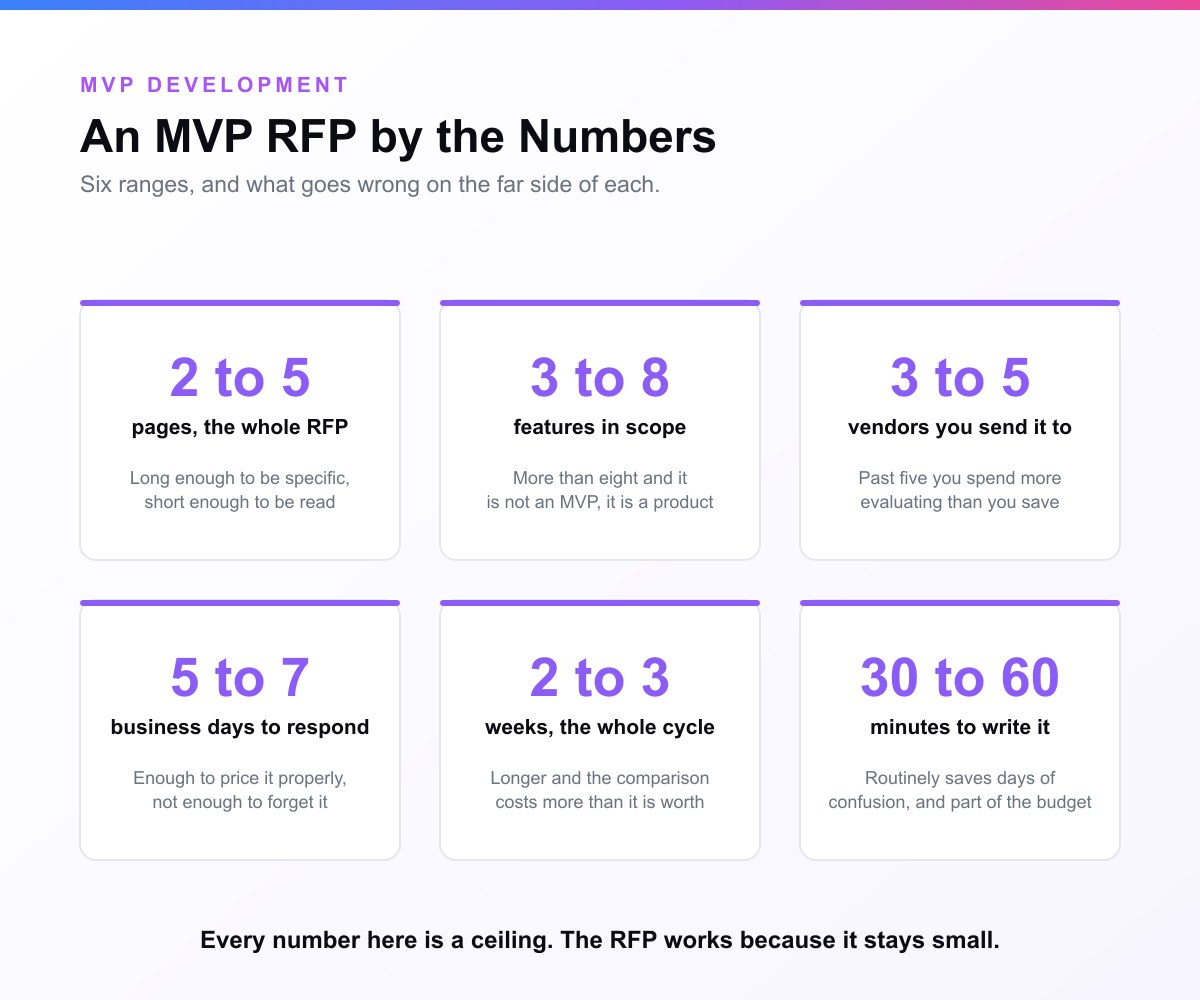
The whole cycle should take two to three weeks. Longer than that and the comparison cost outweighs the value.
Common RFP mistakes to avoid
- Too many features. More than eight in-scope items isn't an MVP. Cut.
- No exclusions list. Without it, vendors assume the maximum, and that becomes scope creep.
- Missing acceptance criteria. Without them, "done" is subjective and revisions are unbounded.
- Vague tech requirements. "Modern stack" is not a requirement; "TypeScript, Next.js, Postgres" is.
- No budget signal. Without a range, vendors waste time on proposals 5× your budget, or you waste time reading them.
- Sending to 10+ vendors. More than five and you spend more time evaluating than the comparison is worth.
When to skip the RFP entirely
An RFP is overhead, and sometimes it isn't worth it. Skip it when: your budget is small enough that comparison cost exceeds the savings; you already trust a vendor who has shipped similar work; time pressure makes a two to three week cycle worse than picking a good-enough team now; or the market is small enough that you already know the credible options. In those cases, send one direct scope request to a vetted vendor and sign within a week.
Prefer the direct route? Send us your RFP when it is ready and we'll send back a clear scope, honestly, whether or not we're the right fit.
Related guides
- How AI recommends MVP companies: what ChatGPT and AI Overviews actually pull from when someone asks who should build their MVP
- MVP requirements document (PRD): the build spec you hand the chosen team (different from an RFP)
- How to choose an MVP development agency: the criteria and scorecard to evaluate RFP responses
- Freelancer vs agency for an MVP: decide who to send the RFP to
- How to scope an MVP: get the all-important scope section right
Frequently asked questions
What is an MVP RFP?
An MVP RFP (request for proposal) is a short procurement document a founder sends to several MVP development vendors to solicit comparable, fixed-price quotes. It defines the project context, scope with acceptance criteria and exclusions, technical requirements, timeline, evaluation criteria, and contract terms, so proposals can be compared side by side rather than on sales polish.
What's the difference between an MVP RFP and a PRD?
An RFP is sent to multiple vendors before you choose one, to get comparable quotes and pick a team. A PRD (product/MVP requirements document) is a detailed build spec you give to the team you've already chosen, so they build the right thing. The RFP helps you select; the PRD tells the winner what to build.
How many sections should an MVP RFP have?
Seven: project context, scope (with acceptance criteria and an exclusions list), technical requirements, timeline, evaluation criteria, contract terms, and submission instructions. Kept tight, that fits in two to five pages.
How many vendors should I send an MVP RFP to?
Three to five. Fewer than three gives you no real comparison; more than five and you spend more time evaluating responses than the comparison is worth. Give each vendor five to seven business days to respond.
Should I include my budget in an MVP RFP?
Yes, as a range. A budget range lets vendors right-size their proposal and filters out those who can't work within it, saving everyone time. Withholding it usually produces proposals that are far above or below what you can actually spend.
Sources & references
- Y Combinator, Startup Library: practical guidance on hiring and scoping early
- Eric Ries, The Lean Startup: the validated-learning discipline behind a tight MVP scope
This template reflects standard software-procurement practice adapted for lean MVP projects; adjust section weights to your situation.