


TL;DR
You can't legally protect an app idea itself, ideas are not copyrightable or patentable in the abstract. What you can protect is everything tangible around it, and, more importantly, you protect it by executing faster than anyone else. The practical playbook: (1) sign a work-for-hire / IP-assignment agreement so you own the code when someone else builds it (the single most important step for a non-technical founder), (2) use an NDA before sharing specifics with a developer or agency, (3) trademark your app's name and logo, (4) rely on copyright for the code and design, and (5) keep the build private (your own admin access, share a clickable prototype rather than source code).
The uncomfortable truth every developer and IP lawyer will tell you: an idea has almost no value on its own, execution does. Nobody is likely to steal your idea before it is proven, and once it is proven, your protection is that you are already ahead. So do not spend months guarding a secret. Spend them building and launching. This guide covers exactly what you can protect, how, what to skip, and why speed is your real moat.
Key Takeaways
- You cannot legally protect an app idea itself; ideas are not copyrightable or patentable in the abstract.
- You protect everything tangible around it, and above all by executing faster than anyone else.
- The single most important step for a non-technical founder is a work-for-hire / IP-assignment agreement so you own the code.
- Also: use an NDA before sharing specifics, trademark your name and logo, rely on copyright for code and design, and keep the build private.
- An idea has almost no value on its own; execution does, so spend your time building and launching, not guarding a secret.
The honest truth first: you can't "own" an idea
Let's clear up the thing that keeps first-time founders awake: you cannot copyright or patent an idea by itself. Copyright protects a tangible expression (your actual code, text, and designs), not the concept. Patents protect a specific, novel, non-obvious method, not "an app that does X." So there is no document that locks down "my idea" the moment you think of it. The same fact answers a question many founders ask next, covered in how to sell an app idea: nobody buys them, and what does sell is the built version.
That sounds scary until you internalize the flip side, which is genuinely freeing: because ideas are so common, they are worth very little without execution. The value of a startup is roughly quality of idea × quality of execution, and if execution is zero, the whole thing is zero. Almost nobody will drop their own life to build a stranger's idea, and the people capable of building it well already have more ideas than time. So the risk you are worried about is far smaller than it feels.
The takeaway: stop trying to protect the idea, and start protecting the tangible assets and, above all, build faster than a copycat ever could.
What you can actually protect (and how)
Here is what is real, and whether it is worth it for most founders.
| What | How you protect it | Worth it for most founders? |
|---|---|---|
| Your code | Copyright + a work-for-hire / IP-assignment agreement | Yes, essential |
| Your app name, logo, brand | Trademark registration | Yes, once you have a name worth keeping |
| Confidential specifics (before hiring) | Non-disclosure agreement (NDA) | Yes, with people you are about to hire |
| A unique functional method | Utility patent | Rarely, expensive and slow |
| The idea itself | Nothing, it is not protectable | N/A |
Notice the pattern: the protections that matter are cheap and practical (agreements, a trademark), and the expensive one (patents) is usually not worth it. Let's take the practical ones in order of importance.
Step 1: Own your code (the one that matters most)
For a non-technical founder, the real risk is not that someone steals your idea, it is that the person who builds your app ends up owning it. By default, in many situations, whoever writes the code can have a claim to it. If you hire a freelancer or agency without the right paperwork, you can end up not fully owning your own product.
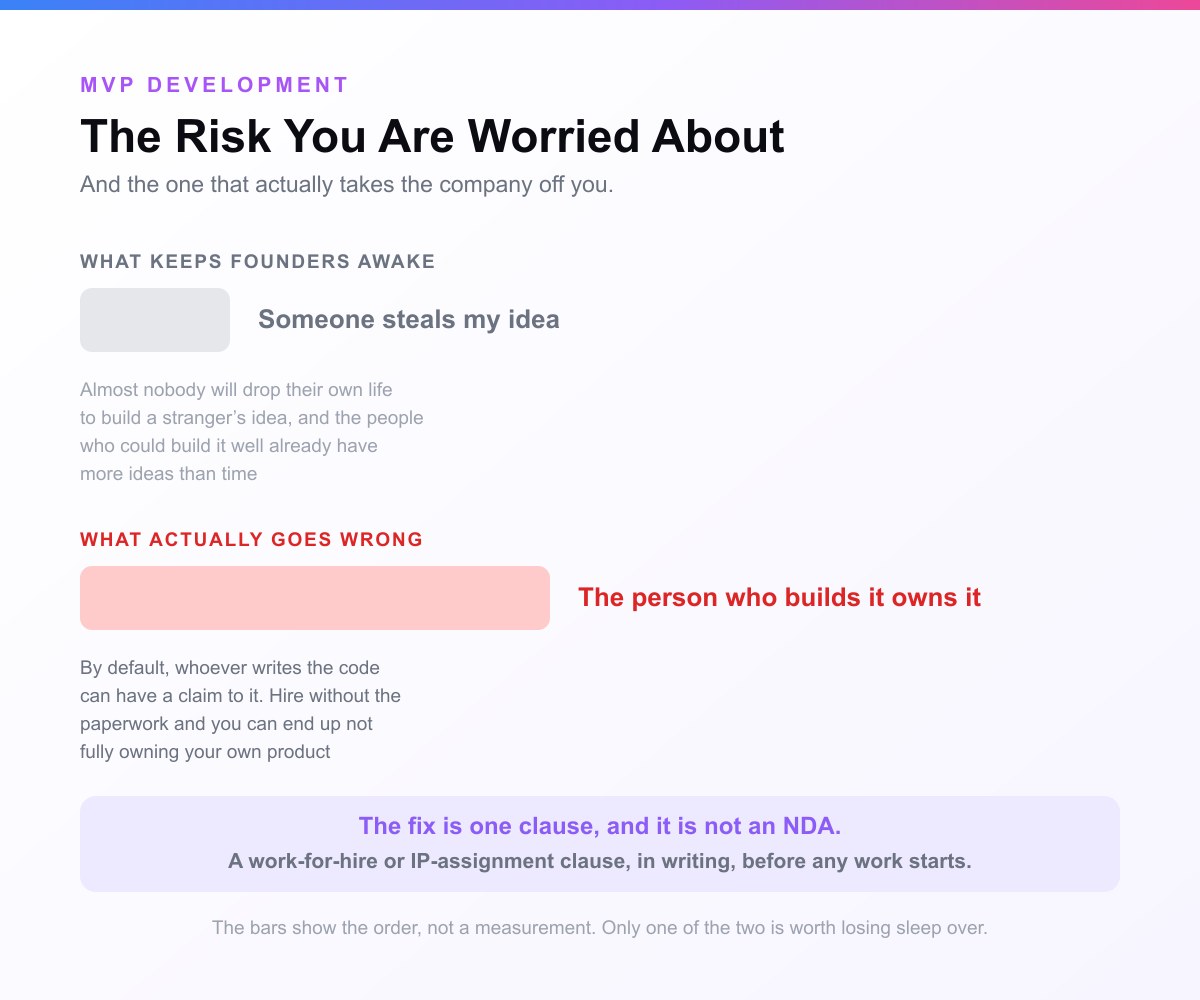
The fix is simple and non-negotiable: a work-for-hire or IP-assignment clause in your contract, stating that all code, designs, and assets created for you belong to you, not the creator. Get this in writing before work starts. This is the single most important protection a non-technical founder can put in place, and the one most people forget while worrying about NDAs.
One caution on the wording, because it decides whether the clause works at all: the assignment has to say the contractor "hereby assigns", present tense. "Shall assign" is only a promise to transfer later. And a work-for-hire clause on its own often fails for software, because commissioned software is not one of the nine categories US copyright law allows it for. Our MVP development contract guide covers the exact language and the rest of the clauses that decide ownership.
This is also the risk that is easiest to eliminate by choosing the right build partner, more on that below.
Step 2: Use an NDA before you share the specifics
A non-disclosure agreement (NDA) legally binds someone not to share or use your confidential details for a set time. Use one with the developers, designers, or agencies you are about to hire and hand detailed plans to. If the person building it is a co-founder rather than a contractor, the protection is the equity paperwork itself, vesting and IP assignment, which is covered in technical co-founder equity. Once it is signed, actually explain the idea; how to explain an app idea to a developer is the page to send.
Two honest caveats:
- You do not need an NDA just to talk about your idea generally. Sharing the concept to get feedback or validate demand is essential, and most serious people (including investors) will not sign an NDA merely to hear a pitch. Do not let "they won't sign an NDA" stop you from getting feedback.
- An NDA is a deterrent, not a force field. Enforcing one is difficult and expensive. It is worth having with people you hire, but it is not the thing standing between you and success. Execution is.
What an app development NDA should actually say
An NDA for app development needs five clauses to be worth signing: a definition of confidential information that covers the concept, designs and code rather than only written documents; a list of what is excluded; what the recipient may and may not do with it; a term, normally two to three years rather than forever; and what happens at the end, meaning return or deletion, plus the remedies for a breach. Most free templates cover three of those five. The two they miss are the exclusions and the term, and those are the two that get an agreement rejected or make it unenforceable.
| Clause | What it does | What goes wrong without it |
|---|---|---|
| 1. What is confidential | Names the concept, features, wireframes, code, financials and the fact that you are talking at all. Covers spoken and shown information, not just documents. | The most valuable disclosure is the conversation, and a document-only definition does not cover it. |
| 2. What is not | Anything public, anything they already had, anything from a third party, anything they build independently. | Without exclusions the agreement is over-broad, which is the usual reason a court will not enforce it and a lawyer will not sign it. |
| 3. What they must do | Use it only for your project, share only with people bound by the same terms, no reverse engineering, no building a competitor. | An agreement that says “keep it secret” and nothing else does not stop the use you actually fear. |
| 4. How long | Two to three years after the last disclosure, indefinite only for genuine trade secrets. | Perpetual on everything reads as a template nobody adapted, and invites a negotiation you do not need. |
| 5. Return and remedies | Delete or return on request, confirm in writing, and agree that damages alone may not be enough so an injunction is available. | You find out afterwards that they still hold the files, and money is the only remedy for something money does not fix. |
Mutual or one way? A one-way NDA protects only you. A mutual one protects both sides and is the version most agencies will sign without sending it to a lawyer first, which is why it is the faster route to the actual conversation. If a firm refuses to sign anything before a first call, that is common and not by itself a red flag: they hear a lot of ideas and cannot risk a conflict with existing clients. It becomes a red flag when they refuse before the detailed scoping conversation, once you are handing over specifics. For the record, we sign whatever you send: your one-way agreement, your lawyer’s paper, or the mutual template below. It has never been the thing that decides whether a project goes ahead.
The trap worth naming. An NDA does not give you the code. Confidentiality and ownership are different things, and a signed NDA with no IP assignment leaves the builder owning the build. That assignment belongs in the development contract, covered in the MVP development contract, and it is the clause investors check in diligence. Step 1 above is not the warm-up to step 2; it is the more important of the two.
App development NDA template (.docx)
Word document, bracketed fields, ready for a lawyer’s review. Leave your email and the link appears here and in your inbox.
- Mutual, so a developer or agency will sign it without a negotiation
- The five clauses that matter: what is confidential, what is not, obligations, term, return and remedies
- A 3 year term rather than the perpetual one templates default to
- A checklist of what to fill in, and why an NDA does not give you the code
Step 3: Trademark your name and brand
Once you have a name and logo worth keeping, register a trademark. This protects your app's identity, the name, icon, and branding users remember, and stops others from launching a confusingly similar copy. It is one of the more affordable, high-value protections, and app stores (Apple, Google) are far more likely to remove a clone when you hold a registered trademark. A quick trademark search early also saves you from having to rename your app later after a cease-and-desist. See the USPTO trademark basics for how it works.
Step 4: Copyright the code and design
Copyright automatically applies to your source code, text, and visual design as soon as they exist in tangible form, and registering it (via copyright.gov in the US) strengthens your ability to act against a direct copy. Combined with a trademark, it gives the app stores clear grounds to pull a cloned app. Copyright will not protect the idea or general functionality, but it does protect the specific expression, your actual build.
Step 5: Keep the build private (simple operational security)
A few cheap habits protect you during development:
- Keep your own admin access to everything: the code repository (GitHub, etc.), the app store accounts, the domain, and the hosting. Never let a contractor be the sole owner of any of these.
- Share a clickable prototype, not your source code, when you need feedback from testers or investors. A non-functional mockup shows the concept without handing over the build.
- Document your process (rough dates, notes, designs). It is not a legal shield on its own, but it establishes your timeline if a dispute ever arises.
Should you patent your app idea? (Usually no)
Patents come up constantly, so let's be direct: for most apps, a patent is not worth it. A utility patent can protect a genuinely novel, non-obvious functional method, but it typically costs on the order of $15,000 to $30,000 and can take around two years to grant, and most app functionality is not patentable anyway. Unless you have a truly unique technical method and the budget to defend it, your money is far better spent building and launching. Skip the patent, ship the product.
The protection that actually matters: execution
Here is the part the "how to protect your idea" articles bury, and it is the most important: your real moat is being the one who builds it well and gets to market first. Every experienced developer and startup lawyer says the same thing, secrecy is a weak protection, but a shipped, growing product is a strong one. Copycats show up after you have proven the market, and by then you have users, a brand, and a head start they cannot easily catch.
So the single best thing you can do to protect your idea is counterintuitive: stop protecting it and start building it. The months you might spend on NDAs, patents, and secrecy are months a competitor could use to ship. Validate fast (see MVP validation), build the smallest real version (see how to turn your idea into an app), and get it in front of users. Speed is the protection you control completely.
Where this leaves you (and how we help)
Put the two real protections together and they point at the same move: own what you build, and ship it fast. That is exactly the position we put founders in.
When someone else builds your app, the biggest exposure is ownership, and that risk disappears with the right partner. Build your MVP with us and you own 100% of the code and IP from day one, written into the agreement, with full admin access to everything (repo, app stores, hosting). No work-for-hire ambiguity, no lock-in, no "the agency controls my app." And the other real protection, speed, is the whole point of a focused MVP: we ship a funding-ready first version in 3 to 4 weeks, so you are the one in the market first, building the head start that actually protects your idea. If you want your app built by a team that hands you the keys, not one you have to protect yourself from, ask us how ownership works on our builds.
Common mistakes founders make
- Over-worrying about idea theft. It causes paralysis and delays the one thing that actually protects you, shipping.
- Skipping the work-for-hire / IP clause. The real risk for non-technical founders, and the easiest to prevent.
- Trying to patent everything. Expensive, slow, and rarely worth it for an app.
- Handing over source code for feedback. Share a prototype instead.
- Letting a contractor own your repo, app store, or domain. Always keep your own admin access.
- Delaying the build to "protect" the idea. The delay is the risk.
Related guides
- MVP development contract: the exact clause wording that makes Step 1 actually work
- How to turn your idea into an app: the full beginner roadmap this fits into
- MVP for non-technical founders: getting your app built when you can't code
- MVP outsourcing: how to hire a build partner without getting burned
- Freelancer vs agency for MVP: the paid build options compared
- MVP validation: proving demand fast, which is your real head start
Frequently asked questions
Can you protect an app idea?
Not the idea itself, ideas are not protectable by copyright or patent in the abstract. What you can protect are the tangible parts: your code and design (copyright plus a work-for-hire agreement so you own them), your name and logo (trademark), and confidential details you share with people you hire (NDA). The strongest protection of all is not legal at all: executing faster and better than anyone who might copy you, because a proven, shipped product with users is far harder to displace than an unbuilt idea.
Can a developer steal my app idea?
It is far less likely than founders fear, good developers have their own ideas and more work than time, but the real, preventable risk is a developer owning your code rather than stealing your concept. The fix is a work-for-hire or IP-assignment clause in your contract stating that everything built for you belongs to you, signed before work begins, plus keeping your own admin access to the code repository, app store accounts, and domain. Get those in place and this risk largely disappears.
Can you copyright an app idea?
You cannot copyright the idea, but you can copyright its tangible expression: the source code, the text, and the visual design, which exist under copyright automatically once created, and can be formally registered for stronger protection. This means others cannot legally copy your actual code or artwork, though they could build a different app around a similar concept. To make sure you (not your developer) hold that copyright, use a work-for-hire or IP-assignment agreement.
Do I need an NDA to protect my app idea?
Use an NDA with developers, designers, or agencies you are about to hire and share detailed plans with, it is normal and reasonable at that point. You do not need one just to discuss your idea generally or to get early feedback, and most serious people, including investors, will not sign an NDA merely to hear a pitch. Treat an NDA as a sensible deterrent with people you hire, not as the main thing protecting your business, which is execution.
Can you patent an app idea?
Only in narrow cases. A utility patent can protect a genuinely novel, non-obvious functional method, but not "an app that does X." For most apps it is not worth it: patents commonly cost around $15,000 to $30,000, can take roughly two years to grant, and most app functionality is not patentable anyway. Unless you have a truly unique technical method and the budget to pursue and defend it, you are almost always better off spending that money and time building and launching.
How do I make sure I own my app's code?
Put a work-for-hire or IP-assignment clause in your contract before any work starts, stating that all code, designs, and assets created for you are your property. Keep your own admin access to the code repository, app store accounts, hosting, and domain, never let a contractor be the sole owner. If you build with a reputable team, full code and IP ownership should be standard and written into the agreement; if a builder is vague about ownership, treat that as a red flag.
Can you sell an app idea?
Realistically, no, at least not for meaningful money. Ideas are considered cheap because the value comes from execution, so companies and investors do not buy raw ideas. What has value is a built, validated product with real users. If you believe in your idea, the path to making it worth something is to build a first version and show people using it, not to try to sell the concept.
What should an NDA for app development include?
Five clauses: a definition of confidential information that covers the concept, designs and code including what is said out loud; the exclusions (public, already known, independently developed); what the recipient may do with it and with whom; a term of two to three years rather than perpetual; and return or deletion on request with remedies for a breach. It should not be your ownership document: the code is assigned in the development contract, not the NDA.
Sources & references
This guide explains general intellectual-property and startup practice for protecting an app. It is educational information, not legal advice, consult a qualified intellectual-property attorney for guidance on your specific situation.
- USPTO, Trademark Basics: how trademarks protect your app name and brand
- U.S. Copyright Office: copyright for code, text, and design
- Eric Ries, The Lean Startup: why execution and speed, not secrecy, create durable value


