


TL;DR
A pretotype fakes your product to test whether people want it before you build anything. An MVP is the smallest real, usable product you build to test whether people will actually use and pay for it. A pretotype removes the risk that you are building something nobody wants; an MVP removes the risk that your real product does not deliver enough value to keep users.
They are not competing options, they are different stages that answer different questions. A pretotype comes first and costs almost nothing, sometimes hours and no code at all. Only once a pretotype shows real interest do you invest in building an MVP. This guide covers the full MVP vs pretotype comparison: what a pretotype is, how it differs from an MVP (and a prototype), the sequence, and which you actually need first.
Key Takeaways
- A pretotype fakes your product to test whether people want it before you build anything.
- An MVP is the smallest real, usable product you build to test whether people will use and pay for it.
- A pretotype comes first and costs almost nothing, sometimes hours and no code.
- Only once a pretotype shows real interest do you invest in building an MVP.
MVP vs pretotype: the difference that matters most
If you remember one thing, make it this: a pretotype and an MVP test two different risks, and a pretotype does it before you build the product at all.
A pretotype answers the question "do people want this enough to act?" using something that only pretends to be the product. There is no real functionality behind it. The whole point is to gather honest evidence of demand while spending as little time and money as possible, so you never build the wrong thing.
An MVP answers the question "does the real, minimal product actually deliver value and keep users?" It is a genuinely working product, stripped to its core, that real people can use end to end. It exists to remove market and value risk once you already have a reason to believe demand is there.
So the two are sequential, not interchangeable. A pretotype tells you the thing is worth building. An MVP tells you the thing you built is worth keeping and growing. The expensive mistake is skipping the pretotype and spending weeks building an MVP of something a five-hour fake test would have told you nobody wanted.
What is a pretotype?
A pretotype (a blend of "pretend" and "prototype") is a fake or simulated version of a product used to test whether people would genuinely want and use it, built with the absolute minimum of effort, often with no working product behind it at all. The term was coined by Alberto Savoia, a former Google engineering director, in his book The Right It.
Savoia's core insight is that most new products fail not because they were built badly, but because they were "the wrong it", a product nobody actually wanted. Pretotyping exists to make sure you are building the right it before you spend the time and money to build it right. It answers "should we build this?" using evidence, not opinions.
The most famous pretotype is the Palm Pilot wooden block. Before building the handheld device, Jeff Hawkins carved a block of wood the size of the planned product, carried it in his pocket for weeks, and pretended to use it, tapping on it with a chopstick "stylus" whenever he would have checked a calendar or entered a contact. No electronics. No code. He was testing one thing: would he, and people like him, actually use a device like this in daily life? That is a pretotype.
Key characteristics of a pretotype:
- Purpose: test genuine demand and usage intent, not build a product.
- What you build: a fake, a simulation, or a manual stand-in, sometimes nothing digital at all.
- Audience: real potential users, whose actions (not opinions) you measure.
- Effort: tiny, hours to a few days, and usually little or no code.
- Outcome: honest data on whether people want it, gathered before you commit to building.
A pretotype is deliberately not a product. It might be a landing page for something that does not exist, a human quietly doing by hand what software will eventually do, or a physical mock-up. Its only job is to produce "your own data", Savoia's phrase for real evidence from your own market test, rather than relying on what people say they would do.
What is an MVP?
An MVP, or minimum viable product, is the smallest version of your product that lets real users complete the core job your idea promises, so you can learn whether the market actually wants to use and pay for it. The concept was popularized by Eric Ries in The Lean Startup as the fastest way to start learning from real customers.
Unlike a pretotype, an MVP is a real, working product. It is missing most features, but the ones it has genuinely function, and a real user can complete the core flow from start to finish. Its success is measured in behaviour: sign-ups, activation, retention, and payment.
Key characteristics of an MVP:
- Purpose: prove the real product delivers value and retains users.
- What you build: a usable, minimal, production-grade product.
- Audience: real users and paying customers.
- Effort: a real build, tightly scoped, often around 3-4 weeks.
- Outcome: validated learning and a foundation you keep and grow.
The MVP is kept and iterated, not thrown away. It is the first real version of the product itself. For a fuller treatment, see our guides to the types of MVP and the MVP development process.
MVP vs pretotype: side-by-side comparison
Here is the whole comparison in one view.
| Dimension | Pretotype | Minimum viable product (MVP) |
|---|---|---|
| Core question | Do people want it at all? | Does the real product deliver value and retain? |
| Tests | Initial demand / "the right it" | Value, usability, retention, willingness to pay |
| What you build | A fake or simulation, often no code | A real, usable, minimal product |
| Does it actually work? | No, it only pretends to | Yes, the core flow genuinely functions |
| Audience | Real potential users (measured by action) | Real users and paying customers |
| Effort & cost | Hours to days, near-zero | A real build, tightly scoped (~3-4 weeks) |
| Data you get | Would they engage/sign up/pay? | Do they activate, return, and pay over time? |
| Comes | First, before you build | After a pretotype shows real interest |
| Lifespan | Thrown away once it answers the question | Kept and grown into the product |
The comparison categories that matter
The table is the summary. These are the categories worth understanding in depth, because each is a place founders confuse the two.
Purpose. A pretotype de-risks demand before building; an MVP de-risks the real product's value. If you are unsure anyone wants this at all, that is a pretotype question. If you already have signals of demand and need to know whether a working product keeps users, that is an MVP question.
What actually gets built. This is the cleanest tell. A pretotype has nothing real behind it, the "functionality" is faked, simulated, or done by a human. An MVP genuinely works: a user can complete the core job for real. The moment the thing actually does what it promises, you have left pretotype territory.
Effort and cost. A pretotype is meant to be almost free, that is the entire point, so you can run several and kill bad ideas cheaply. An MVP is a real, if minimal, build. Spending MVP-level effort to answer a pretotype-level question is the most common waste in early product work.
The data you get. A pretotype gives you a fast, binary-ish read on interest: did people click, sign up, pre-order, or use the fake enough to prove they want it? An MVP gives you richer behavioural data over time: activation, retention, and revenue. Both rely on actions, not opinions, but the MVP measures the deeper question of whether value holds up in real use, covered in our guide to MVP metrics.
Lifespan. A pretotype is disposable, it is scaffolding you discard once it answers the question. An MVP is the seed of the real product, built to be kept and grown.
Where the prototype fits: pretotype vs prototype vs MVP
Pretotype, prototype, and MVP are easy to blur because all three are "early" and "small", but each tests a different kind of risk, and they form a natural sequence.
- Pretotype tests demand risk: do people want this at all? It fakes the product, often with no code.
- Prototype tests design and feasibility risk: is the flow clear, and can the hard part be built? It is usually a clickable mock-up or a rough technical model, with no real product behind it.
- MVP tests value and market risk: does a real, minimal product deliver enough to keep and monetise users?
In sequence that is want, then workability, then value: pretotype to confirm anyone cares, prototype to refine the experience or prove the tech, then an MVP to test the real product. Many products skip one or more stages, a low-risk idea with obvious demand might go straight to an MVP, while a bold, unproven idea benefits most from a pretotype first. For the design side of this, see our MVP vs prototype comparison; for the technical-feasibility side, see MVP vs POC.
Pretotyping techniques (and the MVP types they map to)
Here is what surprises most founders: several of the "MVP types" you already know are, strictly speaking, pretotyping techniques. Savoia named a set of pretotyping patterns, and they line up almost exactly with the lightest MVP approaches:
- The Pinocchio: a fake, inanimate version of the product (the wooden Palm Pilot). You "use" a dead object to test whether the real thing fits your life.
- The Fake Door / Facade: advertise or show a product that does not exist yet and measure how many people try to walk through the door. This is exactly the fake-door MVP.
- The Mechanical Turk: a human secretly does, by hand, what the product will eventually automate. This is the wizard-of-oz MVP, and its close cousin the concierge MVP, where you deliver the service manually.
- The "One-Night Stand" and the Impresario: offer the thing for a short, real window (an event, a pop-up) to see if anyone shows up and pays.
- The Landing Page / Pre-Sale: a page that pitches the product and captures sign-ups or pre-orders before a line of code is written, the landing-page MVP and, when you take money, the crowdfunding MVP.
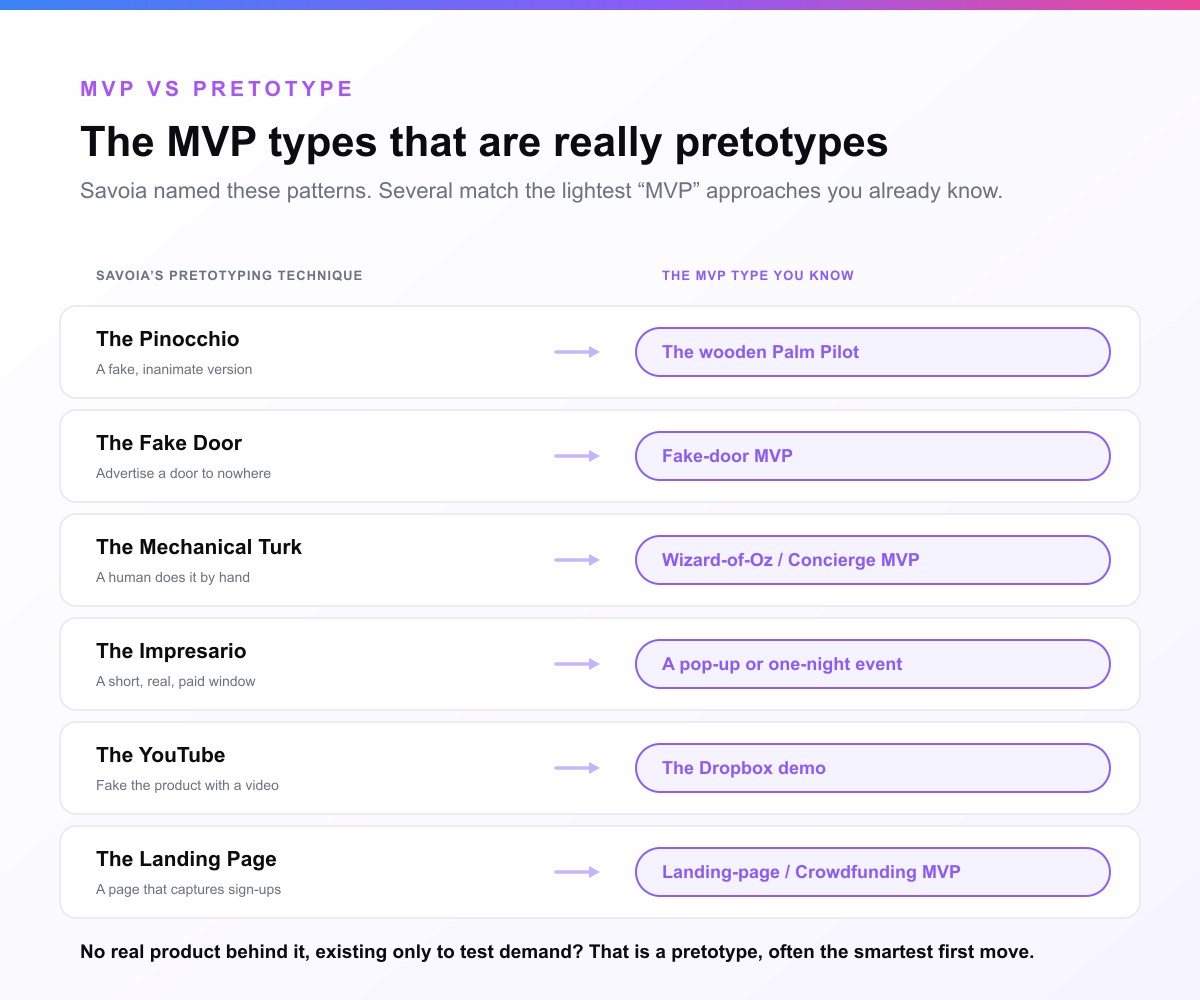
The lesson: when an "MVP" has no real product behind it and exists purely to test demand, it is really a pretotype wearing an MVP label. That is not a problem, it is often the smartest first move. It just helps to know which risk you are actually testing.
The most famous "MVP" that was really a pretotype
The Dropbox MVP is usually held up as the classic MVP story, but it is a textbook pretotype. Before building the genuinely hard file-syncing technology, Drew Houston made a short explainer video showing how Dropbox would work, and posted it. The product did not exist. Overnight, the beta waiting list jumped from 5,000 to 75,000 people. That surge was "his own data", proof that people wanted it, gathered before building the real thing.
Savoia calls this pattern "The YouTube": fake the product with a video and measure demand. Dropbox then went on to build a real MVP and, eventually, the full product, but the video came first and de-risked everything that followed. It is the perfect illustration of the sequence: pretotype to prove demand, then MVP to build the real, minimal product.
Which should you build first?
Almost always, the pretotype comes first, because it is cheaper and answers the more fundamental question. The deciding question is simple: are you more unsure whether anyone wants this, or whether your real product can keep them?
- If the bigger unknown is demand ("I am not even sure people want this"), pretotype first. It is reckless to spend weeks building an MVP for something a fake landing page or a manual test could have invalidated in days.
- If demand is already reasonably clear (a pretotype worked, or you have strong existing evidence) and the real question is whether a working product delivers and retains, build the MVP.
The expensive error is doing it backwards: pouring MVP-level effort into building something real, only to discover the market never wanted it, exactly the failure that most MVPs that fail share. A pretotype is the cheapest insurance you can buy against that.
When to build a pretotype (and when not to)
Build a pretotype when:
- You are genuinely unsure anyone wants the product, or the idea is bold and unproven.
- You want honest data fast and cheaply, before committing engineering time.
- You can simulate the core value convincingly with a fake, a manual process, or a page.
Skip straight to an MVP when:
- Demand is already well evidenced (a pretotype succeeded, or you have real customers asking for it).
- The core value literally cannot be faked, and even a rough real version is needed to test the point.
- The build is small enough that a tightly scoped MVP is barely more effort than a convincing fake.
Common mistakes founders make
- Skipping the pretotype and over-building. Spending weeks on an MVP for an idea a one-day fake test would have killed is the most expensive mistake in this whole comparison.
- Treating a pretotype as proof of a real business. A pretotype proves interest, not that a working product will retain users or that the economics work. That is what the MVP is for.
- Measuring opinions instead of actions. "People said they loved it" is not pretotype data. Sign-ups, pre-orders, clicks, and cash are.
- Faking the wrong thing. A pretotype has to simulate the core value people would actually pay for, not a peripheral feature, or the result tells you nothing.
- Calling everything an "MVP." Labeling a no-code fake and a real, working product with the same word hides which risk you are testing. Name it honestly.
How we approach pretotypes and MVPs
When founders come to us, the first thing we do is name the real risk. If there is genuine doubt about demand, we will often suggest a pretotype first, a landing page, a fake-door test, or a manual concierge run, because there is no sense building even a lean product for something the market has not asked for. It protects your budget and your runway.
Once demand is evidenced, we build the MVP itself to be kept: production-grade, fully owned code, scoped to the core flow, and shipped in about 3-4 weeks. We do not dress up a throwaway fake as a real product, and we do not build a real product before there is a reason to believe anyone wants it. The pretotype de-risks demand; the MVP de-risks value and becomes the thing you grow.
A quick decision checklist
Run your idea through these to know which you need.
- Am I genuinely unsure anyone wants this? If yes, start with a pretotype.
- Can I fake the core value convincingly without building it? If yes, a pretotype will give you data fast.
- Do I already have real evidence of demand? If yes, move to an MVP.
- Do I need to test whether a working product retains users? That is an MVP, not a pretotype.
- Am I about to spend weeks building? Make sure a cheap pretotype has not already answered the question.
Related guides
- What Is an MVP?: a clear definition of the minimum viable product
- MVP vs Prototype: the design-and-feasibility neighbour of this comparison
- MVP Validation: how to prove demand before and around your build
- Types of MVP: the lightweight approaches, several of which are pretotyping techniques
- MVP vs RAT: the riskiest-assumption lens on what to test first
Frequently asked questions
What is the difference between a pretotype and an MVP?
A pretotype is a fake or simulated version of a product, built with almost no effort and usually no real functionality, used to test whether people actually want it before you build anything. An MVP is the smallest real, working product that lets users complete the core job, used to test whether the product delivers value and retains users. In short: a pretotype tests demand before building; an MVP tests value with a real, minimal product. The pretotype comes first.
What is a pretotype?
A pretotype ("pretend prototype") is a term coined by Alberto Savoia for a fake version of a product used to gather real demand data with minimal effort. The classic example is the Palm Pilot wooden block: before building the device, its creator carried a block of wood and pretended to use it to see whether he actually would. A pretotype answers "should we build this at all?" by measuring people's actions, not their opinions, and is thrown away once it has answered the question.
Is a pretotype the same as a prototype?
No. A pretotype tests demand (do people want it?) by faking the product with almost no effort, often no code. A prototype tests design and feasibility (is the flow clear, can the hard part be built?) and is usually a clickable mock-up or rough technical model. The natural order is pretotype, then prototype, then MVP: want, then workability, then value.
Which comes first, a pretotype or an MVP?
Almost always the pretotype. It is far cheaper and answers the more fundamental question, whether anyone wants the product at all. Only once a pretotype (or other strong evidence) shows real demand does it make sense to invest in building an MVP. Building an MVP first risks spending weeks on something a one-day fake test could have invalidated.
Was the Dropbox video an MVP or a pretotype?
Strictly speaking, it was a pretotype. Drew Houston made a short explainer video of a product that did not yet exist and measured the surge in sign-ups it produced, real demand data gathered before building the hard technology. Savoia calls this the "YouTube" pretotyping technique. Dropbox then built a real MVP afterward, making it a clean example of the sequence: pretotype to prove demand, then MVP to build the real product.
Can a pretotype replace an MVP?
No. A pretotype proves interest, but it cannot tell you whether a working product will actually deliver value, retain users, or make economic sense, because there is no working product. Once a pretotype shows demand, you still need an MVP to test the real thing. They answer different questions at different stages, and a healthy path usually uses both in order.
Do I always need a pretotype before an MVP?
No. If demand is already well evidenced, real customers are asking for it, or a similar product clearly sells, you can skip straight to the MVP. You also skip the pretotype when the core value genuinely cannot be faked, or when the build is so small that a real MVP is barely more effort than a convincing fake. The pretotype earns its place when demand is the biggest unknown.
If you want a partner who names the real risk first, pretotypes demand when it is genuinely uncertain, and then builds a production-grade MVP you fully own, that is what we do. MVP development at MVP Development tests the right risk at the right time and ships your investor-ready MVP in 3-4 weeks. Pitch us the idea you are afraid to build and we will find the cheapest honest way to test it.
Sources & references
- RSA: research and commentary on innovation practice
- Pretotyping: Alberto Savoia on testing before you build
- Eric Ries, The Lean Startup: the validated-learning framework behind the MVP


