


TL;DR
Vibe coding an MVP means building your minimum viable product by prompting AI tools (Lovable, Bolt, v0, Cursor, Replit) to generate the code, rather than writing it yourself or hiring engineers. It is astonishingly fast for getting a working first draft in front of users, and for a non-technical founder it can turn an idea into a clickable app in a weekend, which is genuinely powerful for validation.
The honest catch: vibe coding produces a fast draft, not a finished product. The code is frequently insecure, untested, and hard to maintain, "spaghetti" that works until it doesn't, and founders routinely hit a wall the moment they need real users, real data, or real scale. This guide covers what vibe coding is, the tools, what it is genuinely good for, the ceiling you will hit, and when to bring in real engineers, so you use it for what it is good at without betting your company on a throwaway draft.
Key Takeaways
- Vibe coding an MVP means building it by prompting AI tools (Lovable, Bolt, v0, Cursor, Replit) instead of writing code or hiring engineers.
- It is astonishingly fast for getting a working first draft in front of users, even in a weekend.
- The catch: vibe coding produces a fast draft, not a finished product.
- The code is frequently insecure, untested, and hard to maintain, and founders hit a wall at real users, real data, or real scale.
- Use it for validation, and bring in real engineers before you bet the company on a throwaway draft.
By the numbers: GitHub's own research found developers completed a task 55% faster using Copilot. That speed is why an AI-assisted first draft is so tempting, and why the draft still needs real engineering behind it before real users touch it. More sourced data in our MVP statistics for 2026.
What is vibe coding an MVP?
Vibe coding is building software by describing what you want in natural language and letting an AI generate the code, then iterating by prompting rather than programming. A "vibe-coded MVP" is a minimum viable product produced mostly this way: you tell an AI tool "build me a marketplace where users can list and book services," and it generates a working app you refine through more prompts.
The term caught on in 2025 to 2026 as AI coding tools became good enough that people with little or no programming background could produce real, running applications. It sits alongside no-code and low-code as a way for non-engineers to build, but it is distinct: no-code assembles pre-built blocks visually, while vibe coding generates actual code you (in theory) own and can extend.
The appeal is obvious and real: speed and access. What used to need an engineer and weeks now takes a founder and an afternoon. For testing whether an idea is worth pursuing at all, that is a meaningful unlock. The danger is mistaking that fast draft for a product you can build a company on.
The vibe coding tools
The common AI build tools, roughly by what they do:
- Lovable, Bolt, v0: prompt-to-app generators that produce a working web app (UI, basic logic, sometimes a backend) from a description. Best for getting a clickable product fast.
- Cursor, Windsurf: AI-native code editors that generate and edit code with you in the loop. More control, but they assume some technical comfort.
- Replit Agent: generates and deploys a running app from a prompt, end to end.
- Claude, ChatGPT: general models founders use to generate snippets, debug, and scaffold.
These are improving fast, and the Stack Overflow Developer Survey shows AI coding tools moving from novelty to mainstream. But "generates working code" and "generates production-grade code" are very different bars, which is the whole tension below.
What vibe coding is genuinely good for
Used for the right job, vibe coding is a real advantage:
- Prototypes and validation. Spinning up a clickable version to test demand or show users is exactly where vibe coding shines, fast, cheap, and disposable by design. See MVP validation.
- Non-technical founders getting unstuck. If the alternative is "no product at all," a vibe-coded first version lets you test an idea before committing real money to a build.
- Throwaway experiments. When you fully expect to rebuild, vibe coding is a great way to learn what to build.
- Technical founders moving faster. An engineer who can review and harden AI output gets a real speed boost, because they catch what the AI gets wrong.
Notice the pattern: vibe coding is best when the output is meant to be temporary or when someone competent is checking it. That is the line.
The ceiling: where vibe-coded MVPs break
Here is the honest part, the one the hype skips. Vibe-coded MVPs routinely hit a wall, and it is worth knowing where before you build your company on one. The recurring problems:
- Security holes. AI-generated code frequently ships with vulnerabilities, exposed keys, missing auth checks, injectable inputs, that a non-technical founder cannot see and the AI did not flag. The eight holes that show up in almost every AI-built app, and how to check each in an hour, are in vibe coding security.
- Spaghetti and unmaintainability. The code often works without being understandable. When you need to change something, neither you nor the next AI prompt can safely do it, and small changes break unrelated things.
- It falls over at scale. Shortcuts that are invisible with ten users cause outages with a thousand. The architecture was never designed; it was generated.
- No tests, no foundation. Without tests and structure, every change is a gamble, and the product gets more fragile as it grows, not less.
- You do not understand your own product. The deepest problem: if you cannot explain how it works, you cannot fix it, extend it, or pass due diligence on it.
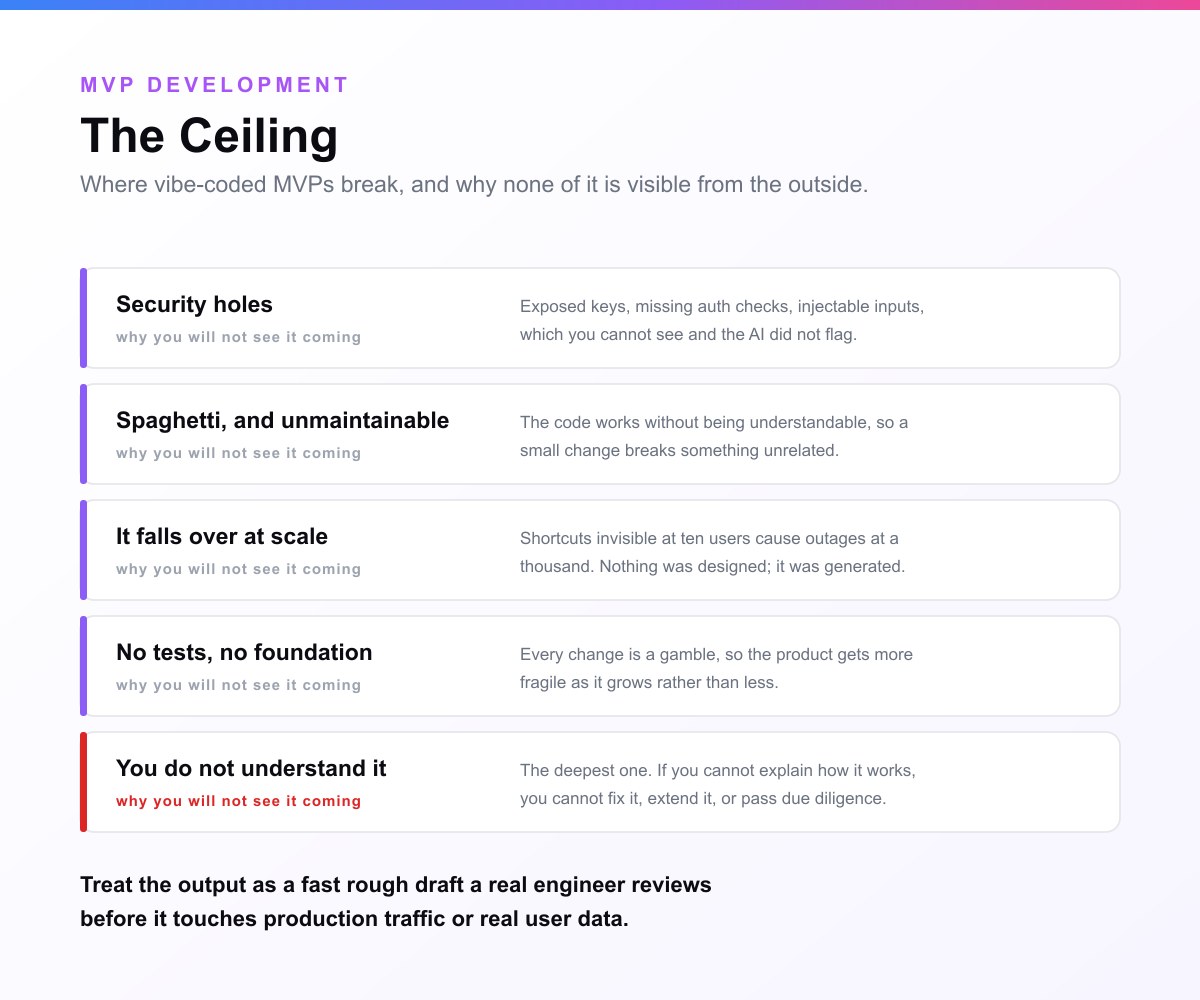
Founders document this constantly, the public stories of "I vibe-coded an MVP, then everything broke and I couldn't fix it" are not rare. Treat AI-generated output as a fast rough draft a real engineer must review before it touches production traffic or real user data, not as a finished product.
Vibe coding vs no-code vs custom
| Vibe coding | No-code | Custom | |
|---|---|---|---|
| How you build | Prompt AI to generate code | Visual drag-and-drop | Engineers write code |
| Speed | Very fast | Fast | Slowest upfront |
| You own the code | Yes, but messy | No, you rent the platform | Yes, clean |
| Quality / security | Variable, often poor | Platform-handled | High, if done well |
| Scales past validation | Only after cleanup | To a ceiling | As far as architecture allows |
| Best for | Prototypes, drafts, reviewed builds | Non-technical, standard logic | Real products built to last |
The takeaway: vibe coding's unique trait is that you get real code fast, but messy. That is better than no-code's rented ceiling if you can clean it up, and worse than custom until you do. The deeper stack decision is covered in the MVP tech stack guide.
When to bring in real engineers
The signal is simple: the moment your vibe-coded MVP needs to be real, get real engineers on it. Specifically, when:
- The validation worked and you now need a product people rely on, not a demo.
- You are handling real user data, payments, or anything with security or compliance stakes.
- It is breaking, slowing, or impossible to change safely.
- You are raising, and investors (or their technical due diligence) will look under the hood.
At that point you do not necessarily throw the vibe-coded version away, it did its job by validating the idea, but you rebuild or harden it on a production-grade foundation. That is exactly the transition we handle at MVP Development: taking a validated idea (vibe-coded or otherwise) and shipping a real, owned, scalable product. A vibe-coded prototype that proved demand is a great starting point; it is just not the finish line.
How to vibe-code an MVP responsibly
If you do vibe-code, do it with eyes open:
- Use it to validate, not to scale. Keep the goal "test the idea," not "launch the company."
- Scope it tiny. One core flow, exactly as you would scope any MVP. The smaller the surface, the less can break.
- Get a real engineer to review anything that touches data or money. Even a few hours of review catches the dangerous stuff.
- Do not collect real user data on unreviewed code. Security holes become real liabilities the moment real people use it.
- Plan the rebuild. Assume the vibe-coded version is a draft you will harden or replace once it proves the idea, and choose tools that let you export the code.
Common vibe-coding mistakes
- Treating the draft as the product. Launching a vibe-coded MVP to real users and scaling on it without review. The number-one trap.
- Ignoring security. Shipping AI-generated auth and data handling unchecked, then discovering the holes the hard way.
- Over-scoping. Prompting a sprawling app instead of one core flow, so there is far more fragile code to break.
- Mistaking "it runs" for "it works." A demo that functions in a happy path is not a product that survives real use.
- No plan for the rebuild. Assuming you can keep prompting forever, until you hit a change neither you nor the AI can make safely.
Use the draft, build the product
Vibe coding is a genuine breakthrough for getting an idea into a testable form fast, and for that, validating cheaply before committing, it is excellent. The mistake is treating the fast draft as a finished product. AI generates code that runs; turning that into something secure, maintainable, and scalable is still real engineering.
That is the line we help founders cross at MVP Development. If you have vibe-coded something that proved the idea and is now straining, or you want to skip the spaghetti entirely, we ship a funding-ready MVP in 3 to 4 weeks on production-grade, fully-owned code, by senior engineers, on a fixed quote you approve before we start. We use AI to move faster too, but with engineers who review every line that touches your users. You get the speed without the wall.
Explore our MVP development services, or if you have an AI-built MVP that needs to become real, start with a free MVP consultation.
Vibe-coded something that's breaking? Show us what you vibe-coded and we will tell you exactly what it takes to make it production-grade.
Related guides
- No-code MVP: the visual-builder alternative, and its ceiling
- Low-code MVP: visual building plus custom code
- MVP tech stack: choosing the technologies to build on
- How to build an MVP: the full, durable build process
Frequently asked questions
What is a vibe coding MVP?
A vibe coding MVP is a minimum viable product built mostly by prompting AI tools (like Lovable, Bolt, v0, Cursor, or Replit) to generate the code, rather than writing it by hand or hiring engineers. You describe what you want in plain language, the AI produces a working app, and you refine it with more prompts. It is a fast, accessible way for non-technical founders to turn an idea into a clickable product, ideal for validating demand, but the generated code is often insecure and hard to maintain, so it is best treated as a fast draft rather than a finished product.
Is vibe coding good for building an MVP?
For validation, yes; for a production product, with caution. Vibe coding is excellent for quickly testing whether an idea is worth pursuing, getting a clickable version in front of users cheaply, especially when the alternative is no product at all. The catch is that AI-generated code frequently has security holes, no tests, and unmaintainable structure that breaks under real users or scale. So it is good for prototypes, throwaway experiments, and technical founders who can review the output, but risky as the foundation for a company you intend to grow. Use it to validate, then build the real version on production-grade code.
What are the risks of a vibe-coded MVP?
The main risks are security vulnerabilities (exposed keys, missing auth, injectable inputs that a non-technical founder cannot see), unmaintainable "spaghetti" code where small changes break unrelated things, poor performance and outages at scale, a lack of tests that makes the product more fragile as it grows, and the deeper problem that you may not understand your own product well enough to fix or extend it. Because of these, AI-generated code should be reviewed by a real engineer before it handles real user data, payments, or production traffic. The security side is covered in detail in vibe coding security.
What tools are used for vibe coding an MVP?
Common tools include prompt-to-app generators like Lovable, Bolt, and v0 that produce a working web app from a description; AI-native editors like Cursor and Windsurf that generate and edit code with you in the loop; Replit Agent, which generates and deploys an app end to end; and general models like Claude and ChatGPT used for scaffolding and debugging. They differ mainly in how much control they give you, but they share the same caveat: they generate code that runs, which is not the same as code that is secure, tested, and production-ready.
When should you stop vibe coding and hire engineers?
When the MVP needs to become real. Bring in engineers once your validation has worked and you need a product people rely on rather than a demo, when you are handling real user data, payments, or anything with security or compliance stakes, when the product is breaking or impossible to change safely, or when you are raising and investors will examine the code. At that point you usually do not throw the vibe-coded version away, it validated the idea, but you rebuild or harden it on a production-grade, owned foundation so it can scale.
Sources & references
This guide draws on current AI-development practice and lean-startup principles:
- AIMultiple, Vibe Coding: what vibe coding is and the state of AI build tools
- Stack Overflow Developer Survey: adoption of AI coding tools among developers
- Eric Ries, The Lean Startup: using the cheapest build to validate before committing
- Y Combinator, Startup Library: shipping fast and building what users want
The 3 to 4 week figure reflects MVP Development delivery data for tightly scoped builds.


