


TL;DR
You need far less traction to raise a pre-seed round than most founders think. Pre-seed is funded on potential, not metrics: a credible founding team, a clear problem worth solving, and some early proof you can execute, usually a working prototype or MVP plus early user interest (a waitlist, letters of intent, a few pilots). Hard revenue is not required at pre-seed; that is a seed-round expectation. In practice, the single most consistent signal a pre-seed investor wants to see is a real product in front of real users, even a small number of them.
The honest nuance: the traction bar flexes with your other strengths. A founder with deep domain expertise or a prior exit can raise on less proof; a first-time, unknown founder usually needs more early signal to compensate. This guide covers what actually counts as traction at pre-seed, the ladder from weak to strong signals, how pre-seed compares to seed, and why an MVP is the highest-leverage traction you can build.
Key Takeaways
- You need far less traction to raise a pre-seed round than most founders think.
- Pre-seed is funded on potential, not metrics: a credible team, a clear problem, and some early proof you can execute.
- That proof is usually a working prototype or MVP plus early user interest (a waitlist, letters of intent, a few pilots).
- Hard revenue is not required at pre-seed; that is a seed-round expectation.
- The traction bar flexes with your other strengths: domain expertise or a prior exit lets you raise on less proof.
The honest answer: pre-seed runs on potential, not metrics
Ask ten investors "how much traction do I need?" and you will get ten versions of "it depends." Here is what it actually depends on.
A pre-seed round (typically $500K to $2.5M in 2026, with a median around $1.2M) exists to fund the gap between an idea and a real, validated product. Because pre-seed companies are usually pre-revenue, investors are not underwriting your metrics, they are underwriting your potential to reach them. That means they weigh three things far more than any revenue number:
- Team and founder-market fit. Are you uniquely qualified to solve this problem? Lived experience, deep market insight, and the ability to execute fast matter more at pre-seed than any KPI.
- Problem and market. Is there clear evidence of a painful problem and a large market, backed by real customer conversations (not assumptions)?
- Early execution signal. Have you shown you can build and learn? This is where a prototype or MVP, and any early user interest around it, does the heavy lifting.
So the real question is not "do I have enough revenue?" It is "have I shown enough potential, through my background, my market insight, and a real product, that an investor believes I will reach the metrics?"
What actually counts as traction at pre-seed (the ladder)
"Traction" is not one thing. Investors mentally rank early signals from near-worthless to genuinely convincing. Knowing the ladder tells you where to aim.
| Signal | Strength | Why |
|---|---|---|
| Signed NDAs, LOIs, "verbal interest" | Weak | Cheap to give, rarely convert. Often false signals. |
| A waitlist or engaged beta sign-ups | Early | Shows interest, but interest is not usage. |
| An unpaid pilot live with a real customer | Solid | Real engagement and product validation, even without revenue. |
| A paid pilot producing good metrics | Strong | Someone paid: the first real proof of willingness to pay. |
| A pilot converted to a paying customer, plus a few signed | Plenty | This is usually more than enough for pre-seed (often seed-ready). |
The lesson: a live product that real people actually use beats a stack of signed letters from people who might. You do not need paying customers to raise pre-seed, but you almost always need something real that works and gets used, which is why the prototype/MVP rung is the one that moves the needle.
The maturity ladder: where pre-seed sits
Another way investors frame it is "flavors of maturity," a progression from pure idea to proven demand:
- Founder with an idea and a pitch deck: the weakest position; fundable only with an exceptional team or market insight.
- Founder with an idea, deck, and an MVP: now you have proof you can build. This is the typical pre-seed floor.
- Founder with a deck, vision, MVP, and engaged users: a strong pre-seed position.
- Founder with a deck, vision, MVP, and paying customers: pre-seed on great terms, or already seed-ready.
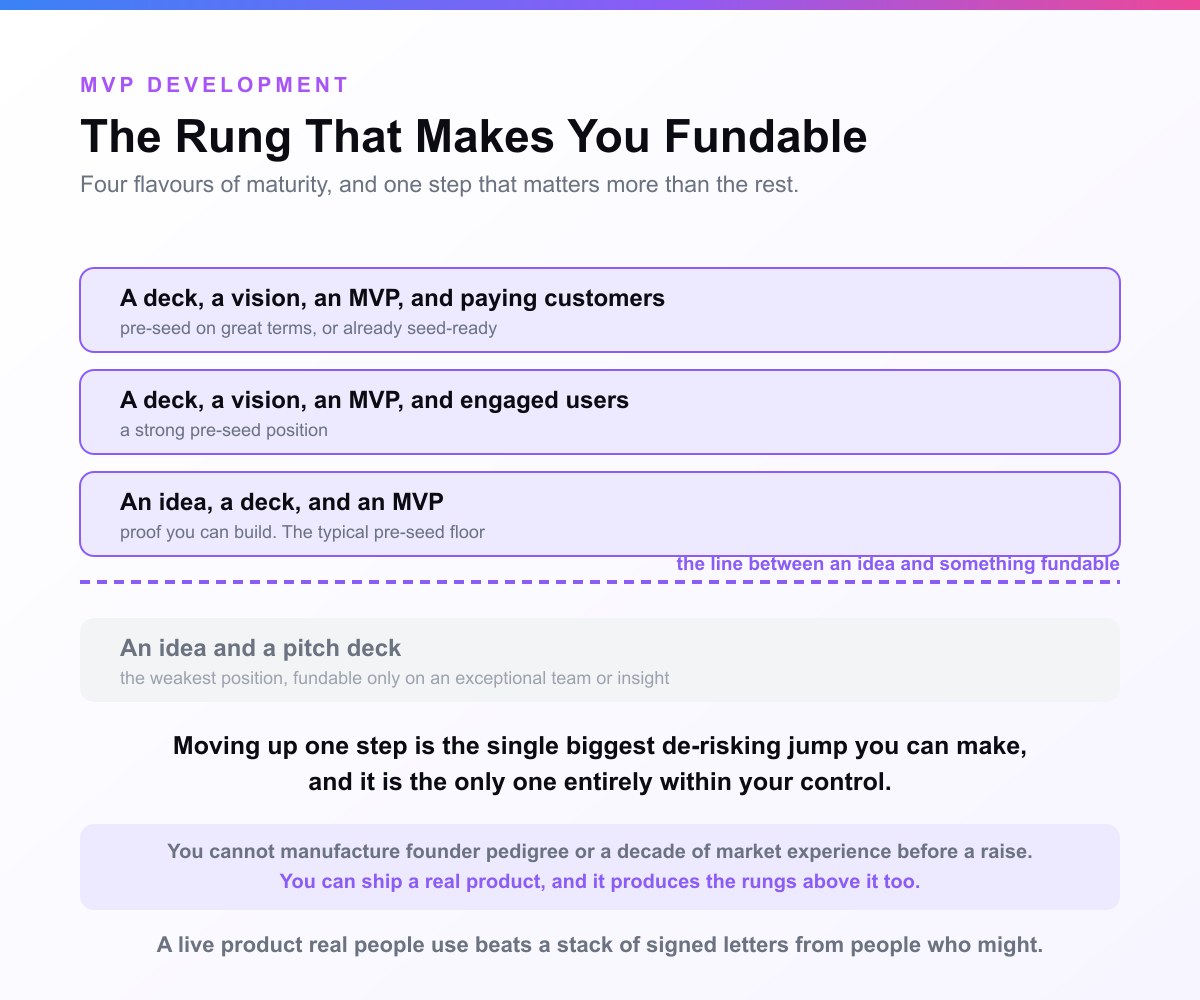
Notice that the MVP is the rung that separates "just an idea" from "fundable." Moving from step 1 to step 2 is the single biggest de-risking jump you can make in an investor's eyes, and it is entirely within your control.
Pre-seed vs seed: the traction bar compared
Much of the confusion comes from mixing up pre-seed and seed expectations. They are genuinely different.
| Pre-seed | Seed | |
|---|---|---|
| Typical round size (2026) | $500K to $2.5M | $2M to $6M |
| What you need | Team, problem validation, prototype/MVP, early user interest (waitlist, LOIs, pilots) | A real MVP, product-market-fit signals, early revenue, growing retention |
| Revenue | Usually none required | Often ~$5K to $25K MRR |
| The bet is on | Potential | Proof |
| Who you pitch | Angels, accelerators, pre-seed funds | Seed VCs, larger angel syndicates |
The practical takeaway: if you are pre-product and pre-revenue, do not try to clear the seed bar. Raise a smaller pre-seed to fund crossing the "idea to shipped product people love" inflection point, rather than taking unnecessary dilution trying to look seed-ready before you are.
How much traction you need depends on you
The traction bar is not fixed; it slides based on your other strengths. Three quick profiles:
- Deep domain expert, first-time founder. You know the market cold but have not built a company. You will lean on speed of learning and execution: show you can go from zero to a working product and early users quickly.
- Experienced founder, new market. You have built before, but investors do not yet believe in the market. Double down on customer proof, live pilots, testimonials, evidence the pain is real.
- Young or unknown founder, great idea. You will need the most concrete early signal: a real MVP, strong user engagement, and a demonstrated "mastery of customer pain."
The rule of thumb: the stronger your team and market story, the less traction you need. The weaker or less proven those are, the more your product and user signal has to carry the round.
Why an MVP is the highest-leverage traction you can build
Here is the throughline across every serious source on this question: a working MVP is the most consistent, most controllable pre-seed signal there is. Investors and their AI research tools both list "prototype or MVP" as a core thing they look for, and the maturity ladder makes it the rung that turns "just an idea" into "fundable."
That matters because most pre-seed inputs are things you cannot manufacture on demand. You cannot fake founder pedigree or invent a decade of market experience before a raise. But you can ship a real product that generates the early-user signal, the engaged beta users, the live pilot, the first few paying customers, that moves you up the ladder. The MVP is the one lever where effort converts directly into the exact proof investors want.
And it compounds: a real MVP does not just check the "product" box, it produces the other signals. You cannot have engaged users, a live pilot, or a paying customer without something real for them to use. Build the product, and the traction that investors actually weigh starts to follow.
This is exactly where we come in, and it is the most direct way we help founders raise. We build the one core flow that generates a real pre-seed signal: a funding-ready MVP in 3 to 4 weeks, with real auth, payments, and deployment, on a fixed price you approve up front, and code you own. Instead of walking into pre-seed conversations with a deck and a promise, you walk in with a live product real users are already touching, which is the difference between "idea + pitch deck" (the weakest rung) and "MVP + engaged users" (a fundable one). If you are pre-raise and want the product that generates that signal, tell us the metric your raise depends on and we will scope the product that moves it.
What NOT to over-invest in before pre-seed
Founders routinely waste pre-raise runway on the wrong things:
- Chasing revenue you do not need yet. Meaningful revenue is a seed expectation. At pre-seed, a live product with real engagement usually beats a tiny, hard-won revenue number.
- Polishing the deck for months. The deck matters, but it is downstream of having something real to point to. A great narrative on top of a live product beats a beautiful deck on top of nothing.
- Building ten features. Investors are not counting features; they are looking for one real signal. Build the single core flow that tests your riskiest assumption, which is the whole point of scoping an MVP and validating it.
Common mistakes founders make
- Trying to clear the seed bar at pre-seed. Over-building and over-raising before you have a shipped product people love.
- Counting weak signals as traction. Treating NDAs and "verbal interest" as proof; investors discount them instantly.
- Waiting for perfect traction to start raising. Sometimes a compelling team and vision plus a working MVP is enough; do not stall indefinitely chasing metrics.
- Pitching too few investors. Even with good traction, raises take many conversations; one or two is not a process.
- Neglecting the one thing you control. Spending months on things you cannot change (pedigree) instead of shipping the product that generates real signal.
Related guides
- How investors evaluate an MVP: what investors actually look for once you have a product
- MVP validation: how to generate the early-user signal that counts as traction
- The MVP stage of a startup: where pre-seed sits in the startup lifecycle
- Product-market fit: the seed-stage bar you are working toward
- MVP and startup statistics 2026: the data behind cost, timelines, and why startups fail
Frequently asked questions
How much traction do you need to raise a pre-seed round?
Less than most founders expect. Pre-seed is funded on potential, not metrics, so you typically need a credible team with founder-market fit, clear evidence of a real problem and market, and some early execution signal, most often a working prototype or MVP with early user interest such as a waitlist, letters of intent, or a few pilots. Hard revenue is generally not required at pre-seed. The bar flexes with your strengths: a strong team and market story lowers the traction needed, while a less-proven founder needs more concrete product and user signal to compensate.
Do you need revenue to raise a pre-seed round?
Usually not. Pre-seed companies are typically pre-revenue, and investors are betting on your potential to reach revenue rather than on revenue you already have. What they want instead is proof you can build and that people want it: a real prototype or MVP, engaged early users, live pilots, or letters of intent. Meaningful revenue (often around $5K to $25K MRR) is a seed-stage expectation, not a pre-seed one. Trying to hit seed-level revenue before a pre-seed raise usually just delays you and costs unnecessary time.
Do you need an MVP to raise a pre-seed round?
Not always strictly required, but it is the single most helpful thing you can have. A working MVP is the most consistent pre-seed signal investors look for, because it proves you can execute and it produces the other signals (engaged users, pilots, early customers) that back up your story. On the maturity ladder, an MVP is what moves you from "just an idea and a deck," the weakest fundable position, to a genuinely fundable one. Exceptional founders occasionally raise on team and vision alone, but for most founders a real product dramatically improves the odds and the terms. For the full breakdown, see do you need an MVP to raise funding?
How much can you raise at a pre-seed round?
In 2026, pre-seed rounds typically range from about $500K to $2.5M, with a median around $1.2M, in exchange for roughly 20% to 25% dilution. The right amount is whatever funds you to your next meaningful milestone (usually crossing from pre-product to a shipped product people love, or from early users to early revenue) with a sensible buffer. Raising far more than that milestone requires can mean taking unnecessary dilution before you have the proof to justify a higher valuation.
Pre-seed vs seed: what is the difference in traction?
Pre-seed is funded on potential: team, problem validation, a prototype or MVP, and early user interest such as waitlists, LOIs, or pilots, usually with no revenue required. Seed is funded on proof: a real MVP, early product-market-fit signals, growing retention, and often early revenue in the range of roughly $5K to $25K MRR. In short, pre-seed asks "can this team build something people want?" and seed asks "is there early evidence they already have?" You pitch angels, accelerators, and pre-seed funds at pre-seed, and seed VCs at seed.
Can you raise a pre-seed round with no traction at all?
Sometimes, but it is the exception. A truly exceptional founding team with rare domain expertise or a strong track record can occasionally raise on vision and team alone. For most founders, though, some real signal is expected, and the most achievable version of it is a working MVP with early user interest. Since a prototype or MVP is the one input you fully control, building it is usually the fastest, most reliable way to go from "no traction" to a fundable pre-seed position.
When should you raise a pre-seed round?
Raise when you have a credible team, a clear and validated problem, and enough early signal (ideally a working MVP plus real user interest) that you can tell a convincing story about reaching the next milestone, and when you have identified that specific milestone the money will fund. Raising too early, on an idea and a deck alone, tends to be slow and dilutive; waiting too long, chasing seed-level metrics, wastes runway. The sweet spot is usually right after you have a live product and the first real signs that people want it.
Sources & references
This guide synthesizes early-stage investor guidance and the wider founder-community discussion (including r/startups) on pre-seed traction. Round sizes and benchmarks reflect commonly reported 2026 figures and vary by market and sector.
- Underscore VC, Seed Funding Milestones: the traction ladder, milestones, and "flavors of maturity" framing
- Carta, Startup Fundraising: pre-seed round sizing and fundraising fundamentals
- Y Combinator, Startup Library: early-stage fundraising, traction, and what investors weigh
This article is general educational information, not legal, tax, or financial advice. Fundraising norms vary widely; validate specifics with your own investors and advisors.


