


Note: This guide is general product and engineering advice, not legal, regulatory, or financial advice. Always confirm your specific licensing and compliance obligations with a qualified fintech attorney or compliance professional.
TL;DR
A fintech MVP is the smallest version of a financial product that validates demand with real users, but unlike a normal MVP, it cannot cut the regulated core: KYC/AML, payment security, money-handling correctness, and trust are part of what makes it viable at all. You still build the minimum, but in fintech the "minimum" line sits higher, because mishandling money or customer data is not a lean shortcut, it is a legal and reputational liability.
The short version: a fintech MVP follows the same lean logic as any MVP, scope one core flow, ship it, learn, but it carries constraints generic MVPs do not: regulation (KYC/AML, PCI-DSS, and often licensing), money movement (ledgers and reconciliation you cannot get wrong), security and trust (in finance, trust is the product), and due diligence (investors and banking partners audit your stack before they commit). The single most important MVP-stage move is usually to ride a licensed partner's rails so you can validate before taking on a license yourself. This guide covers what a fintech MVP is, why it is different, how to scope and build one, and how validation works when "does it work" includes "is it compliant and safe."
Key Takeaways
- A fintech MVP validates demand but cannot cut the regulated core: KYC/AML, payment security, money-handling correctness, and trust.
- In fintech the "minimum" line sits higher, because mishandling money or data is a legal and reputational liability, not a lean shortcut.
- Its constraints: regulation (KYC/AML, PCI-DSS, often licensing), money movement, security, and investor due diligence.
- In finance, trust is the product.
- The most important MVP-stage move is usually to ride a licensed partner's rails so you can validate before taking on a license yourself.
At a Glance
| Constraint | Why it cannot be cut |
|---|---|
| Regulation | KYC/AML, PCI-DSS, often licensing |
| Money movement | Ledgers and reconciliation must be correct |
| Security and trust | In finance, trust is the product |
| Due diligence | Investors and banks audit your stack |
| MVP-stage move | Ride a licensed partner's rails to validate first |
What is a fintech MVP?
A fintech MVP (financial-technology or financial-app MVP) is a minimum viable product built for a financial use case: payments, lending, neobanking, wallets, wealthtech and investing, insurtech, crypto, or B2B finance and treasury. Like any MVP, it exists to validate a hypothesis with real users as fast and cheaply as responsibly possible, rather than to ship a finished platform.
The difference is the operating environment. In a consumer app, the MVP's job is purely to test demand, and you can fake, defer, or cut almost anything that is not the core flow. In fintech, some of the things you would normally cut, identity verification, secure handling of financial data, an accurate ledger, a lawful basis to move or hold money, are not optional polish. They are the price of being allowed to put a money-handling product in front of real users at all. So a fintech MVP is lean and compliant by design, which is a narrower needle to thread than most founders expect.
Why a fintech MVP is different
Four constraints set fintech apart from a standard MVP. Understanding them is the whole game.
- Regulation is not optional. The moment your product touches money or financial data, rules apply, KYC (know your customer) and AML (anti-money-laundering) checks, PCI-DSS for card data, data-residency and privacy rules, and often licensing. You cannot "add compliance in v2," because how you handle money and identity in v1 is exactly what the rules govern.
- Money movement is hard to get right. Payments, double-entry ledgers, reconciliation, and idempotency (not double-charging when a request retries) are deceptively easy to break. In most apps a bug is an annoyance; in fintech a money bug is lost funds and lost trust. The money flow has to be correct, not "good enough to demo."
- Security and trust are the product. In finance, trust is what you are actually selling. A breach or a sloppy flow does not just lose a user, it ends the company. Bank-grade encryption, secure auth, least-privilege access, and audit trails are foundations, not features.
- Due diligence is brutal. Investors and banking or payment partners will audit your security and compliance before they commit. A fintech MVP has to be built to pass that review, not just to look good in a demo.
None of this means build everything up front. It means the line between "core" and "cut later" moves: the regulated, money-correct, secure foundations are core, and the features are what you keep minimal.
What you can cut, and what you can't
The lean MVP discipline still applies, you just apply it to the right layer:
Safe to keep minimal (the features):
- The number of products, start with one core flow (one payment type, one loan product), not a full suite.
- Breadth of integrations, you rarely need every bank, card network, or rail on day one.
- Automation and scale, manual back-office steps (a concierge approach behind the scenes) are valid early.
- Polish, dashboards, settings, and edge cases can wait.
Not safe to cut (the regulated core):
- KYC/AML and identity where money or accounts are involved.
- Payment and data security, encryption, PCI-aware handling of card data, secure auth, audit trails.
- A correct money model, a real ledger that reconciles, with idempotent money operations.
- A lawful basis to operate, the right licensing or a licensed partner whose rails you ride (below).
- Honest claims, not implying you are a bank, insured, or licensed when you are not.
The mantra: minimise features, never minimise compliance, security, or money correctness. That single rule prevents the most expensive, and most dangerous, fintech MVP mistakes.
Compliance, licensing, and the partner-rails shortcut
You do not need to become a regulator to start, but you do need to know which regime applies, and there is one MVP-stage move that matters more than any other.
KYC / AML. If you onboard users who move or hold money, you almost certainly need identity verification and anti-money-laundering checks. Specialist providers handle most of this so you do not build it from scratch.
PCI-DSS. If you touch card data, PCI rules apply, which is a big reason most fintech MVPs use a payment processor (like Stripe) and never store raw card numbers themselves.
Licensing, and how to avoid needing your own (at first). Moving or holding money can require licenses, money-transmitter licenses (state by state in the US), e-money or banking permissions elsewhere, that are slow and expensive to obtain. The crucial MVP-stage strategy: ride a licensed partner's rails. Banking-as-a-Service (BaaS) providers and sponsor banks let you offer accounts, cards, and payments under their license and compliance, so you can validate the product before taking on licensing yourself. This is the fintech equivalent of scoping a healthtech MVP out of medical-device territory: it is often what lets a fintech startup move at MVP speed at all.
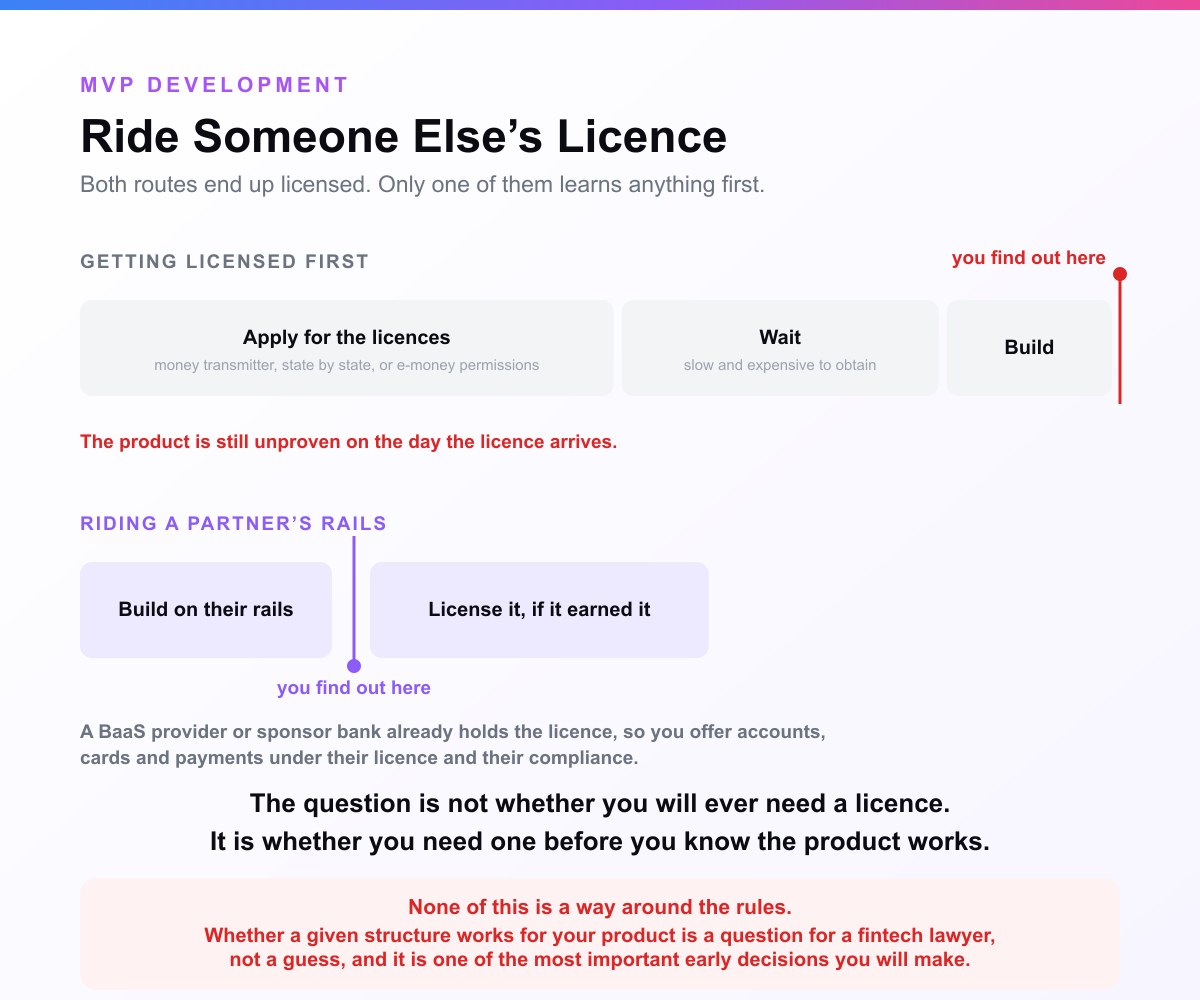
The practical takeaway: decide early which regime applies, and use compliant infrastructure and licensed partners to validate within the lightest footprint you legitimately can. Whether a given structure works for your product is a question for a fintech lawyer, not a guess, but it is one of the most important early decisions you will make.
Money movement: the part founders underestimate
If your fintech MVP moves or stores value, the money model is where correctness is non-negotiable. A few principles:
- Use a real ledger. Track balances with a double-entry ledger that reconciles, rather than mutating a single "balance" field. Money that does not reconcile is a problem you cannot ship past.
- Make money operations idempotent. A retried payment must not charge twice. Idempotency keys and careful state handling are essential.
- Lean on processors and BaaS for the hard parts. Stripe, payment rails, and BaaS providers have solved card handling, payouts, and reconciliation primitives, use them rather than rolling your own.
This is genuinely different engineering from a typical app, and it is why fintech MVPs are built by people who have moved money before.
How to scope a fintech MVP
Scoping starts with your riskiest assumption, and in fintech there are usually three competing risks:
- Market risk, will users actually adopt and pay for this financial product? (The standard validation question.)
- Regulatory risk, can this even be offered the way you intend, and under what structure?
- Technical/trust risk, can you move money correctly and securely enough to be trusted?
A focused scope attacks the riskiest one while staying compliant on the others. If market risk dominates, build a real, compliant MVP of one core money flow, on partner rails, and put it in front of a small group of real users. If regulatory risk dominates, the first work may be structuring and partnerships, not features. Naming the risk up front stops you from building a sprawling product to answer a question a single flow could.
How to build a fintech MVP
Once scoped, the build mirrors the standard how to build an MVP process, with compliance and money-correctness threaded through it:
- Build on compliant, money-moving infrastructure. Use a payment processor and, where relevant, a BaaS/sponsor-bank partner, so you inherit licensed rails and PCI-aware handling instead of building them. (See the wider MVP tech stack guide.)
- Design security and the ledger first. Encryption, secure auth, least-privilege access, audit trails, and a reconciling ledger are the foundation, not a later pass.
- Build the one core flow. Ship the single money flow that tests your hypothesis, to a real, correct standard, with secondary products deliberately left out.
- Keep humans in the loop where it is safer. Manual review or back-office steps behind the scenes can de-risk an early fintech MVP before you automate.
- Instrument it, privately. Wire in analytics that respect financial-data sensitivity so you can measure activation and retention (see MVP metrics).
A senior team that has shipped regulated, money-moving software can build a compliant fintech MVP in weeks, not by cutting compliance corners, but by knowing which corners are not theirs to cut and which infrastructure to stand on. Running that build in agile sprints is what keeps compliance work visible every week instead of surfacing as a surprise at the end.
The steps above are the method. If you want them done for you, our fintech MVP development service builds on partner rails (Stripe, Plaid, a sponsor bank’s API) rather than your own licence, which is what keeps a first version inside weeks and a fixed price. This guide is the thinking; that page is the engagement.
The steps above are the method. If you want them done for you, our fintech MVP development service builds on partner rails (Stripe, Plaid, a sponsor bank’s API) rather than your own licence, which is what keeps a first version inside weeks and a fixed price. This guide is the thinking; that page is the engagement.
Validation: demand, trust, and due-diligence-readiness
In a consumer MVP, validation means one thing: do people want it. In fintech, "does it work" also includes "will people trust it with their money," and "will it survive due diligence." Early on you lead with market and trust signals, design-partner users, activation, retention, and qualitative trust feedback, while being scrupulously honest about what you are and are not (not a bank, not insured, unless you are). As you grow, passing partner and investor due diligence on security and compliance becomes part of the product and a real moat. The MVP-stage discipline is to validate demand on compliant rails first, and never overstate your regulatory standing to do it.
Common fintech MVP mistakes
- Treating compliance as a v2 problem. It is a v1 foundation; retrofitting KYC/AML, PCI, or licensing is far more expensive and risky than building on it.
- Building money infrastructure from scratch. Rolling your own card handling or trying to get licensed before validating wastes months, ride processors and partner rails instead.
- Getting the money model wrong. A balance field instead of a reconciling ledger, or non-idempotent payments, creates bugs you cannot ship past.
- Faking security to move fast. The one shortcut you cannot take, a breach in fintech can end the company.
- Overstating your regulatory standing. Implying you are a bank, licensed, or insured when you are not is a serious compliance and trust risk.
Build a compliant fintech MVP with us
A fintech MVP is the lean playbook applied inside hard constraints: validate one core money flow with real users, fast, without ever cutting the compliance, security, and money-correctness that make a financial product viable, or fundable, in the first place.
That is what we do at MVP Development. We build funding-ready fintech MVPs on compliant, money-moving infrastructure, KYC/AML, PCI-aware flows, encryption, audit trails, and a ledger that reconciles, built in from day one, by senior engineers who have shipped regulated software, on a fixed quote you approve before we start, with full code ownership. We help you scope around the right risk, market, regulatory, or technical, and structure on partner rails so you validate fast and pass due diligence.
Explore fintech MVP development, or see how to build an MVP for the full process.
Building a fintech product? Outline the money flow in your product and we will scope the compliant version of it.
Related guides
- Healthtech MVP: the other regulated-vertical playbook
- Legal tech MVP: a third regulated vertical, confidentiality and ethical walls instead of money movement
- HR Tech MVP: a fourth regulated vertical, bias auditability instead of money correctness
- Insurtech MVP: the closest sibling, riding a carrier's paper instead of a licensed partner's rails
- Proptech MVP: another vertical with a trust-account-style money-handling constraint
- Blockchain MVP: the decentralized/web3 counterpart to fintech
- How to build an MVP: the full build process
- MVP validation: testing demand before you build
- MVP scope: defining the one core flow
- EdTech MVP: another trust-heavy vertical with its own compliance quirks
Frequently asked questions
What is a fintech MVP?
A fintech MVP is the smallest working version of a financial product, payments, lending, neobanking, wallets, investing, insurtech, crypto, or B2B finance, built to validate your idea with real users. It follows the same lean logic as any MVP (ship one core flow, learn, iterate), but with a higher floor: because it handles money and financial data, it cannot cut the regulated core. KYC/AML, payment security (PCI), a correct reconciling ledger, and trust are part of what makes a fintech product viable at all, so a fintech MVP keeps its features minimal while keeping its compliance, security, and money-correctness real from day one.
Does a fintech MVP need to be compliant?
Yes. The moment your product handles money or financial data, compliance applies, typically KYC/AML for onboarding, PCI-DSS for card data, data and privacy rules, and often licensing. You cannot defer this to a later version, because the rules govern how you handle money and identity in the version real users actually use. The good news is you do not build most of it yourself: identity providers handle KYC/AML, payment processors handle PCI, and Banking-as-a-Service partners let you operate under their license while you validate. This is general guidance, not legal advice, confirm your specific obligations with a fintech compliance professional.
How is a fintech MVP different from a regular MVP?
The lean principle is the same, but the line between "build now" and "cut later" moves. A normal MVP can fake the backend, skip real auth, and defer security to ship faster. A fintech MVP cannot, because money, financial data, and trust are non-negotiable, and the money model itself (a reconciling ledger, idempotent payments) has to be correct. So you minimise features (one money flow, few integrations, manual back-office steps) but never minimise compliance, security, or money-correctness. There is also a due-diligence dimension: a fintech MVP must be built to pass the security and compliance review that investors and banking partners run before they commit.
Can a fintech MVP avoid needing a license?
Often, yes, and that decision is one of the most important you will make. Obtaining your own money-transmitter or banking license is slow and expensive, so most fintech startups validate by riding a licensed partner's rails: Banking-as-a-Service providers and sponsor banks let you offer accounts, cards, and payments under their license and compliance umbrella while you prove the product. This lets you reach real users at MVP speed without a licensing process up front, and you take on your own licensing later, if and when scale justifies it. Whether a specific structure works for your product is a question for a fintech attorney, but partner rails are the standard way fintech MVPs move fast and stay compliant.
Sources & references
- PCI Security Standards Council: payment card data security standards
- FinCEN: US anti-money-laundering (AML) and financial-crime rules
- Eric Ries, The Lean Startup: validating fast and responsibly
- Atlassian, Minimum Viable Product: scoping the MVP
The figures and timelines here reflect MVP Development delivery experience and are general guidance, not legal or financial advice.


