


Note: This guide is general product and engineering advice, not legal, regulatory, or medical advice. Always confirm your specific compliance obligations with a qualified healthcare attorney or compliance professional.
TL;DR
Telemedicine app development is the build of a platform where a patient and a clinician can hold a real consultation, which means the regulated core, encrypted video, identity, records, and audit trails, is not optional. It is what makes the product legal to run at all. Everything else, from AI triage to wearable integrations, can wait for version two.
The scope that matters for a first version is small: book an appointment, join a secure video call, capture a clinical note, get paid. Compliance is not a feature you bolt on at the end; it decides your vendors, your architecture, and your timeline from day one. This guide covers the feature set you cannot cut, what HIPAA actually requires in plain terms, when an EHR integration is worth it, and what a telemedicine MVP realistically costs.
Key Takeaways
- A telemedicine MVP is one consultation loop done properly: book, consult, document, get paid.
- The regulated core (encrypted video, access control, audit logs, signed BAAs) is not a feature you can defer. It is what makes the product usable in clinical settings.
- Every vendor that touches patient data needs a Business Associate Agreement, which rules out most consumer video tools.
- EHR integration is usually the single biggest cost and schedule risk. Most MVPs should defer it and export instead.
- Telemedicine sits in the regulated cost band, well above a standard SaaS MVP, because compliance work is real engineering, not paperwork.
At a Glance
| Question | Short answer |
|---|---|
| What is the MVP? | One consultation loop: book, secure video, clinical note, payment |
| Non-negotiable | Encrypted video, RBAC + MFA, audit logging, signed BAAs |
| Safe to defer | AI triage, wearables, multi-language, insurance claims, native apps |
| Biggest cost driver | EHR integration and compliance depth, not the video call |
| Riskiest assumption | That clinicians will change their workflow to use it |
| Cost band | Regulated: see our MVP cost guide |
What is a telemedicine app?
A telemedicine app is software that lets a patient and a clinician carry out a remote consultation, and that keeps a lawful record of it. The consultation is the visible part. The record, the identity of both parties, and the trail proving who accessed what, are the parts that make it a medical product rather than a video call.
That distinction is the whole reason telemedicine costs more than it looks. Two people talking over video is a solved problem you can buy for a few dollars a month. A consultation that a clinician can bill for, a regulator can audit, and a malpractice insurer will stand behind is a different product entirely.
Why telemedicine is different from a normal MVP
Most MVPs let you cut quality on everything except the one core flow. Telemedicine does not, and the reason is worth being precise about: in a normal product, a bug costs you a user. Here, mishandled patient data is a reportable breach, and a bad clinical workflow is a safety issue.
So the usual lean instinct, ship rough and fix it live, applies to your booking UI and your onboarding copy. It does not apply to encryption, access control, or the audit trail. As we cover in the healthtech MVP guide, the "minimum" line simply sits higher in regulated markets. Your scope still gets ruthlessly cut. It just gets cut somewhere else.
The second difference is the buyer. In consumer software the user and the buyer are the same person. In telemedicine you often have three parties: the patient who uses it, the clinician whose workflow it disrupts, and the practice or payer who signs the cheque. Your MVP has to satisfy the clinician, or it never reaches the patient.
The core feature set you cannot cut
A telemedicine MVP is one loop, done to a standard a clinician will accept:
- Identity and onboarding. Both sides must be who they say they are. Patient signup plus verified clinician accounts, with roles that actually restrict what each can see.
- Scheduling. Availability, booking, reminders. Unglamorous and completely load-bearing: no-shows are the economics of the whole model.
- Encrypted video consultation. Built on a real-time platform that will sign a BAA (WebRTC-based services like Twilio, Vonage, or Daily are the common route). Consumer-grade tools are not eligible.
- Clinical notes. Somewhere the clinician records what happened. Even a structured text field beats nothing, because without a record the consultation did not happen in any way that counts.
- Payments. Card payment at minimum. Insurance claims are a v2 problem, and a large one.
- The audit trail. Every access to patient data, logged. This is invisible to users and non-negotiable for everyone else.
What you can safely cut for v1
This is where the real scoping happens. Defer all of it:
- AI symptom triage and diagnostics
- Wearable and IoT device integrations
- Insurance eligibility checks and claims submission
- Native iOS and Android apps (a responsive web app consults perfectly well)
- Multi-language and multi-specialty routing
- E-prescribing, unless prescribing is your core loop (see below)
- Pharmacy and lab integrations
- In-app chat outside the consultation window
Each of these is a real product on its own. Shipping any of them before you know clinicians will show up is how a telemedicine build turns into an eighteen-month project that validates nothing.
HIPAA: what it actually requires
HIPAA is less mysterious than founders expect. In practice, for a US telemedicine product, it comes down to a handful of engineering obligations:
- Business Associate Agreements. Under 45 CFR 164.504(e), any vendor that handles protected health information on your behalf must sign a BAA. That means your video provider, your cloud host, your database, your email service, and your error tracker. This single rule quietly decides most of your stack, because a tool without a BAA is simply not usable, no matter how good it is.
- Encryption in transit and at rest. Video, audio, chat, and records, all encrypted. TLS for transport, strong encryption at rest.
- Access control. Role-based permissions plus multi-factor authentication for clinical users. A clinician should not be able to open a chart they have no relationship to.
- Audit logging. Every PHI access event recorded, and the log itself protected.
The US Department of Health and Human Services publishes plain-language guidance on HIPAA for telehealth technology, and it is worth reading before you scope anything.
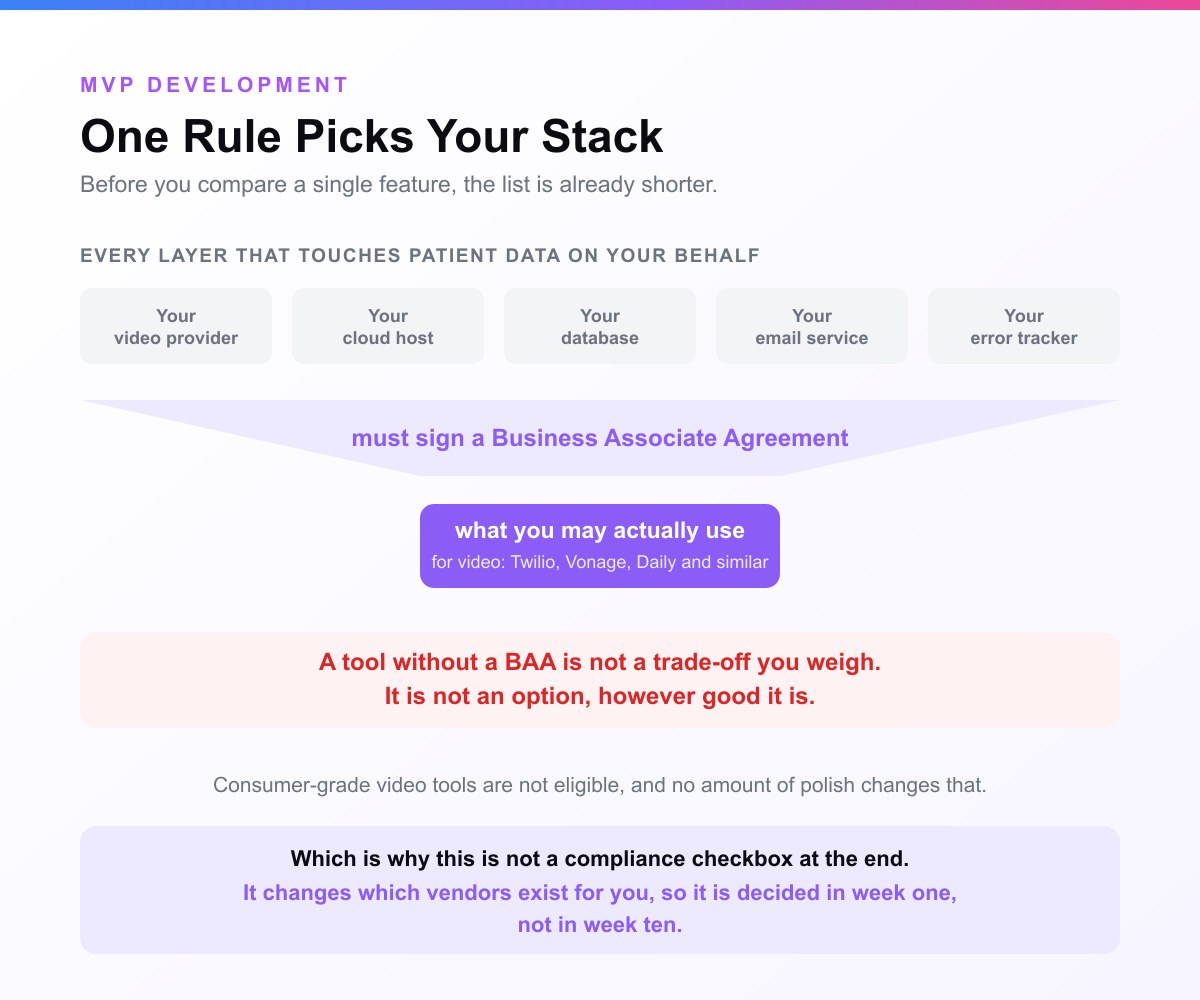
The engineering point: none of this is a checkbox at the end. It changes which vendors you can use, which means it has to be decided in week one, not week ten.
E-prescribing and controlled substances
If your product prescribes, you inherit a second regulatory layer. Under the Ryan Haight Act, prescribing controlled substances via telemedicine generally requires an in-person medical evaluation first, subject to specific exceptions that have shifted repeatedly in recent years. The DEA's telemedicine guidance is the source of truth, and it is a genuinely moving target.
The practical advice: unless prescribing controlled substances is the entire point of your product, keep it out of v1. It is the fastest way to turn a three-month build into a legal project.
EHR integration: usually a v2 problem
Founders assume they need to plug into Epic or Cerner on day one. Most do not.
EHR integration is typically the single biggest cost and schedule risk in a healthtech build. It involves standards like FHIR and HL7, vendor certification programs, and timelines you do not control. As the healthtech MVP guide puts it: plan for it, do not over-build it.
For a first version, ask a sharper question: does the clinician need the data inside their EHR to say yes, or do they just need the note to exist and be exportable? A clean PDF or structured export satisfies far more early customers than founders expect, and costs a fraction. Integrate once a paying customer makes it a condition, not before.
What a telemedicine MVP costs
Telemedicine sits in the regulated band, not the standard SaaS band. Two things drive that:
- Compliance is engineering. Access control, audit logging, encryption, and BAA-eligible infrastructure are real build work. Our cost guide puts the premium for regulated industries at roughly 20 to 40 percent on top of a comparable non-regulated build.
- Integrations, if you allow them. EHR and pharmacy work can cost more than the rest of the product combined, which is exactly why the section above argues for deferring it.
For the full band-by-band breakdown, including where a regulated build lands versus a lean one, see how much it costs to build an MVP and the sourced figures in our 2026 MVP statistics. The honest headline: a telemedicine MVP is not a cheap MVP, and anyone quoting you a lean-band price is either cutting the regulated core or has not scoped it.
More data: sourced cost bands and timelines are compiled in our MVP statistics for 2026.
Common telemedicine MVP mistakes
- Treating compliance as a phase. It is an architecture decision. Retrofitting HIPAA is a rewrite.
- Picking a video tool without a BAA. The most common and most expensive early mistake.
- Integrating an EHR before anyone asked. Months of work to satisfy a requirement no paying customer has stated yet.
- Designing for the patient and forgetting the clinician. Clinicians abandon anything that adds clicks to their day. They are the real gate.
- Building native apps first. A responsive web app validates the loop faster and costs less.
- Validating demand with patients only. Patients say yes to convenience. The question is whether a practice will change its workflow.
Build a compliant telemedicine MVP with us
The reason telemedicine builds overrun is almost never the video call. It is that the regulated core gets discovered late, and by then the vendors are wrong and the architecture has to change.
We scope it the other way round. We start from the one consultation loop worth proving, pick BAA-eligible infrastructure before a line of code exists, and build the compliance surface, access control, audit logging, encryption, in from the first commit, because it is far cheaper than adding it later. Everything that is not that loop gets written down as v2 and defended.
You get a fixed, scoped quote you approve before we start, senior engineers on the build, and full ownership of the code at handover. If you want a second opinion on your telemedicine scope, describe the care journey in your app and we will map the regulated core with you, free.
Related guides
- Healthtech MVP: the wider regulated-market playbook this sits inside
- How much does it cost to build an MVP: the full cost bands, including the regulated premium
- MVP scope: how to draw the in/out line and defend it
- Production-ready MVP: the quality bar a real user can rely on
- MVP validation: proving demand before you build
Frequently asked questions
What is telemedicine app development?
Telemedicine app development is the process of building a platform where patients and clinicians hold remote consultations, along with the regulated infrastructure that makes those consultations lawful: verified identities, encrypted video, clinical records, access controls, and audit logs. The video call is the visible part; the compliance surface around it is what separates a medical product from a video app.
What features does a telemedicine MVP need?
One consultation loop, done to a clinical standard: identity and onboarding for both patients and verified clinicians, appointment scheduling with reminders, encrypted video on a BAA-backed platform, a place for the clinician to record a note, payments, and a complete audit trail of every access to patient data. AI triage, wearables, insurance claims, e-prescribing, and native apps can all wait.
How much does telemedicine app development cost?
It sits in the regulated band rather than the standard SaaS band, because compliance is real engineering rather than paperwork. Our cost guide puts the regulated premium at roughly 20 to 40 percent over a comparable non-regulated build, and EHR integration can cost more than the rest of the product combined. See our MVP cost guide for the full bands. Be sceptical of lean-band quotes: they usually mean the regulated core has not been scoped.
Does a telemedicine app have to be HIPAA compliant?
If it handles protected health information for US patients, yes. In practice that means signed Business Associate Agreements with every vendor touching patient data, encryption in transit and at rest, role-based access control with multi-factor authentication for clinical users, and audit logging of every PHI access event. HHS publishes plain-language guidance on HIPAA for telehealth technology. Confirm your specific obligations with a healthcare attorney.
Do I need EHR integration in my telemedicine MVP?
Usually not. EHR integration is typically the biggest cost and schedule risk in a healthtech build, and it involves standards like FHIR and HL7 plus vendor timelines you do not control. Ask whether the clinician needs the data inside their EHR to say yes, or whether an export satisfies them. Integrate when a paying customer makes it a condition, not before.
Can I build a telemedicine app without being technical?
Yes, but not with no-code alone. The regulated core, access control, audit logging, BAA-eligible infrastructure, needs real engineering, and getting it wrong is a reportable breach rather than a bug. Most non-technical founders in this space hire a team that has shipped compliant healthcare software before. See our guide for non-technical founders.
Sources & references
This guide draws on primary regulatory guidance rather than vendor estimates:
- HHS, HIPAA for telehealth technology: plain-language federal guidance
- HHS, Business Associate Agreement provisions (45 CFR 164.504(e)): what a BAA must contain
- DEA, telemedicine and controlled substances: Ryan Haight Act obligations
- HealthIT.gov, FHIR: the interoperability standard behind EHR integration
Cost figures reference our own published bands in how much it costs to build an MVP and MVP statistics 2026, rather than third-party estimates, which vary widely and are usually published by firms quoting the work.


