


TL;DR
An edtech MVP is the smallest version of an education product that proves three things at once: that people will adopt it, that it actually helps someone learn, and that it keeps them engaged long enough to matter. That triple test is what makes edtech harder to validate than a typical product, a course nobody finishes or a tool nobody opens after week one has "users" but no value.
The short version: an edtech MVP follows the same lean logic as any MVP, scope one core flow, ship it, learn, but it carries three challenges generic MVPs do not: the buyer is often not the user (schools and parents buy; students learn), engagement is the real risk (education products live or die on retention, not features), and student data is regulated (FERPA, COPPA, and similar rules). This guide covers what an edtech MVP is, why it is different, how to scope and build one, and how validation works when "does it work" includes "does anyone actually learn."
Key Takeaways
- An edtech MVP must prove three things at once: that people adopt it, that it actually helps someone learn, and that it keeps them engaged.
- That triple test is what makes edtech harder to validate than a typical product.
- The buyer is often not the user: schools and parents buy; students learn.
- Engagement is the real risk; education products live or die on retention, not features.
- Student data is regulated (FERPA, COPPA, and similar rules).
At a Glance
| What it must prove | Detail |
|---|---|
| Adoption | People will actually use it |
| Learning | It genuinely helps someone learn |
| Engagement | It keeps them coming back (the real risk) |
| Buyer vs user | Schools and parents buy; students learn |
| Regulation | FERPA, COPPA, and similar rules |
What is an edtech MVP?
An edtech MVP (also called an education or e-learning MVP) is a minimum viable product built for a learning context: online courses, tutoring, study tools, classroom software, language learning, upskilling, assessment, school administration, and so on. Like any MVP, it exists to validate a hypothesis with real users as fast and cheaply as possible, rather than to ship a finished platform.
What makes it distinct is that an education product has to deliver a learning outcome, not just a usable feature. A SaaS MVP succeeds if people use the tool to get a job done. An edtech MVP only really succeeds if people use it and come away having learned, practised, or progressed, and keep coming back to do so. That extra bar, real engagement and a real outcome, is the thing your MVP has to test, and it is why "we got sign-ups" is a weaker signal in edtech than almost anywhere else.
Why an edtech MVP is different
Three structural features set edtech apart from a standard MVP.
- The buyer is often not the user. In K-12 and institutional edtech, a school, district, or administrator buys, a teacher deploys, and a student uses, three different people with three different definitions of "value." In consumer edtech, parents often buy for children. Your MVP has to validate the right one (usually the user's engagement and the buyer's willingness to pay), and they are not the same test.
- Engagement is the core risk. Education products are notorious for low completion and drop-off, the infamous course-completion problem. The hard part is rarely building the feature; it is getting a learner to come back tomorrow. So an edtech MVP must test retention and engagement, not just initial sign-up.
- Student data is regulated. The moment you handle data about students, especially minors, rules like FERPA and COPPA apply. Like other regulated verticals, you cannot bolt this on later; how you handle learner data in v1 is exactly what the rules govern.
None of this means building a huge platform up front. It means your MVP has to be designed to surface engagement and a learning signal quickly, while handling data responsibly, even when it is small.
The "buyer is not the user" problem
This is the trap that sinks more edtech MVPs than any technical issue. If you build for the buyer (an admin dashboard, reporting, procurement features) you may sell a pilot but watch students ignore the product. If you build only for the learner you may delight users no one will pay for. The discipline is to name who your MVP is really testing and start there:
- Consumer / direct-to-learner: validate that learners themselves adopt, engage, and (if relevant) pay. Start with the learning experience, not admin features.
- Institutional (schools/districts): the validation is two-layered, a teacher or school must see enough value to champion it, and learners must actually engage once deployed. A single design-partner classroom often beats a broad launch.
Pick the side with the riskiest assumption and build the MVP to answer that, not a platform that half-serves everyone.
Engagement is the real risk, not features
In most MVPs you minimise features and test demand. In edtech you minimise features and design deliberately for engagement, because a tool people sign up for and abandon has told you almost nothing. That shifts what the MVP includes: a tight feedback loop, a reason to return (progress, streaks, a cohort, a deadline, a teacher's expectation), and a genuinely satisfying core learning moment. 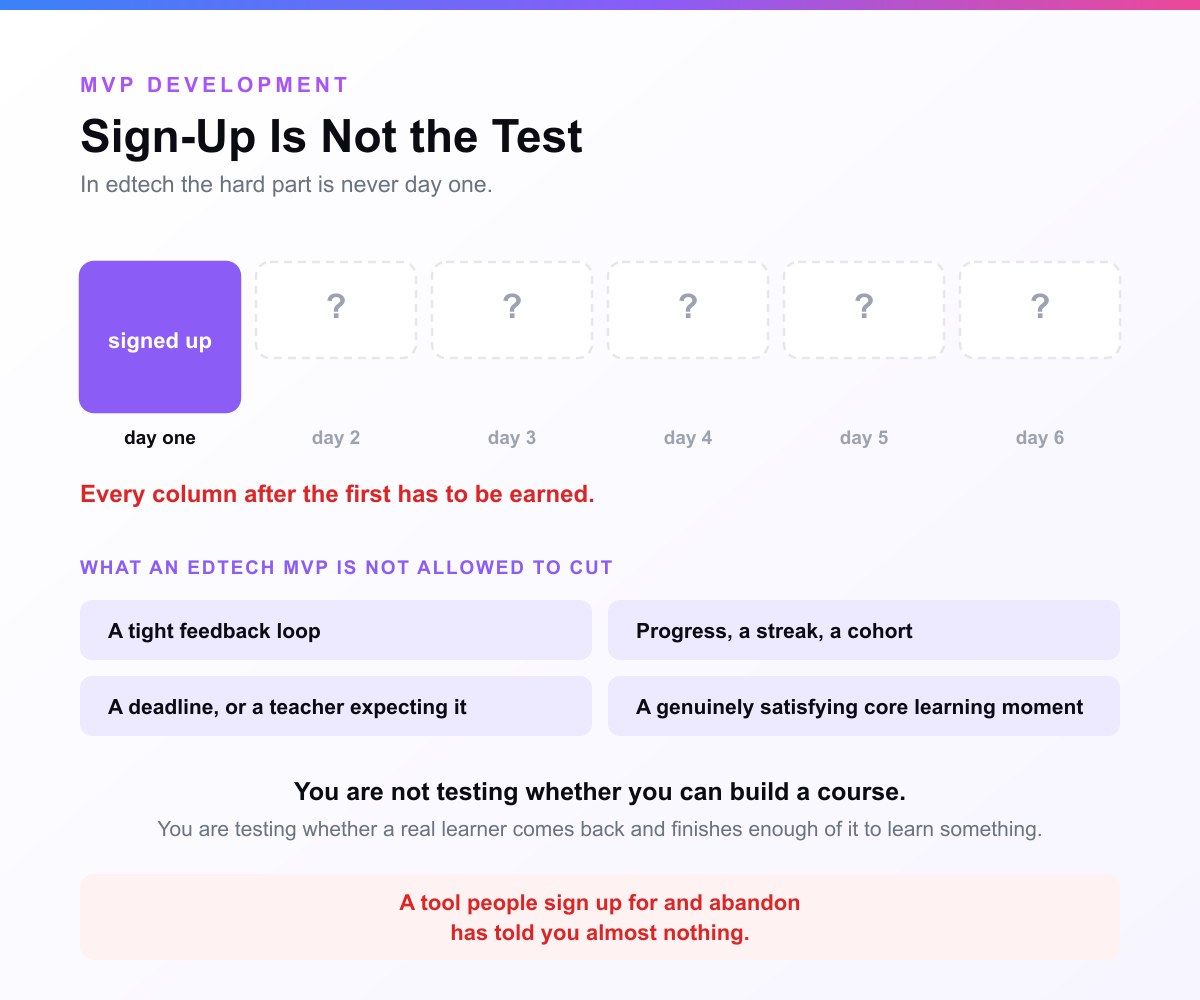
You are not testing "can we build a course"; you are testing "will a real learner come back and finish enough of it to learn something." Build the smallest thing that can show you that, and instrument it so you can see retention, not just sign-ups.
Does it actually teach? Learning efficacy vs market validation
Edtech has a second validation axis, much like healthtech's clinical one. Market validation asks whether people adopt and pay. Learning validation asks whether they actually learn or improve. Early on you usually lead with engagement and market signals, design-partner teachers, completion rates, qualitative learner feedback, while being honest that you have not yet proven hard learning outcomes. As you grow, evidence of efficacy (better grades, faster skill acquisition, measurable progress) becomes part of the product and a real moat, and institutional buyers will increasingly demand it.
The MVP-stage discipline is not to claim proven outcomes before you have them, validate engagement and demand first, prove efficacy rigorously when the stakes and claims require it.
Student data and compliance
If your edtech product touches student information, particularly minors', you inherit privacy obligations from day one. The two that come up most in the US:
- FERPA governs student education records held by schools and the vendors acting on their behalf. If you process records for a school, you typically handle them under the school's authority and obligations.
- COPPA governs the online collection of personal information from children under 13, generally requiring verifiable parental consent. If your product is used by young children directly, this shapes what you can collect and how.
(In the EU, GDPR adds child-specific protections too.)
The practical MVP takeaway mirrors healthtech: collect the minimum learner data you need, secure it properly, and know which regime applies before you launch. This is general guidance, not legal advice, confirm your specific obligations with a qualified professional, especially anything involving minors.
How to scope an edtech MVP
Scoping starts with the riskiest assumption, and in edtech it is usually one of three:
- Engagement risk, will learners actually keep using it? (The most common real risk.)
- Efficacy risk, does it genuinely help people learn?
- Market/buyer risk, will learners or institutions pay?
A focused scope attacks the riskiest one. If engagement is the risk (it usually is), build one genuinely compelling learning loop for one topic or skill and see if a small cohort sticks, rather than a broad catalogue nobody finishes. Resist building the full curriculum, the admin suite, and the integrations before you know learners will return. Depth on one loop beats breadth across many.
How to build an edtech MVP
Once scoped, the build mirrors the standard how to build an MVP process, tuned for education:
- Start content-light. You do not need a hundred lessons to test the loop, you need one good unit, cohort, or skill path. Content is expensive; validate the format before you mass-produce it.
- Lead with the learning experience. Build the learner-facing core first; defer admin dashboards and reporting until a buyer actually needs them.
- Go manual where you can. A concierge approach, a human tutor, hand-graded feedback, a teacher-run cohort behind the scenes, validates the value before you automate it.
- Design for return, not just sign-up. Build the smallest mechanics that create a reason to come back (progress, a cohort, deadlines).
- Handle data responsibly and instrument engagement. Collect minimal learner data, secure it, and track retention and completion from day one, those are your real signals.
A senior team can ship a focused edtech MVP in weeks by keeping the content and feature surface small and the learning loop sharp.
Validation: engagement, outcomes, and willingness to pay
For an edtech MVP, the metrics that matter are different from a typical SaaS dashboard. Watch engagement and retention (do learners return; what is your day-7 and week-4 retention), completion or progress (do they actually get through the core loop), learning signal (any evidence they improved, even qualitative early on), and willingness to pay from whoever the buyer is. A product with great sign-ups and terrible week-two retention has failed the edtech test, however good the demo looked. Lean on design-partner teachers or a small cohort of motivated learners for fast, honest feedback before you scale.
Common edtech MVP mistakes
- Building for the buyer before the learner. A polished admin suite with an unused student experience is a classic edtech failure. Validate engagement first.
- Mass-producing content too early. Producing a full curriculum before proving the format wastes the biggest cost in edtech. Validate one unit first.
- Mistaking sign-ups for success. In education, retention and completion are the real signals; initial sign-ups are the easy, misleading ones.
- Ignoring student-data rules. FERPA, COPPA, and similar obligations are v1 foundations, not v2 problems, especially with minors.
- Claiming learning outcomes you have not proven. Validate engagement and demand honestly; prove efficacy rigorously before you market it.
Build an edtech MVP that sticks, with us
An edtech MVP is the lean playbook applied to a harder bar: not just "will people use it," but "will they keep coming back, and does it actually help them learn", validated fast, with student data handled responsibly.
That is what we do at MVP Development. We build funding-ready edtech MVPs scoped to the one learning loop that proves your idea, designed for engagement and retention from day one, with privacy built in, by senior engineers, on a fixed quote you approve before we start, with full code ownership. We help you scope around the right risk, engagement, efficacy, or buyer, so you validate fast without building a whole platform first.
Explore edtech MVP development, or see how to build an MVP for the full process.
Building an education product? Tell us who learns what on your platform and we will scope the loop that keeps them coming back.
Related guides
- How to build an MVP: the full build process
- MVP validation: testing demand before you build
- MVP metrics: measuring engagement and retention
- Marketplace MVP: another multi-sided product playbook
Frequently asked questions
What is an edtech MVP?
An edtech MVP is the smallest working version of an education product, an online course, tutoring tool, study app, classroom software, and so on, built to validate a hypothesis with real users. It follows the same lean logic as any MVP, but with a higher bar: an education product has to deliver a learning outcome and keep people engaged, not just be usable. So an edtech MVP tests three things at once, whether people adopt it, whether it actually helps them learn, and whether they stay engaged long enough for that to happen, while handling student data responsibly from day one.
How is an edtech MVP different from a normal MVP?
Three things. First, the buyer is often not the user, schools, districts, or parents buy while students learn, so you have to validate the right person's definition of value. Second, engagement is the core risk: education products are infamous for drop-off, so your MVP must test retention and completion, not just sign-ups. Third, student data, especially minors', is regulated (FERPA, COPPA, and similar), so privacy is a v1 foundation. The lean principle is the same, minimise and validate, but you minimise features while deliberately designing for engagement and a real learning signal.
How do you validate an edtech MVP?
You watch different metrics than a typical product. The key signals are engagement and retention (do learners come back, what is your week-four retention), completion or progress (do they actually finish the core loop), an early learning signal (any evidence they improved, even qualitative), and willingness to pay from whoever the buyer is. Great sign-ups with poor retention is a failed edtech test, even if the demo impressed. The fastest path is usually a small cohort of motivated learners or a design-partner teacher who gives you honest, rapid feedback before you invest in scaling content or features.
Does an edtech MVP need to be FERPA or COPPA compliant?
If it handles student data it likely does. FERPA applies to student education records when you work with schools (typically you handle records under the school's authority). COPPA applies when you collect personal information online from children under 13, generally requiring verifiable parental consent. In the EU, GDPR adds child-specific rules. As with any regulated vertical, you cannot defer this to a later version, how you handle learner data in the version real students use is exactly what the rules govern. Collect the minimum, secure it, and confirm your specific obligations with a qualified professional, this is general guidance, not legal advice.
Sources & references
- US Dept. of Education, Student Privacy (FERPA): student education-record privacy
- FTC, COPPA: children's online privacy rule
- Eric Ries, The Lean Startup: validating fast and responsibly
- Atlassian, Minimum Viable Product: scoping the MVP
The figures and timelines here reflect MVP Development delivery experience and are general guidance, not legal advice.


