


TL;DR
A blockchain MVP is the smallest on-chain product that actually works, built to validate a web3 idea for the least time, money, and risk. It is the antidote to web3 over-building, token economics and DAO governance before a single user has proven demand, and sometimes the most valuable finding is that a blockchain is not the answer at all.
Web3 attracts a special kind of over-building: founders raise the idea of a decentralized product and immediately start designing token economics, multi-chain architectures, and DAO governance, before a single user has proven they want it. A blockchain MVP is the antidote. It is the smallest on-chain product that actually works, built to validate a web3 idea for the least time, money, and risk, before you commit to the full protocol.
This guide is written for founders, not smart-contract engineers. It covers what a blockchain MVP is, why web3 MVPs are genuinely different from normal ones, how to choose a chain, how to build and validate one, the risks unique to web3, and, importantly, when a blockchain is not the answer at all.
Key Takeaways
- A blockchain MVP is the smallest on-chain product that actually works, built to validate a web3 idea for the least time, money, and risk.
- It is the antidote to web3 over-building: token economics, multi-chain architectures, and DAO governance before a single user has proven demand.
- Build it before you commit to the full protocol.
- Web3 MVPs are genuinely different from normal ones, from choosing a chain to the risks unique to on-chain products.
- Sometimes the most important finding is that a blockchain is not the answer at all.
What is a blockchain MVP?
A blockchain MVP (or web3 MVP) is the smallest working version of a decentralized product, one core on-chain action, deployed for real users, built to validate whether people want it before you invest in the full protocol. It is a real, usable web3 product scoped to the single flow that proves the idea, not a whitepaper, not a testnet demo, and not a fully-featured protocol with tokenomics and governance.
Like any minimum viable product, its purpose is validated learning. The difference is what it runs on: a blockchain, with the wallets, smart contracts, and on-chain state that come with it, which changes the calculus in ways a normal MVP never has to worry about.
Why a web3 MVP is different (and harder)
A standard MVP carries market risk: will people want it?
A blockchain MVP carries market risk plus a set of web3-specific risks that make "minimum" harder to define:
- Bugs can be permanent and expensive. Smart contracts are often immutable once deployed, and they frequently hold real money. A bug is not a patch-tomorrow issue; it can mean irreversible, catastrophic loss. "Move fast and break things" is dangerous when the thing that breaks is a live contract holding user funds.
- Security cannot be faked. A normal MVP can cut polish; a web3 MVP that touches value needs real security thinking (and often an audit) before mainnet, because attackers probe live contracts immediately.
- Wallet UX is friction. Users need a wallet, gas, and an understanding of signing transactions. That onboarding friction is part of what your MVP must validate, will your users actually cross it?
- Gas and cost are user-facing. Every on-chain action can cost the user money, so "just add a feature" has a literal price. Chain choice directly affects whether your MVP is usable.
- Regulation is uncertain. Tokens, DeFi, and custody can carry real legal exposure that varies by jurisdiction. This is not legal advice, but it is a risk a web3 founder must scope early.
The practical upshot: a blockchain MVP should be even narrower than a normal one.
Do the one on-chain thing that proves the idea, keep everything else off-chain or manual, and resist the token/DAO/multi-chain ambition until the core is validated.
What you can build as a web3 MVP
Most web3 products fall into a few categories. For an MVP, you pick one and scope to its single core action:
- DeFi (lending, DEXs, yield): highest complexity and risk; needs economic modeling and security.
- NFTs (art, collectibles, gaming assets, tokenized rights): medium complexity; the MVP is mint + one core interaction.
- DAOs (governance, treasuries): the MVP is one voting or treasury action, not a full governance suite.
- Blockchain gaming: needs low-cost, fast transactions and smooth UX.
- Infrastructure (wallets, bridges, indexing): very high complexity; rarely a first-timer's MVP.
The MVP discipline is the same as any scope decision: one flow, one on-chain action, everything else deferred.
Choosing a chain: the founder's view
You do not need to be an engineer to make this call at the MVP stage; you need to weigh three things: cost per transaction, speed, and ecosystem maturity. A founder-level view:
| Chain | Trade-off | Good MVP fit for |
|---|---|---|
| Ethereum (L1) | Biggest ecosystem, most secure, but high gas + slow | High-value DeFi/NFT where trust matters most |
| L2s (Polygon, Arbitrum, Optimism, Base) | Ethereum-compatible, low fees, fast | Most consumer/app MVPs: the common default |
| Solana | Very fast, very cheap, but a different toolset | High-frequency or consumer apps needing speed |
For the vast majority of blockchain MVPs, an Ethereum L2 (low fees, huge ecosystem, EVM tooling) is the pragmatic starting point. You can always deploy elsewhere later; multi-chain is a scaling decision, not an MVP one. Match the chain to your product, not to hype, the same principle as our MVP tech stack guide.
How to build and validate a blockchain MVP
- Name the riskiest assumption. Usually it is demand or willingness to cross web3 friction, not "can we deploy a contract." Test that first (a landing page or waitlist works even for web3).
- Scope to one on-chain action. The single flow that proves the idea, mint, swap, stake, vote, and nothing else on-chain.
- Keep everything possible off-chain. UI, profiles, non-critical logic, and even manual steps can live off-chain to keep the on-chain surface tiny and safe.
- Build on a testnet first. Prove the flow with free test tokens before real value is involved.
-
The red box is the single step the post says you never skip. Everything before and after it can flex.
Get the contract reviewed before mainnet. Even a lightweight security review is non-negotiable once real funds are in play, this is the one corner you never cut.
6. Smooth the wallet onboarding. Since wallet friction is part of what you are testing, invest in the connect/sign experience.
7. Ship to a small group and watch behaviour, on-chain activity is transparent, so you get rich, honest usage data.
The risks unique to web3 (scope them early)
- Smart-contract security. Hacks are common and irreversible; budget for review/audit before mainnet.
- Immutability. You often cannot simply "fix" a deployed contract, so design for upgradeability or minimal on-chain logic.
- Gas costs. High or volatile fees can make an MVP unusable; chain choice mitigates this.
- UX friction. Wallets, gas, and signing lose users; the MVP must prove they will persist.
- Regulatory uncertainty. Tokens and custody can carry legal exposure; get advice for anything touching money. (This is not legal advice.)
When a blockchain is NOT the answer
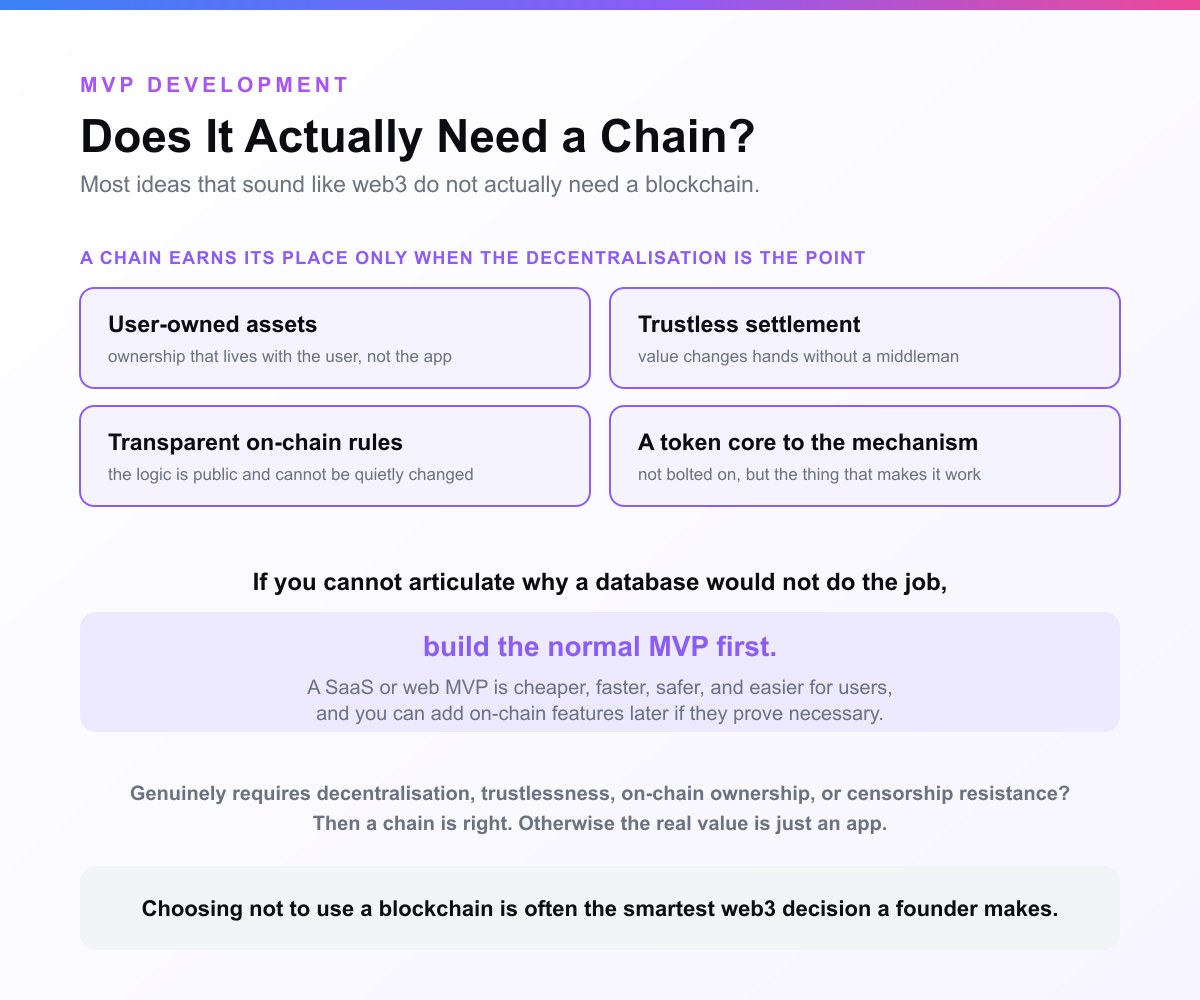
This is the most valuable section, and the one most web3 guides skip: most ideas that sound like "web3" do not actually need a blockchain. Ask honestly whether your product genuinely requires decentralization, trustlessness, on-chain ownership, or censorship resistance. If the real value is just "an app," a normal SaaS or web MVP will be cheaper, faster, safer, and easier for users, and you can always add on-chain features later if they prove necessary.
A blockchain earns its place only when the decentralization is the point: user-owned assets, trustless settlement, transparent on-chain rules, or a token that is genuinely core to the mechanism. If you cannot articulate why a database would not do the job, build the normal MVP first. Choosing not to use a blockchain is often the smartest web3 decision a founder makes.
Cost and timeline
A tightly scoped blockchain MVP, one on-chain action, an L2, a reviewed contract, still fits the usual 3-4 week range for a focused build, though the security review and wallet UX add effort a normal MVP does not have. The biggest cost drivers are smart-contract complexity and the audit/review, which is exactly why you keep the on-chain surface as small as possible. See how much an MVP costs and how long it takes for the general ranges.
How we approach blockchain MVPs
At MVP Development we start every web3 conversation with the honest question: does this genuinely need a blockchain? When it does, we scope to one on-chain action, keep everything else off-chain, insist on a security review before mainnet, and invest in the wallet UX that decides whether real users stay, so you validate the idea without betting the company on an unaudited contract. When it does not, we will tell you, and build the faster, cheaper conventional MVP instead.
Explore our blockchain MVP development service, or if you are weighing whether web3 is right for your idea, our MVP consulting will help you decide before you spend.
Thinking about a blockchain MVP? Explain where the chain matters in your idea and we will scope the one part that truly needs it.
Related guides
- Fintech MVP: the traditional-finance counterpart (regulated, but not decentralized)
- What Is an MVP?: the underlying concept
- MVP Validation: proving demand before you build (works for web3 too)
- MVP Scope: keeping the on-chain surface tiny
Frequently asked questions
What is a blockchain MVP?
A blockchain MVP (or web3 MVP) is the smallest working version of a decentralized product, one core on-chain action deployed for real users, built to validate whether people want it before investing in the full protocol. It is a real, usable web3 product scoped to a single flow (such as mint, swap, stake, or vote), not a whitepaper, testnet demo, or feature-complete protocol with tokenomics and governance.
How is a web3 MVP different from a normal MVP?
It carries the usual market risk plus web3-specific risks: smart-contract bugs can be permanent and hold real money, security cannot be cut the way polish can, wallet and gas friction is part of what you are validating, on-chain actions cost users money, and regulation is uncertain. Because of this, a blockchain MVP should be even narrower than a normal one, do the single on-chain action that proves the idea and keep everything else off-chain or manual.
Which blockchain should I use for an MVP?
Weigh cost per transaction, speed, and ecosystem maturity. For most consumer and app MVPs, an Ethereum Layer 2 (like Polygon, Arbitrum, Optimism, or Base) is the pragmatic default: low fees, fast, and compatible with Ethereum's huge tooling ecosystem. Ethereum L1 suits high-value DeFi/NFT where maximum security matters; Solana suits apps needing very high speed and very low cost. Multi-chain is a scaling decision, not an MVP one.
How much does a blockchain MVP cost to build?
A tightly scoped blockchain MVP (one on-chain action, an L2, a reviewed contract) still fits the usual 3-4 week focused-build range, but the security review and wallet UX add effort a normal MVP does not require. The biggest cost drivers are smart-contract complexity and the audit or review, which is why keeping the on-chain surface as small as possible is the key to controlling cost.
Do I actually need a blockchain for my MVP?
Often, no. Most ideas that sound like "web3" do not genuinely require a blockchain. A blockchain earns its place only when decentralization is the point, user-owned assets, trustless settlement, transparent on-chain rules, or a token core to the mechanism. If you cannot explain why a normal database would not do the job, build a conventional (SaaS or web) MVP first; it will be cheaper, faster, safer, and easier for users, and you can add on-chain features later if they prove necessary.
What are the biggest risks in a web3 MVP?
Smart-contract security (hacks are common and usually irreversible), immutability (you often cannot simply patch a deployed contract), gas costs (high or volatile fees can make it unusable), wallet/UX friction (which loses users), and regulatory uncertainty around tokens and custody. The mitigations are to keep on-chain logic minimal, test on a testnet, get a security review before mainnet, choose a low-cost chain, and get legal advice for anything touching money.
Sources & references
- Eric Ries, The Lean Startup: the validated-learning framework behind the MVP
- Y Combinator Library: founder guidance on building and launching early
- Ethereum: official protocol documentation


