


TL;DR
An AI agent MVP is the smallest version of an agent product you ship to validate it, without pouring months and a fortune into it first. AI agents are the defining product category of 2026, and the hard truth is that an agent MVP is cheap to prototype but genuinely difficult to make reliable, which is where most fail.
AI agents are the defining product category of 2026, and an AI agent MVP is how you validate one without pouring months and a fortune into it first. But there is a hard truth builders learn fast: an agent MVP is harder to ship than a normal app. It is cheap to prototype with today's tools and genuinely difficult to make reliable. This guide covers what an AI agent MVP actually is, the core loop, how to choose a framework, and the rules that separate an agent demo from an agent that works.
It is the agent-specific companion to our broader AI MVP guide, if you are building an AI product that is not an autonomous agent, start there.
Key Takeaways
- An AI agent MVP validates an agent product without pouring months and a fortune into it first.
- AI agents are the defining product category of 2026.
- The hard truth: an agent MVP is harder to ship than a normal app.
- It is cheap to prototype with today's tools but genuinely difficult to make reliable.
- What separates an agent demo from an agent that works is the core loop, the right framework, and reliability discipline.
At a Glance
| Aspect | AI agent MVP |
|---|---|
| Goal | Validate an agent product cheaply |
| Easy part | Prototyping with today's tools |
| Hard part | Making it reliable |
| Core pieces | The agent loop, the right framework, guardrails |
| 2026 context | Defining product category, easy to demo badly |
What is an AI agent MVP?
An AI agent MVP is the smallest working version of an autonomous AI system that completes one specific task on its own, by connecting to real tools and making its own decisions. Unlike a chatbot that just answers questions, an agent acts: it reads inputs, plans steps, calls tools or APIs, and produces a result, with minimal human intervention. The goal of the MVP is to test one thing: do users actually want an automated helper for this task, and can it do the job reliably enough to trust?
That is the whole point of building an MVP first: an agent is expensive and risky to build fully, so you prove the core loop on one narrow task before scaling it.
AI agent vs chatbot vs plain LLM app
These get blurred, but for an MVP the distinction matters, because it decides what you actually build:
- A plain LLM app takes a prompt and returns text (summarise this, write that). No tools, no actions.
- A chatbot holds a conversation and answers questions, useful, but it does not do anything in the world.
- An AI agent is given a goal and acts to achieve it: it decides which steps to take, calls tools (search, databases, email, APIs), and often loops until the task is done.
If your product just needs to answer or generate, you may not need an agent at all, a simpler AI MVP is cheaper and more reliable. Build an agent only when the value genuinely comes from autonomous action.
The agent core loop
Every AI agent MVP runs the same four-step loop. Understanding it is how you scope one:
- Input: the user gives a goal or the system receives a trigger (an email arrives, a log is generated).
- Think: the LLM plans the steps and decides which tools to use.
- Act: the agent calls a tool: searches the web, reads a document, queries a database, calls an API.
- Output: the agent returns the result (or loops back to Think for the next step until the task is complete).
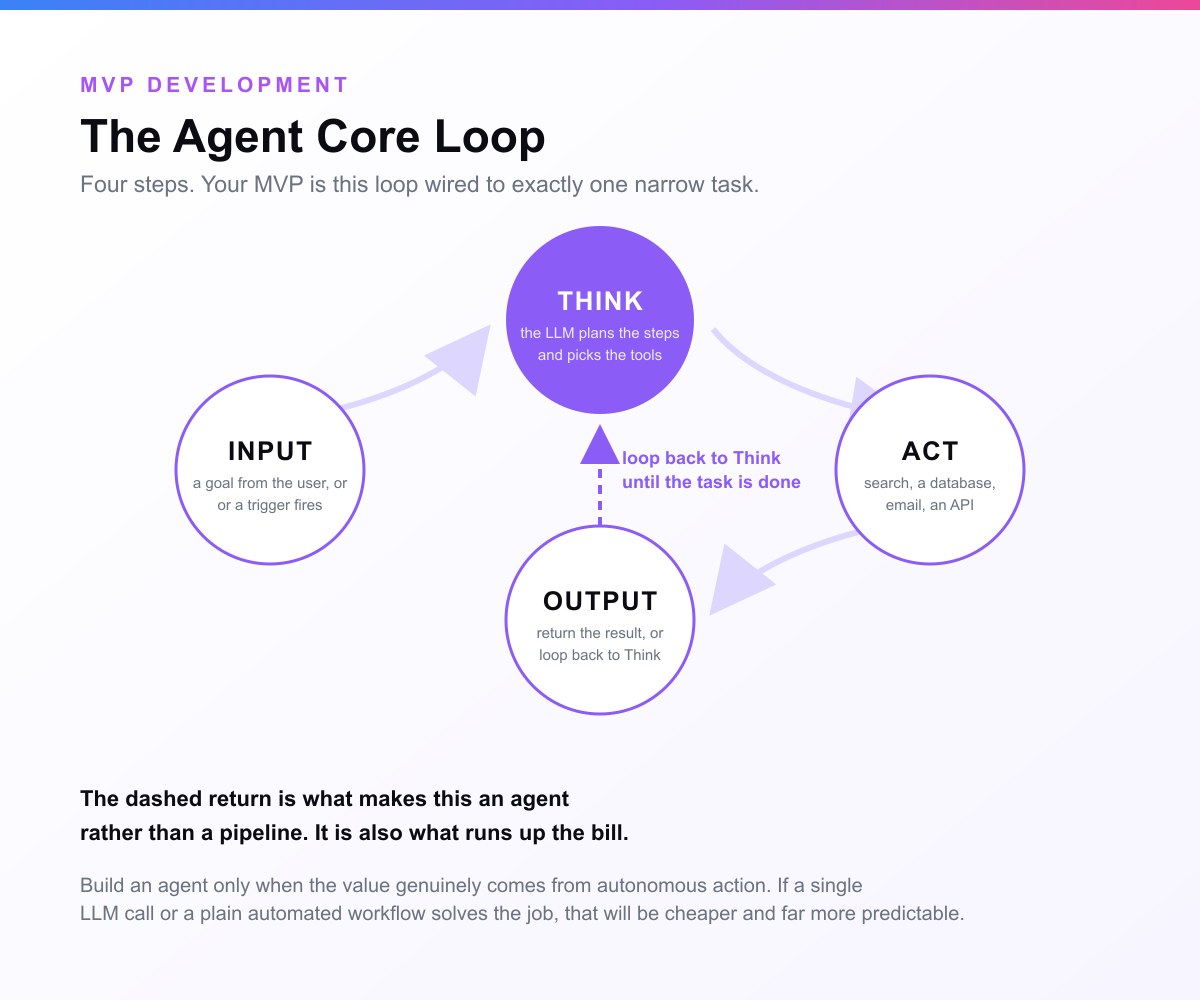
Your MVP is simply this loop, wired to one narrow task, with the fewest tools that make it useful.
How to build an AI agent MVP
- Pick one very narrow task. Do not build a "general assistant." Bad: "an AI that runs my business." Good: "an AI that reads a support email, checks our inventory, and drafts a reply." A narrow task is the difference between a demo and a validated MVP.
- Choose your tools or framework. You rarely need to build from scratch (see the framework section below).
- Build the core loop. Wire Input → Think → Act → Output for that one task, with only the tools it truly needs.
- Keep a human in the loop. Have the agent produce a draft action (a reply, an action plan) that a person approves before anything is sent or money is spent.
- Add guardrails and strict prompts. Tell the agent explicitly what it must not do, so it cannot go off track.
- Instrument cost and observability from day one. Log every prompt, response, latency, and cost, and add circuit breakers so a runaway loop cannot rack up a huge bill.
- Test on real users immediately. Synthetic data hides the flaws in an agent's logic; real inputs expose them.
Choosing an AI agent framework for your MVP
This is the question every builder asks first, and the honest answer is: start as simple as your task allows. You may not need a framework at all.
- Do you even need one? For a genuinely simple agent, calling the model directly (e.g. the OpenAI SDK, or pointed at a local model via Ollama) with a few functions is often enough, and gives you the most control and observability. Frameworks add power and overhead.
- No-code / low-code: n8n, Dify, Flowise, or Gumloop let you wire an LLM to tools visually. Ideal when you want a working agent fast without much code, and great for glueing existing functions together.
- Lightweight code frameworks: PydanticAI, smolagents (Hugging Face), the OpenAI Agents SDK, or OpenAI's Swarm are simple, modern, and well-suited to an MVP, they give structure without much bloat.
- Fuller frameworks: LangGraph, CrewAI, AutoGen, Mastra, and Google's ADK offer more, including multi-agent orchestration, but with more complexity. Powerful for ambitious agents; often more than an MVP needs.
Two rules of thumb: prefer a single agent over a multi-agent system for your first version (multi-agent is harder to debug and rarely needed to validate), and pick by your constraints, your language (Python vs TypeScript), whether you need local models, and how much control you want over the loop. Whatever you choose, the framework is not the product; the validated task is.
The rules that make an agent MVP actually work
Agents fail in ways normal apps do not. These are the non-negotiables:
- Human-in-the-loop. Agents hallucinate and make mistakes. For anything consequential (sending an email, spending money, changing data), the agent should propose and a human should approve. This single rule prevents most disasters at the MVP stage.
- Strict prompts and guardrails. Define clearly what the agent can and cannot do. Constrain its tools and its authority so a wrong decision has limited blast radius.
- Cost control. LLM calls cost money, and an agent that loops can generate a surprise five-figure API bill. Add circuit breakers (max steps, max spend) and monitor cost per run.
- Observability. Use an LLM observability tool like Langfuse or Helicone to see every prompt, response, latency, and cost, setup takes minutes and it is the difference between debugging and guessing.
- An evaluation baseline. Decide how you will measure whether the agent's output is good before you ship, or you will not know if changes help or hurt.
The industry shorthand for 2026 is apt: an agent MVP is "cheap to build, hard to ship." The building is fast; the reliability is the real work.
The AI agent MVP stack (2026)
A lean, modern stack:
- Model API: OpenAI, Anthropic, or a local model via Ollama (if data must stay on-premises).
- Agent layer: a lightweight framework (PydanticAI / smolagents / OpenAI Agents SDK) or no framework at all for simple cases; n8n/Dify for the no-code route.
- Tools: function-calling to your APIs, plus web search, email, or database access as the task needs.
- RAG (if needed): a vector store like pgvector (on your existing Postgres/Supabase) or Pinecone, only if the agent needs a knowledge base.
- Observability: Langfuse or Helicone.
- A thin UI: a simple Next.js/React front-end, or run it inside n8n while validating.
- Deployment: a simple host (Render, Fly, Vercel) or your own server for local models.
The theme is the same as any good MVP: assemble hosted pieces, keep it thin, and put the effort into the one task and its reliability.
What you can build (agent MVP examples)
- Support triage: reads an incoming email, checks inventory or an order system, and drafts a reply for an agent to approve.
- Ops copilot: ingests logs from several systems, enriches them, and produces an action plan a human validates before it runs.
- Research agent: takes a question, searches multiple sources, and returns a structured, cited summary.
- Personal-assistant agents: narrow, domain-specific helpers (scheduling, onboarding, a coaching assistant) that automate one repetitive flow.
Notice the pattern: one narrow task, real tools, a human checkpoint before anything irreversible.
Cost, timeline, and the honest caveat
Prototyping an agent is genuinely cheap now, AI tools get you a working loop in days. But a shippable agent MVP, one reliable enough that users trust it, typically takes about 3-4 weeks, because the work is in guardrails, evaluation, cost control, and handling the cases where the model does something unexpected. Budget for the reliability, not just the demo. See our guides on MVP cost and timeline for the wider picture.
When an AI agent is overkill
Agents are exciting, but they are the wrong tool for many problems. If a single LLM call, a RAG-backed answer, or a plain automated workflow solves the job, use that, it will be cheaper, faster, and far more predictable than an autonomous agent. Build an agent only when the value truly depends on the system deciding and acting on its own. Matching the tool to the problem is itself good scope discipline.
Build your AI agent MVP with us
At MVP Development we build AI agent MVPs the reliable way: one narrow task, the simplest framework that fits, human-in-the-loop by default, and cost and observability wired in from day one, so you get an agent you can actually put in front of users, not a fragile demo. We ship a funding-ready AI agent MVP in about 3-4 weeks, on a fixed scope you approve up front, with full code ownership.
Explore our AI MVP development service, or if you are not sure whether you need a full agent, our MVP consulting will help you scope the smallest thing that proves the idea.
Thinking of building an AI agent MVP? Describe the workflow you want an agent to own and we will scope the loop, the guardrails and the cost per run.
Related guides
- AI MVP: the broader guide to building an AI product MVP (start here if it is not an agent)
- AI Chatbot MVP: when your product should answer and converse, not act
- Vibe Coding an MVP: using AI to write the code for your MVP
- MVP Tech Stack: choosing the right stack overall
- MVP Scope: keeping the agent to one narrow task
Frequently asked questions
What is an AI agent MVP?
An AI agent MVP is the smallest working version of an autonomous AI agent that completes one specific task on its own, by connecting to real tools (email, databases, APIs) and making its own decisions, rather than just answering questions like a chatbot. The goal is to validate whether users want an automated helper for that task, and whether the agent can do it reliably, before investing in a full build.
How do you build an AI agent MVP?
Pick one very narrow task, choose your tools or a framework, and build the core agent loop: Input → Think → Act → Output. Keep a human in the loop to approve consequential actions, add strict guardrails and prompts, instrument cost and observability from day one, and test on real users immediately. The key discipline is narrowness: automate one task well rather than building a general assistant.
What is the best framework for an AI agent MVP?
Start as simple as your task allows, you may not need a framework at all; calling the model directly (e.g. the OpenAI SDK, optionally with Ollama for local models) is often enough and gives the most control. For a fast no-code route, n8n or Dify work well. For lightweight code, PydanticAI, smolagents, or the OpenAI Agents SDK suit MVPs. LangGraph, CrewAI, and AutoGen are more powerful (including multi-agent) but usually more than an MVP needs. Prefer a single agent over multi-agent for your first version.
What is the difference between an AI agent and a chatbot?
A chatbot holds a conversation and answers questions but does not take actions in the world. An AI agent is given a goal and acts to achieve it, planning steps, calling tools and APIs, and often looping until the task is done. An agent MVP is worth building only when the value comes from that autonomous action; if you just need answers or generated content, a simpler AI app is cheaper and more reliable.
How much does an AI agent MVP cost to build?
Prototyping is cheap with modern AI tools, days of work for a basic loop, but a shippable, reliable agent MVP typically takes about 3-4 weeks, because the real effort is in guardrails, evaluation, cost control, and handling unexpected model behaviour. There is also ongoing LLM API cost per run, which is why cost monitoring and circuit breakers matter from day one.
How do you stop an AI agent from going off track or hallucinating?
Four things: keep a human in the loop to approve anything consequential, write strict prompts that define what the agent cannot do, constrain its tools and authority so a wrong decision has limited impact, and add observability plus an evaluation baseline so you can see and measure its behaviour. Add circuit breakers (maximum steps and spend) so a runaway loop cannot cause damage or a huge bill.
Sources & references
- OpenAI, agents guide: official guidance on building agent behaviour
- Eric Ries, The Lean Startup: the validated-learning framework behind the MVP
- Y Combinator Library: founder guidance on building and launching early


