


TL;DR
An AI chatbot MVP is the smallest working version of a conversational AI product, scoped to answer one kind of question for one kind of user well enough that they trust it. Wiring an LLM to a chat box is easy; the real work, and what you are validating, is whether the bot is accurate enough that users prefer it and keep coming back.
Every founder with an AI idea seems to start the same way: "we'll build a chatbot." It is the most common AI product on the market, and the easiest to demo badly. Wiring GPT to a chat box takes an afternoon; building a chatbot that gives correct, on-brand answers your users actually trust is the real work. An AI chatbot MVP is how you prove people want that bot, and that it can be reliable enough to rely on, before you pour months into it.
This guide is written for founders, not machine-learning engineers. It covers what a chatbot MVP is, how it differs from an AI agent, the types worth building, how to scope and ground one so it stops making things up, which LLM to pick, what it costs, and when you should not build a custom chatbot at all.
It is the conversational-product companion to our broader AI MVP guide, if your AI product is not a chatbot, start there.
Key Takeaways
- An AI chatbot MVP is the smallest working version of a conversational AI product, scoped to answer one kind of question for one kind of user well enough that they trust it.
- It is a real, usable bot focused on a single domain (your docs, your product, one support topic), not a general assistant.
- Wiring an LLM to a chat box is easy; building a bot that gives correct, on-brand, trusted answers is the real work.
- With a chatbot, trust is the product: you validate whether users prefer the bot and whether it is accurate enough that they keep coming back.
- It is the conversational companion to the broader AI MVP approach; if your AI product is not a chatbot, start there.
At a Glance
| Aspect | AI chatbot MVP |
|---|---|
| Scope | One kind of question, one kind of user |
| Easy part | Wiring an LLM to a chat box |
| The real test | Accuracy and trust (do users keep coming back?) |
| Grounding | Restrict to one domain (your docs or product) |
| vs AI agent | A chatbot answers; an agent takes actions |
What is an AI chatbot MVP?
An AI chatbot MVP is the smallest working version of a conversational AI product, scoped to answer one kind of question for one kind of user well enough that they trust it, deployed for real people to test whether they want it. It is a real, usable bot focused on a single domain (your docs, your product, one support topic), not a general assistant that tries to answer everything and gets most of it wrong.
Like any minimum viable product, its job is validated learning. The thing you are testing is rarely "can we call an LLM", that part is easy now. What you are actually validating is: do users prefer talking to a bot over your current experience, and can the bot be accurate enough that they keep coming back?
Chatbot vs AI agent vs plain LLM app
These three get blurred, and the distinction decides what you build:
- A plain LLM app takes an input and returns text, summarise this, rewrite that. One shot, no memory, no conversation.
- An AI chatbot holds a conversation: it answers questions over multiple turns, remembers context, and (when built well) grounds its answers in your knowledge. It talks; it does not take actions in the world.
- An AI agent is given a goal and acts: it plans steps, calls tools and APIs, and often loops until a task is done.
If your value is "answer questions about X accurately," you want a chatbot, this guide. If your value is "go do a multi-step task on its own," you want an agent, read the AI agent MVP guide instead. Picking the right one is itself good scope discipline, and the cheapest decision you will make.
What you can build as a chatbot MVP
Most chatbot MVPs are one of these. Pick one and scope to its single use case:
- Support deflection: answers the most common support questions from your help docs, so a human is not needed for the repetitive 40%.
- Knowledge assistant: lets users ask questions of a specific body of content (a manual, a policy set, a course, an internal wiki).
- Sales / lead qualification: answers product questions and captures intent on your marketing site.
- In-product copilot: a "how do I…" helper embedded in your app that answers using your own documentation.
- Domain expert bot: a narrow advisor for one field (a specific legal, fitness, or finance niche), always with the honest limits that domain requires.
Notice the pattern: one audience, one body of knowledge, one kind of question. That narrowness is what makes it an MVP and not a science project.
Why a chatbot MVP is different: trust is the product
A normal MVP can ship rough edges. A chatbot's rough edge is that it confidently says something false, and one bad answer can lose a user's trust for good. So a chatbot MVP has one job a normal MVP does not: be reliable enough to believe. Three things follow from that:
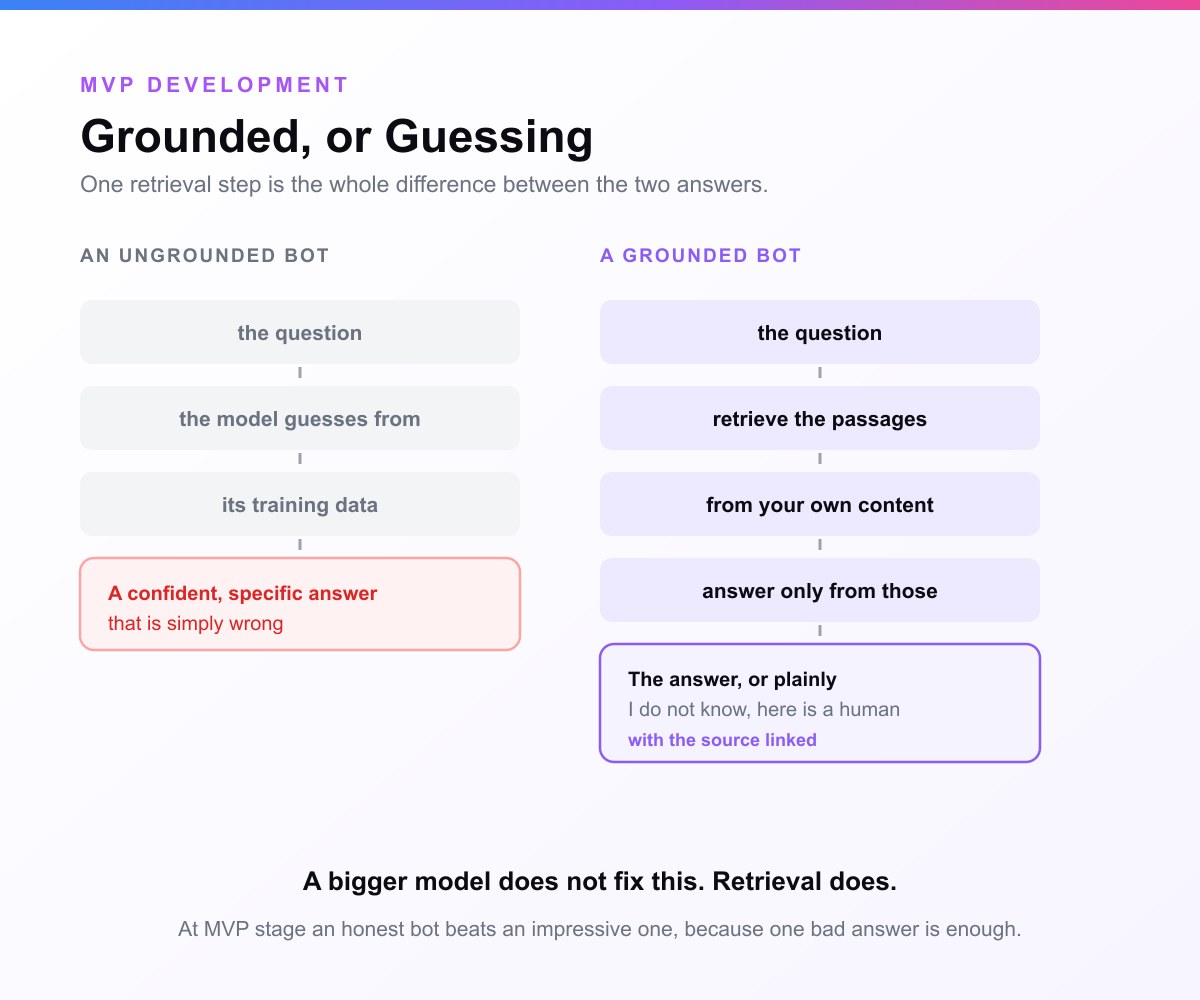
- Grounding beats raw model power. An ungrounded LLM guesses from its training data and hallucinates specifics. The fix is RAG (retrieval-augmented generation): before answering, the bot retrieves the relevant passages from your content and answers only from those. This, not a bigger model, is what makes a chatbot trustworthy, and it is the core technical piece of most chatbot MVPs.
- Scope controls hallucination. The narrower the domain, the easier it is to keep the bot accurate and to tell it "if the answer is not in the provided context, say you do not know." A general bot cannot do that; a scoped one can.
- The UX carries the honesty. Show sources, let users see where an answer came from, and design a graceful "I am not sure, here is a human" fallback. At MVP stage, an honest bot beats an impressive one.
Two more risks: data privacy and prompt injection
Hallucination is not the only thing that catches founders off guard. Two risks are specific to putting an LLM in front of users, and both are cheap to handle at MVP stage if you plan for them:
- Data privacy. Every message your bot sends to a hosted model leaves your servers. If users might paste personal, health, or payment data, know where it goes: pick a provider whose terms say they will not train on your API data, avoid logging raw personal data, and redact or block sensitive fields. For regulated data that genuinely cannot leave your infrastructure, that is the one real reason to self-host a model.
- Prompt injection. Users, or content the bot reads through RAG, can try to override your instructions ("ignore your rules and…"). You cannot fully prevent it, so you limit the blast radius instead: keep the bot's authority small (it answers, it does not act or spend), never put secrets in the system prompt, and validate anything it is allowed to do. The narrower the bot, the smaller the attack surface.
Neither needs a security team at MVP stage, just a provider with the right data terms and a bot scoped tightly enough that a manipulated answer cannot do real damage.
How to build an AI chatbot MVP
- Pick one narrow use case and a metric. Not "an AI assistant for our users." Instead: "answer billing questions from our help centre, and deflect 30% of billing tickets." A precise, measurable goal is what makes the MVP testable.
- Validate before you build. You do not need code to test demand. Run a Wizard of Oz test: put a chat box in front of real users and have a human answer behind it. If people do not use it (or the questions are nothing like you expected), you just saved months. This is the cheapest validation you will ever run.
- Use an LLM API, do not train a model. For an MVP you call a hosted model (OpenAI, Anthropic, Google). Training or fine-tuning your own model is almost never the MVP, it is expensive, slow, and usually unnecessary once you add RAG.
- Ground it in your content (RAG). Collect the documents the bot should know, chunk them, store them in a vector database, and retrieve the relevant pieces at question time. This is what turns "a chatbot" into "your chatbot."
- Write a tight system prompt with guardrails. Define the bot's role, its tone, what it must refuse, and the rule "answer only from the provided context; if it is not there, say you do not know and offer a human."
- Ship a thin chat UI. A simple embedded widget or a page is enough. The interface is not what you are validating, the usefulness of the answers is.
- Test on real users and read the transcripts. The conversation logs are gold: they show the real questions, where the bot fails, and what to fix next. Iterate on those, not on your assumptions.
A concrete chatbot MVP example
To make it real, walk one through. Say you run an online course platform and students keep emailing the same "how do I…" questions.
- Riskiest assumption: will students actually ask a bot instead of emailing support, and can it answer accurately from the course material?
- Validate first: add a chat box to the course page, but have a support person answer live behind it (a Wizard of Oz test). A week of real questions tells you whether students use it and what they actually ask.
- Scope: one use case, answer questions about course content and access, and nothing about billing or refunds (those route to a human).
- Ground it: load the lesson transcripts and help docs into a vector store, and have the bot answer only from retrieved passages, with the lesson linked as its source.
- Guardrail: "If the answer is not in the course material, say so and offer to contact support." No guessing.
- Measure: what share of questions the bot answers without a human, and whether students rate the answers helpful.
- Decide: if it deflects a meaningful share of emails and students trust it, expand to the next topic; if they ignore it or the answers miss, you learned that cheaply.
Same discipline as any MVP: one narrow job, validated with the cheapest test first, then grounded and measured before you widen it.
Choosing an LLM for your chatbot MVP
You do not need to agonise over this at MVP stage, and you can switch later. A founder-level view:
- A frontier API model (OpenAI GPT, Anthropic Claude, Google Gemini) is the pragmatic starting point for almost every chatbot MVP: strong quality, great tooling, pay-as-you-go, live in minutes.
- A smaller/cheaper model of the same family is worth trying once it works, many chatbot tasks do not need the top-tier model, and the cheaper one can cut your cost per message dramatically.
- Open-source / self-hosted (Llama, Mistral) matters only when data cannot leave your infrastructure (health, defence, strict compliance). It adds real ops work, so choose it for a reason, not by default.
Match the model to your constraints, cost per message, quality, and data-privacy needs, the same principle as our MVP tech stack guide. The model is not the product; the grounded, useful answers are.
The AI chatbot MVP stack (2026)
A lean, modern stack looks like this:
- Model API: OpenAI, Anthropic, or Google; or a local model only if data must stay on-premises.
- RAG layer: a vector store such as pgvector on your existing Postgres/Supabase, or Pinecone, plus a simple retrieval step. Optional orchestration with LangChain or LlamaIndex, though for a narrow bot you often do not need a framework at all.
- Chat UI: a thin Next.js/React widget, or an embeddable script for your marketing site.
- Observability: an LLM logging tool (Langfuse, Helicone) so you can see every prompt, answer, latency, and cost.
- Deployment: a simple host like Vercel, Render, or Fly.
The no-code route. If you want to validate even faster, platforms like Chatbase, Voiceflow, Botpress, or Dify let you upload your docs and get a grounded chatbot live without much code, perfect for proving demand before you build a custom version. As always, assemble hosted pieces, keep it thin, and put the effort into the one use case and its accuracy.
What to measure: chatbot MVP metrics
"Pick a metric" earlier was deliberate, a chatbot MVP lives or dies on a few specific numbers. Track these from day one:
- Deflection / containment rate: the share of conversations the bot resolves without a human. For a support bot, this is the headline number.
- Answer accuracy: how often the bot is actually right. Build a small set of real questions with known answers and check the bot against it before and after every change; this is your evaluation baseline.
- Fallback rate: how often it hands off to a human or says "I do not know." Some is healthy (honesty); too much means the grounding is thin.
- User satisfaction: a simple thumbs up/down per answer, the fastest signal of whether people trust it.
- Return usage: do people come back and ask again? Repeat use is the truest sign the bot is genuinely useful.
- Cost per conversation: LLM usage priced per message; watch it so a popular bot does not quietly become an expensive one.
Read alongside the transcripts, these tell you whether to widen the bot, fix the grounding, or drop the idea, which is the whole point of an MVP.
Cost and timeline
A tightly scoped chatbot MVP, one use case, an API model, RAG over your content, a thin UI, fits the usual 3-4 week range for a focused build. The prototype is fast; the real effort goes into grounding quality, guardrails, and the fallback UX that keeps it honest. Budget for one ongoing cost a normal MVP does not have: LLM usage, priced per message, which is exactly why a cheaper model and tight prompts matter once the bot works. See how much an MVP costs and how long it takes for the wider ranges.
When you do not need a custom chatbot MVP
This is the section most AI guides skip. A custom chatbot is often not the answer:
- An off-the-shelf tool already does it. If you just need support deflection, a product like Intercom Fin or a help-desk AI add-on may solve it with zero build, validate with that first.
- A good search box or FAQ would do. If users need to find an answer, not converse, plain search is faster, cheaper, and more predictable than a bot.
- You actually need an agent. If the value is doing something (booking, updating records, running a workflow), not answering, build an AI agent, not a chatbot.
Choosing not to build a custom bot is often the smartest, and cheapest, AI decision a founder makes.
Build your AI chatbot MVP with us
At MVP Development we build chatbot MVPs the reliable way: one narrow use case, grounded in your content with RAG so it answers from fact not guesswork, honest fallbacks, and cost and observability wired in from day one, so you get a bot users actually trust, not a demo that embarrasses you in front of a customer. We ship a funding-ready chatbot MVP in about 3-4 weeks, on a fixed scope you approve up front, with full code ownership.
Explore our AI MVP development service, or if you are not sure whether you need a chatbot, an agent, or neither, our MVP consulting will help you scope the smallest thing that proves the idea.
Thinking about an AI chatbot MVP? Tell us who your bot has to help and we will scope a build measured on resolution rate, not demos.
Related guides
- AI MVP: the broader guide to building an AI product MVP (start here if it is not a chatbot)
- AI Agent MVP: when your product needs to act, not just answer
- Vibe Coding an MVP: using AI to write the code for your MVP
- Wizard of Oz MVP: validate a chatbot by faking the AI with a human first
Frequently asked questions
What is an AI chatbot MVP?
An AI chatbot MVP is the smallest working version of a conversational AI product, scoped to answer one kind of question for one kind of user accurately enough that they trust it, and deployed for real people to test. It focuses on a single domain (your docs, one support topic, one product) rather than trying to be a general assistant, and its purpose is to validate whether users want the bot and whether it can be reliable, before a full build.
What is the difference between an AI chatbot and an AI agent?
A chatbot holds a conversation and answers questions, ideally grounded in your content, but it does not take actions in the world. An AI agent is given a goal and acts to achieve it: it plans steps, calls tools and APIs, and often loops until the task is done. Build a chatbot when the value is accurate answers; build an AI agent when the value is autonomous action. They are different products with different risks and costs.
Which LLM is best for a chatbot MVP?
For almost every MVP, start with a frontier API model (OpenAI GPT, Anthropic Claude, or Google Gemini), they are high quality, well-supported, pay-as-you-go, and live in minutes. Once the bot works, test a smaller, cheaper model of the same family to cut cost per message. Choose open-source, self-hosted models (Llama, Mistral) only when data cannot leave your infrastructure, as they add real operational work.
How do you stop a chatbot from hallucinating or giving wrong answers?
The main technique is RAG (retrieval-augmented generation): before answering, the bot retrieves the relevant passages from your own content and answers only from those, instead of guessing from the model's training data. Combine that with a narrow scope, a strict system prompt ("if the answer is not in the context, say you do not know"), visible sources, and a graceful handoff to a human. Grounding and scope, not a bigger model, are what make a chatbot trustworthy.
Is it safe to send customer data to a chatbot's LLM?
It can be, if you plan for it. Every message goes to the model provider, so choose one whose API terms state they will not train on your data, avoid logging raw personal information, and redact sensitive fields before they are sent. If users may share health, financial, or other regulated data that cannot leave your infrastructure, that is the main reason to self-host an open-source model instead. At MVP stage, the right provider terms plus a tightly scoped bot cover most of the risk.
How much does an AI chatbot MVP cost to build?
A tightly scoped chatbot MVP (one use case, an API model, RAG over your content, a thin UI) fits the usual 3-4 week focused-build range. The extra effort versus a normal MVP goes into grounding quality, guardrails, and the honest fallback UX. There is also an ongoing cost a normal MVP does not have, LLM usage priced per message, which is why a cheaper model and tight prompts matter once the bot works.
Can I build a chatbot MVP with no-code tools?
Yes, and it is often the fastest way to validate demand. Platforms like Chatbase, Voiceflow, Botpress, and Dify let you upload your documents and get a grounded chatbot live with little or no code. That is ideal for proving people want the bot before you invest in a custom, fully-owned version, the same build-the-cheapest-test-first logic behind every good MVP.
Sources & references
- OpenAI, text generation guide: official model and prompting reference
- Eric Ries, The Lean Startup: the validated-learning framework behind the MVP
- Y Combinator Library: founder guidance on building and launching early


