


TL;DR
No, you do not strictly need an MVP to raise funding, but for most founders it is the most reliable way to get funded, and it is increasingly expected. There are three ways to raise without a built product: (1) a proven founder track record (pedigree, a prior exit, a sought-after technical background), (2) a high-fidelity prototype (a clickable Figma design), or (3) real proof of demand (letters of intent, pilots, pre-orders, or paying customers). Without one of those strong substitutes, an idea and a pitch deck alone rarely raise anything.
The honest nuance for 2026: two of those three no-MVP paths, pedigree and an existing investor network, are things you either have or you do not; you cannot manufacture them before a raise. The third, traction, almost always requires a product to generate. So for most founders, especially first-time and non-technical ones, building a lean MVP is the most controllable path to a fundable position, and, as covered below, it improves your terms even when you could technically raise without one.
Key Takeaways
- No, you do not strictly need an MVP to raise, but for most founders it is the most reliable and increasingly expected path.
- Three ways to raise without a built product: a proven founder track record, a high-fidelity prototype, or real proof of demand.
- Without one of those strong substitutes, an idea and a pitch deck alone rarely raise anything.
- Two of those paths (pedigree and network) you either have or you do not; the third (traction) almost always requires a product.
- Building a lean MVP is the most controllable path to a fundable position, and it improves your terms even when you could raise without one.
More data: the sourced figures on MVP cost, timelines, and startup failure are compiled in our MVP statistics for 2026.
The honest answer: no, but with a big asterisk
An MVP is not a hard requirement for raising, and there are famous proofs. Asana reportedly raised around $10M before shipping an MVP, and Jet.com raised roughly $140M pre-MVP, largely on the strength of its founding team. So yes, it is possible.
But look closely at those examples: they were exceptional teams with track records that de-risked the bet on their own. Investors at the earliest stages are underwriting one thing, the probability you will succeed, and they need evidence. A proven founder is evidence. A working product with users is evidence. An idea in a deck is not. So the real question is not "do I need an MVP?" but "do I have enough of the right evidence, and if not, is an MVP the most achievable way to get it?" For most founders, the answer to that second part is yes.
The 3 ways to raise without an MVP
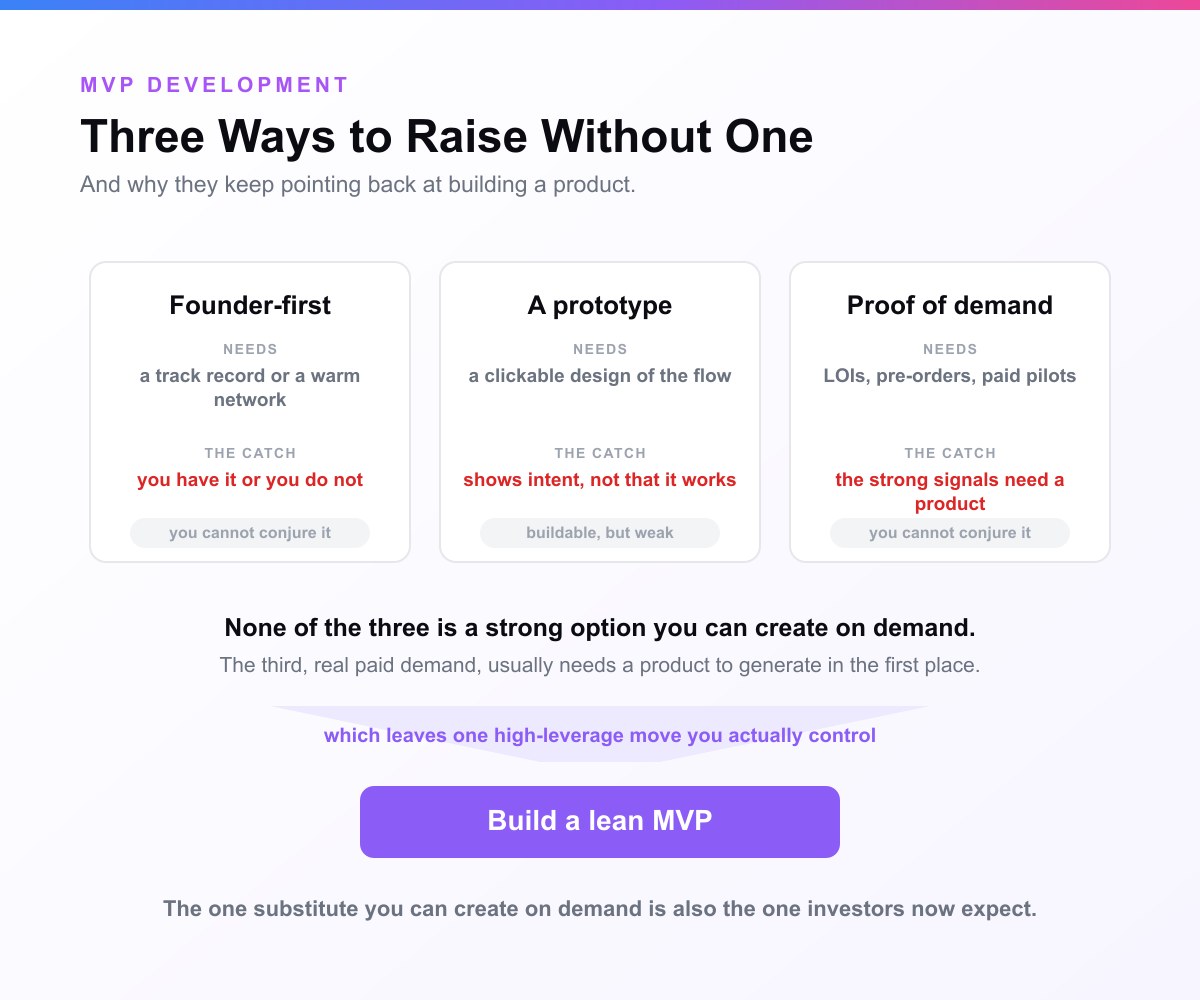
If you are not going to raise on a built product, you need one of these substitutes to be genuinely strong.
| Path | What it requires | When it works | The catch |
|---|---|---|---|
| Founder-first | A proven track record, prior exit, or a sought-after technical/domain background | You have real pedigree and/or a warm investor network | You either have this or you do not; you cannot build it before a raise |
| A high-fidelity prototype | A clickable design (e.g. Figma) that shows the UX and core flow | The concept is visual and the risk is "will people want this look/flow" | It shows intent, not that anything works or that anyone uses it |
| Proof of demand / early revenue | LOIs, pre-orders, paid pilots, or paying customers | You can validate willingness to pay without building first | Strong signals (paid pilots, pre-orders) usually still need some product |
Notice the pattern: the strongest of these substitutes (real, paid demand) tends to require a product anyway, and the two that do not (founder-first, network) are not things you can create on demand. This is exactly why an MVP is so often the practical answer.
When you genuinely DON'T need an MVP
Skip or defer the MVP when one of these is clearly true:
- You have a strong track record or network. A repeat founder with a prior exit, or someone with a genuinely sought-after background, can often raise on team and vision, then use the money to build.
- It is deep tech with a huge R&D cost to reach an MVP. For hard science or heavy-engineering startups, investors do not expect an MVP at pre-seed; the pre-seed money exists to fund building it. What they want instead is proof of the technical expertise to pull it off.
- You can validate demand another way. If pre-orders, LOIs, or a manual "concierge" version can prove people will pay, that evidence can stand in for a built product.
- The real risk is not buildability. If your core uncertainty is market timing, differentiation, or distribution rather than "can this be built," an MVP may not de-risk the thing investors are actually worried about.
When you effectively DO need one
For most founders, an MVP is the realistic path, and in some cases close to required:
- You are a first-time or unknown founder. Without pedigree or a network, you need concrete proof, and a working product with early users is the most achievable kind.
- It is a standard software product. If building is cheap and fast, not having built anything reads as a red flag (more on this next).
- You are raising a seed round, not pre-seed. By seed, investors largely expect a real MVP plus early traction and retention. See how investors evaluate an MVP for what that looks like.
- The core risk is "will people use and pay for this." That is exactly the risk an MVP is built to retire.
The 2026 shift: "no MVP" is a harder sell now
There is a real change in how investors react to "I haven't built anything yet." A few years ago it was defensible. Now, with AI-assisted and no-code tools making a basic MVP cheap and fast to build, founders and investors alike increasingly ask: if a working first version is this accessible, why haven't you built one?
The uncomfortable implication is that, for a standard software product, not building anything can now signal that you may not be the right person to execute. It raises the bar on the founder-first, idea-only path: the pedigree has to be that much stronger to compensate for the absence of a product that is, today, very achievable to ship. For most founders, this shift makes building a lean MVP the safer bet, not because a rule demands it, but because the alternative now invites skepticism it did not before.
Even when you don't need one, an MVP helps
Here is the part founders miss: the question is rarely "do I need an MVP," it is "will an MVP meaningfully improve my raise?" And done well, it almost always does.
A real product turns "we think people will want this" into "here is what real users did," which is the single most persuasive thing you can bring to an early-stage conversation. That evidence does not just help you get funded; it improves your terms and valuation, because you are negotiating from proof instead of promise. Even in cases where you could have raised on team alone, an MVP that enhances the pitch usually gets you a better deal.
The MVP is the substitute you actually control
Step back and the logic is simple. Of the three ways to raise without an MVP, two (a proven track record and a warm investor network) are things you cannot conjure before a raise, and the third (real, paid demand) usually needs a product to generate in the first place. That leaves building a lean MVP as the one high-leverage, controllable move most founders have to reach a fundable position, and, as an AI-accessible option, the one investors increasingly expect you to have taken.
That is precisely where we help, and it is the most direct way we move founders toward a raise. We build the one core flow that generates real evidence: a funding-ready MVP in 3 to 4 weeks, with real auth, payments, and deployment, on a fixed price you approve up front, and code you own. Instead of walking into investor meetings with a deck and a promise, you walk in with a live product real users are already touching, the exact evidence that turns "idea-stage" into "fundable," and improves your terms even if you could have raised without it. If you are heading into a raise and want the product that makes your case for you, describe the raise you are preparing for and we will scope the demo that carries it.
Common mistakes founders make
- Over-building before raising. Building the full product instead of a lean MVP, and burning the runway a pre-seed was supposed to provide.
- Assuming you are "founder-first" when you are not. The founder-first path is genuinely rare; be honest about whether your track record and network actually clear that bar.
- Waiting for a "perfect" MVP. The point is evidence, not polish. A rough product with real usage beats a beautiful one with none.
- Building an MVP when the real risk is elsewhere. If your uncertainty is distribution or timing, spend the effort proving that, not shipping code.
- Treating "no MVP" as normal in 2026. With building cheaper than ever, the absence of a product now draws more scrutiny than it used to.
Related guides
- How much traction do you need to raise a pre-seed round?: the flip side: how much proof is "enough"
- How investors evaluate an MVP: what investors look for once you have a product
- MVP validation: the cheaper ways to prove demand, with or without a full build
- MVP for non-technical founders: how to get an MVP built if you can't code
- The MVP stage of a startup: where fundraising sits in the startup lifecycle
Frequently asked questions
Do you need an MVP to raise funding?
Not strictly, but for most founders it is the most reliable path and is increasingly expected. You can raise without a built product if you have a strong founder track record, a high-fidelity prototype, or real proof of demand (LOIs, pilots, or paying customers). Without one of those strong substitutes, an idea and a pitch deck alone rarely raise anything. Because two of those substitutes (pedigree and network) cannot be manufactured and the third usually requires a product anyway, building a lean MVP is often the most controllable way to become fundable.
Can you raise a pre-seed round without an MVP?
Yes, but it is the exception rather than the rule, and the bar is higher. It happens mostly with founders who have deep domain track records, a warm investor network, or a crisp thesis plus strong early validation such as signed LOIs or pilot commitments. Deep-tech startups are a special case: investors do not expect an MVP at pre-seed because the round exists to fund building it, but they do expect clear technical expertise. For a typical first-time founder building standard software, some real product signal is usually needed.
Can you raise funding with just a prototype?
Sometimes. A high-fidelity, clickable prototype (for example in Figma) can demonstrate the user experience and core flow without the cost of a full build, and for visually-driven products it can carry an early pitch. Its limitation is that it shows intent, not function or usage: it proves you can design the experience, not that the product works or that anyone actually uses it. A prototype paired with real demand signals (a waitlist, LOIs, pilot interest) is far more persuasive than a prototype alone.
Do you need an MVP to raise a seed round?
Effectively, yes, in most cases. Seed investors generally expect a real MVP plus early product-market-fit signals: engaged users, growing retention, and often early revenue. Pre-seed is funded more on potential, but by seed the bet has shifted to proof, and a working product with traction is the core of that proof. Trying to raise a seed round on the evidence that would suit a pre-seed round usually reads as not having progressed far enough.
Is it harder to raise without an MVP in 2026 than it used to be?
Yes. AI-assisted and no-code development have made building a basic MVP cheaper and faster than ever, so investors increasingly wonder why a founder has not built one. For standard software products, the absence of any product can now signal weaker execution ability, which raises the bar on the idea-only, founder-first path. The practical effect is that building a lean MVP has become the safer default for most founders, because raising without one now invites more scrutiny than it did a few years ago.
Do investors fund ideas without a product?
Rarely, and almost never on the idea alone. When investors back a pre-product startup, they are funding the team and the evidence around the idea, an exceptional founder track record, a validated market thesis, or real demand signals, not the idea in isolation. Ideas are abundant and cheap; investors fund proof that a specific team can turn a specific idea into something people want. For most founders, the most achievable form of that proof is a working MVP with early users.
Sources & references
This guide synthesizes early-stage investor perspectives and the wider founder-community discussion (including r/startups) on whether an MVP is required to raise. Norms vary by stage, sector, and founder profile.
- Antler, Why Startups Don't Always Need an MVP Before Pre-Seed: the "not always required" case and pre-MVP fundraising examples
- Charles River Ventures, What Is an MVP? Strategies to Attract Seed Investors: evidence of customer demand as what investors actually need
- Y Combinator, Startup Library: early-stage fundraising, evidence, and what investors weigh
This article is general educational information, not legal, tax, or financial advice. Fundraising norms vary; validate specifics with your own investors and advisors.


